
Running After 60: A Safe Beginner’s Guide
If you are over 60 and thinking about running, you may have two voices in your head. One says it is too late, or that running will wreck your knees. The other says you would love the feeling of moving freely again — the fresh air, the steady rhythm, the quiet sense of accomplishment.
Many people start running in their 60s and beyond and keep running for decades. The secret is not toughness but patience. A slow, structured start protects your joints, builds fitness gradually, and keeps running enjoyable instead of painful. This guide covers a safe beginner plan: a walking base first, short run intervals, forgiving surfaces and sensible footwear, and when to check with a clinician before you begin.
Is running safe after 60?
For most healthy adults, yes — with the right approach. Running is a vigorous activity, so it asks more of your heart, lungs, bones, and joints than walking does. That is why the build-up matters: bones, tendons, and cartilage adapt to impact more slowly than your heart and lungs, so your breathing may feel ready before your legs are.
It also helps to reframe what “running” means at this stage. A beginner run is not a sprint. It is a slow, comfortable jog — a pace at which you can still talk in short sentences. If you cannot talk, you are going too fast. What causes trouble is usually doing too much, too soon, on hard surfaces, in worn-out shoes, or while ignoring pain. All of those are within your control.
Before you start: a quick readiness check
Before your first run, ask yourself a few honest questions:
- Can you walk briskly for 30 minutes without stopping? If not yet, that is your starting point — not a reason to give up, just the first step of the plan.
- Do you have any condition that affects your heart, joints, bones, or balance? If so, talk to your doctor first (more on this below).
- Do your shoes still have cushioning left in them? Running in old, flattened shoes is an easy mistake to avoid.
If you already walk regularly, you may be ready to begin the walk-run plan right away. If you have been mostly inactive, give yourself two to four weeks of regular walking first — that walking base is the foundation everything else is built on. Our guide to walking after 70 covers a sensible starting point, and how many steps per day after 60 can help you set a realistic daily target.
The walk-run plan: your first 8 weeks
The walk-run method is the standard beginner approach: it builds running fitness in small doses, with walking breaks that keep the effort comfortable and the impact load low.

Do three sessions per week, with at least one rest day between sessions. Each session lasts about 25–30 minutes in total, including a 5-minute warm-up walk and a 5-minute cool-down walk. The intervals below are the middle portion.
| Week | Run interval | Walk interval | Repeat |
|---|---|---|---|
| 1–2 | 1 minute | 2 minutes | 6 times |
| 3–4 | 2 minutes | 2 minutes | 5 times |
| 5–6 | 3 minutes | 2 minutes | 4 times |
| 7–8 | 5 minutes | 2 minutes | 3 times |
A few rules make this plan work:
- Repeat a week if you need to. If a week felt hard, or your knees or shins complained, stay at that level for another week. Repeating is how you build durability.
- Keep the pace conversational. You should be able to speak in short sentences during the run intervals. If you are gasping, slow down or walk.
- Change only one thing at a time. If you increase your run intervals, do not also add a fourth session that week or pick a hilly route.
- Take rest days seriously. Fitness improves during recovery, not during the run itself.
By the end of week 8, you will be running 15 minutes, in comfortable chunks. From there, gradually extend the run intervals until you can run continuously for 20–30 minutes.
Warm up and cool down every time
Older muscles and tendons need more time to get ready — never skip the warm-up. Start every session with 5 minutes of easy walking, plus gentle movements: leg swings, ankle circles, and easy marching in place. Save longer stretching for after the session, when muscles are warm. Cool down with 5 minutes of easy walking, then gentle stretches for your calves, thighs, hips, and lower back, holding each stretch comfortably.

Protecting your joints
Joint care comes down to four habits:
- Progress gradually. The classic guideline is to increase total weekly running time by no more than about 10% per week.
- Strengthen the muscles around your joints. Strong glutes, thighs, and calves absorb impact that would otherwise land on your knees and hips. Two short weekly sessions — bodyweight squats to a chair, step-ups, calf raises, and bridges — make a real difference. See our guide to strength training at home after 60 for a safe starting routine.
- Learn the difference between soreness and pain. Mild muscle soreness the day after a session is normal and fades within a day or two. Sharp pain, pain that changes how you walk, swelling, or pain still there after two rest days is a signal to stop and get checked.
- Keep your stride short and relaxed. Overstriding — reaching far ahead with each step — increases impact on the knees. Aim for shorter steps landing close to underneath your body, with a slight forward lean from the ankles.
If you already live with knee discomfort, read our guide to knee pain after 60 before you begin — it covers common causes and when discomfort needs a clinician’s attention rather than a new pair of shoes.
Footwear: what actually matters
You do not need the most expensive shoes on the shelf, but you do need shoes that fit your feet and your gait. Look for:
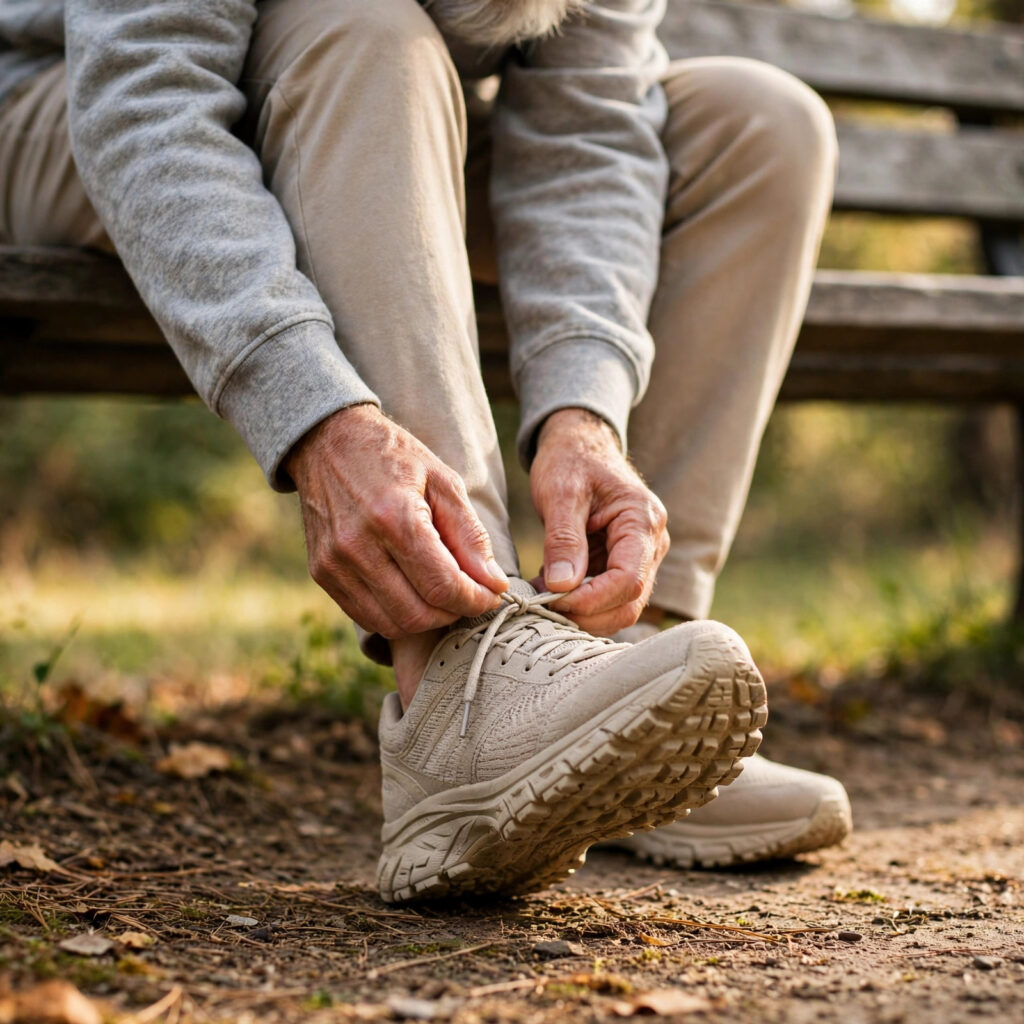
- A comfortable, roomy toe box. Your toes should be able to spread, with about a thumb’s width between your longest toe and the end of the shoe.
- Support that matches your feet. If your feet roll inward noticeably or you have flat feet, a stability shoe may feel better than a very soft neutral shoe. A running specialty store can watch you walk or jog and suggest a category.
- The right size, checked late in the day. Feet swell slightly during the day, so try shoes on in the afternoon, wearing the socks you will run in.
Replace running shoes when the cushioning feels dead or the tread is worn smooth — for most casual runners, roughly every 300–500 miles. If you have knee pain, our article on shoe features for knee pain explains which design details tend to help.
Choosing your surface
Where you run matters, especially in the early months:

- Kindest on joints: grass, dirt trails, and rubberized tracks. These absorb impact and are the best choice while you are building up.
- Good middle ground: asphalt paths and treadmills, both more forgiving than concrete.
- Hardest on joints: concrete sidewalks and pavements. Save these for later, when your legs are stronger.
- Handle with care: sand and steep hills. Soft sand overworks the calves and ankles, and steep downhills load the knees heavily — walk the downhills until your legs are well adapted.
A park loop on grass or packed dirt is the ideal beginner venue: soft and flat. Uneven trails with roots and rocks can be a trip hazard, so save technical trails until your balance and ankle strength are well developed.
Weather, hydration, and safety basics
Older runners need to be a little more deliberate about conditions:
- Heat: Run in the morning or evening in warm weather, wear light clothing and a hat, and carry water on longer sessions. Thirst becomes less reliable with age, so sip before you head out and drink during sessions longer than 20–30 minutes.
- Cold: Layer up, cover your ears and hands, and take a longer warm-up — cold muscles are stiffer and more injury-prone. Watch for icy patches, which are a fall risk at any age.
- Visibility and route safety: Near roads, wear bright or reflective clothing and run facing traffic where there is no sidewalk. On trails, let someone know where you are going and when you expect to be back, and carry a phone.
How running fits into your week
The CDC recommends that adults 65 and older get at least 150 minutes of moderate-intensity aerobic activity per week, or 75 minutes of vigorous activity, or an equivalent mix — plus muscle-strengthening activity on at least 2 days and activities that improve balance. Running counts as vigorous activity, so two or three short run sessions a week, combined with walking on other days, can cover a large part of that target. Staying active after 60 has more ideas for filling the non-running days enjoyably, from gardening to swimming to dancing.
When to see a doctor
Get medical advice before starting, or stop and seek advice promptly, if any of these apply:
- Chest pain, pressure, or unusual breathlessness during or after exercise
- Dizziness, fainting, or heart palpitations during activity
- A known heart condition, including heart failure, a previous heart attack, or an irregular heartbeat
- A joint replacement, or a surgeon who has advised against high-impact activity
- Osteoporosis, especially if you have had a fracture from a minor fall
- Balance problems, frequent falls, or a condition that affects your coordination
- Pain that is sharp, swollen, or still present after two rest days
- A foot ulcer, numbness in the feet, or poor circulation, particularly if you have diabetes
- Medication that affects your heart rate, blood pressure, or balance
None of these automatically rules running out. Many people with these conditions do exercise safely — but the type and intensity should be agreed with a clinician who knows your history, not decided from an article. If running turns out not to be right for you, brisk walking, cycling, and swimming offer much of the same benefit with less impact.
The bottom line
Starting to run after 60 is not about reclaiming your twenties. It is about adding a simple, joyful movement to your life at a pace your body can sustain. Walk first, add short run intervals, rest between sessions, choose soft surfaces, wear shoes that fit, and strengthen the muscles that protect your joints. Lace up and start slow.
Sources
- Centers for Disease Control and Prevention, “Older Adults: Adding Physical Activity Recommendations” — https://www.cdc.gov/physical-activity-basics/adding-older-adults/index.html
- Centers for Disease Control and Prevention, “Older Adult Activity: An Overview” — https://www.cdc.gov/physical-activity-basics/guidelines/older-adults.html
- U.S. Department of Health and Human Services, Physical Activity Guidelines for Americans, 2nd edition — https://health.gov/our-work/nutrition-physical-activity/physical-activity-guidelines/current-guidelines
- National Institute on Aging, “Exercise and Physical Activity” — https://www.nia.nih.gov/health/exercise-and-physical-activity
- Mayo Clinic, “Exercise: 7 benefits of regular physical activity” — https://www.mayoclinic.org/healthy-lifestyle/fitness/in-depth/exercise/art-20048389
- NHS, “Couch to 5K: week by week” — https://www.nhs.uk/conditions/nhs-fitness-studio/running-and-jogging/couch-to-5k/
This article is for general information only and is not medical advice. Talk to your doctor before starting a new exercise program.