
How Many Steps Per Day After 60? What Research Says
If your fitness tracker buzzes at 10,000 steps every day, you have probably wondered: is that number real science, or just a nice round target someone made up? For adults over 60, the answer matters — an impossible goal can make people give up before they start.
The research is more encouraging than the number on your wrist. You very likely need fewer steps than you think, and the biggest gains come from the smallest increases.
Where Did the 10,000-Step Number Come From?
The 10,000-step goal was not born in a laboratory. In 1965, a Japanese company called Yamasa began selling a pedometer named the Manpo-kei, which translates to “10,000-step meter.” Japan had just hosted the 1964 Tokyo Olympics, and public interest in fitness was running high.
The number was chosen for marketing reasons, not medical ones. It was round and memorable, and the Japanese character for 10,000 (万) happens to resemble a person walking, which made for a catchy advertising image. As Harvard epidemiologist I-Min Lee has pointed out, no studies had examined 10,000 steps as a target at the time.
Decades later, fitness trackers adopted 10,000 as their default target, giving a marketing number the appearance of scientific consensus. But the question researchers finally asked was simple: what does the evidence actually show?
What the Research Actually Found
The most influential study on this question comes from Dr. I-Min Lee and colleagues at Brigham and Women’s Hospital and Harvard Medical School. Published in 2019 in JAMA Internal Medicine, it followed 16,741 women with an average age of 72. Each wore an accelerometer on her hip for seven consecutive days, and researchers tracked mortality for the next four-plus years.
The results were striking:
- Women averaging just 4,400 steps a day had a 41 percent lower risk of death than the least active group, who averaged about 2,700 steps.
- Mortality risk continued to fall as step counts rose, but the benefits leveled off at around 7,500 steps a day — well below the 10,000-step default in most wearables.
- Notably, walking speed did not change the outcome: for the same daily step count, faster walking was not linked to lower mortality risk.
A larger 2022 meta-analysis in The Lancet Public Health, led by Amanda Paluch, pooled 15 international cohorts totaling about 47,471 adults. It confirmed the pattern: compared with people averaging about 3,500 steps a day, those taking more steps had a 40–53 percent lower risk of death. Crucially, the plateau point shifts with age: for adults aged 60 and older, the mortality benefit leveled off at roughly 6,000 to 8,000 steps a day, while for adults under 60 it leveled off closer to 8,000–10,000.
The most recent large review, a 2025 dose-response meta-analysis in The Lancet Public Health covering 57 studies, pointed the same way: compared with just 2,000 steps a day, about 7,000 steps was linked to 47 percent lower all-cause mortality, along with lower risks of dementia and cancer mortality.
One honest caveat: no randomized controlled trial has ever tested whether increasing daily steps reduces mortality. All of these findings are observational associations — healthier people tend both to walk more and to live longer. Still, the curve’s shape is remarkably consistent across studies.
The 6,000–8,000 Sweet Spot, Explained
For adults 60 and older, the research converges on a practical sweet spot of about 6,000 to 8,000 steps a day. Here is what that range really means:
A plateau is not a wall. Walking 10,000 steps is fine if you enjoy it — the evidence simply shows little extra benefit past roughly 8,000 steps.
The biggest gains are at the low end. The steepest part of the curve is the move from very sedentary (around 2,700–3,500 steps) up toward the middle range. That means the people with the most to gain are the ones currently doing the least.
These are population patterns, not prescriptions. A realistic number you hit consistently beats an ambitious one you abandon in a week.
For heart-specific guidance, you may also like Walking for Heart Health After 60.
Realistic Starter Goals by Fitness Level

Where should you start? First, wear a simple pedometer or phone tracker for a normal week and find your baseline — most sedentary adults over 60 land between 2,000 and 4,000 steps a day. Then aim one level up, not straight for the top:
- Very sedentary (under 3,000 steps/day): Aim for 3,000–4,000. Just getting to 4,400 steps is linked to substantially lower mortality risk than staying at 2,700, according to the Lee study. That is only about a 20-minute walk added to your day.
- Lightly active (3,000–5,000 steps/day): Aim for 5,000–6,000. You are entering the zone where the steepest benefits accumulate.
- Moderately active (5,000–7,000 steps/day): Aim for 7,000–8,000, the sweet spot where research suggests benefits plateau for most adults over 60.
- Already active (8,000+ steps/day): Keep going. Extra steps are still fine — just with smaller incremental gains.
Before and after — a good rule of thumb is to add about 1,000 steps per day every week or two — roughly 10 minutes of walking — until you reach a level that feels sustainable. Slow, steady progress beats a burst of enthusiasm followed by sore knees.
If you are in your 70s and wondering what is realistic at that stage, see Walking After 70: How Much Is Enough?
Pace and Intensity: Brisk Walk vs. Stroll
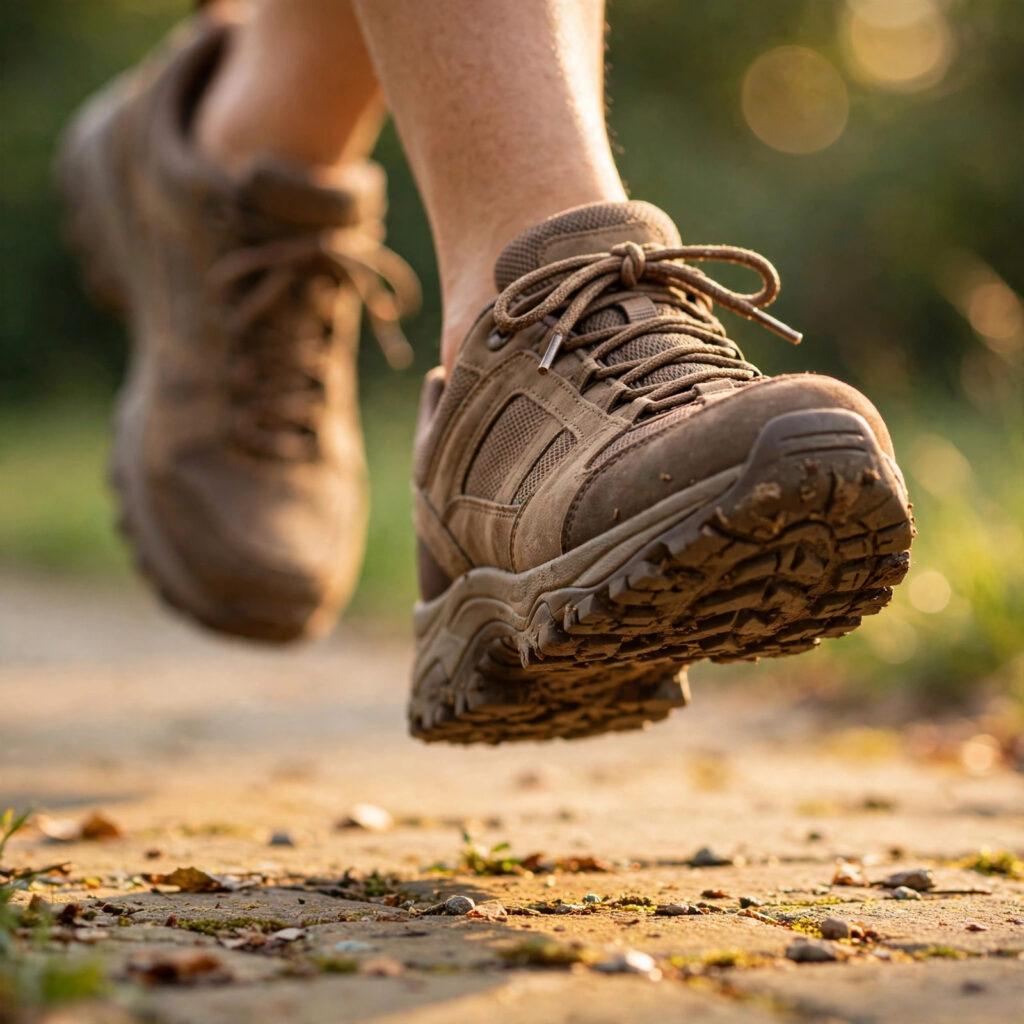
Does it matter how fast you walk? For mortality, the Lee study and a 2020 JAMA analysis of NHANES data by Saint-Maurice and colleagues both found that total step volume mattered more than stepping intensity. Two people taking 6,000 steps had similar outcomes whether they walked briskly or at a gentle pace.
That said, pace is not irrelevant: the Physical Activity Guidelines for Americans recommend at least 150 minutes per week of moderate-intensity activity, and brisk walking is one of the best ways to get there. A common marker for moderate intensity is about 100 steps per minute (roughly 3 miles per hour), so 30 minutes of brisk walking is about 3,000 steps.
The practical takeaway:
- Any walking counts. A slow stroll still adds to your daily total, and the research links total steps to lower risk regardless of speed.
- Brisk walking adds fitness. Walking at a pace that raises your breathing and heart rate — you can talk, but not sing — is linked to better cardiovascular fitness, blood pressure control, and stamina.
- A mix is ideal. Make most of your steps easy and comfortable, and fold in one or two brisker 10–20 minute walks on days you feel up to it.
The “talk test” is a simple intensity gauge: if conversation takes some effort while you walk, you are in the moderate zone.
Making Steps a Habit After 60
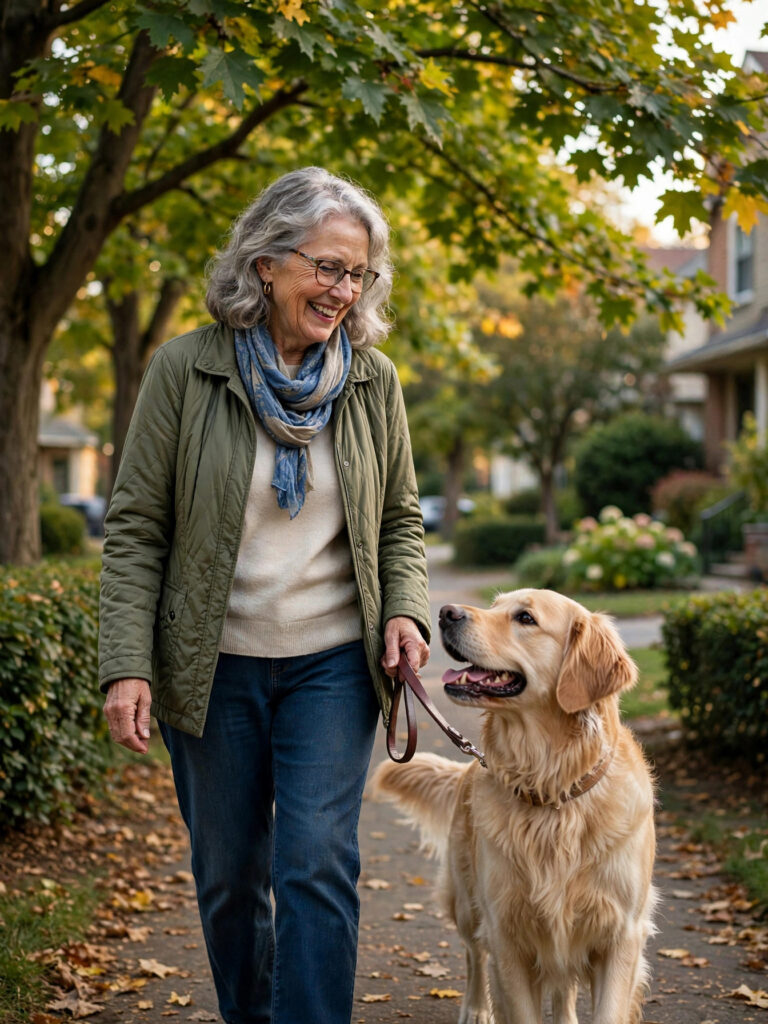
Knowing the number is only half the battle. Here are practical ways to fold more steps into an ordinary day without turning your life into a workout:
- Anchor a morning walk. A 15–20 minute walk after breakfast is the easiest habit to keep — daylight, routine, and done before the day gets busy.
- Use 10-minute chunks. Three short walks spread through the day add up exactly like one long one. A stroll after lunch may also help steady blood sugar.
- Pair walking with something pleasant. Call a friend, listen to music, or walk with a dog. Enjoyment predicts consistency.
- Make errands count. Park farther from the store entrance, take the long route through the mall, walk to nearby shops instead of driving.
- Break up sitting time. Set a gentle reminder to stand and move for a few minutes every hour. Long uninterrupted sitting is its own risk factor.
- Track simply. A basic pedometer or your phone’s step counter is enough. Watching your weekly average climb is motivating, and studies have found that pedometer-based programs add roughly 2,000 extra steps a day.
When Walking Isn’t Enough
Steps are one measure of activity, not the whole picture. Walking is excellent for the heart, mood, and mobility, but after 60 your body also needs:
- Strength training at least twice a week — bodyweight exercises, resistance bands, or light weights — to fight the muscle loss that comes with aging.
- Balance exercises such as standing on one foot, heel-to-toe walking, or tai chi, because falls are the leading cause of injury in adults 65 and older.
- Flexibility and joint mobility work to keep stiff joints moving comfortably.
For a fuller plan covering all three, read Staying Active After 60: Strength, Balance, and Fall Prevention.
When to See a Doctor
Walking is safe for most people, but talk to your clinician before ramping up if any of these apply — and seek prompt care if they appear during a walk:
- Chest pain, pressure, or tightness, especially during exertion
- Unusual shortness of breath, dizziness, or feeling faint while walking
- Calf pain or cramping that starts with walking and eases with rest (a possible sign of peripheral artery disease)
- New or worsening joint swelling, sharp joint pain, or pain that does not ease after a few days of rest
- Balance problems, recent falls, or a fear of falling that keeps you indoors
- Any heart condition, or new medications that affect blood pressure or heart rate
If you live with a heart condition or significant joint problems, build up gradually and talk with your clinician about a step target that fits your situation. Steps are one measure of activity — not a prescription.
Sources
- Centers for Disease Control and Prevention — Physical Activity Guidelines for Americans, 2nd edition
- National Institute on Aging (NIA) — Exercise and Physical Activity: Your Everyday Guide
- American Heart Association — guidance on walking and physical activity for heart health
- Harvard Health Publishing — coverage of step-count research and walking guidance
- Lee IM, Shiroma EJ, Kamada M, et al. “Association of Step Volume and Intensity With All-Cause Mortality in Older Women.” JAMA Internal Medicine, 2019.
- Paluch AE, Bajpai S, Bassett DR, et al. “Daily steps and all-cause mortality: a meta-analysis of 15 international cohorts.” The Lancet Public Health, 2022.
- Ding D, et al. “Daily steps and health outcomes in adults: a systematic review and dose-response meta-analysis.” The Lancet Public Health, 2025.
- Saint-Maurice PF, et al. “Association of Daily Step Count and Step Intensity With Mortality Among US Adults.” JAMA, 2020.
- Bravata DM, et al. “Using Pedometers to Increase Physical Activity and Improve Health: A Systematic Review.” JAMA, 2007.
This article is for general information only and is not medical advice. If you have a health condition or concerns about increasing your activity, please talk to your doctor or another qualified health professional.