Staying Active After 60: Strength, Balance, and Fall Prevention
If you are over 60 and wondering whether it is too late to get fit, here is the good news: it is not. Evidence suggests that adults who start exercising in their 60s, 70s, and even beyond still gain meaningful improvements in strength, balance, mobility, and mood. You do not need to train like an athlete. You need a modest, consistent mix of movement — and this guide lays it out.
This is the anchor article for the fitness section of this site. It covers why activity matters after 60, how much you need, the three types of exercise that matter most, a sample weekly plan, how to stay safe, and how to progress. Two companion articles go deeper on specific topics: balance exercises for fall prevention, one on walking after 70.
Why activity matters more — not less — after 60
Three quiet changes make movement more important with age, not less:
1. Muscle fades faster. Research estimates adults lose roughly 3–8% of muscle mass per decade after age 30, and the pace quickens after 60 — a process called sarcopenia. Less muscle means less strength for everyday tasks: climbing stairs, carrying groceries, getting up from the floor. The encouraging part is that strength training can slow, and in many cases partly offset, this decline even in very old adults.
2. Bones thin out. Bone density gradually declines with age, and bones become more fragile — especially for women after menopause. Weight-bearing activity (walking, dancing, stair climbing) and resistance work may help preserve bone strength, which matters enormously when falls happen.
3. Balance deteriorates — and falls follow. Falls are the leading cause of injury for older adults. The CDC reports that about one in four adults aged 65 and older falls each year, and falling once doubles your chances of falling again. Most falls are not random bad luck; they are linked to declining leg strength, slower reactions, poorer balance, and vision changes — all things exercise can improve.
And beyond the body: regular activity is linked to better sleep, sharper thinking, lower risk of heart disease and type 2 diabetes, and lower rates of depression and anxiety in older adults. It is also linked to independence — the ability to keep doing what you want to do, in your own home, for longer. That is the real prize.
The three pillars: aerobic, strength, and balance
Forget the idea of one magic workout. The major health organizations that study aging — the CDC, the World Health Organization, and the National Institute on Aging (NIA) — all recommend the same three-legged stool:
1. Aerobic activity: keep your heart and lungs working
This is anything that raises your heart rate and breathing: brisk walking, cycling, swimming, dancing, gardening done with energy. The CDC’s guideline for adults 65 and older is:
- At least 150 minutes a week of moderate-intensity aerobic activity (for example, 30 minutes of brisk walking, five days a week), or
- 75 minutes a week of vigorous activity (like jogging or fast cycling), or an equivalent mix of both.
“Moderate intensity” simply means you can talk but not sing while doing it — the classic talk test. And the activity does not have to happen in long sessions: 10-minute chunks through the day count just as much as one 30-minute walk.
If 150 minutes sounds like a lot from where you are now, start with 10–15 minutes a few days a week and add five minutes each week. The evidence is clear that some activity is much better than none — the biggest health gains come from going from sedentary to moderately active.
2. Strength training: protect the muscle you still have
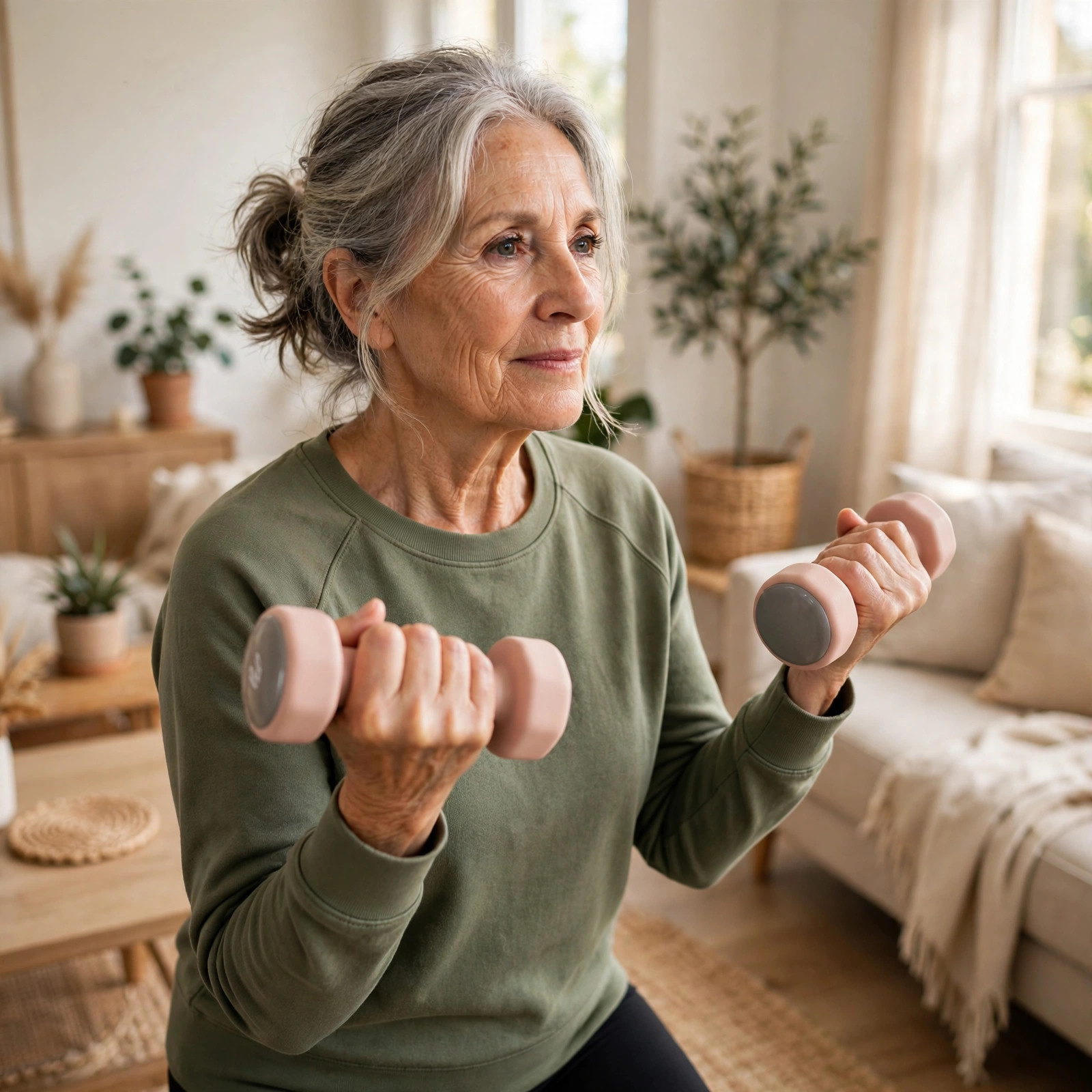
Strength work is the pillar most older adults skip — and arguably the one they need most. The CDC recommends muscle-strengthening activities on 2 or more days a week, covering all major muscle groups (legs, hips, back, chest, shoulders, arms).
You do not need a gym membership. Body weight, resistance bands, light dumbbells, or even household items (water bottles, cans) all work. Research reviewed by the American College of Sports Medicine (ACSM) shows that older adults — including those in their 80s and 90s — can still build meaningful strength with progressive resistance training.
Good starting moves include:
- Chair squats — stand up and sit down from a sturdy chair, using your hands only if needed
- Wall push-ups — lean against a wall and push away, easier than floor push-ups
- Calf raises — rise onto your toes while holding a countertop
- Seated or standing rows with a resistance band — for upper-back posture
- Step-ups — step onto a low, stable step, alternating legs
Start with 1–2 sets of 8–12 repetitions, with a day of rest between strength sessions for the same muscles. If the last two reps feel challenging but doable, the resistance is about right.
3. Balance and flexibility: the fall-prevention leg

Balance training is where exercise meets safety directly. The NIA recommends balance exercises for older adults at risk of falling, and the evidence suggests programs combining balance and strength training meaningfully reduce fall rates.
Simple, effective balance exercises:
- Heel-to-toe walk — walk in a straight line placing one foot directly in front of the other, arms out for balance
- Single-leg stand — hold a chair and lift one foot, aiming for 10 seconds each side, gradually using less hand support
- Weight shifts — stand with feet hip-width apart, shift your weight slowly from one foot to the other
- Tai chi — widely recommended for older adults; studies link it to improved balance and fewer falls
Flexibility work — gentle stretching, yoga, or simply moving joints through their full range — keeps movement comfortable and may help with stiffness. Stretch when muscles are warm (after a walk, never on cold muscles), hold each stretch 15–30 seconds without bouncing, and stop before pain.
A fall-prevention throughline: this article keeps returning to balance and falls for a reason. After 60, the single most valuable return on your exercise time may be not falling. Strength in your legs plus practiced balance is the combination the evidence supports best.
How the three pillars fit together
| Type | Guideline | Examples | Why it matters |
|---|---|---|---|
| Aerobic | 150 min/week moderate (or 75 vigorous) | Brisk walking, swimming, cycling, dancing | Heart, lungs, mood, weight, sleep |
| Strength | 2+ days/week, all major muscles | Chair squats, bands, light weights, wall push-ups | Muscle, bone density, everyday tasks |
| Balance + flexibility | Several times a week | Single-leg stands, heel-to-toe walk, tai chi, stretching | Fall prevention, mobility, stiffness |
A sample weekly plan to start

This plan assumes you are mostly sedentary now and reasonably healthy. Adapt it to your schedule and fitness — and check the safety section below first.
| Day | Activity | Time |
|---|---|---|
| Monday | Brisk walk + stretching | 20 min walk + 5 min stretch |
| Tuesday | Strength (legs, hips, core) + balance | 20–25 min |
| Wednesday | Brisk walk | 20–30 min |
| Thursday | Strength (arms, shoulders, back) + balance | 20–25 min |
| Friday | Brisk walk + stretching | 20 min walk + 5 min stretch |
| Saturday | Active hobby: gardening, dancing, easy cycling | 30 min |
| Sunday | Rest or gentle walk | Optional |
Total: roughly 120–150 minutes of aerobic activity plus two strength and two balance sessions — right at the guideline level. Notice that no single day asks for more than about 35 minutes.
Only have 10 minutes a day? Do a 10-minute brisk walk on five days, and on two of those days add a mini circuit first: 10 chair squats, 10 wall push-ups, a 20-second single-leg stand per side, and 30 seconds of marching in place. That covers all three pillars in a quarter of an hour and is a legitimate starting point — you can grow into the full plan above over a month or two.
Make it yours. Hate walking? Swim. Love music? Dance counts. The best exercise after 60 is the one you will still be doing in six months.
Starting safely: the non-negotiable rules
Enthusiasm is good; caution is better. A few rules keep you safe:
1. Check before you charge in. If you have heart disease, chest pain, uncontrolled high blood pressure, dizziness, joint problems that limit movement, or take medications that affect balance or heart rate, talk to your doctor before starting — or before increasing intensity. This is the exercise equivalent of the PAR-Q (Physical Activity Readiness Questionnaire) used by fitness professionals: better to get a green light than guess.
2. Warm up and cool down. Five minutes of easy walking or marching in place before, and gentle stretching after. Skipping the warm-up is the most common cause of pulled muscles in new exercisers of any age.
3. Wear proper footwear. Supportive, closed-toe shoes with non-slip soles — not slippers, sandals, or socks on smooth floors. Much of fall risk at home comes down to what’s on your feet.
4. Hydrate, and mind the heat. Thirst dulls with age, so drink water before, during, and after activity — don’t wait until you’re thirsty. In hot weather, exercise in the morning or evening and shorten sessions.
5. Learn the difference between effort and pain. Muscle fatigue and mild breathlessness are normal. Sharp pain, chest pain, pressure, dizziness, or unusual shortness of breath are stop signals — stop, rest, and seek medical advice if they persist.
6. Set up your space. Strength and balance exercises need a clear floor, a sturdy chair or countertop to hold, and good lighting. Never do balance work near sharp furniture edges or on slippery surfaces without support in reach.
Fall prevention beyond the exercises
Exercise is the foundation, but falls have several contributing causes worth addressing in parallel:
- Get your eyes checked. Vision changes — cataracts, outdated prescriptions — are strongly linked to falls. An annual eye exam after 60 is sensible.
- Review your medications. Some blood-pressure drugs, sleep aids, and antidepressants cause dizziness or lightheadedness. Ask your doctor or pharmacist whether any of yours raise fall risk, and never adjust doses on your own.
- Make the home safer. Remove loose rugs or tape them down, add grab bars in the bathroom, improve lighting on stairs, keep frequently used items within easy reach. Most falls happen at home.
- Address foot problems. Painful feet change how you walk. Comfortable, well-fitting shoes and treatment for bunions, corns, or nail problems all reduce fall risk.
Our companion article on balance goes much deeper into the exercises themselves — this pillar covers the strategy; that one is the practice manual.
How to progress without overdoing it
The goal is gradual, steady improvement — not week-one heroics:
- Follow the 10% rule: increase total weekly activity by no more than about 10% at a time.
- Add difficulty before duration: once 20-minute walks feel easy, add a few hills or pick up the pace before extending to 30 minutes.
- Make strength progressively harder: more repetitions first, then more resistance (heavier band, deeper squat, less hand support on balance work).
- Track something simple: a notebook, a phone step counter, or a calendar with checkmarks. Seeing a streak builds the habit.
- Expect setbacks: illness, bad weather, and sore days happen. Missing a week is not failure — just resume at a slightly easier level rather than trying to “make up” missed sessions.
A realistic timeline: most people notice better energy and sleep within 2–4 weeks, measurable strength gains within 6–8 weeks, and noticeably better balance within 2–3 months of consistent practice.
Quick answers to common questions
Is walking enough on its own? Walking is an excellent start and covers the aerobic pillar — but it does little for upper-body strength or balance. Pairing walking with two short strength sessions and a few minutes of balance work each week covers far more ground.
What if I have arthritis or bad knees? Exercise is still recommended — inactivity usually makes joint stiffness worse, not better. Low-impact options (swimming, cycling, water aerobics) protect joints, and our article on low-impact exercises for bad knees lists joint-friendly alternatives. Strengthening the muscles around a painful joint often reduces the pain over time.
Should I exercise if I feel unsteady? Yes — with support and supervision at first. Hold a chair or countertop during balance exercises, work near a wall, or ask a physical therapist for a starter program. Avoiding all activity because of unsteadiness usually makes balance worse, not better.
Morning or evening — does it matter? Whichever time you will actually stick to. Some people find morning exercise improves sleep; others do better after lunch. Consistency beats timing.
Do I need special equipment? No. A sturdy chair, a resistance band or two, and comfortable shoes cover the starter program in this article. Fancier gear can come later if you want it — it is never required.
When to see a doctor
Exercise is medicine, but it isn’t a substitute for medical care. Talk to your doctor before starting — or promptly during — if you experience:
- Chest pain, pressure, or unusual shortness of breath during activity
- Dizziness, fainting, or feeling like you might black out
- New or worsening joint pain that doesn’t ease with rest over a few days
- A fall that caused injury, or repeated near-falls
- Swelling in the legs, or a racing or irregular heartbeat with exertion
- Any new symptom that worries you — trust your instincts
Also worth a check-up: if you haven’t exercised in years and have risk factors for heart disease (high blood pressure, high cholesterol, diabetes, smoking history), a pre-exercise medical review is simply prudent.
The bottom line
Staying active after 60 comes down to three habits: move aerobically most days (aim for 150 minutes a week), strengthen your muscles twice a week, and practice balance regularly — because not falling may be the highest-value outcome of all. Start small, progress gradually, wear good shoes, and listen to your body. The evidence suggests it is never too late: the strength, balance, and independence you build in your 60s pay dividends for decades.
For the hands-on details, continue with the two companion articles in this fitness series: balance exercises to prevent falls, and how much walking is enough after 70.
Sources
- U.S. Centers for Disease Control and Prevention (CDC), “How Much Physical Activity Do Older Adults Need?” — https://www.cdc.gov/physical-activity/features/older-adults-need-physical-activity.html
- U.S. Centers for Disease Control and Prevention (CDC), STEADI — Older Adult Fall Prevention, “Facts About Falls” — https://www.cdc.gov/steadi/about/index.html
- National Institute on Aging (NIA), Go4Life, “Exercise & Physical Activity: Your Everyday Guide” — https://www.nia.nih.gov/health/exercise-and-physical-activity/exercise-and-physical-activity-your-everyday-guide
- World Health Organization (WHO), “Physical activity” fact sheet and guidelines on physical activity and sedentary behaviour — https://www.who.int/news-room/fact-sheets/detail/physical-activity
- American College of Sports Medicine (ACSM), position stand on exercise and physical activity for older adults — https://journals.lww.com/acsm-msse/fulltext/2011/07000/exercise_and_physical_activity_for_older_adults.20.aspx
- Mayo Clinic, “Exercise: A drug-free approach to lowering high blood pressure” and senior fitness guidance — https://www.mayoclinic.org/healthy-lifestyle/fitness/in-depth/exercise/art-20048389
This article is for general information only and is not medical advice. Talk to your doctor or a qualified health professional before starting a new exercise routine.