
Walking After 70: How Much Is Enough?
If you are in your seventies and wondering how much walking you actually need, here is the short answer: much less than the famous 10,000 steps — but probably a bit more than you are doing now. Research on older adults points to a sweet spot of roughly 6,000 to 8,000 steps a day for adults over 60, and even fewer steps still carry real benefits.
The longer answer is more encouraging. Walking after 70 is less about hitting a magic number and more about moving regularly, at a pace that gently challenges you, without pain or dread. This guide walks through what the evidence actually says, how to start safely, and how to build a habit that fits your life.
Forget 10,000 steps
The 10,000-step target was never based on science. It came from a 1960s Japanese marketing campaign for a pedometer — “manpo-kei,” literally “10,000-step meter.” It sounded good, it stuck, and for decades it became the default advice.
The actual research tells a different, kinder story. A well-known 2019 study that followed more than 16,000 women aged 62 and older (published in JAMA Internal Medicine) found that mortality dropped as daily steps rose — but only up to about 7,500 steps a day. Beyond that point, there was no additional benefit. Women averaging around 4,400 steps a day already had notably better outcomes than the least active group.
A larger 2022 meta-analysis in The Lancet Public Health, combining data from over 47,000 adults, confirmed the pattern: the biggest health gains come from going from very inactive to moderately active. For adults 60 and older, benefits leveled off at roughly 6,000 to 8,000 steps a day — lower than the range for younger adults. Speed mattered far less than simply accumulating the steps.
What does this mean for you? If you are walking 3,000 steps a day, you don’t need to triple it overnight to benefit. Moving toward 4,000, then 5,000, then 6,000 is exactly how the evidence suggests gains accumulate.
Pace and consistency matter more than totals
Here is something the step-count debate misses: a leisurely shuffle around the shops and a purposeful walk are not the same thing. But they both count, and they both help.
The CDC’s physical activity guidelines for older adults recommend at least 150 minutes a week of moderate-intensity aerobic activity — things like brisk walking — plus muscle-strengthening on two or more days. Moderate intensity means you can talk but not sing during the activity. That works out to about 20–25 minutes of purposeful walking most days.
That said, don’t dismiss slow, everyday walking. Pottering, gardening, and strolling still keep joints moving and add up. The hierarchy that matters:
- Some walking beats none. This is where the biggest health payoff lives.
- Consistent daily walking beats a weekend marathon. Your heart, joints, and balance prefer rhythm.
- A brisk pace adds a bonus. If you can walk at a pace where conversation takes a little effort, you are getting extra cardiovascular benefit — but it is optional, not required.
Evidence suggests that people who keep walking regularly after 70 maintain better leg strength, better balance, and a lower risk of falls than those who stop. The habit is the intervention.
Starting safely after 70
Walking is one of the safest forms of exercise, but after 70 a little preparation goes a long way. Most injuries in older walkers come from falls or overdoing it in week one — both are preventable.
Get the basics right first
- Footwear. Wear supportive, well-fitting shoes with non-slip soles. Thin-soled slippers, worn-out trainers, and fashion shoes are the most common culprits behind sore feet, blisters, and stumbles. Replace athletic shoes roughly every 300–500 miles of walking.
- Surfaces. Choose even, well-lit paths to begin with — park paths, shopping centers, school tracks. Save uneven trails for later, and always walk on pavement rather than grass edges, which hide dips and roots.
- Warm-up. Spend the first five minutes at an easy pace. Ankle rolls, gentle marching in place, or a few calf stretches before you set off loosens stiff joints. That first-minute stiffness is normal after 70; it eases as you warm up.
- Walking aids. If balance is a concern, use a cane or walking poles without embarrassment. Nordic-style poles add stability and, as a bonus, give your upper body a workout. They are tools, not verdicts.
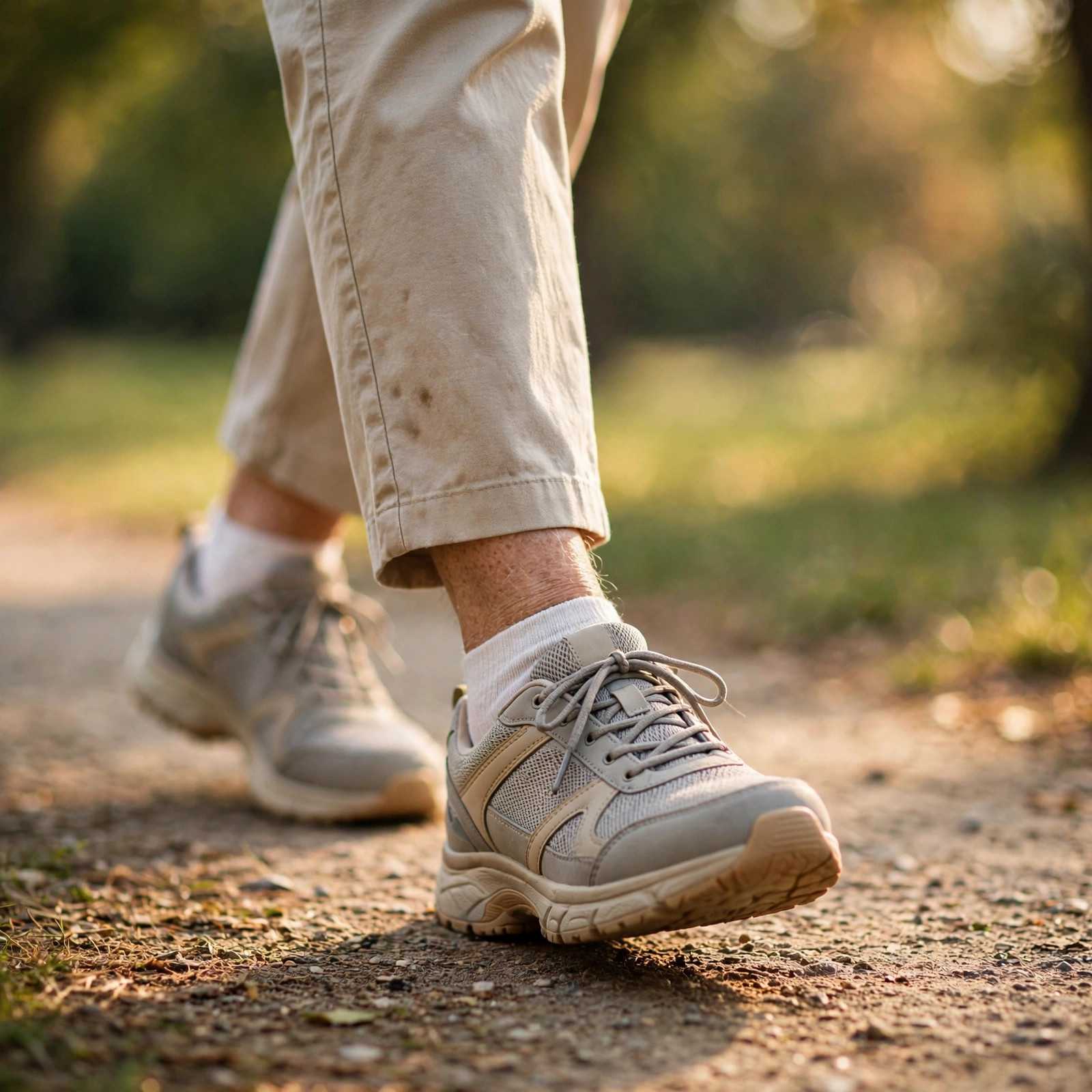
Watch your posture
Stand tall, look ahead (not down at your feet), relax your shoulders, and let your arms swing naturally. Small posture habits make longer walks feel easier and protect your back and neck.
Build up week by week

The biggest mistake people make after 70 is doing too much on day one — then being too sore to walk again for a week. A gentle ramp protects your joints and keeps you coming back.
A simple four-week starter plan for someone currently walking little:
- Week 1: 10 minutes a day, easy pace, on flat ground.
- Week 2: 15 minutes a day, easy pace.
- Week 3: 20 minutes a day, with the last 5 minutes a touch brisker.
- Week 4: 25 minutes a day, mixing easy and brisk stretches.
If you already walk more than that, skip ahead to whatever level feels comfortable and add about 10% more each week — no more. It is better to finish a walk wishing you had done a little more than to finish exhausted.
Expect some muscle soreness in the first two weeks. That is normal and it fades. What is not normal: sharp joint pain, chest pain, dizziness, or pain that is still there the next morning. If any of those show up, stop and talk to your doctor before continuing (more on that below).
Indoor alternatives for bad-weather days
Walking doesn’t have to stop when it rains, freezes, or hits a heatwave. Options that keep the streak going:
- Mall walking. Many shopping centers open early for walkers; the surface is flat, the temperature is controlled, and there are benches everywhere.
- Treadmill. Use the handrails lightly for balance rather than gripping them hard, which wrecks posture. Start at a slow speed and skip the incline until your legs are conditioned.
- Marching in place at home. Ten minutes of marching while watching the news is a real workout for a beginner. Add light arm swings to raise the effort.
- Stair stepping. If you have safe, railed stairs at home, a few gentle flights add intensity — hold the rail and take one step at a time.
One indoor walk a week is also a good chance to do your balance practice (see below) before heading back outside.
How to track your walking
You don’t need expensive gear. Simple tracking turns vague intentions into a habit you can see.
- A basic pedometer clipped to your waistband is cheap and does one job well: counting steps.
- A smartphone counts steps automatically if you carry it in a pocket — most phones show a weekly step graph in their health app.
- A simple fitness band adds heart rate and distance if you want more data, but it is not necessary.
Pick one method and check it once a day — consistency of measuring beats precision of measuring. Write the number on a calendar or in a notebook; seeing a streak of 5,000-step days is quietly motivating. Resist the urge to compare your numbers with a 50-year-old’s. Your comparison is with last week’s you.
Weather and safety tips

- Heat. Walk early in the morning or after dinner in summer. Bring water, wear a hat, and shorten your route on very hot days. Older adults feel heat faster and sweat less — don’t push through it.
- Cold and ice. Layer up, wear gloves (cold hands stiffen), and choose cleared paths. If pavements are icy, walk indoors that day — no step target is worth a fall.
- Low light. If you walk at dawn or dusk, wear reflective clothing and carry your phone. Stick to familiar, well-lit routes.
- Tell someone your route. Even on a short walk, it is sensible to let a family member or neighbor know where you go and when you expect to be back.
- Carry the basics. Phone, water, and any medication you might need (nitroglycerin, glucose tablets, an inhaler) in a small waist pack or jacket pocket.
A small balance bonus
Falls are the leading cause of injury for adults over 65, and walking alone doesn’t fully address balance. The CDC’s STEADI program and the National Institute on Aging both recommend adding simple balance exercises a few times a week:
- Heel-to-toe stand: stand with one foot directly in front of the other, heel touching toes, for 20 seconds each side. Hold a counter at first.
- Single-leg stand: hold the back of a sturdy chair and lift one foot for 10–15 seconds, then switch.
- Side steps: take 10 slow steps sideways, then 10 back. Keep a wall nearby.
Two or three minutes after your walk, a few times a week, is enough to see improvement within a month or two.
When to see a doctor
Walking is safe for most people, but check with your doctor first — or stop and get checked — if you experience:
- Chest pain, pressure, or tightness during or after walking
- Dizziness, fainting, or unusual shortness of breath
- Sharp or persistent joint pain that doesn’t ease within a day or two
- New numbness, weakness, or swelling in your legs or feet
- A fall or near-fall while walking
Also get clearance before starting if you have a heart condition, poorly controlled blood pressure or diabetes, or have had a recent surgery or hospitalization. A one-time visit for a green light is a small investment.
Related reading: Staying Active After 60: Strength, Balance, and Fall Prevention; 10 Balance Exercises to Prevent Falls After 65; 7 Low-Impact Exercises for Bad Knees.
The bottom line
After 70, walking works best as a daily rhythm rather than a number to chase. Aim to build toward roughly 6,000 steps or 20–25 minutes of purposeful walking most days — but remember that the biggest gains come from the first few thousand steps, not the last. Start where you are, build slowly, wear good shoes, and keep showing up. That quiet consistency is linked to stronger legs, better balance, a healthier heart, and more independent years.
Sources
- National Institute on Aging (NIA), “Exercise and Physical Activity” — https://www.nia.nih.gov/health/exercise-physical-activity
- Centers for Disease Control and Prevention (CDC), “Physical Activity for Older Adults” — https://www.cdc.gov/physical-activity/audiences/older-adults.html
- NHS, “Walking for Health” — https://www.nhs.uk/live-well/exercise/walking-for-health/
- American Heart Association, “American Heart Association Recommendations for Physical Activity in Adults and Kids” — https://www.heart.org/en/healthy-living/fitness/fitness-basics/aha-recs-for-physical-activity-in-adults
- Paluch A.E. et al., “Daily steps and all-cause mortality: a meta-analysis of 15 international cohorts,” The Lancet Public Health, 2022 — https://www.thelancet.com/journals/lanpub/article/PIIS2468-2667(22)00168-6/fulltext
- Lee I.M. et al., “Association of Step Volume and Intensity With All-Cause Mortality in Older Women,” JAMA Internal Medicine, 2019 — https://jamanetwork.com/journals/jamainternalmedicine/fullarticle/2734709
This article is for general information only and is not medical advice. Talk to your doctor or a qualified health professional before starting a new exercise routine.