
7 Low-Impact Exercises for Bad Knees
If your knees ache, stiffen up, or feel unsteady, you are not alone — and you are not stuck. Many adults over 50 find that gentle, regular movement actually helps their knees feel better over time. It seems strange at first: why would exercising help a joint that already hurts?
The answer is muscle. Your knee joint is supported by the muscles around it — mainly the quadriceps (front of the thigh), the hamstrings (back of the thigh), the calves, and the glutes. When these muscles are weak, the knee takes more of the load with every step. When they are stronger, they act like shock absorbers, taking pressure off the joint itself. Evidence suggests that targeted, low-impact strengthening is linked to less knee pain and better mobility in people with knee osteoarthritis.
Low-impact means your feet stay planted or the motion is smooth and controlled — no jumping, no pounding, no deep bending under load. The seven exercises below are chosen to be kind to sore knees while still building the support muscles that matter most.
Safety ground rules first
Before you begin, a few rules that matter more than any exercise:
- Start gentle. Use no weight, or the lightest effort, on your first week. You can build up from there.
- Stop if you feel sharp pain. Mild muscle effort or a gentle stretch feeling is normal. Sharp, stabbing, or catching pain is not. Stop the exercise and rest.
- Use support for balance. Keep a sturdy chair, countertop, or wall within arm’s reach for the standing exercises. Falling is a bigger risk than a weak knee.
- Check with your doctor or physical therapist first if you have arthritis, have had knee surgery or a joint replacement, or take blood thinners or other medications that affect exercise. Bring this article along and ask which exercises suit your situation.
- Warm up briefly. March gently in place for 1–2 minutes or do ankle circles before starting. Warm muscles are more forgiving than cold ones.
Aim for slow, controlled movements. If you can breathe comfortably and hold a conversation while doing them, the pace is right.
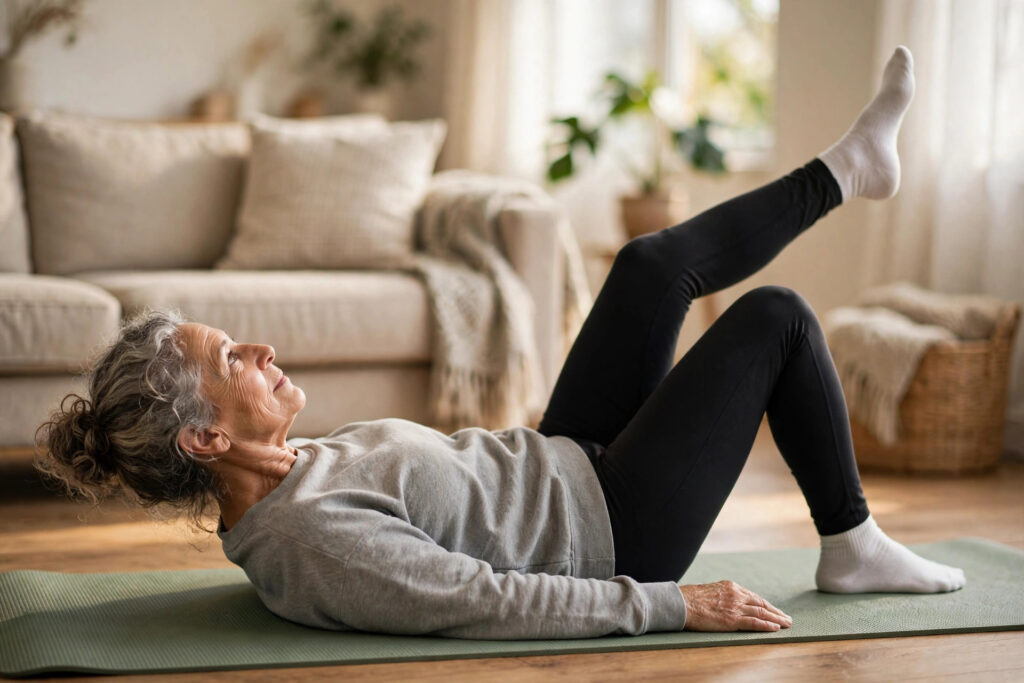
1. Straight-leg raises
This is one of the kindest ways to strengthen the quadriceps without bending the knee at all — a good starting point when knees are at their sorest.
How to do it: Lie on your back on a mat or carpeted floor. Bend one knee with your foot flat on the floor; keep the other leg straight. Tighten the thigh muscle of the straight leg and lift it slowly to about the height of your bent knee. Pause for a second, then lower it slowly. That is one rep.
Reps and sets: 10–12 reps per leg, 2–3 sets, resting 30–60 seconds between sets.
Modification: If lifting feels too hard, start by just tightening the thigh muscle while the leg stays on the floor (hold 5 seconds, release). Build up to the lift over a week or two.
2. Seated knee extensions
A classic for building quadriceps strength, done entirely from a chair — your knee works through a comfortable, controlled range.
How to do it: Sit tall in a sturdy chair with your feet flat on the floor. Slowly straighten one knee until the leg is extended (it does not need to lock out fully). Hold for 2–3 seconds, squeezing the thigh muscle, then lower slowly. Alternate legs or do all reps on one side first.
Reps and sets: 10–15 reps per leg, 2–3 sets.
Modification: If the last few degrees of straightening bother your knee, stop the lift a little short of full extension. You still get most of the benefit in the mid-range.
3. Modified wall sits
Wall sits strengthen the whole lower body, but a full deep hold can be too much for sore knees. A shallow version keeps the benefit and drops the strain.
How to do it: Stand with your back against a wall and feet shoulder-width apart, about a foot away from the wall. Slide down slowly only until your knees are slightly bent — think of it as a “quarter squat,” nowhere near sitting level. Hold the position, keeping your weight in your heels and knees tracking over your toes (not caving inward).
Reps and sets: Hold 10–20 seconds, rest, repeat 4–6 times.
Modification: Make it shallower or shorter — even a 5-second hold counts at first. Hold a chair back in front of you if balance feels uncertain.

4. Step-ups
Step-ups train the same muscles you use on stairs and curbs, which is exactly the strength that makes daily life easier.
How to do it: Stand in front of a low, sturdy step (a single stair or a 4–6 inch aerobic step — not a tall one). Step up with your stronger or less painful leg, bring the other foot up, then step back down in reverse. Keep your movements slow and your knee pointing in the same direction as your toes.
Reps and sets: 8–10 reps leading with one leg, then switch, 2 sets per side.
Modification: Start with a lower step, even just a thick book on the floor. Hold the handrail or a chair beside you. If stepping down hurts, step down with the stronger leg first.

5. Calf raises
Strong calves support your ankle and help your whole leg move more efficiently, which takes some of the sideways stress off the knee.
How to do it: Stand tall holding a chair or countertop for balance, feet hip-width apart. Rise slowly onto your toes, hold for 1–2 seconds, then lower slowly. Keep your weight even across both feet.
Reps and sets: 12–15 reps, 2–3 sets.
Modification: Do them seated if standing is uncomfortable — sit with feet flat and press up onto your toes. For more challenge later, try one foot at a time.
6. Standing hamstring curls
The hamstrings balance out the quadriceps. When quads are much stronger than hamstrings, the knee can feel unstable — this exercise helps even things out.
How to do it: Stand behind a sturdy chair, holding the back for balance. Shift your weight to one leg and slowly bend the other knee, bringing your heel toward your buttock. Pause briefly, then lower slowly. Avoid arching your lower back or swinging the leg.
Reps and sets: 10–12 reps per leg, 2–3 sets.
Modification: If you can only lift the heel a few inches, that is fine — work within your comfortable range. Over time, the range often improves.
7. Stationary cycling or water walking
For gentle cardio that also moves the knee through its range, these two are hard to beat. Both keep impact near zero.
How to do it (cycling): Set a stationary bike to low resistance and a seat height where your knee has only a slight bend at the bottom of the pedal stroke (a seat that is too low strains knees). Pedal at an easy, steady pace for 10–20 minutes.
How to do it (water walking): In chest-deep water, walk laps at a comfortable pace. The water supports your body weight while giving your legs gentle resistance in every direction.
Reps and sets: 10–20 minutes, 2–3 times per week to start.
Modification: On the bike, start with just 5 minutes and add a minute or two each session. In the pool, stay in the shallow end and keep one hand near the wall until you feel steady.

A simple weekly starter plan
You do not need to do everything every day. Here is a gentle way to begin:
| Day | What to do |
|---|---|
| Monday | Exercises 1, 2, 5, 6 (strength, ~15 min) |
| Tuesday | Rest or a short walk |
| Wednesday | Exercise 7 (cycling or water walking, 10–15 min) |
| Thursday | Exercises 1, 2, 3, 4 (strength, ~15 min) |
| Friday | Rest or a short walk |
| Saturday | Exercise 7 (cycling or water walking, 10–20 min) |
| Sunday | Rest |
After two or three weeks, if the exercises feel easy and your knees tolerate them well, add one set to the strength moves or a few minutes to the cardio. Progress gradually — small, steady increases beat big jumps.
When to see a doctor
Exercise is a wonderful tool, but it is not the right answer for every knee problem. See your doctor promptly if you notice any of these:
- Sharp or sudden pain that does not ease with rest, or pain after a fall or twist.
- Swelling, warmth, or redness around the knee, especially if it comes on quickly.
- Locking, catching, or the knee giving way — it buckles or feels like it cannot support you.
- You have had knee surgery or a joint replacement and have not yet been cleared for exercise — get medical clearance first.
- Pain that keeps getting worse over weeks despite gentle activity, or pain that wakes you at night.
These signs may point to something that needs diagnosis before exercise, such as a ligament injury, a meniscus tear, or an infection. Getting checked is not giving up on movement — it is making sure you move safely.
Sources
- National Institute on Aging (NIH) — Exercise and Physical Activity: https://www.nia.nih.gov/health/exercise-and-physical-activity
- Centers for Disease Control and Prevention (CDC) — Physical Activity for Arthritis: https://www.cdc.gov/arthritis/communications/features/healthy-knees.html
- Mayo Clinic — Knee Pain: Symptoms and Causes: https://www.mayoclinic.org/diseases-conditions/knee-pain/symptoms-causes/syc-20350849
- NHS — Knee Pain: https://www.nhs.uk/conditions/knee-pain/
- Arthritis Foundation — Exercises for Knee Osteoarthritis: https://www.arthritis.org/health-wellness/healthy-living/physical-activity/other-activities/better-knee-exercises
- Cleveland Clinic — Knee Strengthening Exercises: https://my.clevelandclinic.org/health/articles/knee-strengthening-exercises
This article is for general information only and is not medical advice. Talk to your doctor or a physical therapist before starting a new exercise routine.