
Walking for Heart Health After 60: How Much Is Enough
After 60, exercise can feel like it needs to be complicated, expensive, or exhausting to count. Walking quietly proves otherwise. It is one of the simplest forms of aerobic activity — and both the American Heart Association and the CDC classify brisk walking as moderate-intensity exercise, the same category as cycling or water aerobics. It costs nothing, requires no special training, and can be adjusted to almost any fitness level.
The question most readers ask is straightforward: how much walking does your heart actually need? This guide covers the widely cited weekly target, what “brisk” really means, how to start safely, and how to turn walking into a lasting habit.
Why Walking Is Good for the Heart
When you walk at a steady, purposeful pace, your heart rate rises and stays elevated. Over weeks and months, this gentle conditioning helps the heart pump more efficiently, which supports healthy circulation throughout the body.

Research links regular moderate activity to several heart-related benefits:
- Healthier blood pressure. The American Heart Association notes that staying active helps manage blood pressure, and Mayo Clinic lists regular brisk walking among the habits that can help prevent or manage high blood pressure. If you already track your numbers, our guide on Blood Pressure After 60 explains what readings mean at this age.
- Better blood sugar control. Working muscles use blood sugar for fuel, and over time this helps the body use insulin more efficiently. Mayo Clinic notes that regular brisk walking can help prevent or manage type 2 diabetes — itself a major risk factor for heart disease.
- Weight management. Walking burns calories and, combined with sensible eating, supports a healthy weight. The CDC counts brisk walking as moderate-intensity activity and notes that regular activity is key to keeping weight off once lost. Pairing your walks with a heart-friendly diet helps too — see 7 Heart-Healthy Foods Cardiologists Recommend.
- Stronger circulation and endurance. Regular walking improves fitness and builds endurance, so everyday tasks — climbing stairs, carrying groceries — feel easier over time.
- Healthier cholesterol patterns. Some studies link regular aerobic activity to improved cholesterol profiles, though results vary from person to person. Think of walking as one piece of the puzzle, alongside diet and any medication your clinician prescribes.
Walking also supports better sleep and lower stress, both of which indirectly benefit the heart. None of this requires running, a gym membership, or athletic talent — just consistency.
How Much Walking Do You Need?
Here is the number most health organizations cite: at least 150 minutes of moderate-intensity aerobic activity per week, according to both the American Heart Association and the CDC. That breaks down to about 30 minutes a day, five days a week — and brisk walking counts toward the total.
A few important details from the guidance:
- Spread it through the week. Both organizations recommend distributing activity across days rather than doing it all in one exhausting session.
- Short bouts count. The NHS notes that even a brisk 10-minute daily walk has benefits and counts toward the weekly total — handy if 30 minutes feels like too much at first.
- Build up gradually. The AHA specifically advises increasing amount and intensity gradually over time.
- Some beats none. The CDC’s message to older adults is direct: “some physical activity is better than none at all.” If you manage 60 minutes a week right now, that is still better than zero — and you can grow from there.
For adults 65 and older, the CDC also recommends at least two days a week of muscle-strengthening activity plus activities that improve balance, since falls become a bigger concern with age. Walking pairs well with simple balance exercises at home.
If you are wondering how this advice shifts as the years advance, see our companion guide Walking After 70: How Much Is Enough?.
How Fast Should You Walk? The “Talk, but Don’t Sing” Test
You do not need a heart-rate monitor to find the right pace. The NHS and the CDC describe moderate intensity the same simple way: you should be able to talk, but not sing.
A few practical pointers:
- Brisk is roughly 3 miles per hour — noticeably faster than a casual stroll, but well short of a jog. That is the NHS’s rough guide.
- Your breathing quickens and you may break a light sweat, but you can still hold a conversation.
- If you can sing the chorus of your favorite song easily, pick up the pace a little. If you are gasping, slow down.
- If a brisk pace is out of reach right now — because of fitness, joints, or both — walk at whatever pace feels comfortable and build from there. The key is moving regularly.
How to Start Safely
New walkers in their sixties do best with a gentle ramp-up. Here is a sensible way to begin:
- Start with 5–10 minute walks. Even three short walks a day add up. Add a few minutes each week as your stamina improves.
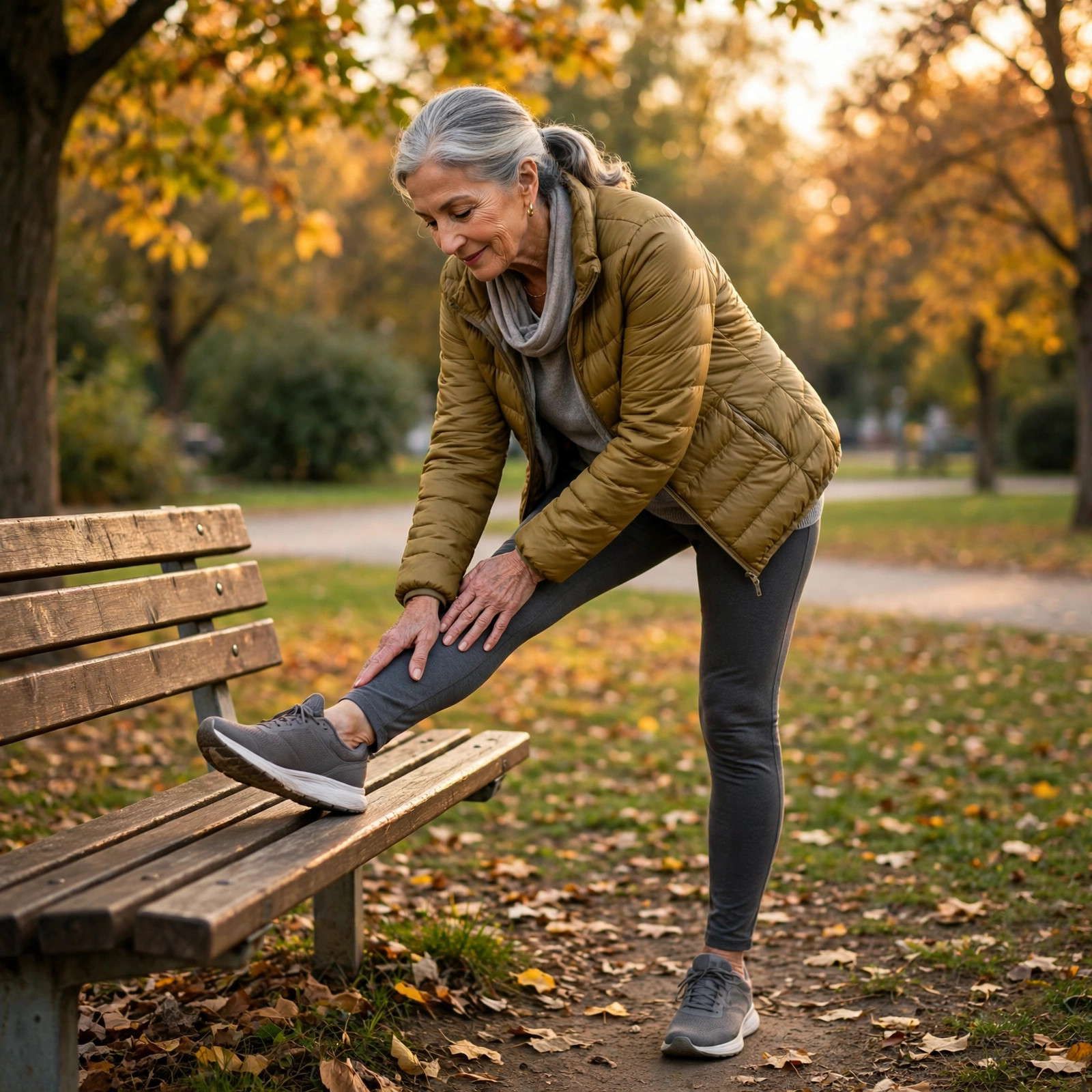
- Warm up and cool down. Walk at an easy pace for the first few minutes, then ease off again at the end. This helps your muscles and joints adjust.
- Wear supportive shoes. The NHS advises comfortable shoes or trainers that do not cause blisters — the most important “equipment” you will own.
- Pick flat, even routes. Well-lit paths, parks, or neighborhood sidewalks beat rocky trails for beginners. Avoid cracked or uneven pavement.
- Stand tall. Head up, shoulders relaxed, arms swinging gently at your sides. Land heel first, then roll through the step.
- Bring water and dress for the weather. Sun protection in warm months, layers and a hat in cold ones. Skip the walk in extreme heat or on icy surfaces.
- Take rest days. Your body adapts on the easy days. A walk most days of the week — not necessarily every day — is a fine goal.
For more ways to support healthy readings alongside activity, see How to Lower Blood Pressure Naturally After 60.
Counting Steps Without the Obsession
Step counters — on a phone, wristband, or simple pedometer — can be motivating, but the number on the screen is a rough guide, not a medical target.

What does the research actually say? In a well-known Harvard-led study of nearly 17,000 older women (average age 72), mortality risk fell as daily steps rose — and then leveled off at around 7,500 steps a day. Later research suggested that for people 60 and over, benefits tend to plateau somewhere between 6,000 and 8,000 steps. Notably, even modest totals were linked to meaningfully lower risk than the lowest step counts.
Two caveats worth knowing:
- These were observed associations, not proof that steps alone caused the benefit — healthier people may simply move more.
- The famous 10,000-step goal came from the marketing of a 1960s Japanese pedometer, not from science.
Use step counts as a friendly nudge. Watching the trend over weeks is far more useful than hitting an exact number on any single day.
Walking With a Heart Condition, Joint Pain, or Balance Issues
Common concerns should not automatically keep you off the path, but they do change the starting rules:
- Heart disease or high blood pressure. Talk with your clinician before starting or intensifying a walking routine. Many cardiac rehabilitation programs include supervised walking as a core activity — your doctor can advise on a safe pace and duration for your situation.
- Joint pain or arthritis. Walking is low-impact, which is one reason clinicians often recommend it over running. Stick to flat, forgiving surfaces, keep walks short at first, and consider plain walking poles for extra support on uneven ground.
- Balance concerns. Choose flat, well-lit routes, wear sturdy shoes, and walk with a companion if steadiness is an issue. The CDC recommends balance-improving activities for adults 65 and older — simple heel-to-toe or one-leg stands at home can complement your walks.
- Medications. Some heart and blood pressure medicines affect heart rate or make you lightheaded. Ask your clinician or pharmacist whether your prescriptions change how you should approach exercise — and keep taking them as directed.
The golden rule: when in doubt, get personalized guidance rather than guessing.
Making Walking a Habit That Sticks
Knowing the target is one thing; keeping it up is another. These strategies help walkers stay consistent:

- Anchor it to an existing routine. A walk after breakfast or before the evening news turns intention into habit.
- Plan your route. Knowing exactly where you will walk removes a daily decision. Keep two or three favorite loops of different lengths.
- Find company. A spouse, neighbor, or local walking group turns exercise into social time — and accountability.
- Have a weather backup. Cold or rain should not end the streak: try a shopping mall, a large store, or marching in place at home.
- Track lightly. A simple calendar checkmark or a weekly step average keeps you honest without pressure.
- Make it pleasant. A podcast, audiobook, or birdsong can make 30 minutes fly by.
Most people who keep walking for a year say the same thing: they stopped thinking of it as exercise and started thinking of it as part of the day.
When to See a Doctor
Stop walking and seek prompt medical attention if you experience any of the following:
- Chest pain, pressure, tightness, or aching — call emergency services rather than driving yourself.
- Unusual or severe shortness of breath that does not ease with rest.
- Dizziness, lightheadedness, or fainting.
- A racing or irregular heartbeat.
- Leg pain or cramping that starts with walking and eases with rest — this pattern deserves a clinician’s evaluation.
Also check in with your clinician before starting a new walking program if you have heart disease, diabetes, uncontrolled blood pressure, or any condition that affects balance or breathing. A quick visit can confirm a safe starting pace — and give you the confidence to keep going.
Sources
- American Heart Association — American Heart Association Recommendations for Physical Activity in Adults. https://www.heart.org/en/healthy-living/exercise-and-physical-activity/fitness-basics/aha-recs-for-physical-activity-in-adults
- Centers for Disease Control and Prevention — Older Adult Activity: An Overview (adults 65 and older). https://www.cdc.gov/physical-activity-basics/guidelines/older-adults.html
- Mayo Clinic — Walking: Trim your waistline, improve your health. https://www.mayoclinic.org/healthy-lifestyle/fitness/in-depth/walking/art-20046261
- NHS — Walking for health. https://www.nhs.uk/live-well/exercise/walking-for-health/
- Harvard Gazette — For older women, just 7,500 steps a day lowers mortality (reporting on Lee et al., JAMA Internal Medicine). https://news.harvard.edu/gazette/story/2019/06/for-older-women-just-7500-steps-a-day-lowers-mortality/
This article is for informational purposes only and is not medical advice. Talk to your clinician before starting a new exercise program.