
Skin Changes After 50: What’s Normal and What Helps
One morning you notice it: the skin on the back of your hand looks thinner, almost papery. A new brown spot on your cheek. Lines around your eyes that seem deeper than last year. It happens to everyone, and it is almost never an emergency. But skin after 50 is genuinely different from skin at 30, and it responds better to a different kind of care.
This guide walks through what actually changes, what the evidence says helps, what is not going to turn back the clock — and which skin changes deserve a prompt visit to your doctor.
What actually changes in your skin after 50
According to the National Institute on Aging, several things happen at once:
It gets thinner and less elastic. The outer layer thins, and the skin gradually loses some of the collagen and elastic fibers that keep it firm and springy. That is the main reason wrinkles deepen and skin feels more fragile — it also bruises more easily, because the small blood vessels underneath become more fragile with age.
It gets drier. The glands that produce oil and sweat slow down. Less natural oil means the skin barrier holds onto water less well, which is why dryness — and the itching that comes with it — is one of the most common skin complaints after 50.
It renews itself more slowly. Younger skin sheds and replaces its surface cells briskly; with age the pace eases off. The result can look duller or rougher, and small irritations take longer to settle.
Decades of sun start to show. Ultraviolet damage is cumulative: years of unprotected exposure add up to rougher texture, uneven pigmentation (the familiar “age spots”), and more visible wrinkles. The NIA notes that accumulated UV damage can also, in some cases, lead to skin cancer — which is why new or changing spots deserve attention, not panic.
Hormones play a role. For women, the drop in estrogen around menopause can make skin thinner and drier still. Some women also notice midlife breakouts — and because mature skin is thinner and more sensitive, harsh teenage-style acne treatments are often too much for it.
The reassuring part: most of what bothers people about aging skin — dryness, dullness, rough texture — responds well to simple, consistent care. The realistic goal is healthy, comfortable skin, not the skin of a 30-year-old.
Sun protection: the single biggest lever
Dermatologists say sun protection is the most powerful thing you can do to slow visible aging — and it is never too late to start. Past exposure does not cancel the benefit of starting now.

What sun protection actually means in practice:
- Sunscreen every day, not just beach days. Use a broad-spectrum sunscreen with SPF 30 or higher on all skin not covered by clothing. UV rays pass through clouds, so overcast days count too.
- Reapply it. About every two hours when you are outdoors, and right after swimming or heavy sweating. A moisturizer that contains sunscreen is fine for everyday use, but it needs the same reapplication.
- Seek shade when the sun is strongest — roughly 10 a.m. to 2 p.m. A quick rule from dermatologists: if your shadow is shorter than you are, find shade.
- Cover up. A wide-brimmed hat, sunglasses with UV protection, and lightweight long sleeves do quiet, reliable work. Clothing with a UPF (ultraviolet protection factor) label offers the most dependable coverage.
- Skip indoor tanning. Tanning beds deliver concentrated UV and accelerate exactly the damage you are trying to limit. Sunscreen prevents further damage rather than erasing what is already there — which is exactly why starting today matters.
Moisturize smarter, wash gentler
Dry skin makes everything look worse: fine lines look deeper, texture looks rougher, and itching can drive you to distraction. The fix is straightforward — dermatologists rank a daily moisturizer alongside sunscreen as one of the two most effective things you can buy for aging skin.
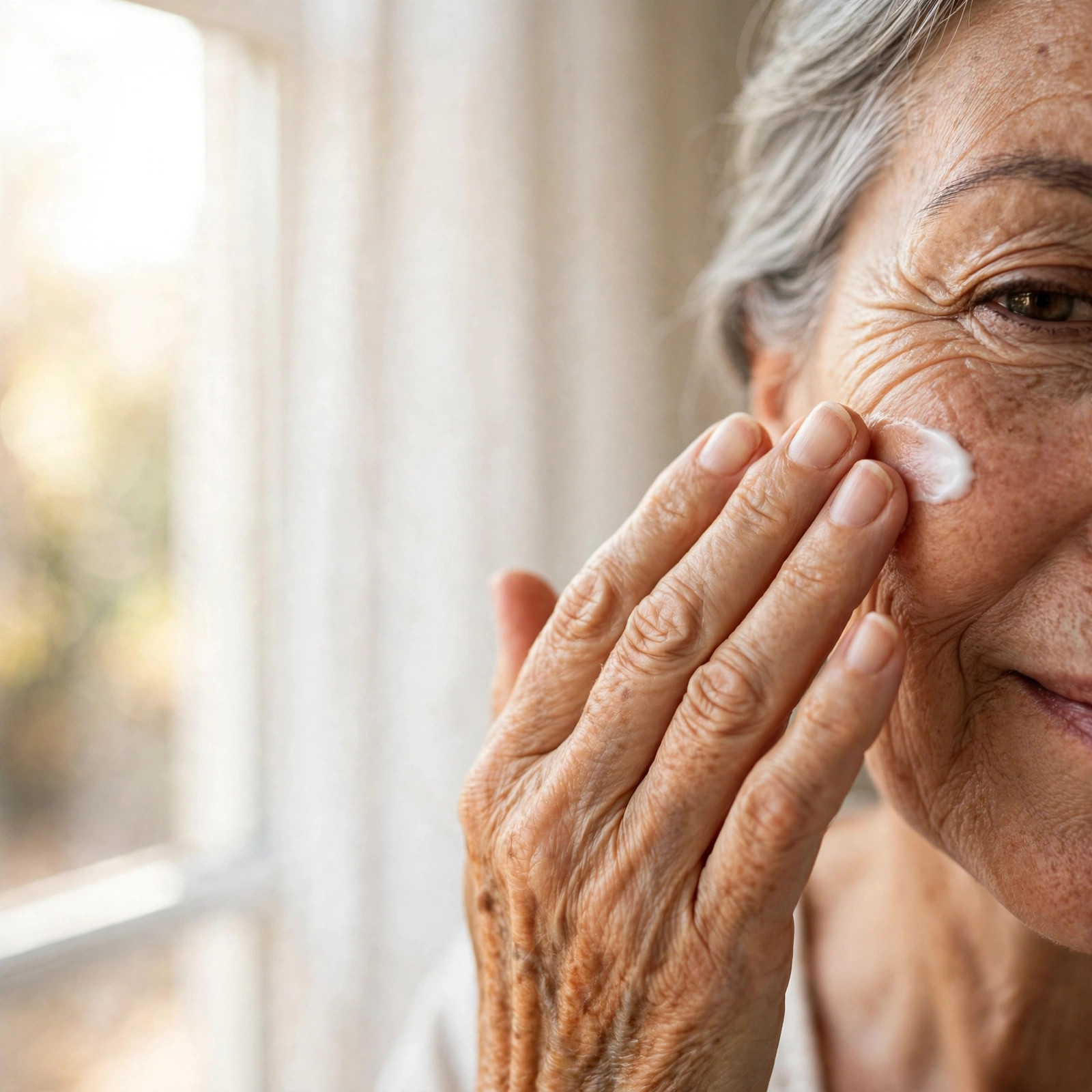
How to moisturize. Apply it to slightly damp skin — right after washing or showering is ideal — because moisturizer works mainly by trapping water that is already there. If skin still feels tight an hour later, try a richer cream, especially in winter.
What to look for (and what to skip). Dermatologists generally recommend fragrance-free products for mature skin, since fragrances are a common source of irritation. Beyond that, it helps to know the three jobs a moisturizer can do:
- Humectants draw water into the skin’s surface — hyaluronic acid and glycerin are the classic examples.
- Barrier-supporting ingredients help the skin hold onto that water — ceramides are the best known.
- Occlusives seal everything in — plain petrolatum is the simplest and one of the most effective.
You do not need expensive products or all three in separate jars — a basic fragrance-free moisturizer that feels comfortable is doing the real work. If a product stings or burns, that is irritation: simplify rather than push through.
Wash gently. Cleanse morning and night with a mild, fragrance-free cleanser, then pat — don’t rub — dry. Use warm rather than hot water, keep showers short, and go easy on soap. In dry seasons, a humidifier helps counter indoor-heated air.
Feed your skin from the inside
No food irons out wrinkles, but skin is living tissue running on the same fuel as the rest of you.

- Water, steadily. The thirst signal dulls with age, so waiting until you are thirsty often means you are already a little behind. Keep water within reach through the day — it supports every tissue, skin included. (See How Much Water Do Older Adults Really Need? for practical targets.)
- Enough protein. Skin, like muscle, is built and repaired from protein, and most older adults need more than the old minimums suggest — How Much Protein Do Older Adults Really Need? walks through the numbers.
- Plenty of plants. Mayo Clinic physicians point to a diet full of fruits and vegetables and their natural antioxidants as part of slowing the skin’s aging. Vitamin C–rich foods like citrus, peppers, and berries fit naturally into that pattern, and a Mediterranean Diet After 50 is one well-studied way to get there.
- Sleep. Dermatologists list getting enough sleep among the basics of a good skin routine — and for good reason, since the body’s repair work runs heaviest overnight.
Habits that quietly age your skin
A few everyday habits do more damage than most people realize:
- Smoking. Tobacco smoke accelerates skin aging and deepens wrinkles. Quitting is one of the highest-impact things you can do for your skin — and everything else. If you smoke, ask your clinician about quit support.
- Long, hot showers and harsh soaps. Hot water strips the skin’s natural oils; combined with strongly scented soaps, it is a fast track to dryness and itching.
- Skipping protection on “safe” days. Cloudy weather, driving, sitting by a sunny window — UV is still in the picture.
- Piling on products. No single product addresses every sign of aging, and layering several new ones at once often just irritates mature skin. Irritated skin looks older, not younger. Start with the basics — gentle cleanse, moisturize, sunscreen — give them a few weeks, then address one concern at a time.
What’s not going to turn back the clock
Here is the honest part the beauty aisle will not tell you: no cream can erase deep wrinkles, restore lost elasticity, or turn back the clock — despite what the packaging suggests. The National Institute on Aging advises skepticism toward products that claim to be anti-aging or to reduce wrinkles, noting that many are sold as cosmetics without the testing that drugs must undergo. Some have even been found to contain harmful ingredients such as heavy metals.
That does not mean skin care is pointless — it means aiming at the right target: moisturizers soften fine lines by plumping skin with hydration, sunscreen stops new damage, and a gentle routine keeps skin comfortable. Real wins — they just will not make 60 look like 30.
If a specific concern really bothers you — deep wrinkles, persistent dark spots, skin that tears easily — that is a conversation for a dermatologist, not a shopping trip. They can explain which options have actual evidence behind them and which do not.
When to see a doctor
Most skin changes after 50 are normal. These are the ones to get checked promptly — by your primary care clinician or a dermatologist:
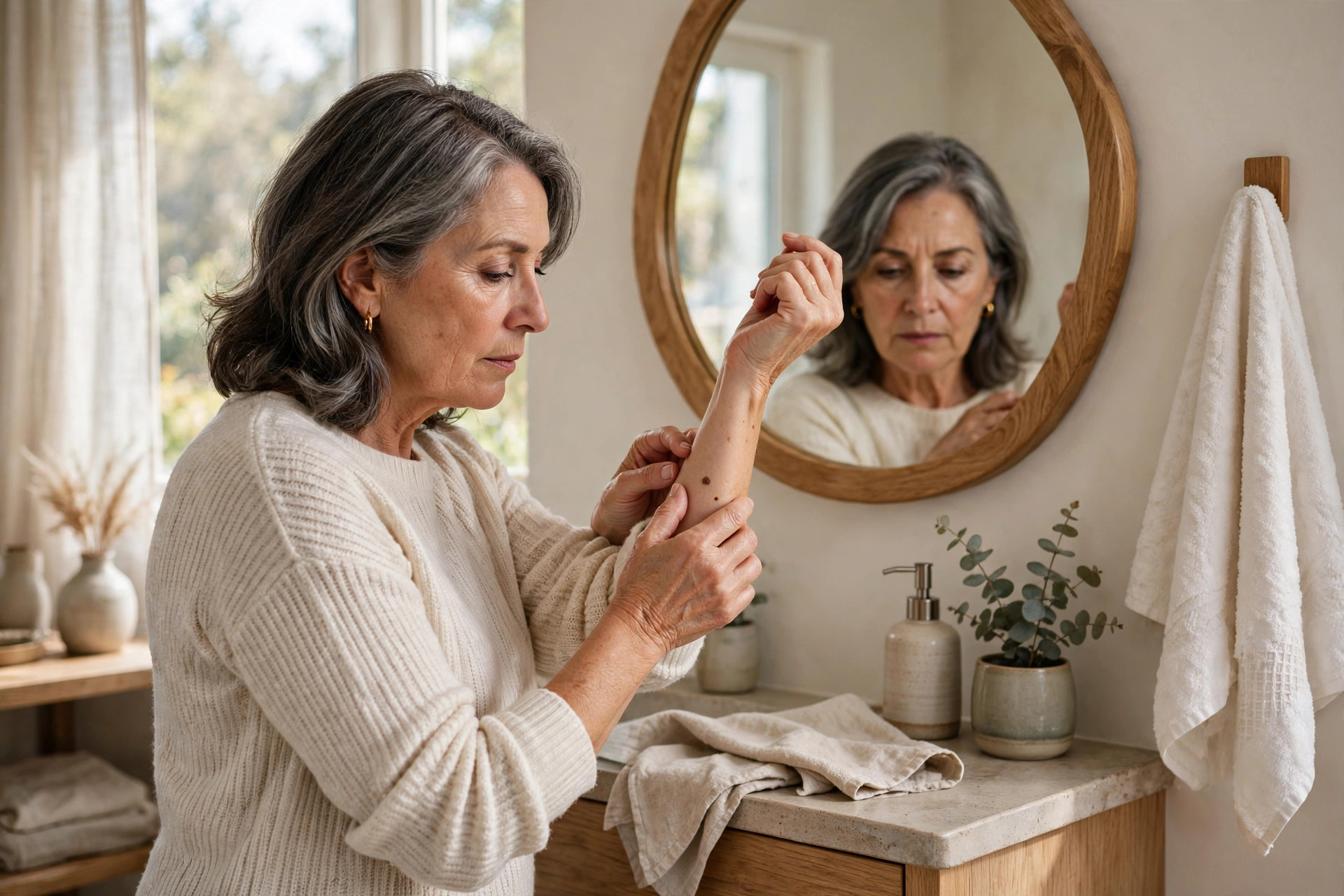
- A new or changing mole. Dermatologists describe warning signs with the ABCDE checklist: Asymmetry (one half unlike the other), Border (irregular or blurred edges), Color (varied shades, or a new color), Diameter (larger than about 6 mm — roughly a pencil eraser — though melanomas can be smaller), Evolving (any change in size, shape, color, or elevation). Any one of these warrants a look.
- A sore that does not heal. Anything that bleeds, crusts, or stays open for more than a few weeks.
- Itching, bleeding, or crusting in a spot that does not settle.
- Rapid changes — a spot that grows quickly or looks very different from your other moles.
- Persistent rashes or itching that do not respond to gentle care and moisturizer.
The NIA’s advice is simple: check your skin regularly and see your doctor about changes that worry you. After 50, a periodic skin check — and asking your clinician about a professional skin exam — is just good maintenance.
The bottom line
After 50, your skin is thinner, drier, and keeping score of every sunny decade — and that is normal. The formula that works is unglamorous: daily sun protection, a gentle fragrance-free moisturizer, mild cleansing, enough water and good food, no smoking, and a professional eye on anything that changes. It mostly comes down to consistency.
Sources
- National Institute on Aging, “Skin Care and Aging” — https://www.nia.nih.gov/health/skin-care/skin-care-and-aging
- American Academy of Dermatology, “Skin care in your 40s and 50s” — https://www.aad.org/public/everyday-care/skin-care-basics/care/skin-care-in-your-40s-and-50s
- Mayo Clinic News Network, “Mayo Clinic Q and A: Aging and changing” — https://newsnetwork.mayoclinic.org/discussion/mayo-clinic-q-and-a-aging-and-changing/
- Mayo Clinic, “Healthy aging: Beyond 50” — https://www.mayoclinic.org/healthy-lifestyle/healthy-aging/basics/healthy-retirement/hlv-20049407?p=1
This article is for informational purposes only and is not medical advice. Talk to your clinician or a dermatologist about concerning skin changes.