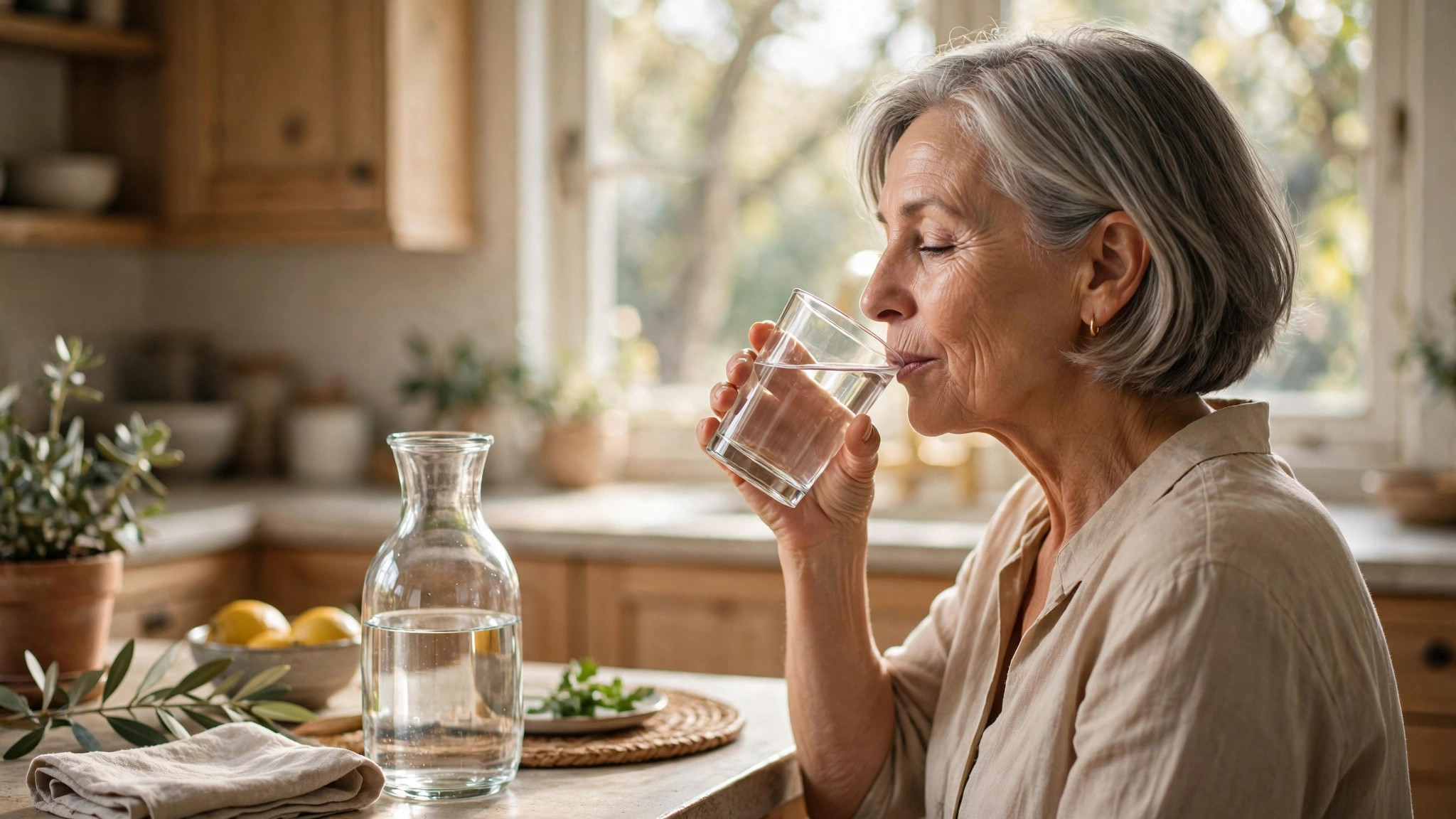
How Much Water Do Older Adults Really Need?
Ask ten people how much water you should drink each day and you’ll hear ten different answers — eight glasses, a gallon, just drink when thirsty. The confusion gets worse after 60, when your body starts playing by different rules.
Staying hydrated matters at every age, but it takes on special importance for adults over 45. The trouble is that the very signals your body uses to tell you “drink more” grow quieter with age. That is why dehydration is one of the most common — and most preventable — health risks in older adults.
So what is the real answer? Here is what the official guidelines say, why hydration gets harder with age, and how to build a realistic drinking habit that fits your life.
Why Drinking Enough Water Gets Harder After 60

Aging changes the way your body handles fluids in several ways. None of them are dramatic on their own, but together they raise the risk of dehydration.
Your thirst sensation fades. This is the biggest change. As you age, your fluid reserve shrinks, your ability to conserve water weakens, and your thirst sense becomes less acute — so by the time you feel thirsty, you may already be behind. Mayo Clinic’s guidance for older adults: don’t wait for thirst to arrive.
Your kidneys work differently. With age, the kidneys become less able to concentrate urine and conserve water, so you lose a little more through urine than you used to — another reason steady sipping beats occasional big glasses.
Medications can increase fluid loss. Certain medications, such as diuretics (often prescribed for blood pressure), can cause the body to flush out more water. Some sedatives, heart medications, and combinations of several prescriptions may also affect fluid balance. Mayo Clinic notes that chronic illnesses such as diabetes and dementia compound the problem.
Total body water declines. Older adults also carry less water in their bodies overall — a smaller fluid reserve — so a hot day, a stomach bug, or a few hours of heavy sweating can tip the balance faster than it would have at 40.
Everyday barriers add up. Reduced mobility can make it harder to get up for a drink, memory problems can make you forget whether you’ve had anything today, and some people deliberately drink less to avoid nighttime bathroom trips — a trade-off that usually backfires.
This matters because the numbers show a real gap: in a CDC survey of U.S. adults, men aged 60 and over averaged about 2.92 liters of total water per day — roughly 0.78 liters below the recommended adequate intake — while women 60 and over averaged about 2.51 liters, also below the target.
What the Guidelines Actually Say

Here are the official numbers, presented the way the experts present them.
The U.S. National Academies of Sciences, Engineering, and Medicine sets an Adequate Intake (AI) for total water of about 3.7 liters (around 15.5 cups) per day for adult men and 2.7 liters (around 11.5 cups) per day for adult women. These are population reference values — useful benchmarks, not rigid minimums that everyone must hit.
And here is the part most articles get wrong: those figures are total water, not just water from a glass. They include all beverages — water, tea, coffee, milk, soup — and the water naturally present in food. Mayo Clinic Health System gives the same figures in practical terms (15.5 cups for men, 11.5 cups for women) and notes that about 20% of daily fluid intake typically comes from food, with the rest from drinks. The National Academies’ own data backs this up: for adults over 50, roughly 19–20% of total water comes from foods.
How much you need also varies day to day — exercise, hot weather, fever, and vomiting or diarrhea all raise fluid needs. Body size, diet, climate, and health status matter too, so there is no single magic number.
Research from NIH adds one more reason to pay attention: adults with higher blood sodium — most commonly caused by low fluid intake — had a higher risk of chronic disease, though the researchers stress the study does not prove causation.
What About the “8 Glasses a Day” Rule?
You’ve heard it everywhere: drink eight 8-ounce glasses of water a day. Here is the honest version: that rule is not official guidance from any major health institution. Mayo Clinic has noted that the “8 by 8” rule is not supported by hard evidence — though it survives because it’s easy to remember.
A more accurate reframing, in Mayo Clinic’s spirit, is: drink at least eight 8-ounce glasses of fluid a day, because all fluids count toward your total — not just plain water. The 8-glasses idea works fine as a simple daily reminder, but it is a memory aid, not a medical prescription. Your personal target may be higher or lower depending on the factors above.
Signs of Dehydration in Older Adults
Dehydration can sneak up, and in older adults its early signs are easy to mistake for “just getting older.” Watch for:
- Dry or sticky mouth and lips
- Feeling unusually tired or weak
- Headache
- Dizziness or lightheadedness
- Dark-colored urine, or urinating less often than usual
- Muscle cramps
- Confusion or disorientation — in severe cases, dehydration can look like dementia, which is why sudden confusion in an older adult deserves prompt medical attention
- Rapid heart rate or low blood pressure
Severe dehydration is linked to falls, urinary tract infections, kidney problems, heat stroke, and hospitalization. The good news: mild dehydration is usually easy to fix — and prevent — by steadily increasing fluid intake.
Practical Ways to Drink More Water
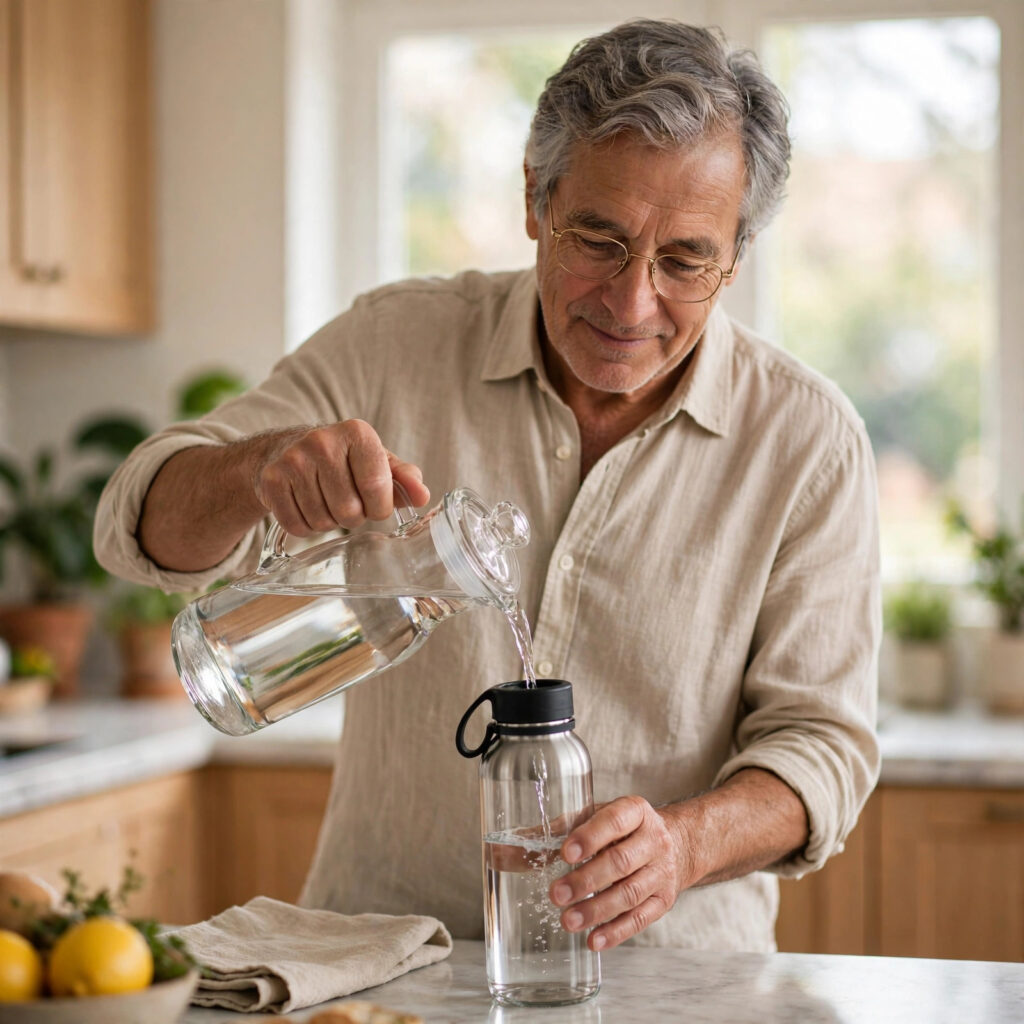
You don’t need to overhaul your life. These small, realistic strategies can add up to a well-hydrated day.
Drink on a schedule, not just on thirst. Since thirst is an unreliable signal after 60, tie drinking to daily cues: a glass when you wake up, one with each meal, one mid-morning and mid-afternoon. Some people find a phone reminder or a marked water bottle helps them pace intake through the day.
Keep water within reach. A glass or bottle on your desk, nightstand, or kitchen counter removes the friction of getting up for a drink.
Eat your water. Water-rich foods — watermelon, oranges, cucumbers, lettuce, tomatoes, broth-based soups, yogurt — contribute meaningfully to your daily total. A fruit-and-vegetable-rich diet, the kind described in guides to healthy eating habits, quietly supports your fluid intake too.
Make water more appealing. If plain water bores you, add lemon, cucumber, or berries. Herbal tea, milk, and diluted juice all count. Caffeinated and alcoholic drinks can increase fluid output, so they shouldn’t be your main hydration source — but normal amounts of coffee and tea still contribute to daily fluids.
Check your urine. A simple self-check that clinicians commonly suggest: if your urine is colorless or light yellow, you are probably drinking enough. Dark yellow or amber means drink more.
Plan for extra-loss days. Hot weather, exercise, fever, vomiting, or diarrhea all raise your fluid needs — drink more on those days, and don’t wait for symptoms.
Manage the bathroom concern. If nighttime urination worries you, front-load your drinking to the morning and afternoon and taper off in the evening, rather than cutting back overall — see these guides on sleep changes if waking persists.
The Important Exception: When You Should Drink Less
One important exception: if your clinician has placed you on a fluid restriction — sometimes the case with heart failure, advanced kidney disease, or certain liver conditions — “drink more water” is the wrong advice.
If your doctor has given you a daily fluid limit, that limit comes first and overrides every general guideline here — never increase intake to hit a guideline number if you have a condition that limits fluids.
When to See a Doctor
Most mild dehydration responds to steady drinking. But seek medical help promptly if you notice:
- Confusion, disorientation, or fainting
- Inability to keep fluids down
- Vomiting or diarrhea lasting more than 24 hours
- Very dark urine or no urination for many hours
- Rapid heartbeat, or feeling like you might pass out
- Signs of dehydration alongside a fever
Also talk to your clinician if you take several medications and aren’t sure how they affect your fluid needs, or if you have heart failure, kidney disease, or another condition that may limit fluids. A quick conversation can give you a personal daily target — far better than guessing.
The Bottom Line
After 45, drinking enough water takes a little more intention, because thirst stops being a reliable guide. The official benchmarks — roughly 3.7 liters of total water a day for men and 2.7 liters for women, from all drinks and food — are reference points, not rules carved in stone. Build drinking into your daily routine, eat water-rich foods, and remember that persistent fatigue that won’t go away can sometimes trace back to not drinking enough.
Staying hydrated won’t solve every health problem, but it is one of the simplest, cheapest habits that supports how you feel every day.
Sources
- National Academies of Sciences, Engineering, and Medicine, Dietary Reference Intakes for Water, Potassium, Sodium, Chloride, and Sulfate (2005) — sets the Adequate Intake for total water at about 3.7 L/day for adult men and 2.7 L/day for women, from beverages and food combined; notes AI values are population reference values, not individual minimums. https://www.nationalacademies.org/read/10925/chapter/2
- Mayo Clinic Health System, “Tips for drinking more water” — gives practical daily intake guidance (about 11.5 cups for women, 15.5 cups for men); notes about 20% of daily liquid comes from food; explains older adults are more prone to dehydration because fluid reserves shrink, water conservation weakens, thirst becomes less acute, and chronic illness, medications, and mobility problems compound the risk. https://www.mayoclinichealthsystem.org/hometown-health/speaking-of-health/tips-for-drinking-more-water/?mc_id=us&utm_source=newsnetwork&utm_medium=l&utm_content=content&utm_campaign=mayoclinic&geo=national&placementsite=enterprise&invsrc=other&cauid=100721
- CDC, National Center for Health Statistics, Data Brief No. 242 (April 2016) — found U.S. men aged 60 and over averaged 2.92 L of total water per day (0.78 L below the adequate intake) and women 60 and over averaged 2.51 L (0.19 L below), the lowest of any adult age group. https://www.cdc.gov/nchs/products/databriefs/db242.htm
- National Institute on Aging, “Common Medical Problems in Alzheimer’s Disease: Information for Caregivers” — lists dehydration signs (dry mouth, dizziness, rapid heart rate, hallucinations) in older adults; advises talking to a doctor about daily fluid targets and offering juice, broth, milk, or decaffeinated drinks when water is refused. https://www.nia.nih.gov/health/alzheimers-caregiving/common-medical-problems-alzheimers-disease-information-caregivers
This article is for informational purposes only and is not medical advice. Talk to your clinician if you have a condition that limits fluids.