Mediterranean Diet After 50: A Practical Guide
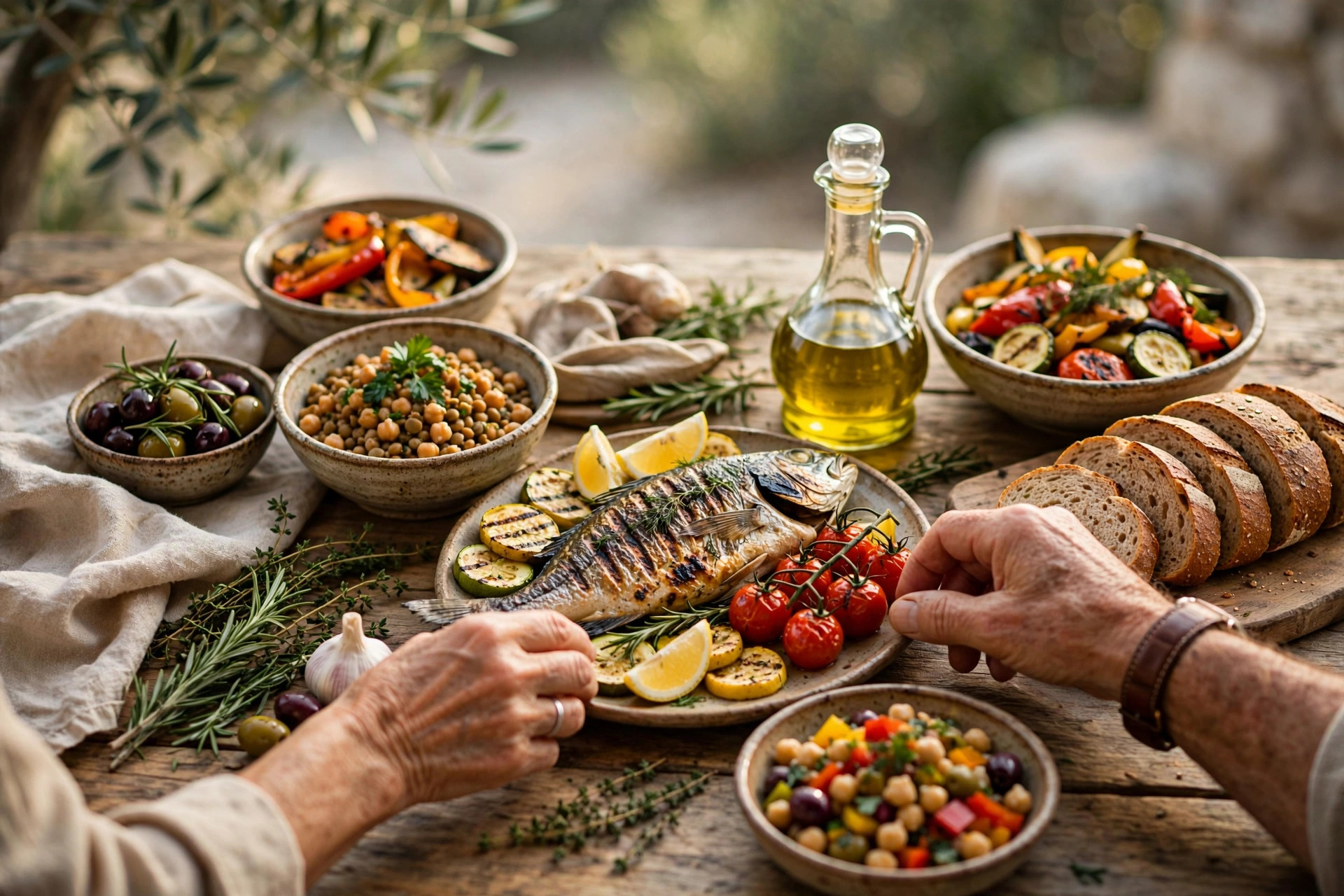
If you are looking for an eating pattern you can actually stick with after 50, few options are better studied than the Mediterranean diet. It is not a crash diet or a set of rigid rules — it is the traditional way people around the Mediterranean Sea have eaten for generations: plenty of vegetables, fruit, whole grains, beans, nuts, olive oil, and fish, with red meat and sweets kept occasional.
Large studies link this pattern to better heart health, slower cognitive decline, and healthier aging. The research has caveats worth knowing — including a famous retraction — and the diet works best when adapted to life after 50: smaller appetites, medications, and the need to keep muscle and bone strong.
What the Mediterranean diet actually is
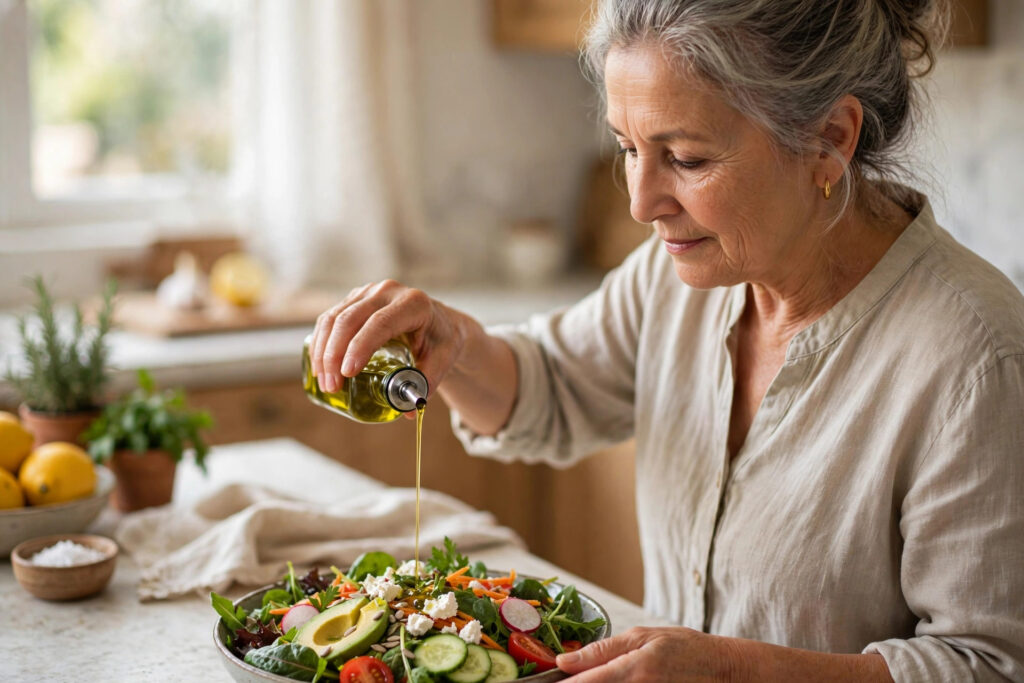
Forget “allowed” and “banned” lists — the Mediterranean diet is a flexible pattern built around these core food groups:
- Vegetables and fruit, every day. Aim for a colorful mix across meals — leafy greens, tomatoes, peppers, berries, citrus, and whatever is fresh and affordable.
- Whole grains and starchy foods. Oats, brown rice, quinoa, whole-grain bread and pasta, barley.
- Legumes. Beans, lentils, chickpeas — an affordable source of fiber and plant protein.
- Nuts and seeds. Walnuts, almonds, hazelnuts, in small handfuls.
- Olive oil as the main added fat. Extra-virgin olive oil for cooking and salads, replacing butter and other animal fats where you can.
- Fish and seafood, a few times a week. Guidance from Cleveland Clinic suggests about 3 servings per week, with an emphasis on oily fish such as salmon, sardines, and mackerel.
- Poultry, eggs, and dairy in moderation — supporting players, not the center of the plate.
- Herbs and spices for flavor, which makes it easier to use less salt.
Red meat, processed meats, sugary drinks, and highly processed sweets sit at the margins — enjoyed rarely. There is no calorie counting and no forbidden food group, which is one reason adherence tends to beat restrictive diets. (If weight loss is your goal, portions still matter.)
Why it may suit adults over 50 especially well
After 50, most people face the same pressures: a shrinking appetite with less room for empty calories, gradual muscle loss, and rising heart and cognitive risk. The Mediterranean pattern addresses these quietly, by default — high in fiber, rich in unsaturated fats linked to healthier blood lipids, and built on flavorful, easy-to-chew foods. Nothing is off-limits, which is why adherence years later beats most restrictive diets.
What the research says — including the retraction you should know about
Heart health and PREDIMED. The most famous trial of this diet is PREDIMED, a Spanish study of about 7,447 adults at high cardiovascular risk. Participants were assigned to a Mediterranean diet supplemented with extra-virgin olive oil, a Mediterranean diet supplemented with mixed nuts, or a control diet with advice to reduce fat. The original 2013 paper in the New England Journal of Medicine reported roughly a 30% lower rate of major cardiovascular events (heart attack, stroke, or cardiovascular death) in the Mediterranean-diet groups.
Here is the honest part: in June 2018, NEJM retracted the original paper after the investigators found randomization-procedure errors at some sites — some participants had not been assigned exactly as described. The journal simultaneously published a corrected, reanalyzed version. Per the Harvard T.H. Chan School of Public Health’s summary, the findings were essentially unchanged, and Cleveland Clinic cardiologist Dr. Steven Nissen noted the relative cardiovascular risk reduction was still around 30%. Treat the heart findings as supportive, but remember the complicated history.
Brain health. An August 2025 study in Nature Medicine, reported by the Harvard Gazette, tracked 4,215 women (from 1989 to 2023, average age 57 at baseline) and 1,490 men, comparing long-term dietary patterns with new dementia cases. People who followed a Mediterranean-style diet more closely had a lower risk of developing dementia and slower cognitive decline. The association was strongest in people carrying two copies of the APOE4 gene variant — the strongest known genetic risk factor for Alzheimer’s — suggesting diet may help offset even genetic risk.
Healthy aging and longevity. A study of more than 10,000 women in their 50s and 60s, published in the Annals of Internal Medicine, found that those eating a Mediterranean-style diet in middle age were about 40% more likely to live past 70 free of chronic illness and without physical or mental limitations. Separately, Harvard T.H. Chan researchers following 110,799 UK adults aged 40–75 found that closer adherence to a Mediterranean lifestyle was linked to 29% lower all-cause mortality and 28% lower cancer mortality over nine years. (That study measured the full lifestyle — diet plus activity, rest, and social habits — so it reflects more than food alone.)
Blood sugar. A 2025 PREDIMED-Plus study, co-authored by Harvard T.H. Chan researchers and published in the Annals of Internal Medicine, followed nearly 5,000 Spanish adults aged 55–75 with overweight or metabolic syndrome but not diabetes. Those combining a Mediterranean diet with modest calorie reduction, regular exercise, and professional support were 31% less likely to develop type 2 diabetes over six years than those following the diet alone.
What the evidence cannot tell you. Much of the supporting research is observational, showing associations rather than proof. Mediterranean populations also walk more and eat socially. So it is fairest to say the evidence suggests this pattern is linked to healthier aging — not that it predicts any outcome for one person.
A practical 7-day meal plan for older adults

A simple starting template, not a prescription — modest portions, protein at every meal to help maintain muscle, most dishes under 30 minutes or using leftovers.
| Day | Breakfast | Lunch | Dinner | Snack |
|---|---|---|---|---|
| Monday | Greek yogurt with berries and walnuts | Lentil soup with whole-grain bread | Baked salmon, roasted vegetables, quinoa | Apple slices |
| Tuesday | Oatmeal with sliced banana and almonds | Chickpea and tuna salad with olive oil | Whole-wheat pasta with tomato, spinach, white beans | Small handful of hazelnuts |
| Wednesday | Whole-grain toast, soft-boiled eggs, tomato | Leftover lentil soup | Grilled sardines, green salad, brown rice | Orange |
| Thursday | Smoothie: yogurt, berries, spinach, flaxseed | Hummus, vegetable sticks, whole-grain pita | Chicken and vegetable stir-fry with barley | Pear |
| Friday | Cottage cheese with peach slices and walnuts | Bean and vegetable minestrone | Baked cod, roasted sweet potato, broccoli | Greek yogurt |
| Saturday | Vegetable omelet with whole-grain toast | Sardine and white-bean salad on greens | Turkey meatballs with tomato sauce, couscous | Banana |
| Sunday | Whole-grain pancakes with berries, light syrup | Leftover minestrone | Roast chicken with root vegetables and salad | Mixed nuts |
A few notes for the 50+ cook: frozen fish and frozen vegetables are just as nutritious as fresh and far more convenient; canned beans and lentils are fine (rinse to cut sodium); and if chewing is difficult, favor soups, stews, soft fish, and well-cooked vegetables.
Six small steps to get started

- Swap your cooking fat. Use extra-virgin olive oil where you used butter or margarine — in the pan, on salads, over vegetables.
- Eat fish twice a week. Canned sardines or tuna count and cost little.
- Make one meal bean-based. A lentil soup or chickpea salad a few times a week adds fiber and plant protein cheaply.
- Snack on nuts, not chips. A small handful (about a quarter cup) is enough.
- Go whole grain by default. Brown rice, oats, and whole-wheat bread instead of refined versions.
- Season with herbs. Garlic, lemon, oregano, and basil add flavor that makes less salt painless.
Foods to limit
- Red and processed meats (sausage, bacon, deli meats) — keep to rare occasions.
- Sugary drinks and sweets — including sweetened teas and juices.
- Highly processed snacks — chips, pastries, packaged desserts.
- Excess salt — flavor with herbs and lemon instead.
- Alcohol — traditional in small amounts with meals, but optional, not a health recommendation. If you don’t drink, don’t start.
When to see a doctor
The Mediterranean diet is widely considered safe, but talk to your clinician or a dietitian before making major changes if any of these apply:
- You have diabetes — eating differently can shift blood sugar, and medication or insulin doses may need adjusting.
- You have kidney disease — higher intakes of potassium-rich foods (beans, bananas, nuts) or protein may not suit you.
- You take blood thinners such as warfarin — sudden big changes in vitamin K–rich greens can interfere with dosing; consistency matters most.
- You have heart failure or a sodium restriction — canned foods and cheese need watching even in a healthy pattern.
- You’ve lost weight without trying — unintentional weight loss after 50 deserves a medical check first.
Sources
- Harvard T.H. Chan School of Public Health, The Nutrition Source — “PREDIMED Study Retraction and Republication” (the 2013 NEJM paper was retracted in June 2018 over randomization-procedure errors; a corrected, reanalyzed version was published simultaneously). https://nutritionsource.hsph.harvard.edu/2018/06/22/predimed-retraction-republication/
- Cleveland Clinic, ConsultQD — “Perspective: Mediterranean Diet Still Best for Heart Health” (Dr. Steven Nissen on the reanalysis: relative cardiovascular risk reduction still around 30%). https://consultqd.clevelandclinic.org/perspective-mediterranean-diet-still-best-for-heart-health
- Cleveland Clinic — “Mediterranean Diet: Food List & Meal Plan” (food groups and serving guidance behind this article’s recommendations). https://my.clevelandclinic.org/health/articles/16037-mediterranean-diet?blog_category=Blog%2CHealthy+eating%2CNutrition
- Harvard Gazette — “Mediterranean diet offsets genetic risk for dementia, study finds” (August 2025 Nature Medicine study of 4,215 women and 1,490 men: closer adherence linked to lower dementia risk and slower cognitive decline, strongest in APOE4 double-copy carriers). https://news.harvard.edu/gazette/story/2025/08/mediterranean-diet-offsets-genetic-risk-for-dementia-study-finds/
- Harvard T.H. Chan School of Public Health — “Adherence to a Mediterranean lifestyle associated with lower risk of all-cause and cancer mortality” (110,799 UK adults aged 40–75: higher adherence linked to 29% lower all-cause mortality and 28% lower cancer mortality over nine years). https://hsph.harvard.edu/news/adherence-to-a-mediterranean-lifestyle-associated-with-lower-risk-of-all-cause-and-cancer-mortality/
- Harvard T.H. Chan School of Public Health — “Mediterranean diet combined with calorie reduction and exercise may reduce risk of type 2 diabetes by nearly one-third” (PREDIMED-Plus, Annals of Internal Medicine, August 2025: nearly 5,000 Spanish adults aged 55–75; 31% lower type 2 diabetes risk over six years in the combined-intervention group). https://hsph.harvard.edu/news/mediterranean-diet-combined-with-calorie-reduction-and-exercise-may-reduce-risk-of-type-2-diabetes-by-nearly-one-third/
This article is for informational purposes only and is not medical advice. Talk to your clinician or a dietitian before making major changes to your diet.