
Strength Training at Home With Light Weights After 60
After 60, the activities that keep you independent — carrying groceries, climbing stairs, getting up from a low chair — are really strength tests in disguise. And muscle is something the body quietly spends down with age.
This natural loss of muscle has a name: sarcopenia. Research suggests adults lose roughly 3–8% of muscle mass per decade after age 30, with the pace quickening after 60. The encouraging part, confirmed by the National Institute on Aging and the CDC, is that muscle responds to resistance training at any age — and you do not need a gym, a trainer, or heavy weights to begin.
This guide gives you a complete beginner routine with light weights at home: about 25–35 minutes, almost no equipment, following the frequency the major guidelines recommend — muscle-strengthening activities on at least two days a week.
Safety first
Strength training is safe for most older adults, but a short check is sensible before you begin, especially if you have not exercised in a while. Check with your doctor first if you have heart disease or high blood pressure, arthritis, osteoporosis, or joint replacements, take medication that affects balance or blood pressure, or have diabetes with complications.
Start lighter than you think you need to. The National Institute on Aging advises beginners to try strength exercises with no weights at all until the movements feel comfortable. The right starting weight lets you finish 8–12 repetitions with good form, feeling tired — but not struggling — on the last couple of reps.
Stop and check with a clinician if you feel sharp or sudden pain, dizziness, or chest discomfort. Muscle tiredness is expected; joint pain is a signal to modify or skip the movement.
What you need

- A pair of light dumbbells. A sensible start is 1–3 lb (0.5–1.5 kg) each. Many people work up to 5–8 lb over a few months.
- Household alternatives. A filled water bottle, a can of soup, or a bag of rice works while you test the routine.
- A sturdy chair for balance and the seated moves — solid seat, no wheels.
- A wall for the push-up variation.
Wear grippy shoes (or go barefoot on a non-slippery floor), keep water nearby, and clear enough floor space to stretch your arms out sideways.
The routine: 8 simple exercises
Do these in order — the sequence alternates lower body, upper body, and back so each muscle group rests while another works. Start with one set of 8–12 repetitions of each, resting 30–60 seconds between exercises. When the session starts to feel easy, add a second set.
1. Goblet squat (or chair sit-to-stand)
Thighs, glutes, core
Hold one dumbbell or a water bottle at your chest with both hands, feet a little wider than hip-width. Sit your hips back and bend your knees as if lowering into a chair, keeping your chest up — go as low as feels comfortable. Press through your heels to stand. Easier: skip the weight and do sit-to-stands from a sturdy chair.
2. Wall push-up
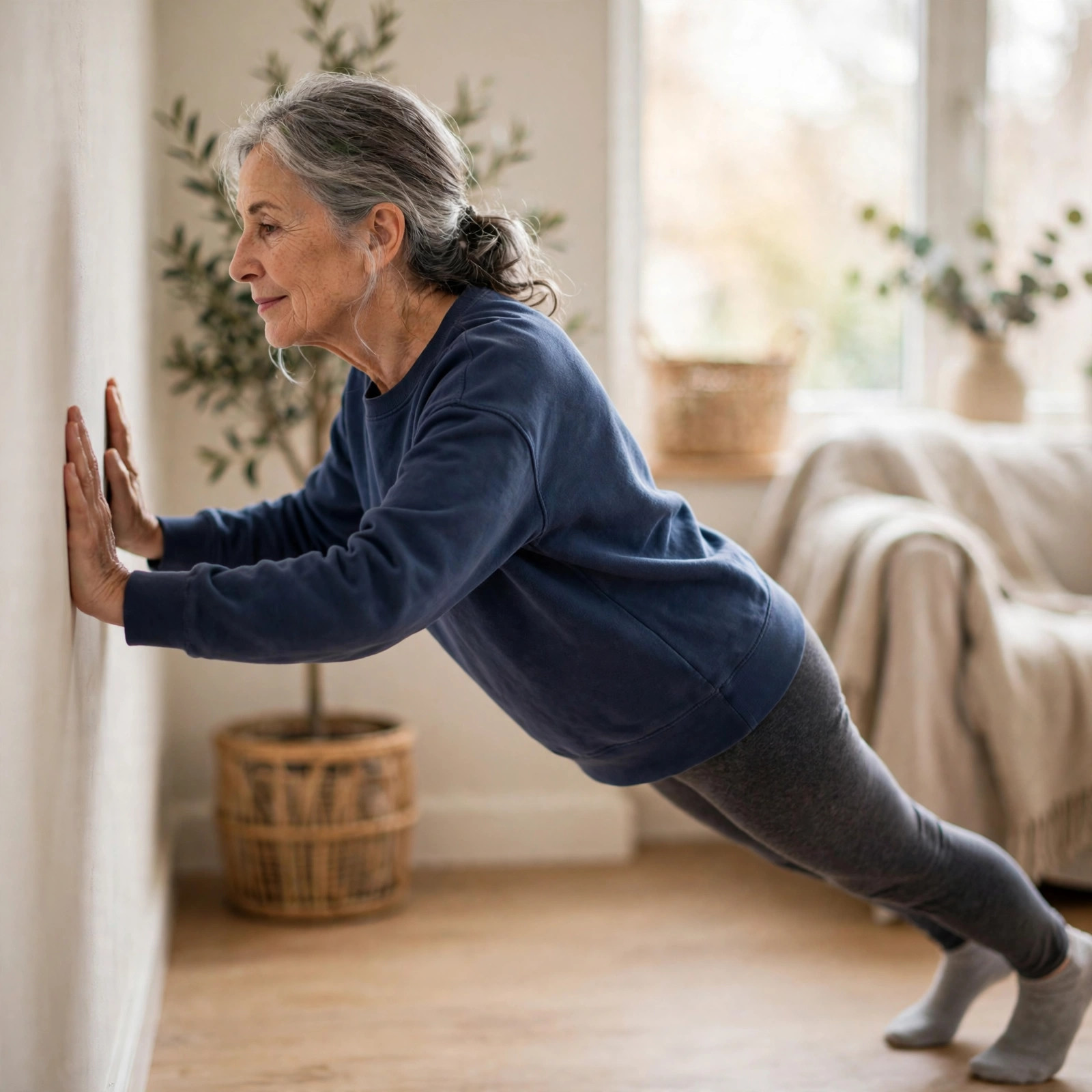
Chest, shoulders, triceps
Stand an arm’s length from a wall, hands flat against it at shoulder height. Bend your elbows and lean in until your chest nearly touches the wall, keeping your body straight from head to heels. Push back. Harder: step your feet a little farther from the wall.
3. Bent-over row
Back, biceps, posture muscles
Hold a light dumbbell in each hand, knees slightly bent, and hinge forward at the hips until your back is nearly flat. Let the weights hang, then pull your elbows toward your ribs, squeezing your shoulder blades together. Lower slowly. Keep your neck in line with your spine — look at the floor a few feet ahead, not forward.
4. Overhead press

Shoulders, triceps
Stand or sit tall, dumbbells at shoulder height, palms facing forward. Press straight up until your arms are nearly extended, then lower slowly. Brace your stomach lightly and avoid arching your lower back. Easier: do it seated in the sturdy chair.
5. Bicep curl
Front of the upper arms
Stand tall, dumbbells at your sides, palms facing forward. Keeping your elbows pinned lightly against your ribs, curl the weights toward your shoulders, then lower slowly all the way down. If you have to swing the weights up, they are too heavy.
6. Light dumbbell deadlift (hip hinge)
Glutes, hamstrings, lower back
Hold a dumbbell in each hand in front of your thighs. With soft knees and a flat back, push your hips back and slide the weights down your thighs until you feel a gentle stretch in the back of your thighs (usually around knee level). Squeeze your glutes to stand tall. Skip this one if you have active lower-back pain or a spinal condition — ask your doctor about alternatives.
7. Standing calf raise
Calves — the muscles that power walking and stairs
Stand behind your chair, fingertips on it for balance. Rise slowly onto the balls of your feet, pause a second, and lower with control. Hold a light dumbbell in each hand once the bodyweight version feels easy. Strong calves support walking speed and balance, both linked to staying independent.
8. Seated leg lift
Quadriceps, hip flexors — the muscles that get you out of a chair
Sit tall, feet flat on the floor. Slowly straighten one leg until it is parallel to the floor, pause, and lower. Alternate legs. This is the gentlest exercise in the routine and a good finisher.
Your weekly schedule
The major guidelines agree on the shape of a beginner plan:
- 2–3 sessions per week, on non-consecutive days. The CDC recommends muscle-strengthening activities on at least 2 days a week for adults 65 and older, and the NIA gives the same guidance. Muscles adapt during rest, not during the workout — so the rest days are part of the program.
- 1–2 sets of 8–12 repetitions per exercise. The CDC advises working to the point where another rep would be difficult: one set counts, and two or three sets may bring more benefit as you get fitter.
- Cover the major muscle groups each session — legs, back, chest, shoulders, and arms, which this routine does.
A sample week: Monday the full routine (about 30 minutes), Wednesday the full routine, Friday the full routine — or an easy walk instead, especially in the first month. Two days is completely fine if three feels like too much; the guidelines put the minimum at two.
Form cues and breathing
Two rules cover most of strength training:
- Move slowly and stay controlled. Count two seconds for the lift, three for the lowering. Slow reps are the point — momentum is a shortcut your muscles do not get to use.
- Exhale on the effort, inhale on the return. The one thing to avoid is holding your breath while straining, which can spike blood pressure.
Also: keep joints “soft” rather than locked at the end of a movement, and stop any exercise if your form breaks down. Ten good repetitions beat twelve sloppy ones.
Progression: getting stronger over time
Within a few weeks the routine will feel easier — that is your signal to make it a little harder, gradually and one change at a time:
- Add repetitions until you can do 12 of everything comfortably.
- Add a second set — the biggest jump in challenge, so give it a week to settle.
- Add a little weight — 1 lb at a time is plenty. The NIA notes that gradual increases in weight, sets, repetitions, or days per week are what build stronger muscles.
- Shorten rest between exercises from 60 seconds toward 30.
Soreness for a day after a harder session is normal; sharp pain is not. If you outgrow this routine after two or three months, consider resistance bands, a community center strength class, or a session with a certified trainer to check your form.
When to see a doctor
Strength training is a health habit, not a treatment. See a clinician promptly if you feel chest pain or pressure during or after exercise, feel dizzy or faint during a light session, have a joint that stays swollen or painful for more than a couple of days after exercising, or have a condition such as osteoporosis, a joint replacement, or a heart condition and are unsure which exercises are safe for you. A physical therapist can also check your form if you are returning to exercise after an injury or a long break.
The bottom line
After 60, strength training is less about physique and more about protecting the everyday: standing up, carrying, climbing, balancing. Two to three short sessions a week with light weights at home cover that need, and the evidence is clear that it is never too late to start. Begin light, move slowly, breathe steadily — and let the rest days do their quiet work.
Sources
- National Institute on Aging, “Three Types of Exercise Can Improve Your Health and Physical Ability” — https://www.nia.nih.gov/health/exercise-and-physical-activity/three-types-exercise-can-improve-your-health-and-physical
- Centers for Disease Control and Prevention, “Physical Activity Guidelines for Americans” (older adults: muscle-strengthening activities at least 2 days a week; 8–12 repetitions per set) — https://www.cdc.gov/physical-activity-basics/guidelines/
- Mayo Clinic News Network, “Stay Active to Slow Muscle Loss That Comes with Aging” (sarcopenia; strengthening exercises twice a week, 8–10 repetitions, 48 hours of recovery) — https://newsnetwork.mayoclinic.org/discussion/stay-active-to-slow-muscle-loss-that-comes-with-aging/
- National Health Service (UK), “How to improve your strength and flexibility” (muscle-strengthening activities on at least 2 days a week) — https://www.nhs.uk/live-well/exercise/how-to-improve-strength-flexibility/
This article is for general information only and is not medical advice. Talk to your doctor or a qualified health professional before starting a new exercise routine, especially if you have a health condition or take regular medication.