
A Gentle Stretching Routine After 60: Flexibility Without Strain
If the first steps of the morning feel stiffer than they used to, you are not alone. Joints and muscles lose some give with age, and a night of inactivity leaves everything tight. But flexibility responds to regular, gentle use: a short routine a few times a week may help you move more freely and start the day less stiff.
This is not a workout or a flexibility contest: just a calm, 10-minute sequence at home, mostly seated or standing with a sturdy chair nearby. No special poses, no equipment. Move each major area gently, breathe normally, and stop well before anything hurts.
Why stretching matters after 60
Flexibility supports everyday movements independence depends on: turning to check traffic, reaching a high shelf, getting up from a low chair, and walking with a comfortable stride. When these stiffen, people often avoid them — which, over time, can make stiffness worse.
Stretching sits alongside, not instead of, other movement that matters after 60. The U.S. Centers for Disease Control and Prevention (CDC) advises adults 65 and older to build a week around aerobic activity, muscle-strengthening on at least two days, and balance activity. Stretching fits naturally into that mix, for example after a short walk — see our guide to staying active after 60.
Keep expectations honest: stretching may help you feel looser, but it does not rebuild a worn joint or undo years of inactivity in a week. Progress is gradual — a little more ease this month than last — but worth having, since these are movements you use every day.
The ground rules: hold, don’t bounce
These rules, drawn from guidance by the American College of Sports Medicine (ACSM), Mayo Clinic, and the NHS, apply to every stretch below.
Warm up first. Never stretch cold muscles straight out of bed. Walk around the house or march gently in place for about five minutes first.
Hold, don’t bounce. Move slowly into each stretch until you feel a gentle pull, then hold still. Bouncing can tighten the muscle and may cause a strain. Mayo Clinic’s general guidance is to hold each stretch for about 30 seconds. ACSM guidance is similar: hold 15 to 30 seconds, repeated two to four times, with older adults sometimes benefiting from 30 to 60 seconds. For this routine, aim for about 30 seconds per stretch, once or twice per side.
Aim for gentle tension, not pain. A stretch should feel like a mild pull. Sharp pain or pinching means ease off at once. If you must hold your breath or grit your teeth, you have gone too far.
Breathe normally. Breathe slowly as you hold each stretch, exhaling as you ease into position. Holding your breath tightens muscles.
Keep both sides even. Stretch left and right, even if one side feels tighter, and give each side the same time.
How often? ACSM suggests flexibility exercise on at least two to three days a week; daily is fine too if it feels good. Start with three days a week.
The 10-minute morning sequence
Work through the stretches in order, from head to toe. Keep a sturdy chair nearby — not a wheeled office chair — for balance or seated stretches. If any stretch does not suit you, skip it; the routine still works without it.
1. Neck: slow turns and gentle tilts
Sit tall, feet flat on the floor, shoulders relaxed. Turn your head right as far as is comfortable, hold about 30 seconds, return to center, and repeat left. Then tilt your right ear gently toward your right shoulder — without lifting the shoulder — hold about 30 seconds, and repeat left. Keep movements slow and small: never roll your head in full circles, force it backward, or pull on it. If you feel dizzy, stop and sit quietly until it passes.
2. Shoulders: rolls and a chest opener

Roll your shoulders slowly up, back, down, and forward: five circles one way, then five the other.
Then, for the chest: stand beside a wall, forearm against it at about shoulder height, and turn your body gently away until you feel a mild stretch across the chest. Hold about 30 seconds, then switch sides. If standing feels unsteady, sit tall instead, clasp your hands behind your back if you comfortably can, and draw your shoulder blades together for about 30 seconds.
3. Back: a seated twist and a gentle arch

Sit on the front half of your chair, feet flat on the floor. Place your left hand on your right knee and your right hand on the chair behind you, then turn gently right, hips facing forward, chin level. Hold about 30 seconds and repeat on the other side.
For the lower back, try a gentle seated arch: sit tall, hands on hips, and arch your upper back very slightly — a small movement, not a deep bend. Hold a few seconds, return upright, and repeat three or four times. Avoid deep forward bends from standing, especially with osteoporosis or back problems.
4. Hips: the seated figure-four
Tight hips make walking, stairs, and getting in and out of a car harder than needed. Sit with feet flat on the floor, cross your right ankle over your left knee with the foot flexed, and sit tall. You should feel a gentle stretch deep in the right hip and buttock. If comfortable, lean forward very slightly from the hips — not by rounding your back. Hold about 30 seconds, then switch sides. If crossing your leg is difficult, rest the ankle on the shin instead.
5. Calves: a wall stretch
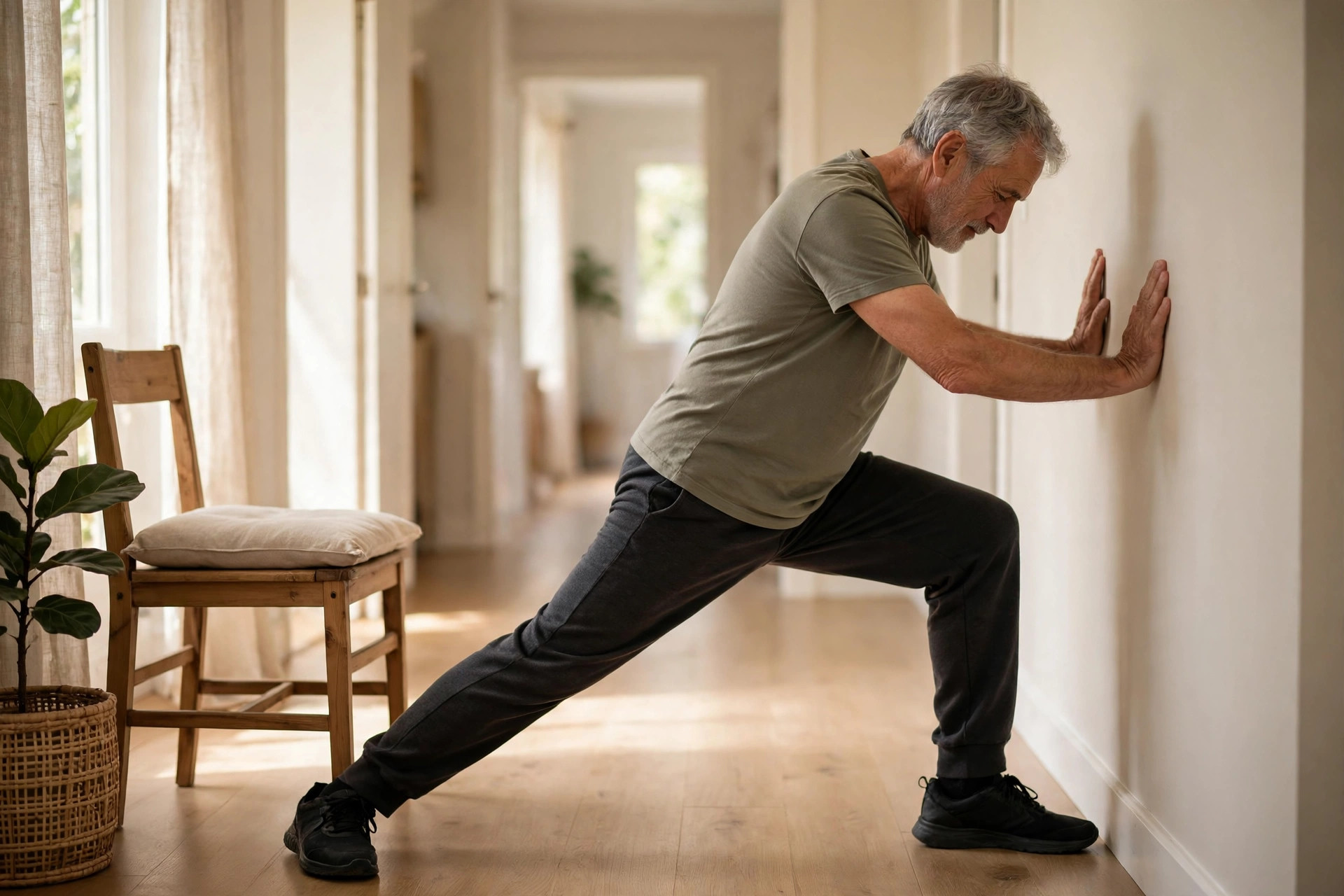
Stand facing a wall, hands flat against it at shoulder height. Step your right foot back, heel on the floor and knee straight, and lean gently forward until you feel a stretch in the back of the calf. Hold about 30 seconds, then switch legs. Keep the chair within reach, and take small steps — a big lunge can strain the calf. With calf pain, swelling, or a recent leg injury, skip this and ask your clinician first.
6. Ankles: circles and flexes
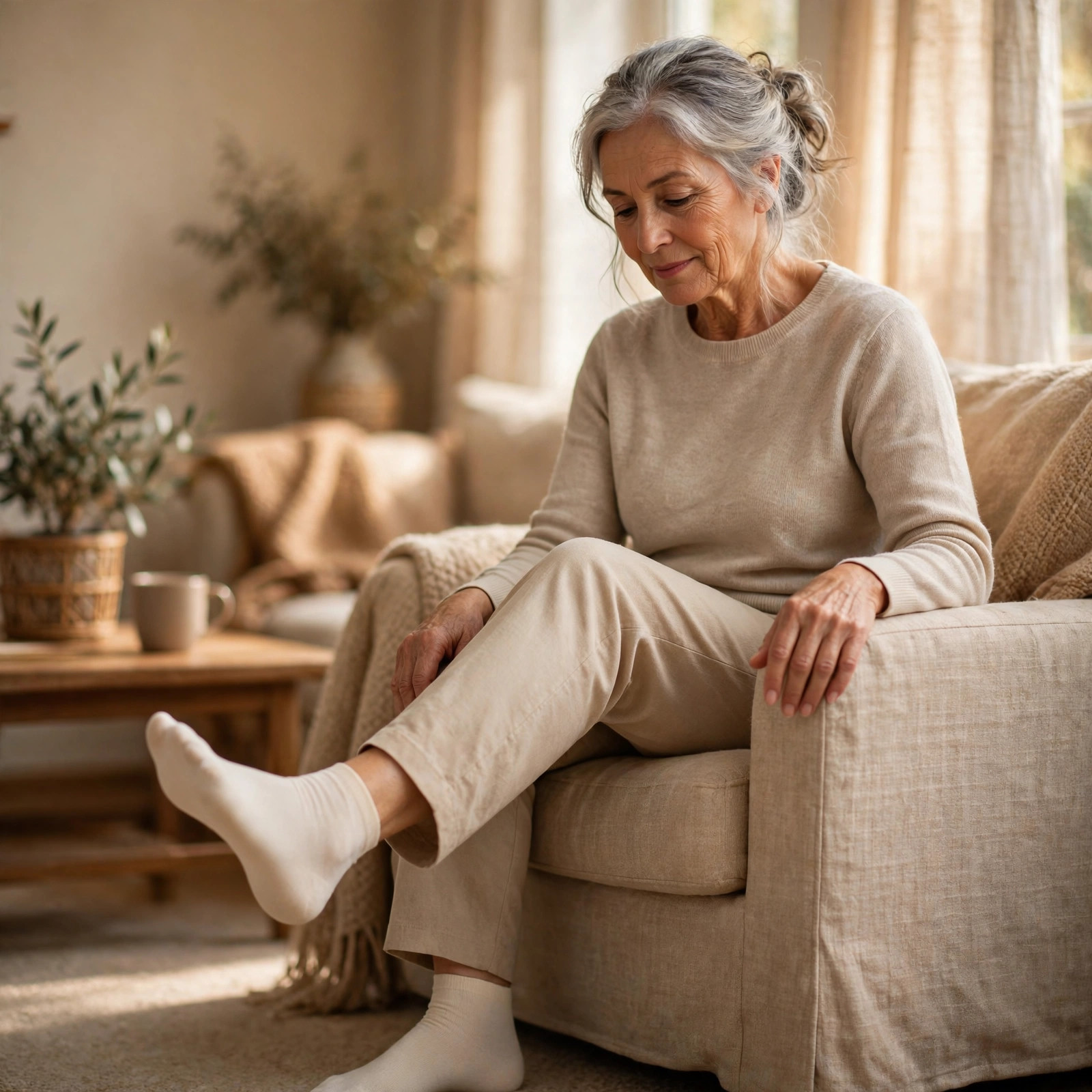
Sit and lift one foot slightly off the floor. Circle the ankle slowly five times one way, then five times the other. Then point your toes away from you, hold a few seconds, and pull them back toward your shin. Repeat with the other foot. Ankle flexibility affects balance and how easily you manage curbs and uneven ground — see our guide to balance exercises to prevent falls.
Chair-supported options for the whole routine
Almost every stretch above can be done entirely from a chair, which suits anyone for whom standing is difficult or balance is a worry. The neck, shoulder, back, hip, and ankle stretches are already seated. Adapt the calf stretch: sit with one leg extended forward, heel on the floor, and gently pull your toes toward you for about 30 seconds per side.
A chair-based routine is also a sensible starting point if you are new to regular movement; our 15-minute chair exercises for seniors cover a broader seated session. Use a firm chair with armrests if you need help standing, keep it on a non-slip surface, and wear shoes with grip.
What stretching is not
Stretching is not a treatment for arthritis, back disease, or any other condition, and it is not a substitute for strengthening or balance work. If your knees are sore, it may help you feel looser, but it will not address the underlying cause — see our guide to low-impact exercises for bad knees.
Stretching is also distinct from yoga. Yoga can be a good activity, but this routine is plain stretching: no named poses or techniques to master. And stretching does not need to hurt to work: a mild, comfortable pull held about 30 seconds is the effective dose; pushing into pain is more likely to set you back.
Common mistakes to avoid
- Stretching cold. Do not stretch the moment you get out of bed, when muscles are stiffest. Move around for five minutes first.
- Bouncing. Quick, jerky movements trigger a reflex that tightens the muscle. Smooth and still wins every time.
- Holding your breath. If you have stopped breathing during a stretch, you are pushing too hard. Ease off and breathe.
- Only stretching the tight side. Skipping the other side can leave you uneven. Give both sides equal time.
- Doing too much too soon. Start with one round of each stretch and shorter holds, adding a second round after a week or two if all feels fine.
- Stretching through pain. Soreness the day after new activity is one thing; sharp pain during a stretch is a stop signal, not a challenge.
Fitting it into your day
The sequence takes about 10 minutes. A short evening session — just neck, shoulders, and hips — can ease stiffness built up after a day of sitting, and stretching after a walk, when muscles are already warm, is ideal. Attach it to something you already do, such as after your morning walk. Three gentle sessions a week beat one long session followed by a week off.
When to see a doctor
Stretching is gentle, but some symptoms deserve medical attention rather than a home routine. Stop stretching and contact your clinician promptly if you notice:
- Sharp, stabbing, or shooting pain during or after stretching, especially pain travelling down an arm or leg
- Numbness, tingling, or weakness in your hands, feet, arms, or legs
- Dizziness, lightheadedness, or feeling faint during stretching
- Swelling, redness, or warmth in a joint or calf, or a calf painful to touch
- Pain that does not settle within a day or two, or that keeps getting worse
- A recent injury, surgery, or joint replacement — ask your clinician or physical therapist which stretches are safe before starting
Talk to your doctor before starting if you have osteoporosis, a history of fractures, a spinal or neurological condition, or anything affecting balance or sensation; a physical therapist can adapt the routine. This matters most if you take blood-thinning medication or have reduced sensation in your feet.
The bottom line
A gentle stretching routine after 60 need not be long, complicated, or uncomfortable. Warm up for five minutes, move slowly into each stretch, hold about 30 seconds, breathe normally, and stop before pain. Cover neck, shoulders, back, hips, calves, and ankles, use a chair whenever it helps, and repeat two or three times a week — daily if it feels good.
Sources
- U.S. Centers for Disease Control and Prevention, “Older Adults: Adding Activity Recommendations” — https://www.cdc.gov/physical-activity-basics/adding-older-adults/index.html
- U.S. Centers for Disease Control and Prevention, “What Counts as Physical Activity for Older Adults” — https://www.cdc.gov/physical-activity-basics/adding-older-adults/what-counts.html
- American College of Sports Medicine, ACSM’s Guidelines for Exercise Testing and Prescription — flexibility guidance: hold each stretch 15–30 seconds, repeat 2–4 times, at least 2–3 days per week; older adults may benefit from 30–60 second holds
- Mayo Clinic, “Stretching: Focus on flexibility” — warm up first, move smoothly without bouncing, hold each stretch for about 30 seconds, stretch to tension rather than pain
- NHS, “Strength and flexibility exercises” guidance for older adults — strength, balance, and flexibility activities on at least 2 days a week
This article is for general information only and is not medical advice. Talk to your doctor before starting a new exercise program.