
Walking With a Weighted Vest After 60: Safe or Risky?
Scroll through any fitness feed and you will see it: walkers in their 50s, 60s, and beyond strapping on weighted vests and calling it the simplest workout upgrade there is. The idea is appealing. You already walk — add a little weight, and every step works a bit harder. No gym, no new skills, no jumping.
But after 60, “a little extra” lands differently on knees, backs, hearts, and balance. A weighted vest can be a useful tool for some older walkers, and a poor choice for others. The difference usually comes down to three things: how much weight you start with, what health conditions you carry, and whether you listen to the warning signs early enough.
Why walkers over 60 are trying weighted vests
Walking is already one of the best exercises for older adults: weight-bearing, low-impact, and easy to sustain. Adding a vest increases the load on muscles and bones with every step, without changing the movement itself — helpful because muscle strength and bone density both decline with age.
A vest keeps weight close to your center of gravity — more comfortable than hand weights or a loaded backpack, with arms free and posture natural. For walkers who find ordinary strolling too easy but do not want to run or join a gym, it can feel like a natural next step.
Still, “natural” does not mean risk-free. Extra weight means extra force through knees, hips, ankles, and spine on every step — thousands of times per walk.
The short answer: safe for many, not for everyone
For a healthy, regular walker with no major joint, heart, or balance problems, a light vest is a reasonable way to add intensity. For people with certain conditions, it is something to discuss with a clinician first — or skip. Think of it as a dosing question: a gentle challenge at a light weight can become a joint problem at a heavy one.
Who should get clinician clearance first
Talk to your doctor or physical therapist before trying a weighted vest if any of these apply:
- Osteoporosis or a history of fractures. Extra spinal loading is exactly what you want to be careful with here; people with thinning bones or past vertebral fractures should not add load without professional guidance.
- Heart disease, high blood pressure, or a history of arrhythmia. Even a light vest raises heart rate and blood pressure during a walk. If your cardiovascular system is already working hard, that extra demand deserves a clinician’s view first.
- Balance problems or a history of falls. Added weight shifts your center of gravity and changes how you recover from a stumble.
- Joint replacements, advanced arthritis, or chronic knee, hip, or back pain. Extra load goes straight through these joints and may aggravate pain that ordinary walking does not.
- Neuropathy or reduced sensation in the feet. If you cannot feel your feet well, you may miss early warning signs of strain or an altered gait.
Start light: around 5% of your body weight
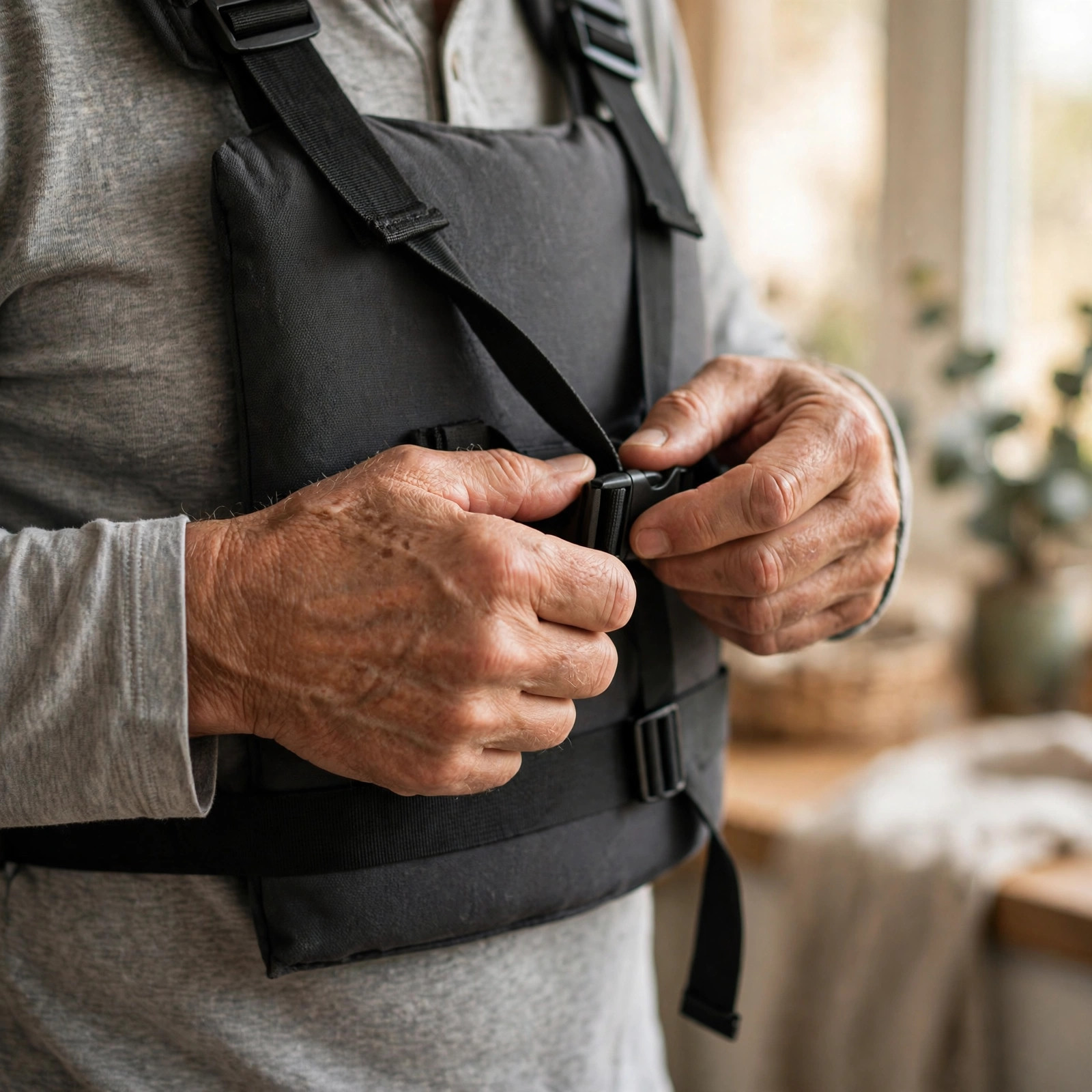
Major medical centers most often suggest starting at about 5% of your body weight. For a 160-pound person, that is roughly 8 pounds; for a 140-pound person, about 7 pounds. Some guidance suggests starting even lighter — around 3% — if you are new to exercise, over 65, or returning after a break. Treat 10% of body weight as a sensible ceiling for walking, not a target to chase.
A few practical points make this easier:
- Choose an adjustable vest. Vests with small removable weight inserts let you start light and add weight gradually. Fixed-weight vests can force you to start heavier than planned — a 20-pound fixed vest is about 14% of body weight for a 140-pound walker, too much for a first outing.
- Fit matters as much as weight. The vest should sit snug against your torso without bouncing or shifting. A loose vest that swings throws off your balance and concentrates force unevenly.
- Start with a short, flat walk. Try 10 to 15 minutes on level ground for your first few outings, at your normal pace. Short and easy tells you how your joints and back respond.
- Keep your normal pace — if you slow dramatically, lean forward, or shorten your stride, the weight is too much for now.
Warning signs: when to stop and take the vest off
Stop, remove the vest, and rest if you notice any of these:
- Sharp joint pain in the knees, hips, ankles, or feet — especially pain that changes how you walk
- Back pain that is new, sharp, or worse than your usual aches
- Chest discomfort, unusual breathlessness, dizziness, or palpitations
- Joint swelling during or after the walk
- Numbness, tingling, or weakness in the legs or feet
- A feeling of unsteadiness or near-stumbles you would not normally have
Muscle soreness the next day is expected; pain in a joint, your back, or your chest is a signal. If a symptom is new, sharp, or does not settle within a day or two, get it checked rather than walking through it — and if the same problem keeps returning at a given weight, drop back down or stop and talk to your clinician.
How to progress gradually

Patience is the whole method. A sensible progression looks like this:
- Weeks 1–2: Walk 10–15 minutes on flat ground, a few times a week, at your starting weight. Focus on posture: stand tall, look ahead, let your arms swing naturally.
- Weeks 3–4: If you have no warning signs, extend the walk toward your usual duration before adding any weight. Time first, load second.
- After a month: Add weight only in small steps — a pound or two at a time — and hold each new weight for at least a week or two. If any warning sign appears, drop back to the previous weight.
- Ongoing: Keep most vest walks on flat or gently rolling ground; hills multiply the load on knees and heart, so save them for later.
The CDC recommends that adults 65 and older aim for at least 150 minutes of moderate-intensity aerobic activity per week, plus muscle-strengthening activity on at least 2 days and activities that improve balance. A weighted vest walk can count toward the aerobic part, but it does not replace dedicated strength or balance work. If you are already staying active after 60, think of the vest as seasoning on a routine you already have. Our guides to balance exercises to prevent falls and strength training at home after 60 cover the other two pieces.
Footwear and surface tips
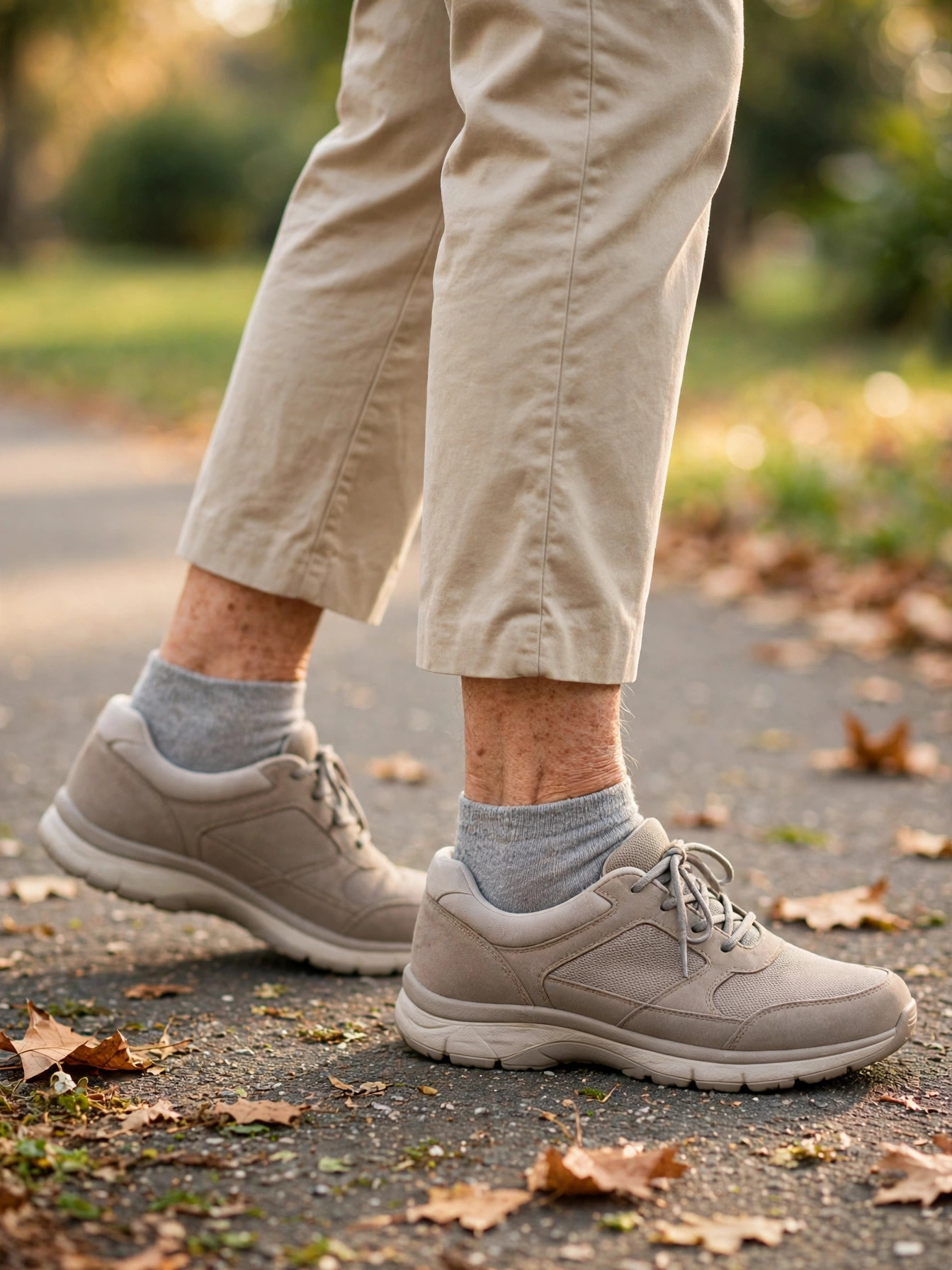
The vest gets the attention, but your feet do the work:
- Wear supportive walking shoes with good cushioning and a stable base. This is not the walk for worn-out sneakers or flat, unsupportive shoes.
- Choose smooth, even surfaces first. Paved paths, tracks, and level sidewalks are ideal starting terrain. Uneven trails and wet leaves add trip risk that a vest makes harder to recover from.
- Avoid steep hills early on. Downhill walking with extra weight is especially hard on knees. Build up on the flat before testing slopes.
- Walk in daylight and watch your footing. Added weight slows your reactions slightly, so give yourself the best conditions: good light and clear paths.
- Check your feet afterward — extra load can cause hot spots and blisters, especially at first.
What the evidence does and does not show
Honesty matters here. The research on weighted vests in older adults is promising but limited. Small studies have linked light vest walking to longer strides and greater leg-muscle activation, and weight-bearing activity in general is associated with better bone and muscle maintenance. But there is no large, long-term trial proving that weighted-vest walking prevents fractures or builds lasting bone density in older adults. Most enthusiastic claims online run well ahead of the evidence.
That does not make the vest useless — it makes it a careful experiment for the right person, not a proven intervention. Dedicated strength work has stronger evidence for leg strength, and a mix of walking, strength, and balance work is the better-supported package for bone health. The vest can sit inside that package, not replace it.
Common mistakes to avoid
- Starting with a vest that is too heavy — the most common error, and the one most likely to cause joint or back pain in the first week.
- Wearing the vest every day from the start. Give your body rest days, especially early on. Two to three vest walks a week is plenty to begin with.
- Wearing it for chores or all day. A vest worn for hours adds fatigue and joint load without the controlled conditions of a walk.
- Ignoring posture. Leaning forward under the load strains the lower back. If you cannot stay upright, the weight is too heavy.
- Treating the vest as a substitute for strength training. Walking with weight loads the legs, but it does not replace targeted strengthening for hips, core, and upper body.

When to see a doctor
See your clinician promptly if you experience chest pain or pressure, severe breathlessness, dizziness, or palpitations during or after a vest walk — treat these as urgent, not as something to walk off. Book an appointment soon if you notice persistent joint pain or swelling, back pain that lingers more than a few days, repeated unsteadiness, numbness or tingling in your legs or feet, or any symptom that keeps returning whenever you wear the vest. Also check in before you start if you have osteoporosis, heart disease, uncontrolled blood pressure, a joint replacement, a history of falls, or any condition affecting balance or circulation — and if ordinary walking has become painful, get that explained before adding load.
The bottom line
Walking with a weighted vest after 60 can be a safe, useful way to make a good habit a little more demanding — if you start light, progress slowly, wear a well-fitted vest, and respect the warning signs. It is not for everyone: people with osteoporosis, heart disease, balance problems, or painful joints should get clearance first, and some should skip it entirely.
The safest way to try it is boring on purpose: a light vest, a short flat walk, a few times a week. If it feels good and your joints stay quiet, build from there. If it does not, plain walking — done regularly, briskly, and for enough minutes each week — remains one of the best exercises there is. The vest is optional. The walk is not.
Sources
- Centers for Disease Control and Prevention, “Physical Activity Basics: Older Adults” — https://www.cdc.gov/physical-activity-basics/guidelines/older-adults.html
- Centers for Disease Control and Prevention, “Adding Physical Activity as an Adult” — https://www.cdc.gov/physical-activity-basics/adding-adults/index.html
- National Institutes of Health (PMC), “Exercise Early and Often: Effects of Physical Activity and Exercise on Women’s Bone Health” — https://pmc.ncbi.nlm.nih.gov/articles/PMC5981917/
- Mayo Clinic Health System, “5 tips to walk for better health” — https://www.mayoclinichealthsystem.org/hometown-health/speaking-of-health/5-tips-for-walking-your-way-to-better-health
- Harvard Health Publishing, guidance on weighted vests for walking (start-low approach; around 10% of body weight cited as an upper guide) — Harvard Health Publishing
- Cleveland Clinic, guidance on walking and weight-bearing exercise for bone and heart health — Cleveland Clinic Health Essentials
This article is for general information only and is not medical advice. Talk to your doctor before starting a new exercise program.