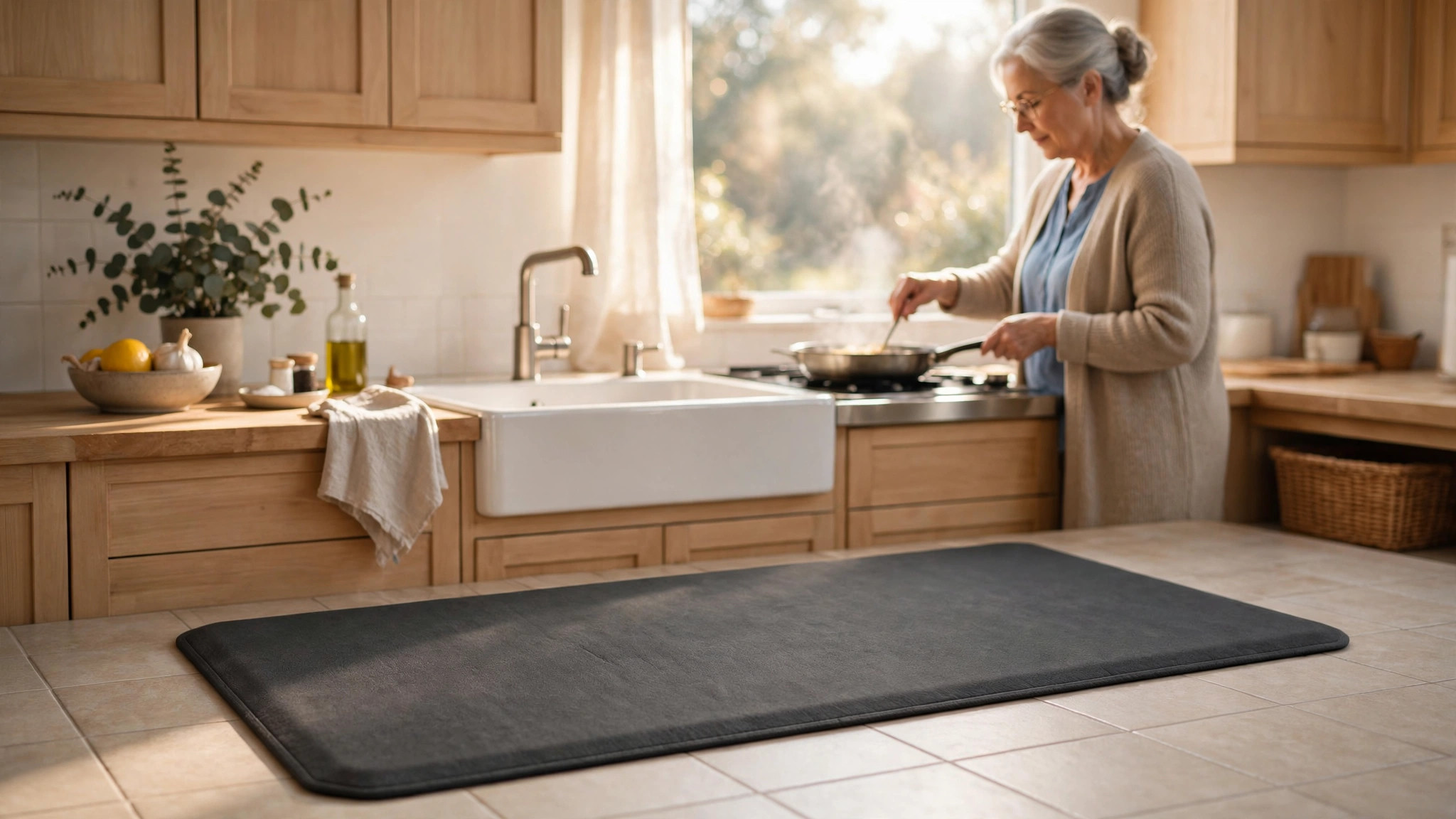
Best Anti-Fatigue Kitchen Mats for Seniors: Comfort Without the Trip Risk
If an hour of cooking leaves you with aching feet, stiff knees, or a sore lower back, the culprit is usually the floor: standing on hard tile, wood, or laminate for long stretches is tough on joints, and it only gets tougher with age. Anti-fatigue kitchen mats were made for exactly this — a cushioned pad that takes pressure off your feet, legs, and back.
But here is what most buyers over 60 miss: the wrong mat can make your kitchen more dangerous, not less. A mat that slides, curls at the corners, or sits like a small cliff at its border is a trip hazard — and falls are no small matter. The CDC reports that more than 1 in 4 adults aged 65 and older falls each year, and falls are a leading cause of injury for that age group.
This is a safety-first buying guide: what to look for, what to avoid, and how to choose a mat that cushions your joints without adding risk to your floors.
Why hard floors hurt more after 45

Three age-related changes make kitchen standing sessions more punishing:
- Foot padding thins. The natural fat pad on the soles of the feet gradually gets thinner, so hard floors feel harder than they used to.
- Joint cartilage wears down. Many adults over 60 have some degree of osteoarthritis, especially in the knees — and standing still loads those joints continuously.
- Balance becomes less automatic. Mayo Clinic notes that age-related physical changes make falls more likely — every home trip hazard deserves a second look.
An anti-fatigue mat gives your feet a slightly softer surface — the subtle give encourages tiny, unconscious posture shifts that may reduce stiffness versus bare hard flooring. No mat will erase arthritis or a long day’s strain, but a well-chosen one may help you cook longer with less discomfort.
The safety paradox: comfort mats can be trip hazards
The CDC counts clutter, loose rugs, and anything that can be tripped over among modifiable fall risk factors. A mat is, by definition, a raised object in a walkway — so its safety design matters at least as much as its comfort design.
For adults over 60, every mat must pass three non-negotiable tests:
- It must not move. A mat that slides underfoot is worse than no mat at all.
- Its edges must not catch a toe. Raised, curled, or abrupt edges are exactly how trips start.
- It must not wobble. A mat that is too soft or too tall can feel unsteady — bad news if your balance is already fragile.
Keep those three rules in mind as we go through the features.
7 features that make a kitchen mat safe for seniors
1. A genuine non-slip backing
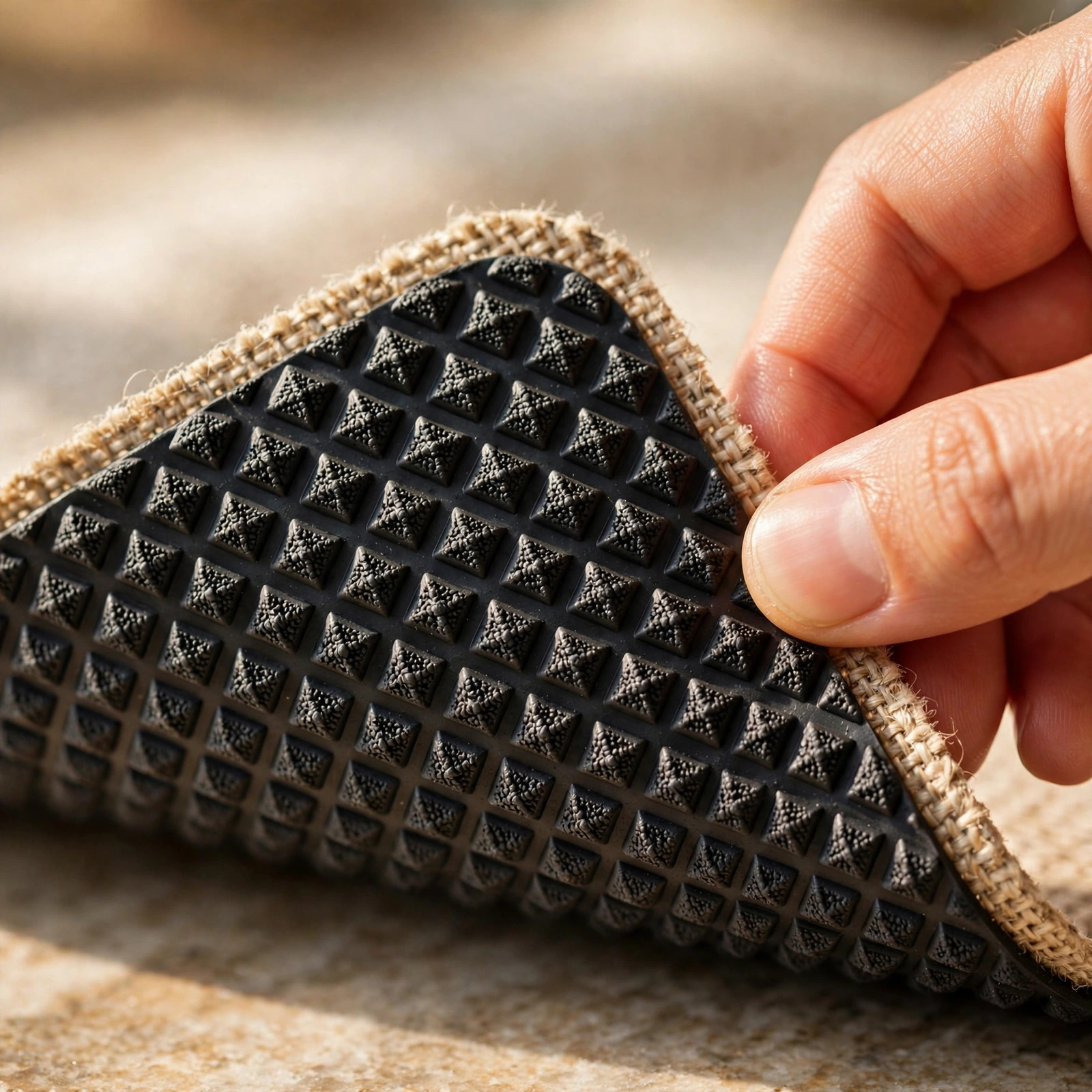
This is the single most important feature. Look for a textured rubber or rubberized PVC backing that grips the floor — not just a smooth foam bottom. The mat should stay put when you step on and off it or pivot at the counter. Note: backing grips best on clean, dry floors, so keep the area spill-free and re-test after a few weeks — grip can wear.
2. Beveled (tapered) edges
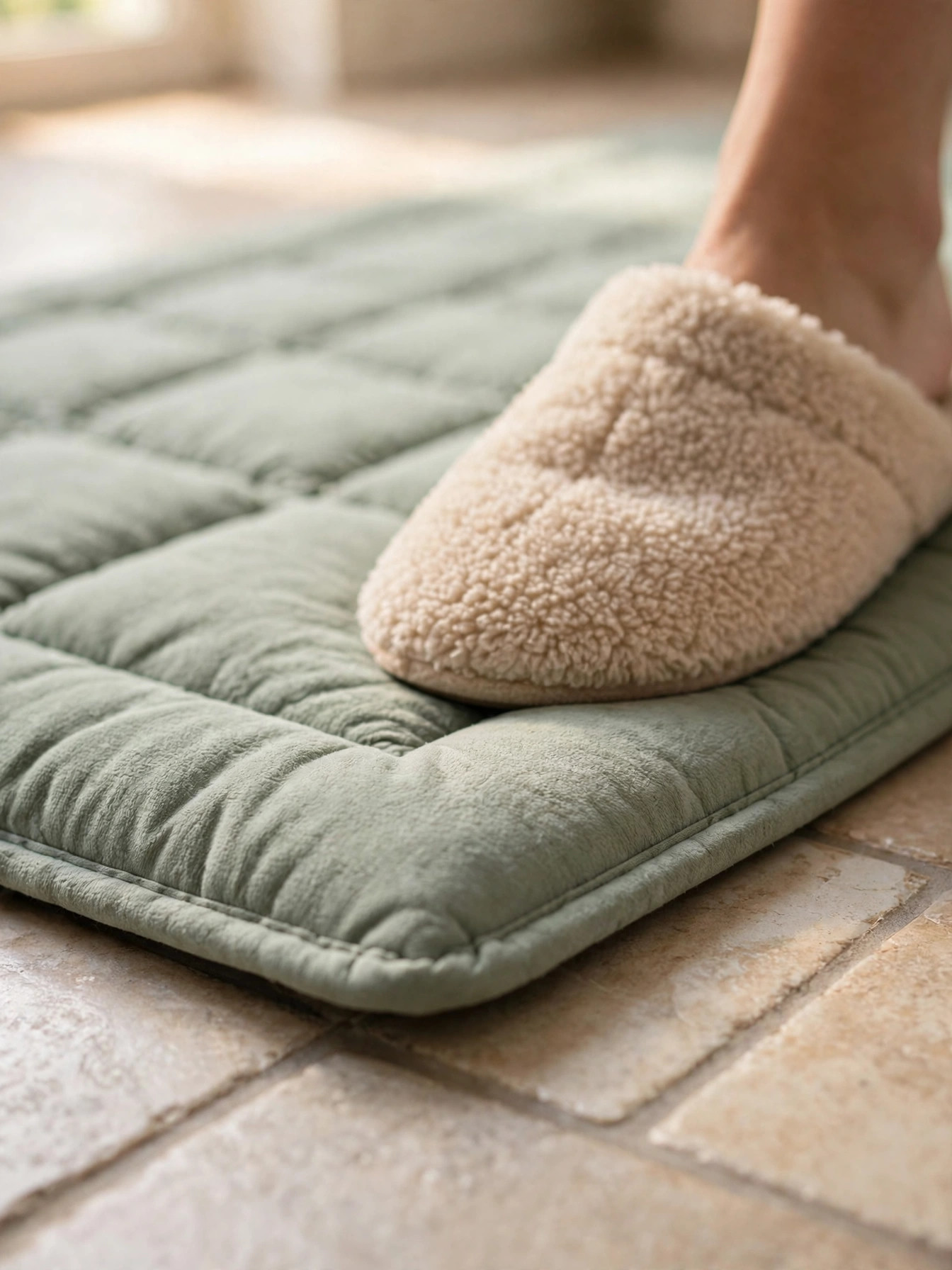
Beveled edges — borders that slope gently down to the floor — are the signature safety feature of a senior-friendly mat. A gradual slope lets your foot step onto the mat smoothly instead of catching on a raised lip, and it lets walkers and mobility aids roll over without snagging.
Avoid any mat with sharp, square-cut edges, and watch for curling over time: a mat whose edges lift loses its bevel and becomes a trip hazard. Prefer mats described as non-curling.
3. Thickness in the sweet spot: about ½ to 1 inch
The core trade-off: too thin and it barely cushions; too thick and it becomes a raised platform that raises trip risk, especially with shallow bevels. For home kitchens, roughly ½ inch to 1 inch (about 12–25 mm) is the sensible band, with ¾ inch a reasonable starting point. But thickness alone is a poor quality measure — see the next point.
4. High density beats high thickness
A thin-but-dense mat supports better than a thick-but-floppy one. Low-density foam feels soft at first, then “bottoms out” — it compresses flat under your weight within weeks, leaving you standing on a pancake with all the trip risk and none of the cushioning.
Judge density with the thumb test: press firmly into the mat. Good materials — high-density polyurethane foam, gel cores, dense rubber — spring back quickly. If the dent lingers or the mat feels squishy and slow to recover, it is likely low-density.
5. An easy-clean, waterproof surface
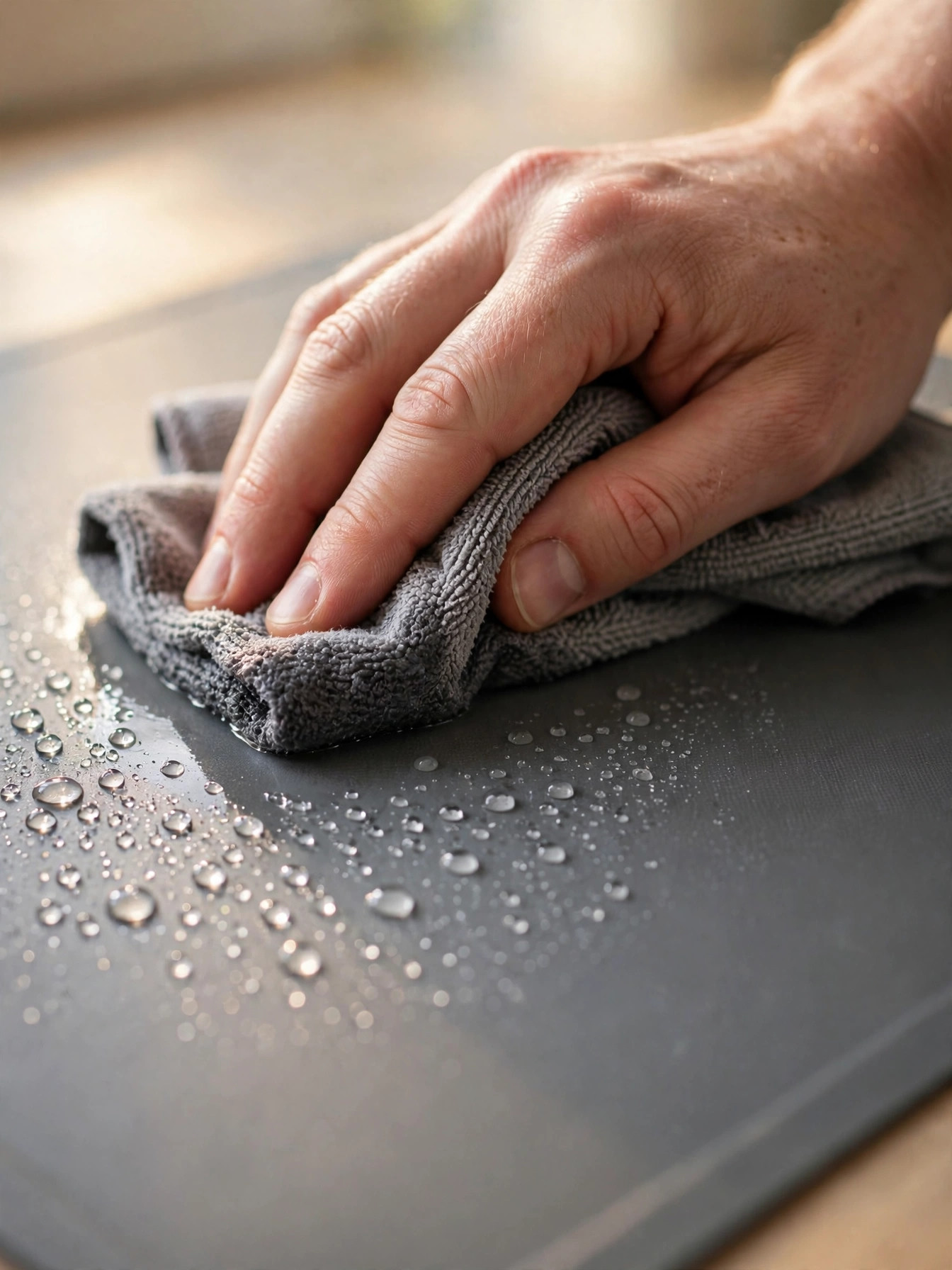
Water splashes, oil splatters, flour dust — kitchens get messy. A sealed, non-porous surface wipes down with a damp cloth and mild soap and does not absorb liquid. Absorbed moisture softens foam cores, creates odors, and makes the mat slippery on top.
For seniors, cleanability is also a safety issue: a mat you can’t easily clean becomes a mat you avoid cleaning, and dried grease on the surface is a slip risk. Favor smooth or lightly textured surfaces over deep grooves or fabric textures that trap crumbs and oil.
Also note odor: some inexpensive foam and PVC mats release a strong chemical smell when new. Air it out fully before use, and return it if the smell doesn’t fade within a few days.
6. The right size and placement
Measure before you buy. The mat belongs where you actually stand: in front of the sink, the stove, and the main prep counter. Roughly 18 × 48 inches covers a single sink station; about 20 × 72 inches suits longer runs, and a runner beats a small rectangle in galley kitchens.
Account for door swings, island carts, and walker routes — and never stack mats: double thickness means double trip risk.
7. It lies flat from day one — and stays flat
Prefer mats that ship flat, or confirm that a rolled mat will relax fully. Check again after a few months — any mat that develops curling edges, bubbles, or warping should be replaced, not taped down.
Materials at a glance
| Material | Pros for seniors | Watch out for |
|---|---|---|
| High-density foam | Good comfort-to-weight balance; wide size range | Low-density versions flatten fast — check density |
| Gel core | Strong pressure relief for long sessions | Heavier; usually pricier; needs beveled edges |
| Closed-cell polyurethane | Waterproof, resists stains and odors | Can feel firm to very sensitive feet |
| Rubber | Excellent grip; very durable | Heavy to lift for mopping; often thinner |
| PVC / vinyl blends | Waterproof and easy-clean | Quality varies — cheap versions smell and curl |
What matters is the combination: safe backing, beveled edges, sensible thickness, and honest density.
Quick red-flag checklist: what to avoid
- Sharp, square-cut edges or no mention of beveling
- A smooth, slippery bottom with no textured or rubberized backing
- Very soft, low-density foam that dents easily and recovers slowly
- Strong chemical odor out of the packaging
- Curling, bubbling, or warping after a few weeks of use
- Over about 1 inch thick with shallow edges — stepping on and off feels like a curb
Kitchen safety beyond the mat
A great mat is one piece of a fall-safer kitchen:
- Clean spills immediately. Liquid and grease are the enemy of every floor surface, mat or not.
- Wear sturdy, non-slip shoes. Mayo Clinic recommends properly fitting shoes with nonskid soles over stocking feet and worn-out slippers.
- Keep walkways clear. Cords, pet bowls, and clutter in traffic paths are modifiable hazards the CDC flags.
- Light it well. Trips happen in dim corners; keep cooking zones brightly lit.
- Store daily items within easy reach. Reaching or climbing for the oil bottle is a fall risk no mat can fix.
- Strengthen your balance. No mat replaces steady legs — see our guide to 10 balance exercises to prevent falls after 65 for simple at-home moves.
And if a fall has already happened, see our guide on what to do after a fall — how to assess the situation, get up safely if you can, and when to call for help.
Test your mat at home: the 5-minute check
Before the mat becomes a permanent fixture:
- Slide test: on a clean, dry floor, step on and off sharply and push it with your foot. It should barely budge.
- Toe test: walk onto the mat in socks at normal speed. Toes should glide up the bevel — nothing catches.
- Wobble test: stand in one spot for a minute. If you feel unsteady or sink unevenly, it’s too soft for you.
- Water test: splash a little water on the surface. It should bead and wipe off, not soak in or turn slick.
- Week-two check: inspect the edges again after two weeks. Curling or lifting? Return it while you can.
When to see a doctor
A kitchen mat is a comfort tool, not a treatment. See a clinician if you notice:
- Foot, knee, hip, or back pain that persists or worsens despite rest and comfort measures
- Tingling, numbness, or burning in the feet or legs
- Dizziness, unsteadiness, or a fall in the kitchen — even a “minor” one
- Faintness, chest discomfort, or shortness of breath during ordinary activity
- You take medications that cause dizziness, drowsiness, or low blood pressure
Falls are the leading cause of injury for older adults, and recurrent falls or balance problems deserve a proper medical review — balance, vision, medications, and home hazards are all things your care team can help you assess.
The bottom line
The best anti-fatigue kitchen mat for a senior is not the softest or the thickest — it is the one that cushions your feet and passes the safety test: genuine non-slip backing, beveled edges that toes can’t catch, thickness in the ½-to-1-inch range, dense material that springs back, and a waterproof surface you can wipe clean. Choose around those features, test it at home, and keep the kitchen fall-safe.
Sources
- Centers for Disease Control and Prevention, “Facts About Older Adult Falls” — https://www.cdc.gov/falls/facts.html
- Centers for Disease Control and Prevention, STEADI home safety and fall prevention resources — https://www.cdc.gov/steadi/patient-resources
- Mayo Clinic, “Fall prevention: Simple tips to prevent falls” — https://www.mayoclinic.org/healthy-lifestyle/healthy-aging/in-depth/fall-prevention/art-20047358
- National Institute on Aging, “Falls and fractures in older adults: Causes and prevention” — https://www.nia.nih.gov/health/falls-and-falls-prevention/falls-and-fractures-older-adults-causes-and-prevention
- NHS (UK), “Falls — Prevention” — https://www.nhs.uk/conditions/falls/
This article is for general information only and is not medical advice. Talk to your doctor about your personal health needs.