10 Balance Exercises to Prevent Falls After 65
Falling is one of the most common — and most feared — health events after 65. According to the CDC, about one in four Americans aged 65 and older falls each year, and falls are the leading cause of injury in that age group. The good news, and it is genuinely good news, is that balance is trainable. Research consistently shows that balance and functional exercises are linked to a lower rate of falls in older adults — this is not about athletic skill, it is about retraining the systems that keep you upright.
This guide gives you ten practical exercises, ordered from easiest to hardest. You need no special equipment: a sturdy chair or countertop, a clear patch of floor, and supportive shoes. If you can do the first three comfortably, you are ready for a routine that can genuinely change how steady you feel on your feet.
Why balance gets worse with age
Balance is not one sense — it is a team effort. Your inner ear (the vestibular system) senses head movement, your eyes tell your brain where your body is in space, and sensors in your muscles and joints (proprioception) report how your limbs are positioned. Your brain fuses all three signals and adjusts your muscles in real time.
With age, every part of that chain gets a little noisier:
- The vestibular system becomes less precise, so quick head turns — looking over your shoulder in the car, glancing up at a shelf — feel more disorienting.
- Vision changes (cataracts, slower adjustment between light and dark, weaker depth perception) reduce one of your brain’s main reference points.
- Proprioception fades, especially in the feet and ankles, so you get less accurate feedback about where the ground is.
- Leg muscle strength declines, and weaker muscles cannot correct a stumble as quickly.
- Some medications — including certain blood pressure drugs, sleep aids, and sedatives — list dizziness as a side effect.
None of this means falls are inevitable. It means balance deserves deliberate practice, the same way memory deserves reading and muscles deserve walking. And practice works at any age: studies of structured balance programs show measurable improvements even in people in their 80s.
Set up for safety first
Before your first session, get the environment right. Most falls during balance exercise happen because someone skipped the setup.
- Always have support within reach. A sturdy dining chair, a kitchen counter, or a wall should be an arm’s length away. “Within reach” means you can grab it instantly — not across the room.
- Wear supportive, closed-toe shoes. Skip socks on smooth floors, high heels, and floppy slippers. Lace-up or velcro walking shoes are ideal.
- Clear the floor. Move rugs, pet toys, and cords out of your exercise area. Do this every time, not just the first time.
- Use good light. Practice during the day or in a well-lit room; dim light makes balance noticeably harder.
- Skip the session if you feel off. Dizziness, unusual fatigue, chest discomfort, or feeling unwell after a medication change are all reasons to rest and talk to your doctor instead.
A final honest note that runs through this whole article: balance exercise may help reduce your risk of falling, but no exercise can guarantee you will never fall. The goal is to make you steadier, stronger at recovering, and more confident moving through your day.
The 10 exercises, easiest to hardest
Do these in order your first few times. For each exercise I give you a starting version and a progression — only move to the progression when the basic version feels easy and you can do it with relaxed hands, not a white-knuckle grip.
1. Side-to-side weight shifts
Stand with feet hip-width apart, hands resting lightly on a chair back. Slowly shift your weight onto your right foot until your left heel just starts to lift, pause two seconds, then shift to the left. That is one rep; do 10.
Progression: use only one fingertip on the chair, then no hands. Slow the shift down — slower is harder.
2. Heel-to-toe walk
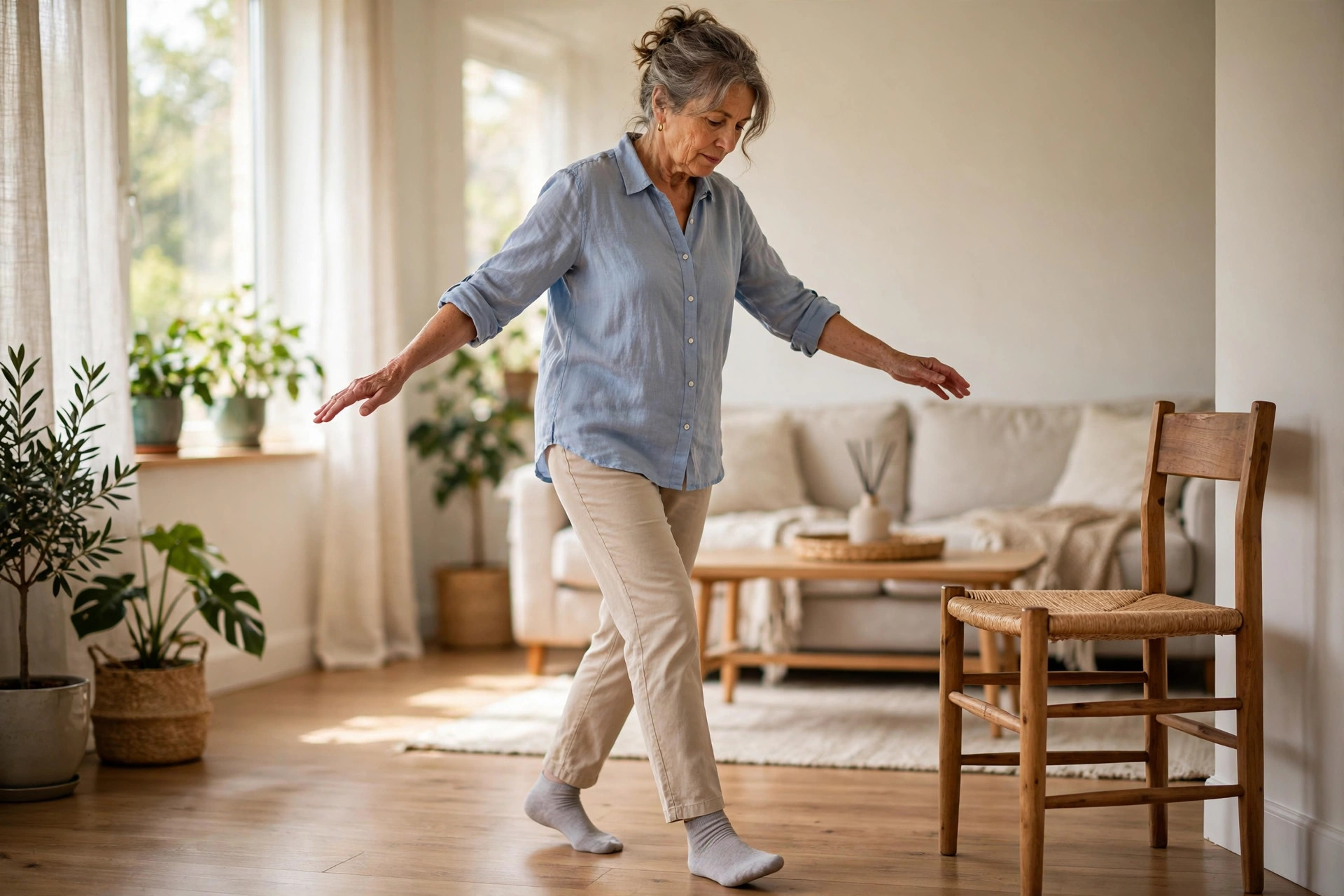
Stand tall near a wall (so you can touch it if needed). Walk forward in a straight line, placing the heel of each front foot directly against the toes of your back foot, like walking a tightrope. Take 10–20 steps, turn carefully, and walk back.
Progression: fold your arms across your chest, then try it backward for a few steps with a hand near the wall.
3. Single-leg stand

Stand behind a sturdy chair, both hands on the back. Lift one foot a few inches off the floor and hold for 10 seconds. Lower it, switch sides. Repeat 3 times per leg, resting as needed.
Progression: hold 20, then 30 seconds. Then one hand, then just fingertips. This single exercise is worth returning to for years — it is the backbone of most fall-prevention programs.
4. Heel raises
Stand behind the chair, feet hip-width apart, light hand support. Rise slowly onto your toes, hold two seconds, lower slowly. Do 10–15 repetitions. Strong calves help you push off firmly and recover when you trip.
Progression: hold each raise for five seconds, then try single-leg heel raises (5–8 per leg) with a firm hand on the chair.
5. Side leg raises

Stand behind the chair, hands on the back. Without leaning your torso, lift your right leg directly out to the side about 6–12 inches, hold two seconds, lower slowly. Do 10–15 reps, then switch legs. This strengthens the outer hip muscles that keep you from tipping sideways — the direction many falls go.
Progression: add a two-second hold at the top, then try with just one hand on the chair.
6. Back leg raises
Same setup, facing the chair. Slowly lift one leg straight behind you (do not bend the knee or arch your back), hold two seconds, lower. Do 10–15 reps per leg. These hip extensors power your walking stride and help you catch yourself when you stumble forward.
Progression: hold five seconds at the top, or do the raises while standing on a thin book or balance pad — only once the basic version is easy.
7. Tandem stance hold
Place one foot directly in front of the other, heel to toe, as if standing on a balance beam. Hold the position for 20–30 seconds with a chair nearby, then switch which foot is in front. Keep your eyes forward, not down.
Progression: reduce hand support, then try closing your eyes for just 3–5 seconds while holding the chair lightly. Short eye-closed intervals are a serious challenge — stay conservative.
8. Marching in place
Stand tall near a wall or chair. March in place, lifting your knees toward hip height if you can (halfway is fine to start), swinging your arms naturally. Continue for one to two minutes, resting when you need to. This blends balance with gentle cardio and leg strength.
Progression: march slower with higher knees, or pause for two seconds each time one foot is off the ground — turning it into a moving single-leg stand.
9. Clock reach
Stand on your right leg with a chair beside you for light support. Imagine you are standing in the center of a clock face. Reach your left foot toward 12 o’clock (forward), then 3 (side), 6 (behind), and 9 (across) — tapping the floor lightly at each position without putting weight on it. Switch legs and repeat. This trains your balance to handle the reaching and turning movements of daily life.
Progression: reach farther each week, and reduce to fingertip support.
10. Single-leg stand, eyes closed (advanced)

Only attempt this when the regular single-leg stand feels easy with no hands. Stand with both hands hovering just above a sturdy chair back (not gripping it). Close your eyes, lift one foot, and hold for up to 10 seconds. Removing vision forces your inner ear and foot sensors to do all the work — it is dramatically harder than it looks.
Progression: build from 5 seconds toward 15. Never do this version without a chair within immediate grabbing distance.
How often and how long
You do not need long sessions. Aim for 10–15 minutes of balance work, two to three days a week to start — most structured fall-prevention programs (including well-studied ones like Tai Chi: Moving for Better Balance and the Otago Exercise Programme) run on that kind of schedule, and the evidence suggests it is enough to produce real improvements. Many of these exercises are gentle enough to fold into daily life once you are comfortable: single-leg stands while the kettle boils, heel raises while brushing your teeth.
A sensible first month looks like this: weeks 1–2, exercises 1–4 with full chair support; weeks 3–4, add exercises 5–7 and reduce hand support where it feels safe. Add the harder exercises only when the easier ones feel boring — boredom, oddly enough, is a reliable sign of progress.
Track progress in a way you can see: once a week, time your single-leg stand on each side with no hands. Watching 8 seconds become 20 seconds over a month is motivating, and it is a reasonable proxy for how much steadier you are getting.
When to see a doctor
Balance exercises are for generally healthy adults. See your doctor or another qualified health professional promptly if you experience any of the following:
- Falls or near-falls that keep happening, especially two or more in a year — the CDC recommends a falls risk assessment in this case
- Dizziness, vertigo, or lightheadedness, particularly when standing up, which can signal blood pressure or medication issues
- New numbness, tingling, or weakness in the legs or feet
- Vision changes that affect depth perception or peripheral vision
- Chest pain, shortness of breath, or fainting during or after exercise — stop exercising and seek care
Also worth a medication review: bring a list of everything you take (including over-the-counter sleep aids and allergy medicines) to your next appointment and ask whether any of them can affect balance. This single conversation prevents a surprising number of falls.
Related reading: Staying Active After 60: Strength, Balance, and Fall Prevention; 7 Low-Impact Exercises for Bad Knees; Is Walking Good for Arthritis? How Much Is Enough.
The bottom line
Falls after 65 are common, but they are not a fixed feature of aging. Ten simple exercises, a sturdy chair, and 10–15 minutes a few times a week can rebuild the steadiness that time quietly takes away. Start with the weight shifts, respect the safety setup, and progress only when an exercise feels easy. Your future self — the one walking confidently across a wet parking lot — will thank you.
Sources
- Centers for Disease Control and Prevention, “Facts About Falls” — https://www.cdc.gov/falls/facts.html
- Centers for Disease Control and Prevention, STEADI — Stopping Elderly Accidents, Deaths & Injuries — https://www.cdc.gov/steadi/
- National Institute on Aging, “Falls and Falls Prevention” — https://www.nia.nih.gov/health/falls-and-falls-prevention
- NHS, “Preventing Falls” — https://www.nhs.uk/conditions/falls/prevention/
- Mayo Clinic, “Balance exercises: Why they’re important and how to do them” — https://www.mayoclinic.org/healthy-lifestyle/fitness/in-depth/balance-exercises/art-20045849
This article is for general information only and is not medical advice. Talk to your doctor or a qualified health professional before starting a new exercise routine.