
Is Walking Good for Arthritis? How Much Is Enough
Yes — walking is one of the best forms of exercise for arthritis, and it’s the one most people can actually stick with. No gym membership, no special equipment, no complicated routine. Regular, moderate walking can ease joint pain and stiffness, build the muscles that protect your joints, and help keep you mobile.
The caveats matter, though. Walking helps when it’s done the right way — moderate, regular, and matched to your joints’ limits. Walk too little and you miss the benefit; walk too much or with poor shoes and poor surfaces, and you can irritate the very joints you’re trying to help. This guide covers what the evidence says, how much to aim for, how to walk safely with arthritis, and when walking alone isn’t enough.
Why walking helps arthritic joints
It sounds backwards: if your knees or hips hurt, wouldn’t resting them be better? For arthritis, the opposite is usually true. When you stop moving, the muscles around your joints weaken, the joints stiffen, and pain tends to get worse — a cycle the Arthritis Foundation warns against.
Walking breaks that cycle in several ways:
- It strengthens the muscles around your joints. Stronger muscles absorb more of the shock of movement, which means less stress landing directly on the joint itself. Mayo Clinic notes that exercise makes muscles stronger and moving easier, and that movement helps keep joints working smoothly.
- It helps control weight. Every extra pound of body weight puts roughly four pounds of extra load on the knees when walking. Even modest weight loss can noticeably reduce joint stress.
- It eases stiffness. Joints tend to stiffen after periods of rest — the classic “rusty gate” feeling in the morning. Gentle, regular movement works like a warm-up, and many people find their joints feel better after a walk than before.
- It supports bone strength. Walking is a weight-bearing activity, and weight-bearing exercise helps maintain bone density — relevant because some arthritis medications are linked to higher osteoporosis risk.
- It helps everything around the pain. Regular walking is linked to better sleep, less fatigue, and improved mood — and fatigue and low mood are common companions of chronic joint pain.
How much is enough?
Here’s the practical answer, built from the standard guidelines:
- The target: about 150 minutes of moderate-intensity activity per week — the same guideline the CDC and US health authorities give for all adults. That works out to roughly 30 minutes, five days a week. And yes, that guidance explicitly includes people with arthritis: the CDC recommends physical activity as a core part of arthritis self-management, and walking counts.
- Moderate intensity means walking at a pace where you can talk but not sing — you’re warm and breathing a little harder, but not exhausted. For most people with arthritis, that’s a comfortable brisk-ish pace, not a power walk.
- Start small and build up. If 30 minutes sounds impossible right now, forget the target for a moment. Start with 10 minutes a day, three to five days a week. The Arthritis Foundation’s Walk With Ease program — which studies have shown can reduce arthritis pain and improve function — is built exactly on this principle: short walks, gradually lengthening, on a schedule you can actually keep. Add about 5 minutes a week as long as your joints tolerate it.
- Splitting counts. Two 15-minute walks give you the same benefit as one 30-minute walk, and shorter bouts are often easier on sore joints. On stiff days, a morning walk and an evening walk may feel far better than one long one.
- Rest days are part of the plan. You don’t need to walk every day. A pattern of five days on, two days off — or alternate-day walking — gives joints recovery time while keeping the habit. Increase your total weekly walking time by no more than about 10% per week, and you’ll build benefit without triggering flare-ups.
How to walk safely with arthritis
The details of how you walk matter almost as much as how much. A few practical choices make a real difference:
Shoes first. This is probably the single most important piece of gear. Look for walking shoes with good cushioning, arch support, and a flexible sole — shoes that absorb shock instead of passing it up to your knees and hips. Replace them when the tread wears down (typically every 300–500 miles). Avoid walking in flat sandals, worn-out sneakers, or dress shoes.
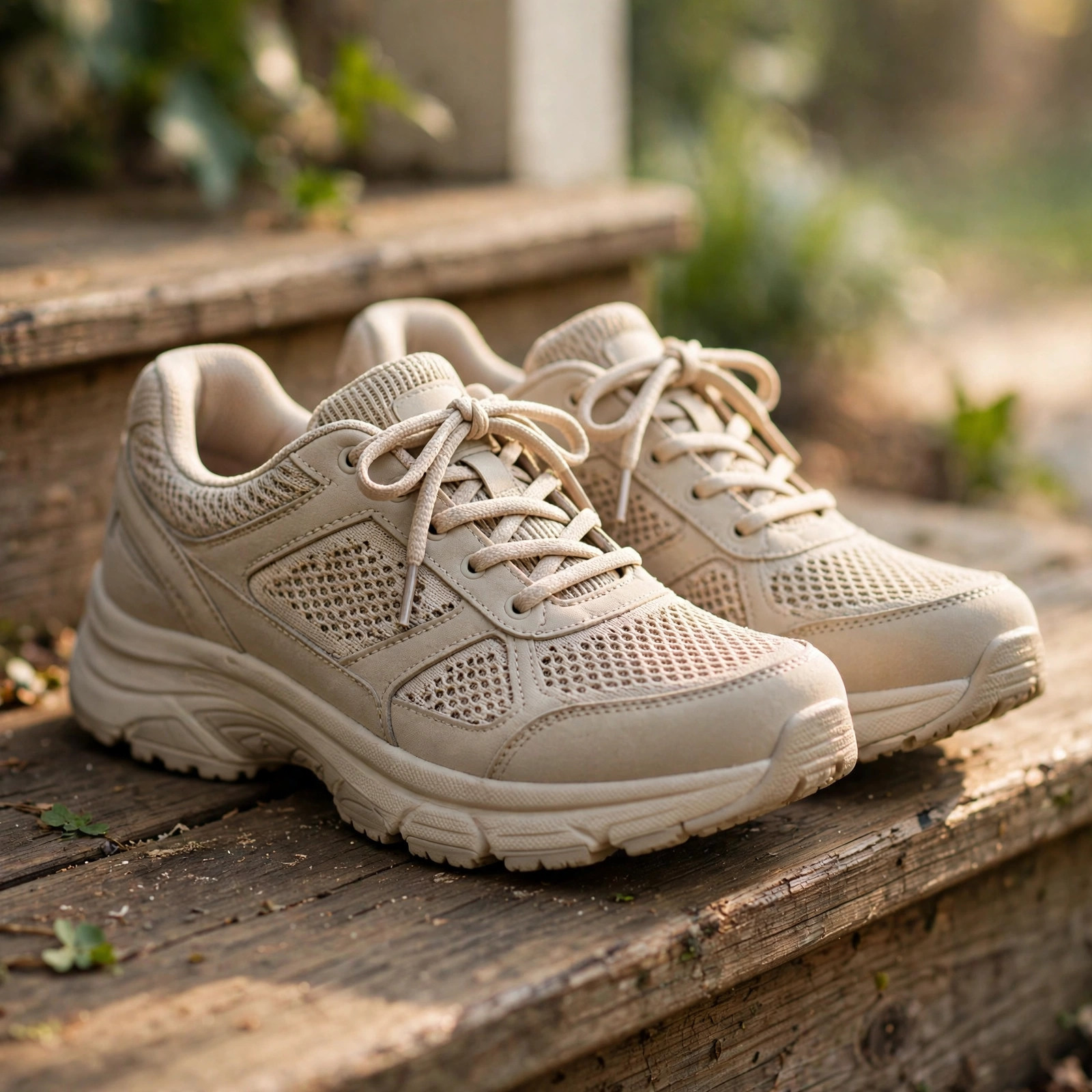
Choose kind surfaces. Flat, even paths are easiest on arthritic joints: park trails, sidewalks, a shopping mall, or a treadmill with a little give. Steep hills, uneven ground, and rocky trails add joint stress — save those for later, or skip them.
Warm up and cool down. Joints hate sudden starts. Begin each walk with 3–5 minutes of easy, slow walking before picking up the pace, and finish the same way. Gentle range-of-motion stretches for the ankles, knees, and hips — done after the walk, when tissues are warm — help maintain flexibility.

Use good posture. Stand tall, look ahead rather than down at your feet, swing your arms naturally, and land on your heel rolling through to your toes. If balance is a concern, walking poles can take some load off the hips and knees while adding stability.
Time it right. Many people with arthritis feel stiffest in the morning. If that’s you, a mid-morning or afternoon walk may feel better than a dawn one. On cold, damp days — when joints often ache more — consider walking indoors.
The pain rules: some discomfort is okay, sharp pain is not
This is the question almost everyone with arthritis asks: is it okay to walk if it hurts? The honest answer is that some mild discomfort is normal and expected — but there are clear lines.
Okay to keep going: – Mild aching or stiffness that eases as you warm up – A general “tired” feeling in the muscles around the joint – Discomfort rated about 1–2 out of 10 that fades within a couple of hours after the walk
Slow down or stop: – Sharp, stabbing, or sudden pain – Pain that gets worse as you walk instead of easing – Pain in one specific spot that feels different from your usual ache
Skip the walk and rest the joint if: – The joint is hot, red, or visibly swollen – Pain lingers into the next day — that’s a sign you did too much – You’ve just had a joint injection or a procedure (follow your doctor’s timing)
One more thing worth saying: fear of pain keeps many people with arthritis from walking at all, and that avoidance tends to make things worse over time. The goal is to find your personal edge and work near it, not to push through it.
When walking isn’t enough
Walking is an excellent foundation, but it doesn’t do everything. It’s mainly an aerobic activity — it does little for muscle strength, flexibility, and balance on its own. For a complete joint-friendly routine, most experts recommend adding:
- Strengthening exercises for the muscles around your joints — especially the thighs (quadriceps) for knee arthritis and the glutes for hip arthritis. Stronger muscles take load off the joints.
- Range-of-motion and flexibility work to keep joints moving through their full motion.
- Balance exercises, because arthritis and aging together raise fall risk.
If even short walks are too painful — for example, with severe knee or hip osteoarthritis, or during a rheumatoid arthritis flare — non-weight-bearing options are a better starting point. Swimming, water aerobics, and stationary cycling give you the aerobic benefit without pounding the joints. For a wider set of joint-friendly options, see our guide to 7 low-impact exercises for bad knees.
Assistive devices are not a failure, either. A cane used in the hand opposite the bad knee can noticeably reduce joint load — and some people find a brief course of physical therapy is what finally gets them walking comfortably. A physical therapist can build you a program tailored to your specific joints.
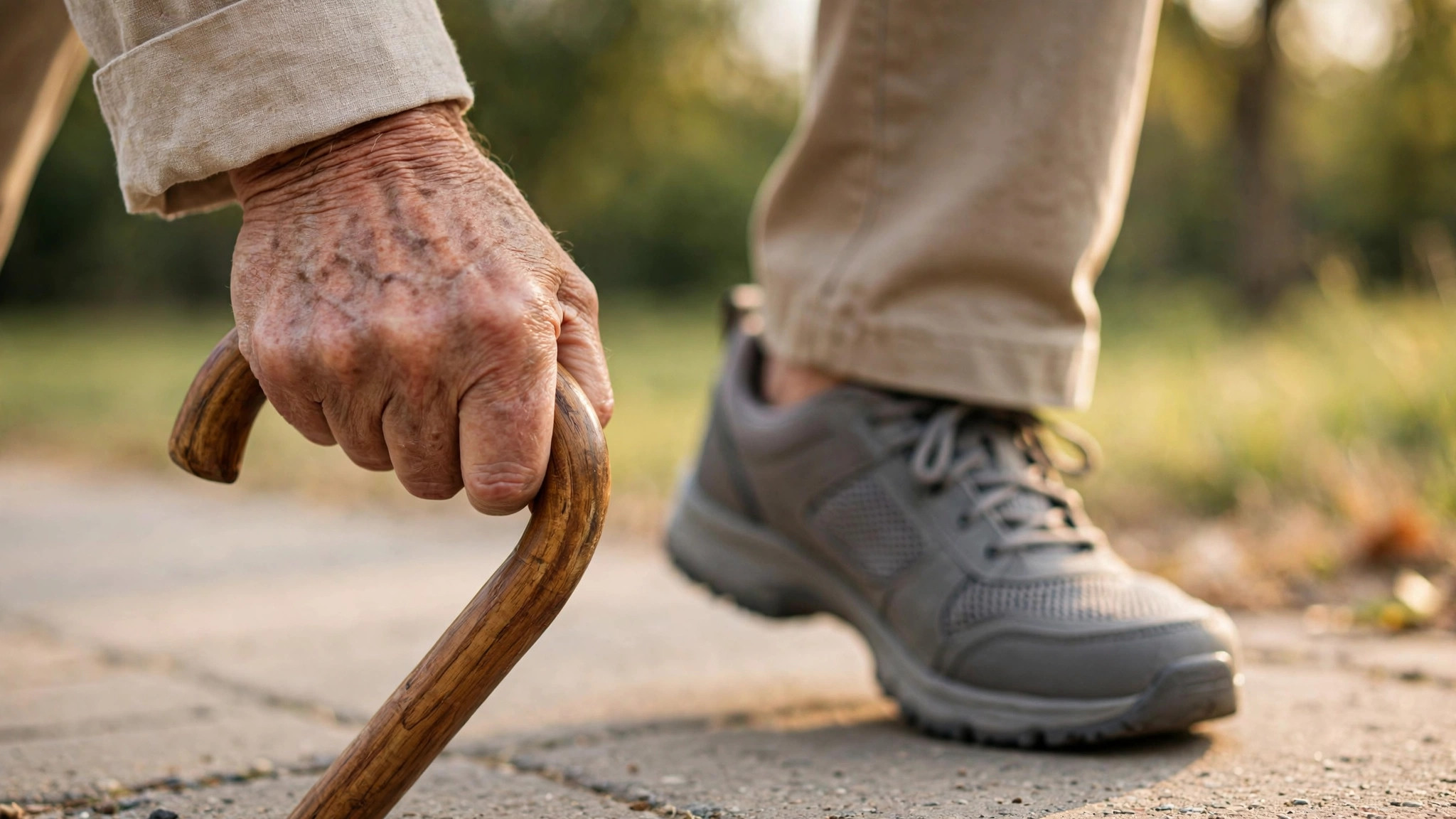
And it’s worth being realistic: exercise manages arthritis symptoms, it doesn’t change the underlying disease. Walking can ease pain and improve function — which is a lot — but it won’t reverse cartilage damage.

When to see a doctor
Walking is safe for most people with arthritis, but check with your doctor or physical therapist before starting if any of these apply:
- You haven’t been formally diagnosed and don’t know what’s causing your joint pain
- Your joint pain is new, rapidly worsening, or came on suddenly
- A joint is swollen, red, or warm to the touch — this can signal inflammation that needs treatment first
- You have rheumatoid arthritis or another inflammatory arthritis and your disease isn’t well controlled
- You have a heart condition, chest pain with exertion, severe shortness of breath, or dizziness when active
- You’ve recently had joint surgery or a joint replacement
- Walking consistently triggers pain that doesn’t settle, or your function is declining despite regular activity
Also see your doctor promptly if a joint locks, gives way, or becomes deformed — those are signs that need evaluation, not exercise.
The bottom line
Walking is good for arthritis — that’s not folk wisdom, it’s the consistent message from the Arthritis Foundation, Mayo Clinic, and the CDC. Aim to build toward about 150 minutes a week of moderate walking, starting from whatever you can manage now (even 10 minutes counts), on forgiving surfaces in supportive shoes. Expect some mild discomfort, respect sharp pain, and back off when a joint flares. And when walking alone can’t cover your needs, add strength, flexibility, and balance work — or switch to lower-impact options until your joints cooperate.
The best exercise for arthritis is the one you’ll keep doing. For most of us after 50, that’s walking.
Sources
- Arthritis Foundation, Walk With Ease program — https://www.arthritis.org
- Mayo Clinic, “Exercise and arthritis” — https://www.mayoclinic.org/diseases-conditions/arthritis/in-depth/arthritis/art-20047971
- Centers for Disease Control and Prevention (CDC), “Physical Activity for Arthritis” — https://www.cdc.gov/arthritis/communications/features/physical-activity.htm
- NHS, “Arthritis” — https://www.nhs.uk/conditions/arthritis/
- Cleveland Clinic, guidance on arthritis and low-impact exercise
This article is for general information only and is not medical advice. Talk to your doctor or a qualified health professional about your personal situation.