Stair Climbing After 60: A Safe Way to Build Leg Strength
You probably climb stairs every day. That ordinary movement is also one of the simplest forms of exercise after 60: each step lifts your whole body weight against gravity, asking more of your thighs, calves, and glutes than flat walking does. Done slowly and safely, stair climbing may help build leg strength and support balance — no gym or equipment required.
The catch is that stairs also demand more balance and joint control than flat ground, and a fall on stairs can cause serious injury — so this guide is about using the stairs you already have safely.
Why stairs are worth your attention after 60
Stair climbing is a weight-bearing activity: your legs carry your own body weight with every step, which is one way to help keep leg muscles and bones strong in later life. The NHS lists walking up stairs as an example of vigorous-intensity activity.
There is encouraging research behind it, too. A large prospective study published in Atherosclerosis in 2023 followed 458,860 adults in the UK Biobank for a median of 12.5 years. People who reported climbing more than five flights of stairs a day — roughly 50 steps — had a lower risk of atherosclerotic cardiovascular disease than people who reported climbing none. This was an observational study, so it shows an association rather than proof that stair climbing itself prevents heart disease.
It also fits the activity targets set by major health bodies. The U.S. Centers for Disease Control and Prevention (CDC) recommends that adults 65 and older get at least 150 minutes of moderate-intensity aerobic activity a week (or 75 minutes of vigorous activity), plus muscle-strengthening activities on at least two days a week and balance activities. A few flights of stairs will not cover the whole weekly target on their own, but they can be a practical piece of it.
Strong legs also support everyday independence: standing up from a chair, stepping onto a curb, or catching a stumble all draw on the same muscles. Our guides to Balance Exercises That Help Prevent Falls and Strength Training at Home After 60 cover the foundations stairs build on.
Who should check with a clinician first
For many healthy adults, climbing the stairs at home is everyday movement. But if you plan to use stairs deliberately for fitness — more flights, more often, or at a brisker pace — talk to your clinician first if you have a heart condition, chest pain, or unusual breathlessness with mild effort; dizziness or fainting; a fall or near-fall in the last few months; knee or hip pain noticeably worse on stairs than on flat ground; a balance disorder, neuropathy, or poor vision; or recent surgery, a joint replacement, or a new medication that makes you drowsy.
None of these automatically rules stairs out — but ask your clinician or a physiotherapist what level is safe for you. If you use a cane or walker, ask a physiotherapist how to use stairs with it — used the wrong way on steps, a mobility aid can become a hazard.
The safe technique: slow, steady, and always holding on
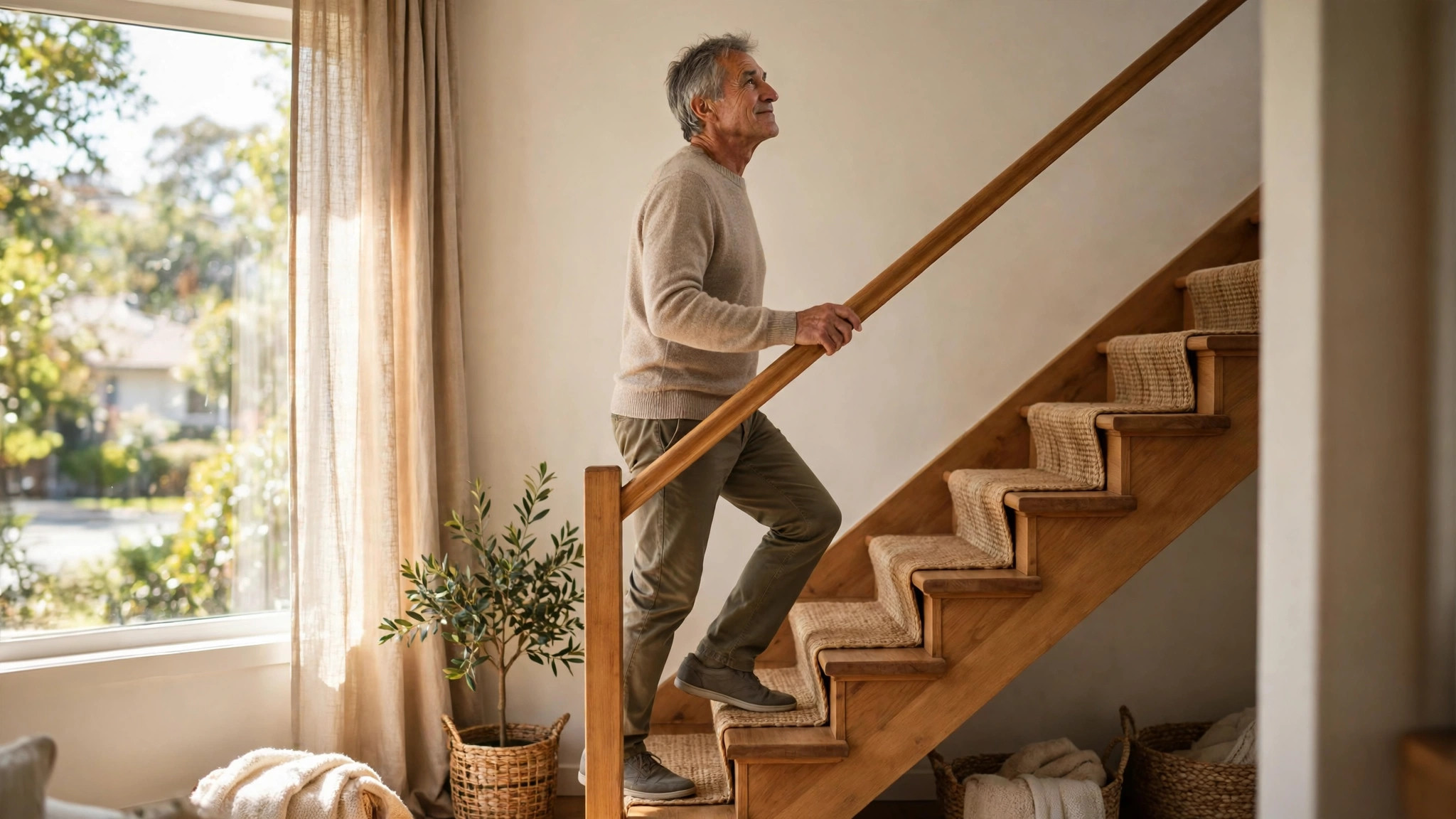
Hold the handrail every time. This is the single most important habit. Grip the rail before your first step and keep holding it until you reach the top or bottom. If your staircase has rails on both sides, use both. If it has only one, consider having a second fitted.
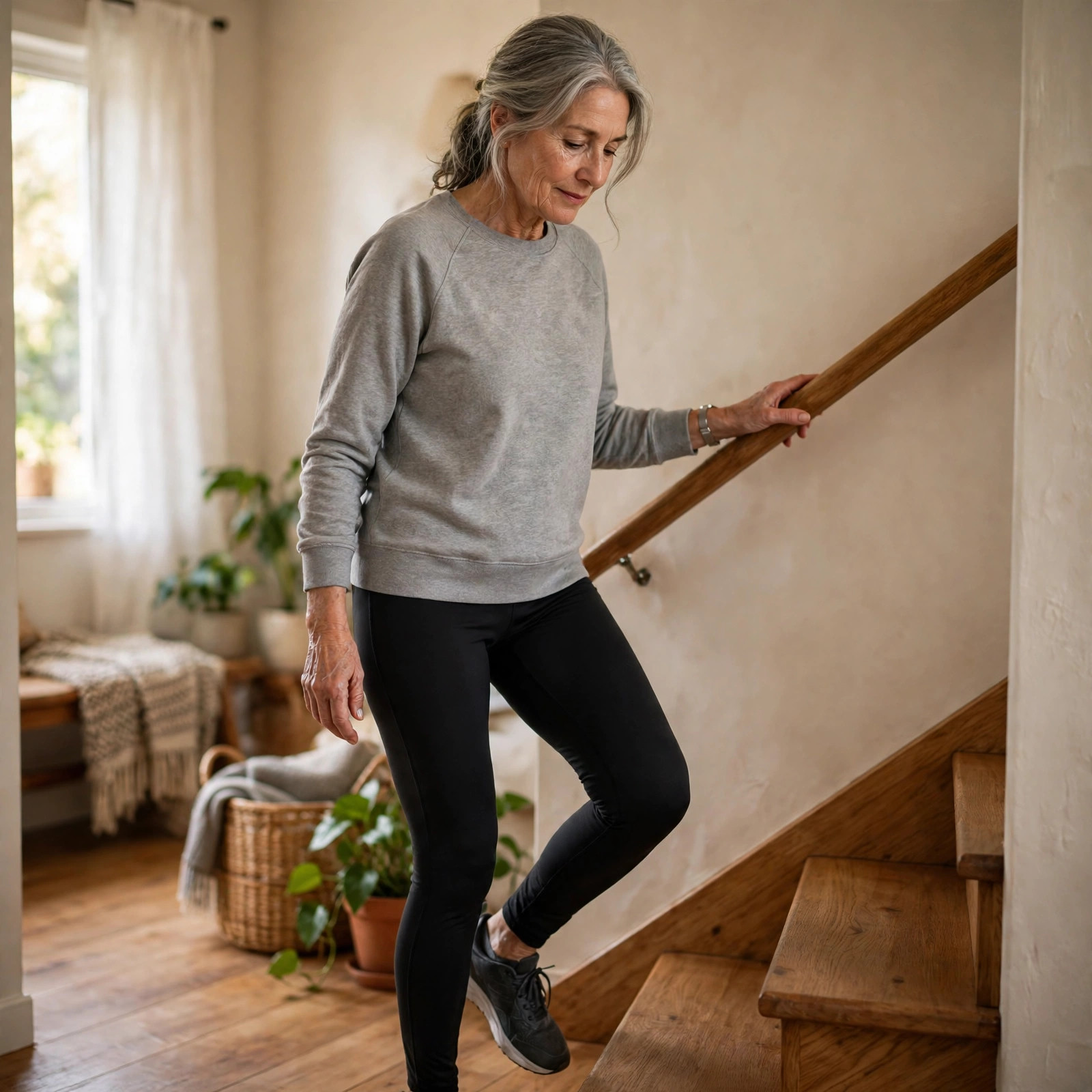
One step at a time. Place your whole foot on each step, not just your toes, and bring the other foot up to the same step before moving on. This “step-to” pattern keeps both feet on the staircase longer and cuts the time you balance on one leg.
Lead with your stronger leg going up, your weaker leg going down. Physiotherapists sum this up as “up with the good, down with the bad”: going up, the stronger leg does the lifting; going down, the weaker leg goes first so the stronger leg controls the descent.
Look at the steps, not your feet. Keep your eyes on the step ahead rather than staring down at your shoes, and keep the stairwell brightly lit, with switches at the top and bottom.
Breathe and pace yourself. You should be able to talk in short sentences while climbing; if you are too breathless to speak, slow down or stop and rest. Keep your hands free: never carry something in both hands on the stairs — use a small bag, make two trips, or ask someone to help.
Footwear and your staircase
Most stair falls trace back to a handful of fixable things: poor lighting, nothing solid to hold, something left on a step, or the wrong shoes.
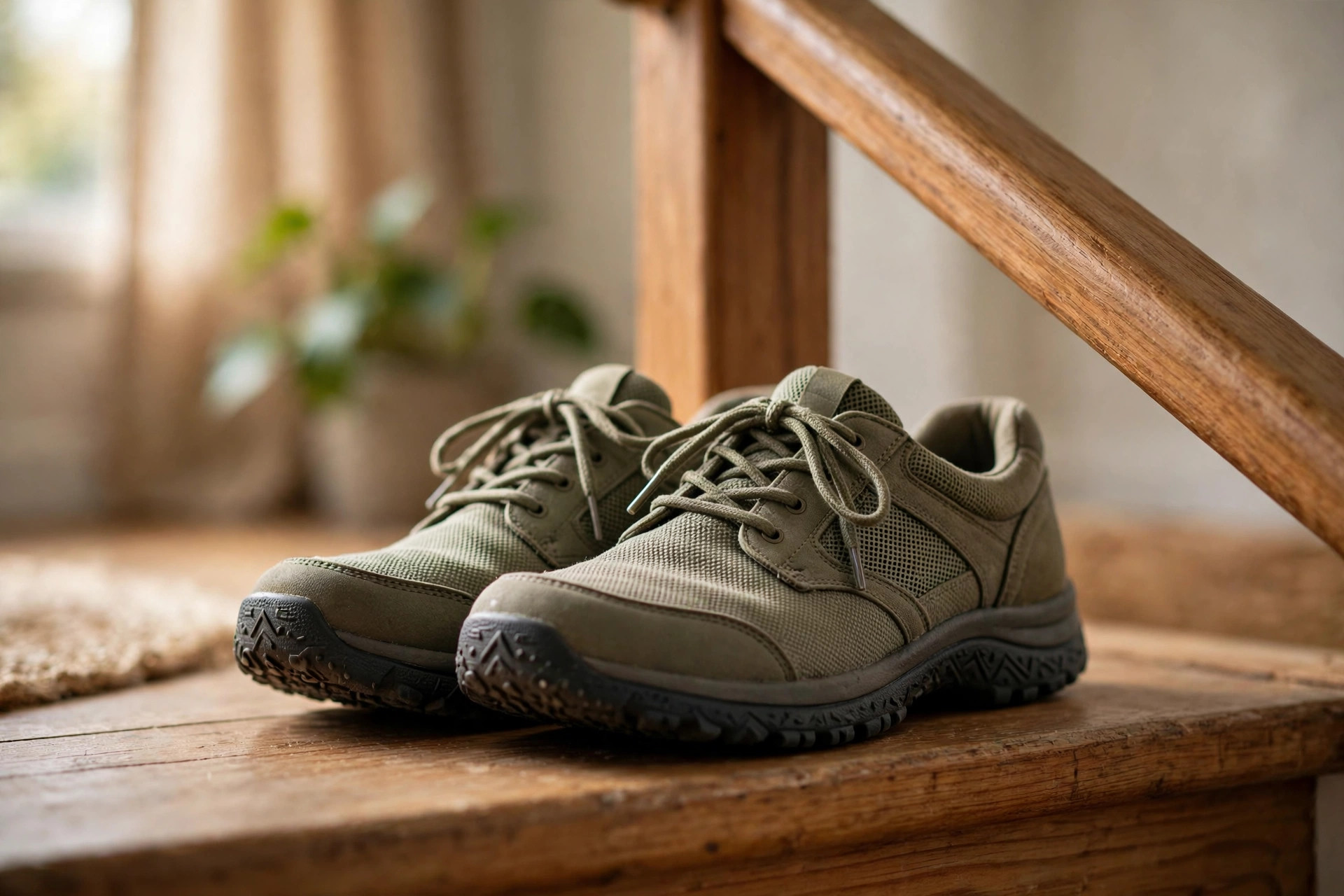
Choose well-fitting, sturdy, flat shoes with non-slip rubber soles — the kind Mayo Clinic recommends for fall prevention. Avoid loose slippers, backless shoes, high heels, and socks alone on the stairs: Mayo Clinic warns that walking in stocking feet can make you slip and fall. Replace shoes when the tread wears smooth, and keep proper house shoes by the stairs.
Never use the stairs as storage: remove shoes, books, and laundry from the steps and landings, and keep loose rugs away from the top and bottom. On smooth wood, tile, or painted steps, consider non-slip treads or anti-slip tape, and check that the handrail is firmly fixed and can take your full weight without wobbling.
Mind your vision and clothing as well. Depth perception fades quietly, so keep your eye prescription current, and take extra care with bifocals, since the reading portion can blur the steps below you. Tuck away long hems and loose cords before you climb.
A gentle four-week starter plan
If you already use stairs at home without difficulty, you do not need a formal program — just keep the technique above. If you want to build up deliberately, here is a conservative way to start. Stop at any stage that feels comfortable and stay there for a few weeks before moving on.
Week 1 — Learn the pattern. Once a day, climb one flight slowly using the step-to pattern with the handrail, resting at the top if you need to. If even one flight leaves you breathless or unsteady, stay at this level and talk to your clinician before pushing further.
Week 2 — Add a second flight. If week 1 felt easy, add a second flight on the same day, with a rest between flights. You can also practice step-ups on the bottom step, holding the rail — five slow repetitions per leg is plenty.
Week 3 — Build the habit. Aim for two or three short stair sessions spread through the week, each of one or two flights. Between stair days, add sit-to-stand from a sturdy chair, calf raises holding a counter, and core work from our guide to Safe Core Exercises for Seniors.
Week 4 — Find your routine. By now you will know how many flights feel comfortable. Some people settle at two or three flights a day; others build toward more. Either is fine — consistency matters more than any single number.
Going down is often harder on the knees than climbing up, so take it even more slowly and hold the rail firmly. If descending regularly causes sharp knee pain, use the lift for the descent and climb up only — and mention the pain to your clinician.
Stop rules: when to pause and when to get help
Stop climbing and rest immediately if you notice chest pain or tightness; dizziness or feeling faint; unusual breathlessness that does not ease quickly with rest; sharp knee, hip, or ankle pain; numbness, tingling, or weakness in a leg; or a feeling that you might fall. Do not push through any of these.
Chest pain, severe breathlessness, or fainting is urgent: sit or lie down safely and seek emergency medical care — these are not a normal part of exercise. If a milder symptom such as knee pain or breathlessness keeps happening on the stairs, see your clinician before your next stair session.
If you do fall on the stairs, do not rush to get up. Stay still, check for pain or injury, and call for help if you need it — our guide on What to Do After a Fall walks through the steps.
Common mistakes to avoid
Rushing. Speed adds nothing to the strength benefit and multiplies the fall risk. Skipping the handrail because you feel fine. Confidence is not stability — a moment of dizziness or a misjudged step can catch anyone. Climbing in socks or loose slippers. Smooth soles on smooth steps are a classic slip combination. Carrying loads. A laundry basket blocks your view of the steps and takes a hand off the rail — make two trips or use a bag. Increasing too fast. Adding several flights in one week is a quick route to sore knees; add one flight at a time.
When to see a doctor
See your clinician promptly if you notice chest pain or unusual breathlessness during or after climbing stairs; dizziness or fainting on the stairs; a fall or near-fall, even if you were not hurt; knee or hip pain that is getting worse or limits daily activities; new weakness, numbness, or tingling in your legs; or needing furniture or walls for support when walking at home. These can be signs of heart, joint, nerve, or balance problems that deserve assessment.
The bottom line
Stairs are already part of your home, and that is what makes them such a practical exercise after 60: they ask your legs to work against gravity, support heart health as part of an active week, and cost nothing. Even a few flights a day are linked to better cardiovascular health in the research — but the benefit only counts if you get to the top safely. Hold the rail, take one step at a time, wear proper shoes, keep the pace conversational, and stop if something feels wrong. Build up slowly, and check with your clinician if you have a heart condition, joint problems, or balance concerns. The stairs will still be there tomorrow.

Sources
- Centers for Disease Control and Prevention, “Older Adult Activity: An Overview” — https://www.cdc.gov/physical-activity-basics/guidelines/older-adults.html
- National Institute on Aging, “Three Types of Exercise and Physical Activity” — https://www.nia.nih.gov/health/exercise-and-physical-activity/three-types-exercise-and-physical-activity
- Mayo Clinic, “Fall prevention: Simple tips to prevent falls” — https://www.mayoclinic.org/healthy-lifestyle/healthy-aging/in-depth/fall-prevention/art-20047358
- NHS, “How to improve your strength and flexibility” — https://www.nhs.uk/live-well/exercise/how-to-improve-strength-flexibility/
- Song Z. et al., “Daily stair climbing, disease susceptibility, and risk of atherosclerotic cardiovascular disease: A prospective cohort study,” Atherosclerosis, 2023 — https://pubmed.ncbi.nlm.nih.gov/37813749/
This article is for general information only and is not medical advice. Talk to your clinician before starting a new exercise program.