
Core Exercises for Seniors: Safe Moves for Strength and Balance
If the words “core exercises” make you think of crunches on the living-room floor, forget that image. For adults over 60, a strong core is not about a six-pack. It is about standing up from a chair without using your hands, catching your balance when you step off a curb, and getting through the day without an aching lower back.
The good news: the safest core exercises for seniors need no equipment, no floor work, and no crunches at all. This guide explains which muscles you are training, gives you seated and standing moves you can start today, and names the classic exercises to skip.
Why your core matters more after 60
Your core is the muscular system around your trunk. According to Harvard Health, these muscles are “the key to supporting your lower back and helping you stand, get out of a chair, bend, lift, and maintain your balance” — and every one of those movements becomes more demanding with age.
Think about your daily life. Reaching for a shelf, carrying groceries, stepping over a threshold — all rely on your trunk staying stable while your arms and legs move. When the core is weak, the spine absorbs more of the load and balance becomes less forgiving. The CDC recommends that adults 65 and older do muscle-strengthening activities at least two days a week, plus activities to improve balance.
What “core” really means (it is not just your abs)
Most people hear “core” and think of the abdominal muscles at the front. Those matter, but they are only part of the picture. Harvard Health explains that the core runs from the lower rib cage to the buttocks and includes:
- The rectus abdominis — the long muscles down the front of your abdomen
- The obliques — the muscles along your sides that help you twist and bend
- The transversus abdominis — a deep, flat muscle that wraps around your middle like a built-in corset
- The erector spinae — the back muscles that help you stand up tall
- The glutes, hip, and pelvic muscles — which help you lift your legs, climb stairs, and stay stable while standing
This is why isolated ab moves alone never do the job. As a Harvard-affiliated physical therapist puts it, the better approach is “working several core muscle groups at the same time, just the way you would naturally if you were lifting something or climbing.”
The safe seated moves (start here)
Seated exercises are the ideal starting point. You need only a sturdy, armless chair on a non-slip surface — with the back against a wall if it tends to slide. Sit near the front edge of the seat, feet flat, spine tall. Breathe freely and deeply throughout; Mayo Clinic advises focusing on tightening the deepest abdominal muscle, the one you feel when you cough.
1. Seated marches Sit tall at the front edge of the chair and tighten your belly as if bracing for a gentle poke. Lift your right knee a few inches, lower it, then lift the left. Alternate slowly, keeping your upper body still — the effort should come from your midsection. Do 8 to 10 lifts per leg, then repeat for a second round when you are ready.
2. Pelvic tilts Sit tall with your feet flat. Gently rock your pelvis so your lower back flattens against the chair, then rock the other way to form a small arch. Move slowly through a comfortable range — about an inch of motion. Do 10 slow repetitions.
3. Seated torso turns Sit tall and fold your arms lightly across your chest. Keeping your hips facing forward, slowly rotate your upper body to the right, pause one second, then turn left. Move only as far as comfortable — no yanking or bouncing. Do 6 to 8 turns per side.
4. Seated knee press (a gentle strengthener) This one borrows from the Mayo Clinic’s core-strength guidance. Sit tall and lift your right knee to about hip height, placing your right hand on top of it. Push your hand down against your knee while your knee pushes up — they should not move. Tighten your belly and hold for three slow breaths, then switch sides. Repeat 3 times per side.
For a routine that pairs well with these seated moves, see our 15-minute chair workout — the two together make a solid weekly exercise habit.

The safe standing moves (when you are ready)
Hold the back of a sturdy chair, a counter, or a wall for balance during all standing exercises. Wear supportive, non-slip shoes.
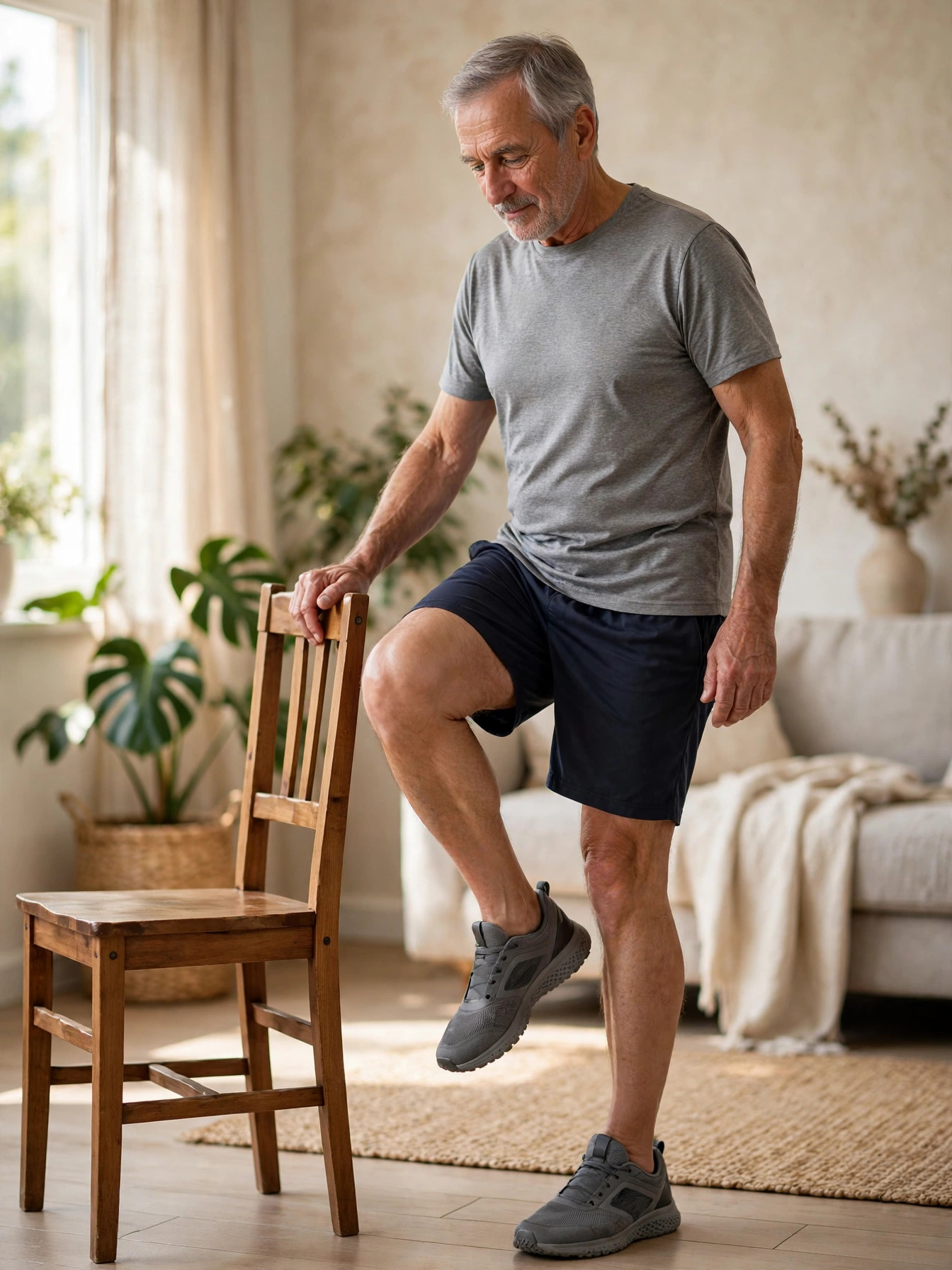
1. Standing knee lifts Stand behind a chair, hands lightly resting on its back. Tighten your belly and slowly lift your right knee to a comfortable height, pause for a count of two, then lower with control. Alternate legs. This trains the core to stabilize you while one leg bears your weight. Do 8 lifts per leg.
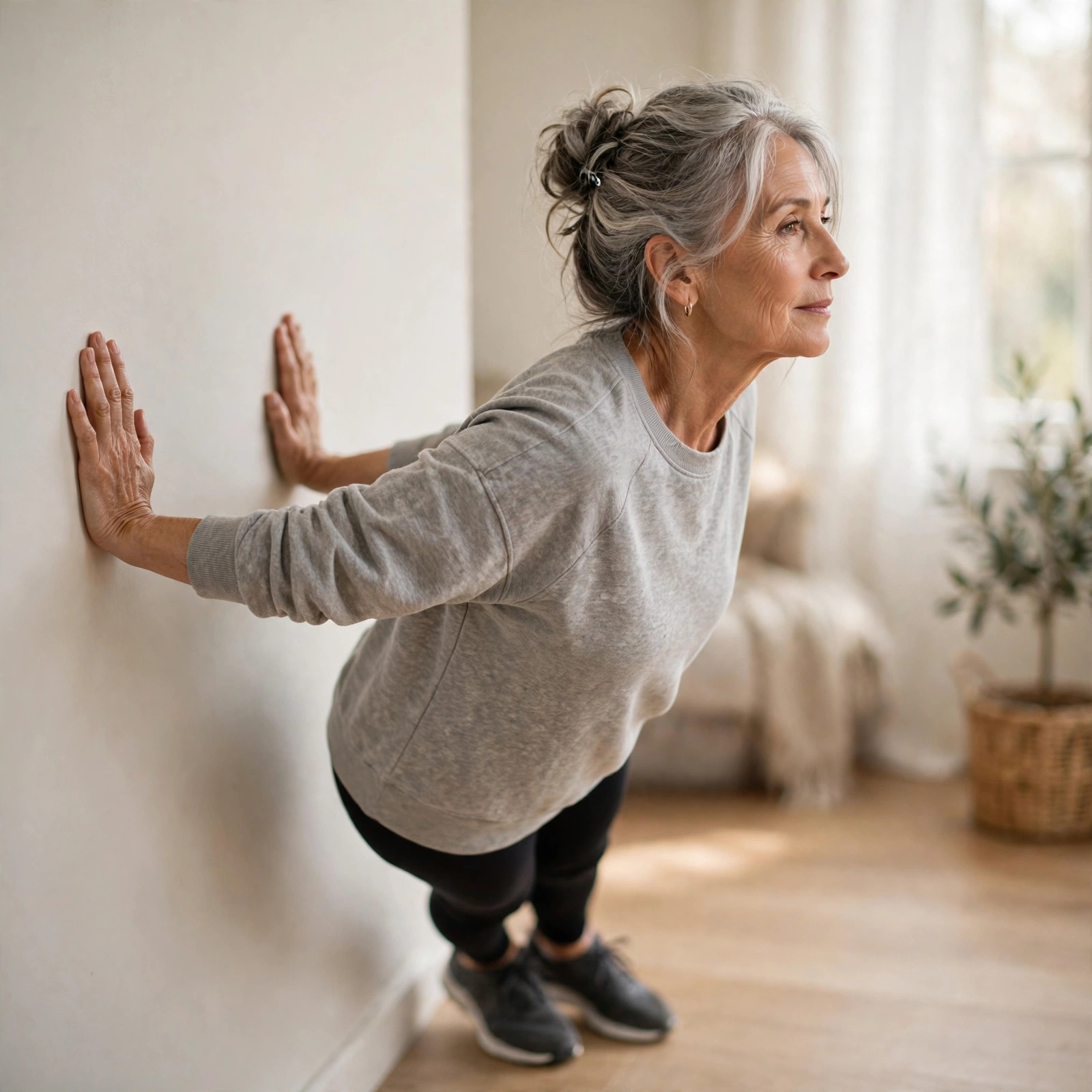
2. Wall push-aways Face a wall at arm’s length, both palms flat against it, shoulder-width apart. Tighten your belly, keep your body straight from head to heels, bend your elbows to bring your chest a few inches closer to the wall, then push back. Your trunk should stay rigid — like a wooden board. Start with 6 to 8 repetitions.
3. Standing side bends Stand tall with one hand on the back of a chair. Raise your free arm overhead and slowly lean your upper body to the opposite side, just until you feel a gentle stretch. Return upright. Do 6 bends per side, keeping the movement smooth.

4. Standing trunk rotation Stand behind the chair, hands on its back. Without moving your hips, slowly rotate your shoulders and chest to the right, pause, return to center, then rotate left. Keep the motion small and controlled. Do 6 rotations per side.
Moves to skip or postpone
Not every classic core exercise is a good first choice after 60. Set these aside — and do this instead.
Traditional sit-ups. Harvard Health lists sit-ups among the worst core exercises for older adults: people tend to pull on the neck, and the movement mainly trains the hip flexors rather than the core. Overdeveloped hip flexors can tug on the lower back and contribute to back pain. Skip them.
Crunches. Crunches have the same problems in milder form: neck strain from tucking the chin, and training of a narrow set of muscles. Stabilization exercises simply do the job better for an older adult’s needs.
Full floor planks (as a starting point). A full plank on toes and forearms is demanding, and getting down to and back up from the floor is itself a barrier for many older beginners. Build the same trunk-stability pattern with the wall push-aways and standing rotations above first. When those feel easy, a modified plank on hands and knees (taught by both Mayo Clinic and Harvard Health) is a reasonable next step: start on hands and knees, lower to your forearms, keep your back straight, and hold for a few slow breaths.
One more note: crunches and sit-ups are often associated with flat stomachs, but spot-reducing belly fat is not how exercise works. Train for strength and stability, and let nutrition and overall activity take care of the rest.
How often, how many, and how to progress
You do not need long sessions. The CDC recommends muscle-strengthening activities on at least two days per week, and Harvard Health notes that the core does not need much recovery, so it can be worked most days. A practical plan: start with two or three short sessions per week of about 10 to 15 minutes each.
Follow these simple rules from the institutional guidelines:
- Start slowly. If you have not trained your core in a long time, begin with one set of each exercise and focus on quality of form. The NIA and Harvard Health both recommend building up gradually over weeks.
- Reps and sets. Mayo Clinic suggests aiming for 12 to 15 repetitions of each exercise. Beginners can start with 8 to 10 repetitions and one set, adding a second set when that feels easy.
- Warm up and cool down. March in place for two or three minutes before you start, and finish with gentle stretching of your hips and upper back.
- Progress step by step. When seated marches feel easy, try the standing knee lifts. When wall push-aways feel easy, try the modified hands-and-knees plank.
- Stop rules. Mild muscle effort is normal; sharp pain, dizziness, or chest discomfort are not. Stop and rest if any of those occur.
When to see a doctor
A quick check with your clinician is the smart move if any of the following apply to you. Mayo Clinic advises talking with your health care professional before doing core-strength exercises if you have back problems, osteoporosis, or other health concerns, and the NIA recommends the same for anyone exercising with a chronic condition.
- Persistent or worsening back pain, or pain that radiates down a leg
- Osteoporosis or a history of fractures — some flexion exercises may not be appropriate
- A hernia (abdominal or inguinal), recent abdominal or spinal surgery, or recent joint replacement
- Dizziness, vertigo, uncontrolled high blood pressure, or a heart condition
- Any new or unexplained symptom that appears when you exercise
If you fall into one of these groups, this is not a reason to give up — it simply means getting personalized guidance first on which moves are right for you.
The bottom line
A strong core after 60 is not built on the floor with crunches — it is built in your chair and on your feet, with simple moves that train your trunk to stay steady while life moves around it. Start seated, progress to standing, and do two or three short sessions a week. Your back, your balance, and your independence will thank you.
Sources
- Harvard Health Publishing — “The best core exercises for older adults” (core muscle anatomy, why sit-ups and crunches are poor choices for older adults, bridges/planks/opposite-arm-and-leg raise guidance). https://www.health.harvard.edu/healthy-aging-and-longevity/the-best-core-exercises-for-older-adults
- Mayo Clinic — “Exercises to improve your core strength” (core-strength exercise instructions, 12–15 repetition guidance, “talk to your health care professional first” caution for back problems and osteoporosis). https://www.mayoclinic.org/healthy-lifestyle/fitness/in-depth/core-strength/art-20546851?s=13
- NIH/NIA — “Tips for Getting and Staying Active as You Age” (progress gradually, combine aerobic/muscle-strengthening/balance activities, talk with your doctor about exercising with chronic conditions). https://www.nia.nih.gov/health/exercise-and-physical-activity/tips-getting-and-staying-active-you-age
This article is for general information only and is not medical advice. Talk to your doctor before starting a new exercise routine.