Best Shower Chair for Seniors: Bathing Safety Without the Slip Risk
A shower chair is one of the simplest, cheapest pieces of bathroom safety equipment you can buy. It turns the riskiest few minutes of the day into a seated, supported activity instead of a balancing act on a wet surface.
But stools, chairs, transfer benches and fold-down seats each suit a different person and a different bathroom. This guide walks through the types, the features that actually matter, and how to make the rest of the bathroom safer at the same time.
Why the bathroom deserves your attention
Falls are the leading cause of injury — fatal and non-fatal — among older adults. According to the CDC, more than one in four adults aged 65 and older falls each year, and about 37% of those falls cause an injury that needs medical treatment or restricts activity for at least a day. Each year, falls send roughly 3 million older adults to emergency departments and lead to about 1 million hospitalizations.
The bathroom concentrates several risk factors at once: hard surfaces, water, a slippery footing, and movements — stepping over a tub wall, bending, reaching — that challenge balance at the worst possible moment. A CDC analysis of emergency-department data found an estimated 234,094 nonfatal bathroom injuries among Americans aged 15 and older in a single year, and 81% of them were caused by falls. The highest injury rates occurred in or around the tub or shower, and bathroom injury rates rose sharply with age.
The two highest-risk moments in bathing are getting in and out, and standing on a wet surface. Sitting down removes both — which is why Mayo Clinic’s fall-prevention guidance specifically recommends a bath seat for sitting while showering, along with nonslip mats and grab bars for the shower or tub.
The three types of shower seating — and who each suits
1. Shower stools
A shower stool is a backless seat, usually round or square, with height-adjustable legs. It is the smallest and most portable option, and some models fold flat for storage.
Best for: people who are fairly steady on their feet but tire easily or want a rest during a long shower; small shower stalls where a full chair will not fit. A stool is also handy as a travel option for visiting family.
Limitations: no backrest and usually no armrests, so it offers less support when sitting down or standing up — a chair with arms is the safer choice if balance is a concern.
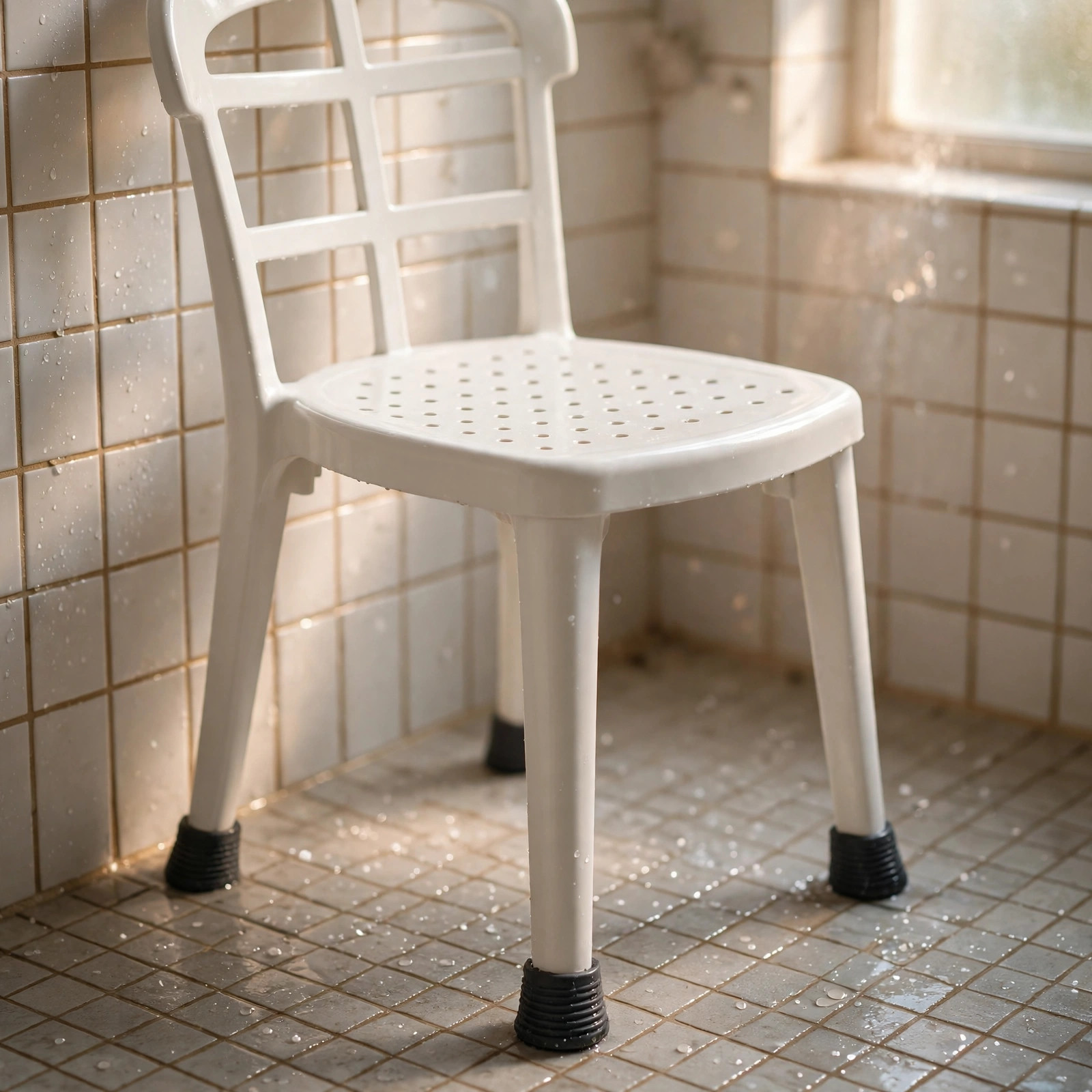
2. Shower chairs (with backrest and armrests)
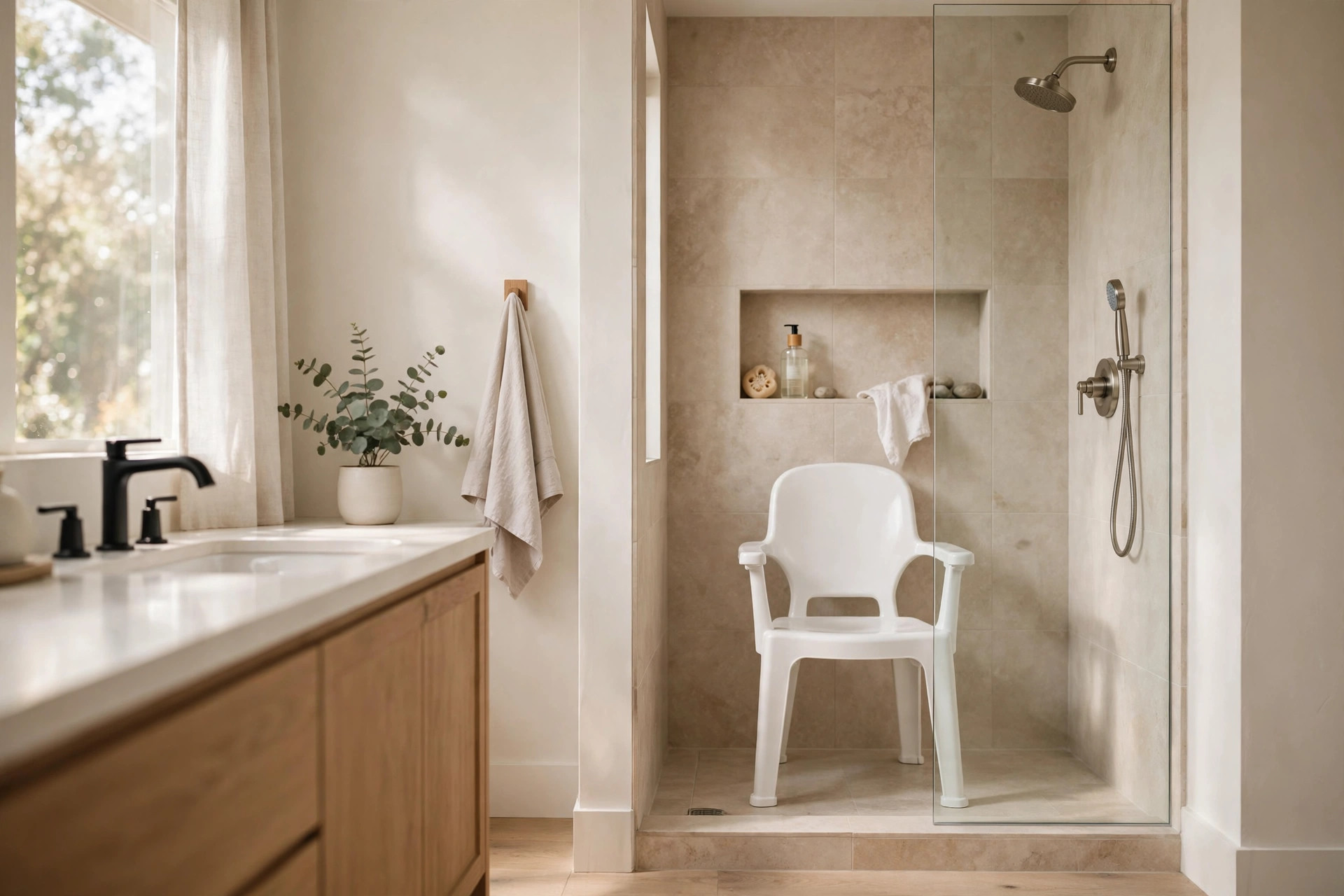
The classic shower chair has a backrest, and many models add armrests — the right default for most older adults. The backrest gives trunk support, and the armrests provide push points for getting up, where many bathroom falls happen.
Best for: anyone with balance problems, muscle weakness, dizziness, or post-surgery recovery; anyone who feels unsteady stepping in or out of the shower. If you are unsure which type to buy, this is usually the one.
Limitations: needs more floor space than a stool — check it fits your shower or tub with the door able to close.
3. Transfer benches
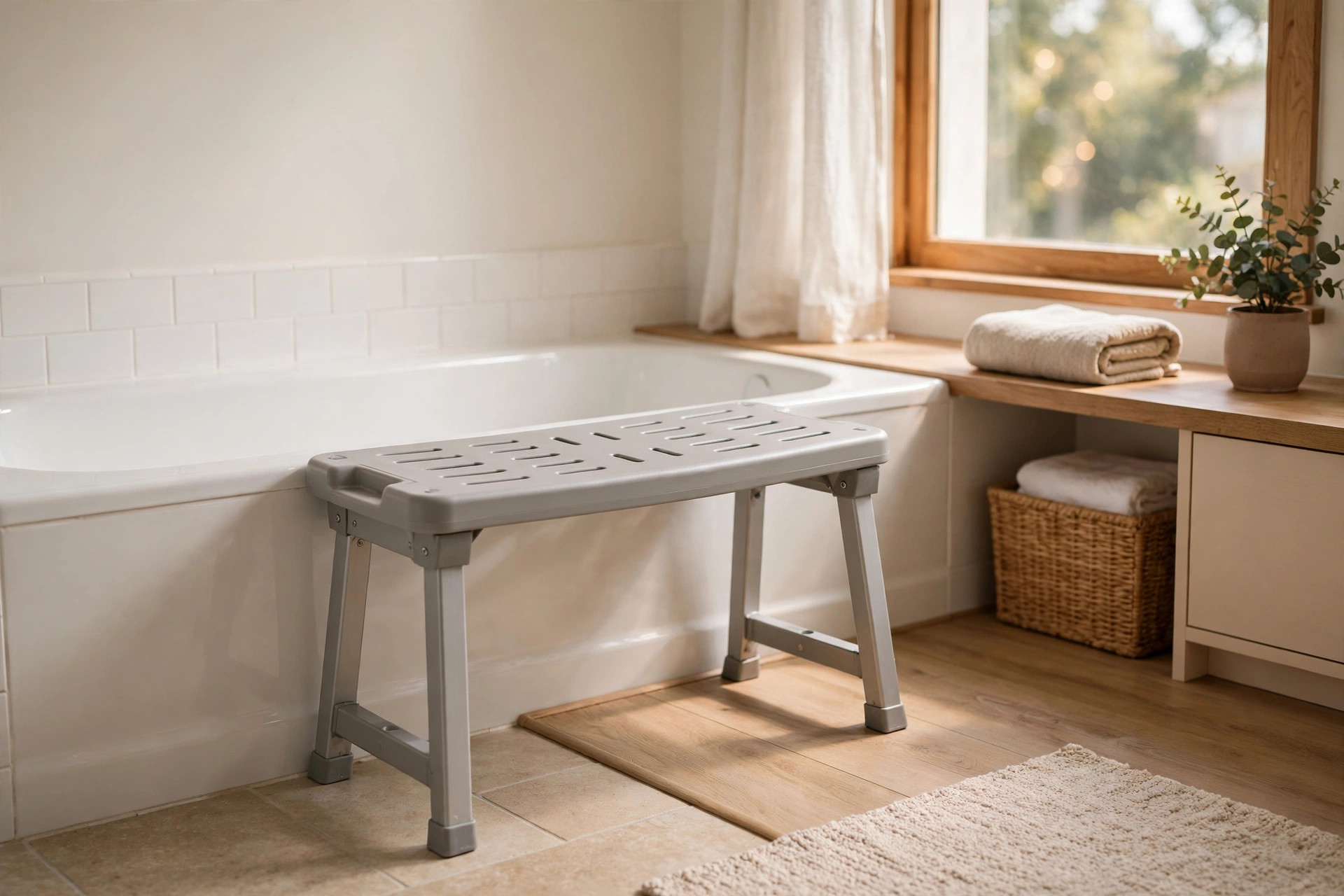
A tub transfer bench is a long seat that bridges the tub wall: two legs sit inside the tub and two legs sit on the bathroom floor outside it. You sit on the outside section and slide across into the tub, so you never have to lift your legs over the wall.
Best for: high-sided bathtubs; people who cannot safely step over the tub edge; wheelchair users; recovery after hip or knee surgery, when bending and lifting the legs are restricted.
Limitations: the largest option; needs clear floor space beside the tub, and the seat should sit level with the tub wall for a smooth slide.
A fourth option is the fold-down wall-mounted seat, which flips up out of the way when not in use — a great space-saver, but it needs professional installation into solid wall structure.

What to look for: the buying checklist
Use this checklist when comparing models — every item affects safety or daily usability.
1. Non-slip feet. Look for wide rubber feet or suction-cup tips on every leg — this is the single most important safety feature. Replace worn tips promptly; they are cheap and easy to find.
2. Drainage holes. The seat should have drainage holes so water runs through instead of pooling under you — pooled water on the seat is a sliding risk.
3. Height-adjustable legs. Most chairs adjust in 1-inch increments with push-button locking pins; set the seat so your feet rest flat on the floor with knees roughly level with your hips. For a transfer bench, the seat should sit level with the top of the tub wall. Make sure the pins click fully into place on every leg.
4. Weight capacity. Standard shower chairs and stools typically support 300 to 350 pounds; heavy-duty and bariatric models support 400 to 500 pounds. Choose a chair rated comfortably above the user’s actual weight, not right at it — if the user’s weight is near a standard model’s limit, step up to the heavy-duty class.
5. Armrests. Armrests turn a chair into a tool for getting up safely — strongly recommended for leg weakness, arthritis or balance concerns. Some flip up or remove for easier side transfers.
6. Backrest. A backrest adds trunk support; many are reversible to suit your bathroom layout. Padded backrests feel nicer, but plain molded plastic dries faster and is easier to clean.
7. Rust-proof materials. Look for anodized aluminum or another rust-proof metal frame with a molded plastic seat — uncoated steel will eventually rust in a wet bathroom.
8. Easy-clean surfaces. Smooth molded plastic with rounded edges is easiest to wipe down. Fabric cushions and lots of crevices trap soap scum and moisture. A quick wipe after each shower keeps the chair hygienic and lets you check that the feet and adjustment pins are still in good shape.
9. Seat size and stability. A wider seat with a wide leg stance feels more stable when shifting your weight. Some seats include a hygiene cutout for easier personal cleaning — worth considering if your reach is limited.
Getting the fit right: measure before you buy
A shower chair that does not fit your bathroom is a waste of money. Before ordering, measure:
- The inside of your shower or tub — width and depth, so the chair fits with room to spare.
- Your ideal seat height — the height that lets your feet rest flat on the floor.
- The door swing and showerhead reach — make sure you can still close the door and reach the controls while seated.
One of the best companion purchases is a handheld showerhead. Mayo Clinic specifically recommends pairing a sturdy plastic shower seat with a hand-held shower nozzle for bathing while sitting down — it lets you control the water and reach toiletries without standing up. If cost is a concern, it is worth asking your insurer whether your plan helps with bathroom safety equipment.
The chair is only one piece: making the whole bathroom safer
A shower chair works best as part of a small safety system. Each piece is inexpensive on its own; together they cover the main risk moments.
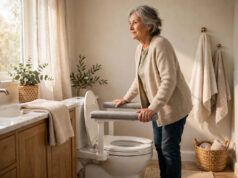
- Install real grab bars. Mayo Clinic, NHS and Harvard Health all recommend grab bars for the shower or tub (and near the toilet). Plan for two: one to steady the step in and out, and one to help from a seated position. Have them properly anchored into the wall — towel racks and soap dishes are not substitutes.
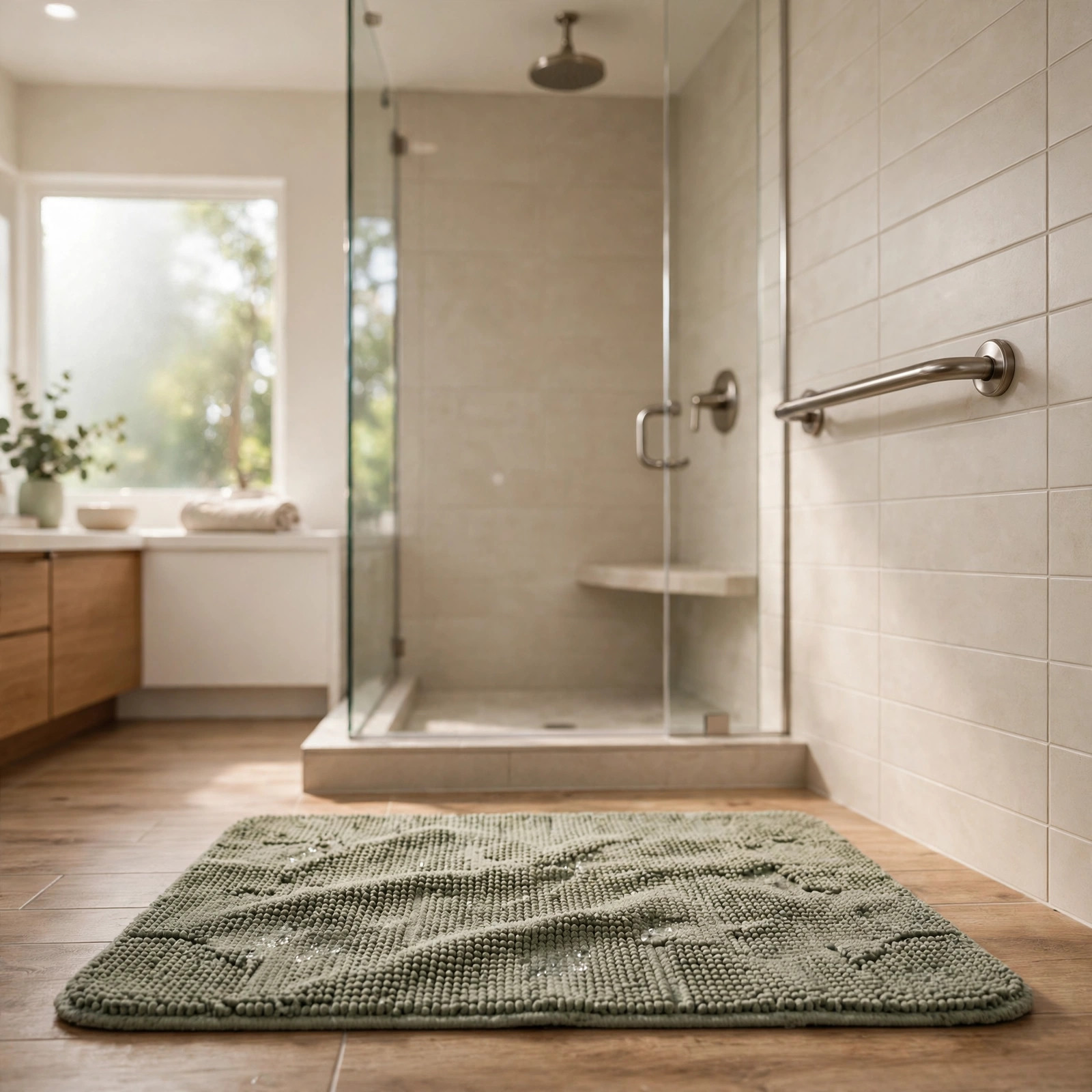
- Use non-slip mats. Put a non-slip mat or adhesive strips inside the tub or shower and a rubber-backed bath mat outside it; the NHS specifically recommends this. Remove loose throw rugs — they are a tripping hazard.
- Improve lighting. A night light in the bathroom and hallway helps for nighttime trips. Keep the bathroom brightly lit so wet patches and edges are easy to see.
- Keep essentials within reach. Store soap, shampoo and towels where a seated person can reach them without standing, stretching or bending. Clear clutter off the floor and out of walkways.
- Consider a home safety assessment. If falls are already happening, a professional review is worthwhile. Mayo Clinic suggests asking your care team for a referral to an occupational therapist; the NHS offers a similar route, with a GP referring to a specialist falls service that checks strength, eyesight, medications — and the safety of the home itself.
Staying active matters too. Strength and balance exercises remain one of the strongest fall-prevention strategies there is — see our guide to Balance Exercises to Prevent Falls After 60 for a safe place to start.
When to see a doctor
A shower chair addresses the environment, but new unsteadiness is often the body’s early warning signal. See your doctor or ask for a fall-risk review if you notice any of these:
- Dizziness or lightheadedness, especially when standing up — this can signal blood-pressure drops or medication side effects.
- Increasing muscle weakness or a feeling that your legs may give way.
- New balance problems — stumbling more often, needing furniture to steady yourself, or a near-fall in the shower or elsewhere.
- Vision or hearing changes, since both play a major role in balance.
- A fall that already happened. Even without injury, a fall predicts future falls — and the fear of falling can make people less active and weaker.
Bring a full list of your medications, including over-the-counter drugs and supplements — sedatives, antihistamines and some antidepressants can affect balance, and your care team may be able to adjust them. And if a fall does happen, knowing what to do in the first minutes matters — see What to Do After a Fall: A Guide for Older Adults for the step-by-step.
Sources
- Centers for Disease Control and Prevention, “Facts About Falls” (updated January 2026) — https://www.cdc.gov/falls/facts.html
- Centers for Disease Control and Prevention, “Nonfatal Bathroom Injuries Among Persons Aged ≥15 Years — United States, 2008,” MMWR — https://www.cdc.gov/mmwr/preview/mmwrhtml/mm6022a1.htm
- National Institute on Aging, “Falls and falls prevention” — https://www.nia.nih.gov/health/falls-and-falls-prevention
- Mayo Clinic, “Fall prevention: Simple tips to prevent falls” (updated July 2026) — https://www.mayoclinic.org/healthy-lifestyle/healthy-aging/in-depth/fall-prevention/art-20047358
- NHS, “Falls” — https://www.nhs.uk/conditions/falls/
- Harvard Health, “Preventing falls in older adults: Multiple strategies are better” — https://www.health.harvard.edu/blog/preventing-falls-in-older-adults-multiple-strategies-are-better-201910221993
This article is for general information only and is not medical advice. Talk to your doctor about your personal fall risk and the bathroom safety equipment that is right for you.