Best Balance Trainers for Seniors: Safer Ways to Build Stability at Home
Balance declines with age, and the stakes are real: the CDC reports that falls among older adults cause about 3 million emergency department visits, 1 million hospitalizations, and 41,000 deaths in the United States every year. Falls are not inevitable, though — the National Institute on Aging (NIA) and the Mayo Clinic both note that balance exercises may help older adults prevent falls and keep their independence.
A balance trainer is a simple home tool that makes the surface under your feet slightly unpredictable. That gentle wobble asks the muscles in your feet, ankles, legs, and core to make constant small corrections — which is how steadier balance is built. Most trainers are compact, affordable, and usable in a living room for a few minutes at a time.
This guide compares the four main types, who each suits, and what to look for before you buy — no product picks or prices.
Why Balance Training Matters More After 60
Balance exercise is one of the few interventions consistently linked to fewer falls in older adults. The NIA lists balance as a core exercise category for aging adults and recommends about three balance sessions per week, naming tai chi, standing on one foot, heel-to-toe walking, and using a wobble board as examples.
Mayo Clinic adds that the risk of falling rises after age 65 and that specific balance exercises can help older adults stay independent. Cleveland Clinic geriatricians report that a 12- to 15-week tai chi course has been linked to as much as a 30% lower fall risk over two years — and that a physical therapist evaluation is wise for anyone with known balance problems.
A balance trainer does not replace walking, strength training, or classes like tai chi. Think of it as a home amplifier: a few minutes on an unstable surface adds a targeted balance challenge, and consistency beats intensity.
The 4 Main Types of Balance Trainers
1. Balance Pads (Foam Cushions)
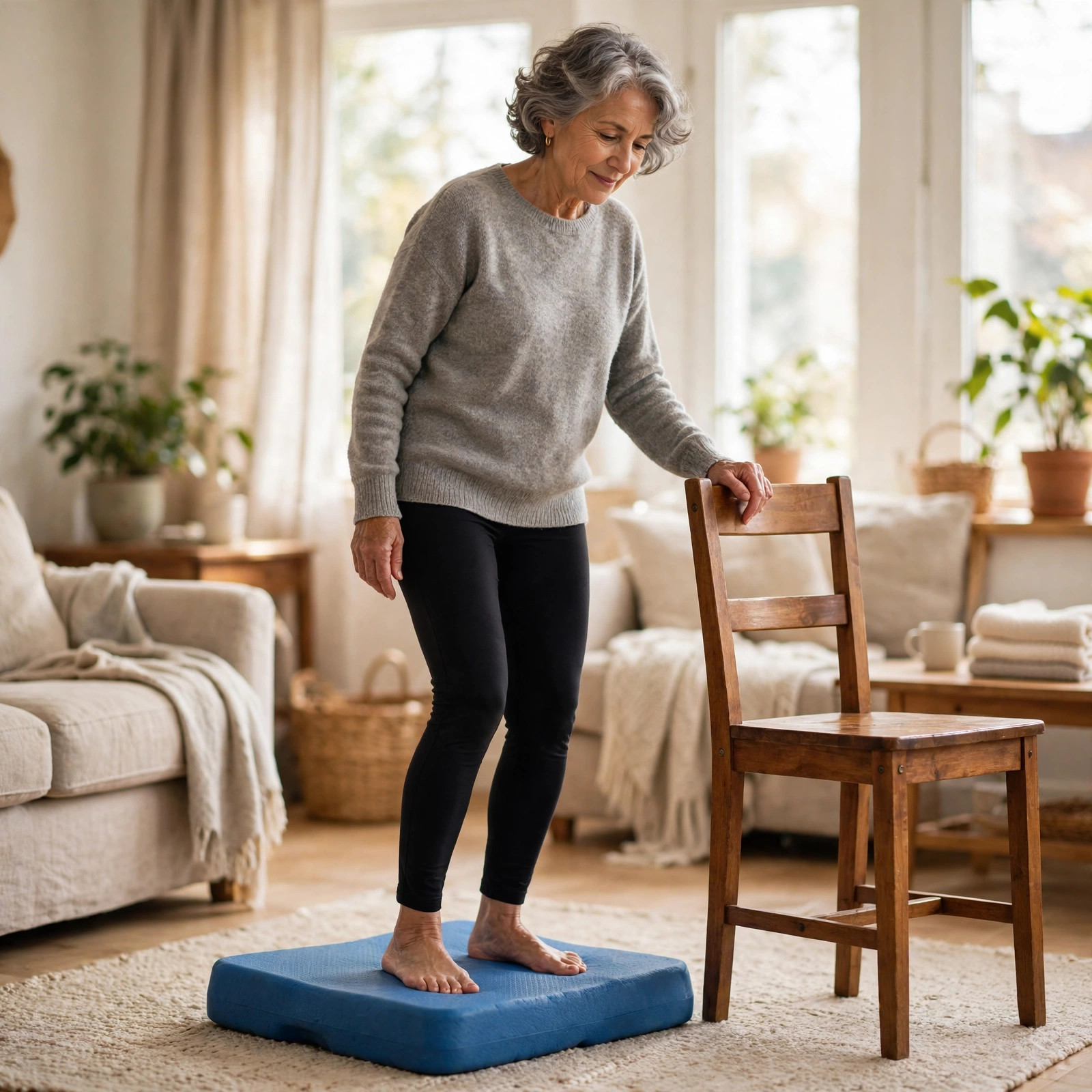
What it is: A thick block of dense foam, usually 2–3 inches tall, that sinks and shifts slightly under your weight.
Who it’s for: The best starting point for most adults over 55, especially beginners or anyone who feels unsteady. It is flat, low, and has no hard pivot — it compresses under your feet rather than tipping over.
Difficulty: ★☆☆☆☆ — Easy.
How to use it: Stand on the pad near a chair or wall; progress to slow weight shifts, marching in place, or partial squats.
Safety cautions: Start with support nearby — the foam can feel surprisingly unstable. Choose a textured, non-slip pad dense enough to support your weight without bottoming out.
2. Rocker Boards (Front-to-Back Tilt Boards)
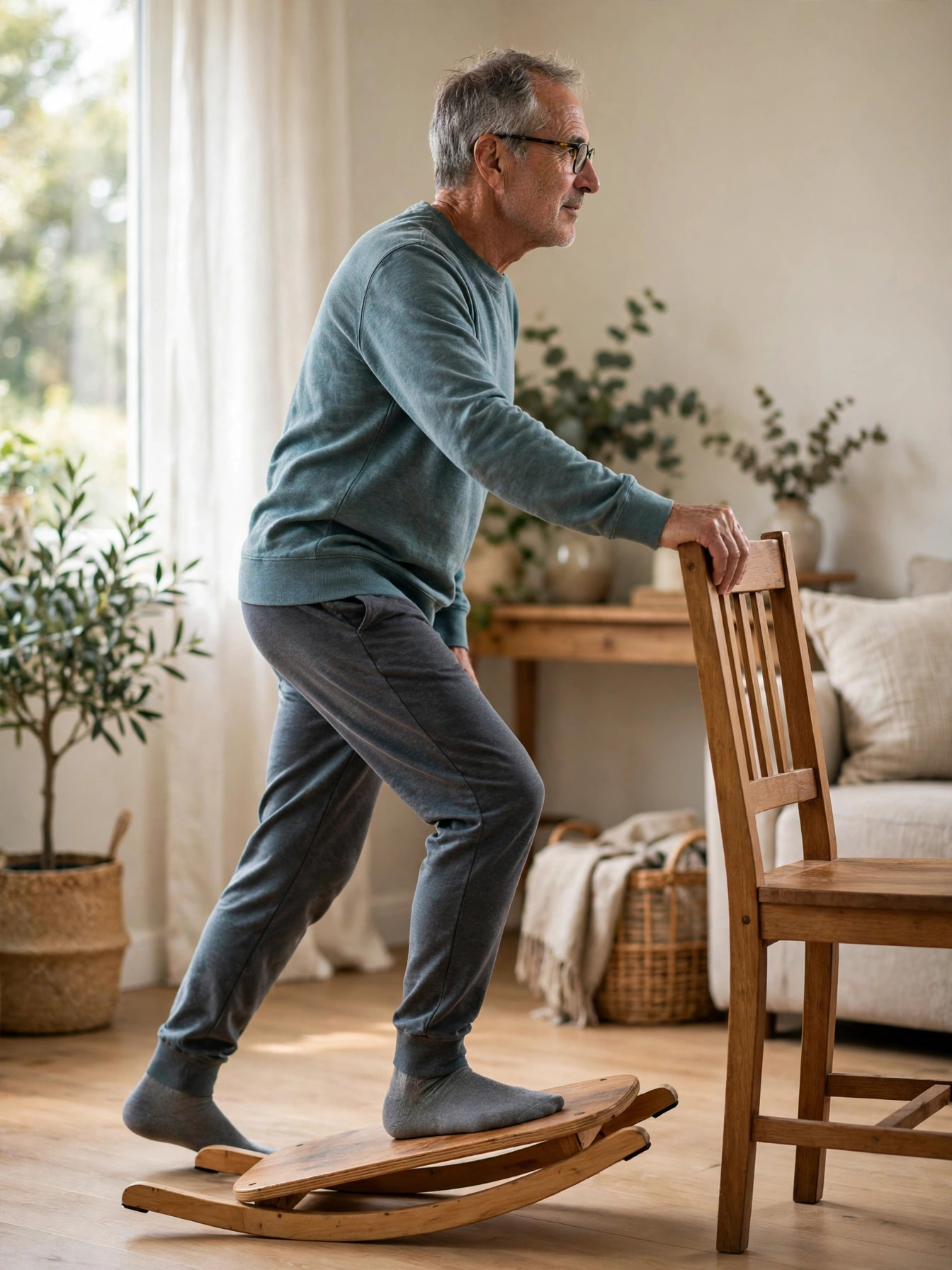
What it is: A flat platform on curved rails or a cylindrical base that tilts in one plane — front to back.
Who it’s for: Beginners who have outgrown a foam pad. One-direction tilt is far easier to control than a full wobble board.
Difficulty: ★★☆☆☆ — Beginner-friendly.
How to use it: Stand with knees slightly soft and rock forward and backward in a small, controlled range; add gentle squats as you progress.
Safety cautions: Keep movements slow and small. Use the board on a non-slip surface, with a chair or countertop within arm’s reach.
3. Wobble Boards (360° Balance Boards)
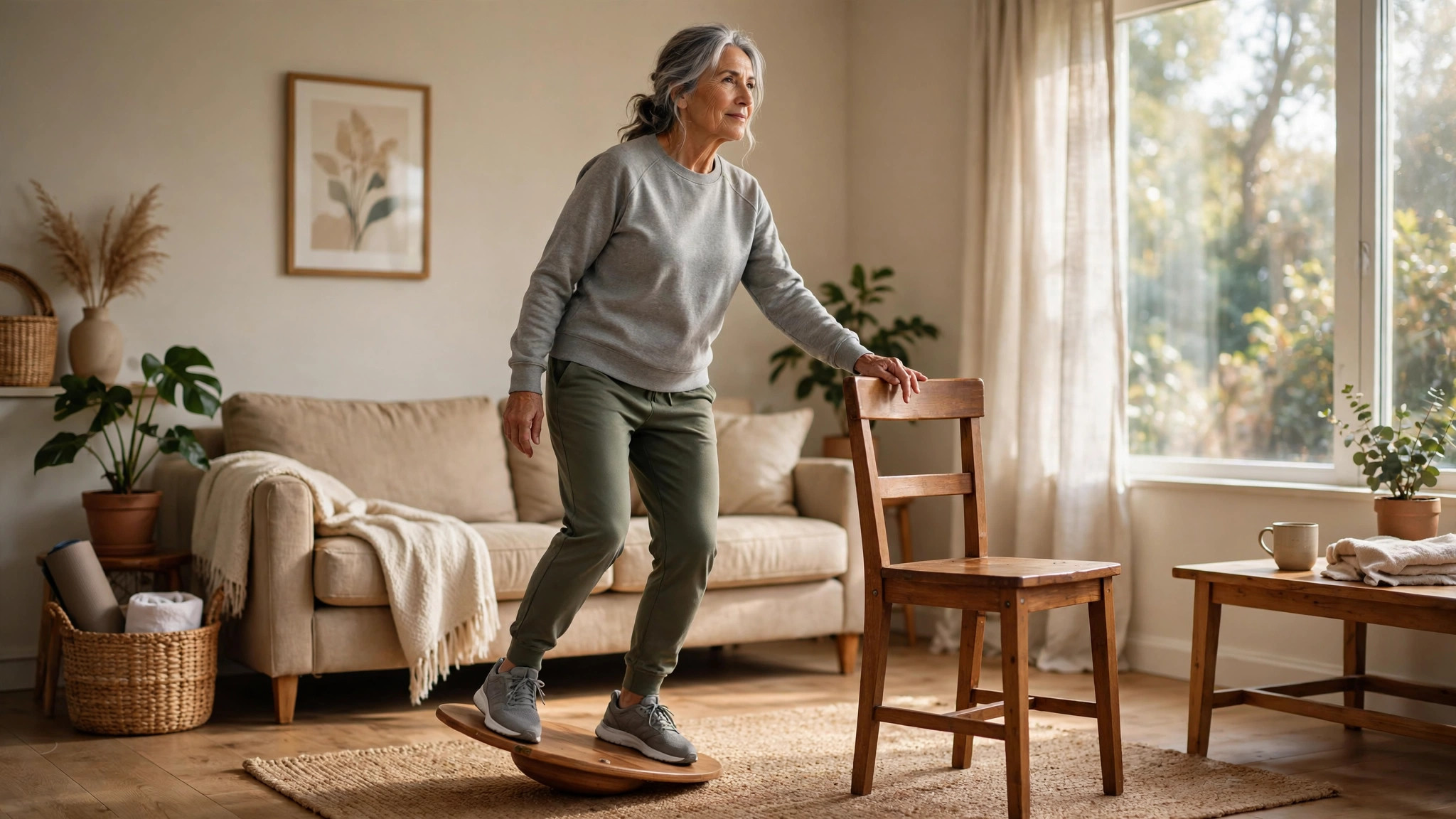
What it is: A round or square platform on a ball or dome underneath, tilting in every direction at once — the classic “wobble board” the NIA lists as a balance exercise option.
Who it’s for: For intermediate users ready for a bigger challenge — all-directions tilt demands quick corrections from ankles, knees, hips, and core.
Difficulty: ★★★☆☆ — Intermediate.
How to use it: Start with both hands on a sturdy support; progress from holding still to controlled tilts in different directions.
Safety cautions: Not a first-day tool — the 360° movement can tip sharply. If you have joint replacements, significant ankle weakness, or a fear of falling, clear it with a physical therapist or doctor first.
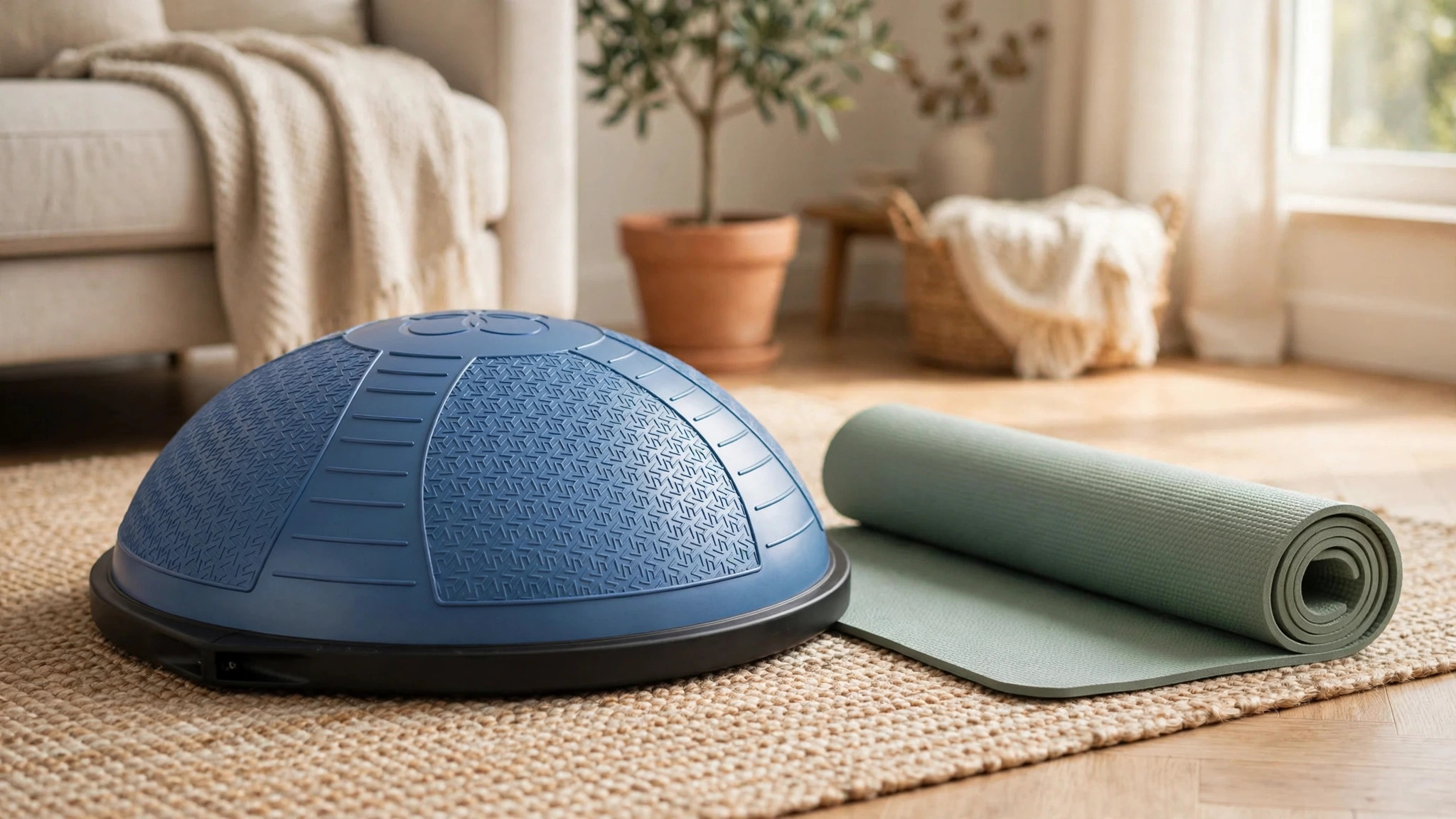
4. Half-Dome Trainers (BOSU-Style Trainers)
What it is: A half-inflated dome on a flat, rigid base. Dome-side up, you stand on a springy surface; flip it over and you balance on the flat platform while the dome rocks underneath.
Who it’s for: Intermediate to advanced users wanting versatility — balance work, gentle strength moves like push-ups against the dome, and seated core exercises.
Difficulty: ★★★★☆ — Intermediate to advanced (dome side up is easier; flat side up is much harder).
How to use it: Start dome-side up with two-foot stands and weight shifts; try flat-side-up only once the dome side feels easy, with support nearby.
Safety cautions: The flat side can roll under your feet. Avoid slippery floors, inflate only to the recommended firmness, and check periodically for air loss.
Which Type Should You Start With?
Start with the least unstable option that still feels like a challenge, and progress one step at a time:
- New to balance training, or a recent fall: Start with a foam balance pad — or no equipment at all. Master single-leg stands and heel-to-toe walks first (see our guide to balance exercises to prevent falls after 60).
- Comfortable on a pad: A rocker board adds controlled tilt without 360° movement.
- Steady on a rocker board: A wobble board or half-dome trainer (dome side up) is the next step.
- Recovering from injury or joint replacement, or managing vertigo: Choose with a physical therapist or doctor first.
No prize for jumping ahead — slow progression means fewer mishaps and better results.
Balance Trainer Buying Checklist
- Weight capacity: Make sure the stated maximum comfortably exceeds your body weight — a trainer used near its limit feels less stable and wears out faster.
- Non-slip surface: A textured or rubberized top keeps feet from sliding; a non-slip base keeps the trainer from skidding on hard floors. Smooth, glossy surfaces are a red flag.
- Platform size: The surface should fit both feet comfortably with room to spare. Too small forces a cramped stance and makes every exercise harder than needed.
- Base stability and floor protection: Boards with rounded or padded bases are gentler on floors. On hardwood, train on an exercise mat or carpet regardless.
- Warranty and build quality: Solid wood and high-density foam tend to outlast thin plastic. A manufacturer warranty of a year or more is a good sign the company stands behind its product.
- Price tiers (general terms): Foam pads are typically the most budget-friendly entry point. Wooden rocker and wobble boards usually sit in the mid-range. Half-dome trainers often cost more, with premium commercial-grade models at the top.
Safety Rules for Training at Home
- Keep support within reach. A sturdy chair, heavy table, or wall should be within arm’s length, especially in your first weeks. The NIA advises having a sturdy chair, person, or wall nearby to hold onto for support.
- Set up your space. Train on a flat, non-slip surface with a few feet of clear space around you. Remove loose rugs, cords, and clutter.
- Choose footwear deliberately. The NIA advises comfortable, stable footwear or going barefoot to keep grip on the floor or mat. Avoid socks-only on hard floors.
- Start seated or supported. Begin each new tool or exercise with your hands on support, then gradually reduce your reliance as steadiness improves.
- Keep sessions short and regular. Aim for about three sessions a week — the NIA’s recommendation — five to fifteen minutes at a time. Tired muscles correct more slowly, so rest when fatigued.
- Progress gradually. Move to a harder tool or exercise only when your current level feels boringly easy, not merely achievable.
- Review your medications. Some common prescriptions — for sleep, anxiety, blood pressure, or pain — can cause drowsiness, dizziness, or slower reaction times that raise fall risk, according to the CDC. Mention your balance training at your next medication review.
If you have ever fallen, read our guide on what to do after a fall before restarting a home program.

When to see a doctor
A balance trainer is a fitness tool, not a medical treatment. Check in with your doctor — or better, a physical therapist — before starting if any of these apply:
- Frequent dizziness, lightheadedness, or vertigo (a spinning sensation).
- A fall in the past year, especially one that caused an injury.
- Severe balance problems, an inner-ear disorder, or a neurological condition such as Parkinson’s disease.
- You use a cane, walker, or wheelchair and are unsure what balance training is safe for you.
- A recent joint replacement, fracture, or surgery affecting the hips, knees, or ankles.
- New symptoms during training: chest pain, shortness of breath, vision changes, or numbness.
Cleveland Clinic geriatricians recommend that patients at risk for falls get a physical therapist evaluation to identify balance problems and build a tailored regimen. Mayo Clinic likewise advises getting a healthcare professional’s OK before balance exercises if you have serious balance problems or a condition affecting bones, joints, or muscles.
Do not try to push through worsening balance alone — professional guidance at the start means safer, faster progress.
Sources
- National Institute on Aging (NIA) — “Three Types of Exercise Can Improve Your Health and Physical Ability”: balance exercises help prevent falls; about three balance sessions per week with sturdy support nearby. https://www.nia.nih.gov/health/exercise-and-physical-activity/three-types-exercise-can-improve-your-health-and-physical
- Mayo Clinic — “Balance exercises”: especially important for older adults; fall risk rises after 65; get a healthcare professional’s OK with serious balance problems. https://www.mayoclinic.org/healthy-lifestyle/fitness/in-depth/balance-exercises/art-20546836
- CDC STEADI — “Pharmacy Care (STEADI-Rx)”: about 3 million ED visits, 1 million hospitalizations, and 41,000 deaths from falls annually; some medications increase fall risk. https://www.cdc.gov/steadi/hcp/clinical-resources/pharmacy-care.html
- Cleveland Clinic — “Keeping Patients Physically Active as They Age”: balance exercises help at-risk patients; physical therapist evaluation recommended; 12–15 weeks of tai chi linked to up to 30% lower fall risk over two years. https://consultqd.clevelandclinic.org/keeping-patients-physically-active-as-they-age-advice-from-geriatricians
This article is for informational purposes only and is not a substitute for professional medical advice. Always talk to your doctor or a qualified health professional before starting a new exercise program, especially if you have balance problems, a medical condition, or take medications that affect dizziness or coordination.