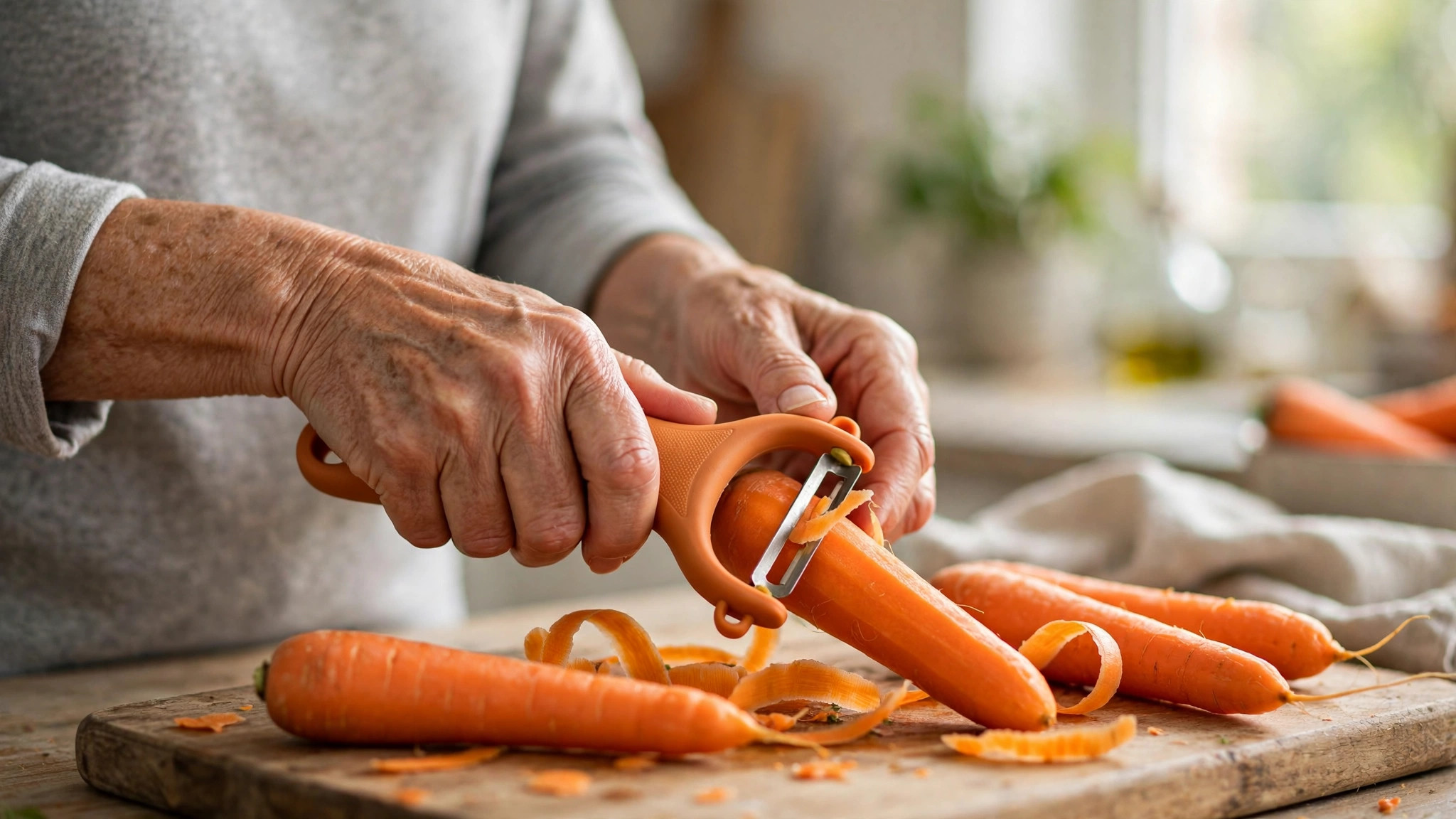
Best Kitchen Tools for Arthritis: A Buying Guide
Opening a jar, chopping an onion, or lifting a full kettle used to be automatic. When arthritis settles into your hands, these small jobs can come with aching fingers, a weakening grip, or a sharp twinge at the base of the thumb. The CDC reports that 47.8% of U.S. adults aged 65 and older have been diagnosed with arthritis (National Council on Aging, 2026).
In the hands, osteoarthritis most often strikes the joint at the base of the thumb (the carpometacarpal, or CMC, joint) and the small joints of the fingers — and hand therapists note that forces applied through the tip of the thumb while pinching are multiplied around twelve times at that base joint, which explains why pinching, twisting, and gripping hurt the most (NHS hand therapy, Poole Hospital).
You do not have to give up cooking. Occupational therapists keep returning to the same strategy — joint protection — and the right tools are at its heart: wider handles, softer grips, lighter weight, and lever or electric action lower the force each task demands of your fingers and wrists. This guide walks through the tool types that matter most and how to shop wisely.
As an Amazon Associate, we earn from qualifying purchases.
Why ordinary kitchen tools hurt arthritic hands
Twisting a lid torques the thumb joints, gripping a thin knife handle concentrates pressure through the knuckles, and lifting a heavy pot loads the wrist. When cartilage is worn, those everyday forces register as pain.
The National Council on Aging’s arthritis guidance lays out the joint-protection principles occupational therapists teach: use larger handles, recruit bigger joints (wrist, elbow, shoulder) rather than the fingers alone, use the palms to open lids, use two hands instead of one when lifting or stirring, and avoid forceful gripping, pinching, repetitive motions, and carrying heavy cookware one-handed. NHS hand therapy adds: respect pain, pace activities, avoid a tight or prolonged grip, and spread the load. The tools below are simply these principles, made of plastic, steel, and rubber.
What makes a kitchen tool joint-friendly: five features to look for
Whatever you are shopping for, the same five features signal that a tool will treat arthritic hands kindly:
- Wide, soft, non-slip handles. A larger handle spreads force across more of the hand, so each finger joint carries less. Foam tubing or pipe insulation around an existing handle is a cheap way to test whether a thicker grip helps before you buy (NHS hand therapy).
- Light weight. Lighter tools, pots, and kettles mean less load on wrists and thumbs.
- Lever action instead of twisting. Leverage multiplies the force your hand produces, so your joints produce less. Long-handled openers and lever-style faucet handles let you use the palm rather than gripping with the fingers (WebMD).
- Electric or powered help. A motor removes the hardest part of a task from your joints entirely (NCOA; WebMD).
- Stability built in. Non-slip mats and silicone-base bowls keep items from sliding, so you grip less hard to hold them steady (NCOA; WebMD).
One shortcut when choice feels overwhelming: look for the Arthritis Foundation’s Ease of Use seal. The Foundation’s certification program tests products through lab and human-factor analysis with a pass-or-fail result — including testing by people with arthritis — and certifies products shown to be easier to use for people with arthritis, chronic pain, and everyone else (Arthritis Foundation).
1. Jar and bottle openers
If one kitchen task defines hand arthritis, it is the stuck jar lid: twisting a small, smooth cap concentrates force straight through the thumb’s base joint. Several tool types address exactly this:
- Textured rubber gripper pads and mats. A simple pad of rubber or silicone (hand therapy services often call these Dycem mats) boosts friction between hand and lid, so you need far less grip force.
- Long-handled openers. A longer handle means more leverage, so a gentle push breaks the vacuum seal instead of a painful twist. Some designs also hook onto ring-pull cans.
- Mounted or under-cabinet openers. Fixed in place, these let you open jars one-handed or with minimal effort — useful when grip strength is very limited.
- Electric jar openers. Battery-powered openers grip the lid and do the turning for you, removing grip and twist from the task entirely.
What to look for: a handle you can hold with your whole palm rather than pinching with fingertips, a mechanism that fits the lid sizes you actually use, and — if your hands are very weak — a design that works one-handed. Larger grips and adaptive devices reduce the force a joint must apply, which makes the activity less painful (Cambridge University Hospitals NHS).
2. Rocker knives, ergonomic peelers, and easy cutters
Chopping demands two hard things at once: a firm grip and repeated force through the wrist. A family of tools redesigns the motion:

- Rocker knives. With a curved blade, you press down and rock instead of sawing. The rocking motion shifts the work from a tight finger grip to the palm and wrist, and some designs have two handles so both hands share the load (WebMD).
- Rolling knives and pizza-style cutters. The wheel does the cutting as you guide it with an open palm — almost no gripping required.
- Press-top choppers and palm peelers. A downward press of the palm replaces the squeeze-and-slice of a knife.
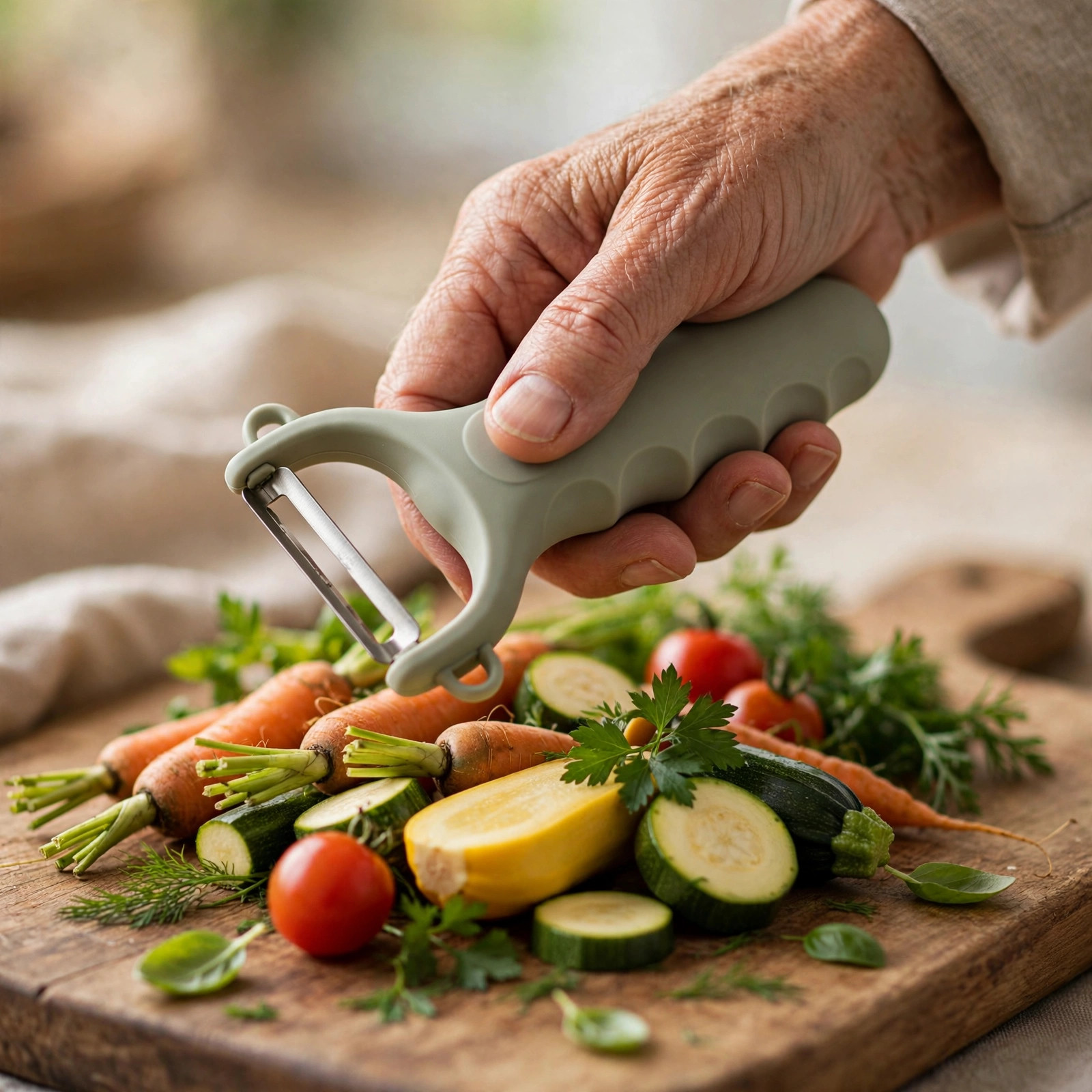
- Ergonomic peelers. Look for thick, soft, non-slip handles rather than thin metal ones. NHS hand therapy services list larger grips on peelers and ergonomic knives among their recommended kitchen gadgets, and note that an angled knife can reduce stress on the thumb joint (Cambridge University Hospitals NHS).
Before spending anything, try the foam-tube test: wrap pipe insulation around your current peeler or knife handle. NHS hand therapists suggest this as a way to learn whether a thicker handle will help — it costs almost nothing and tells you what to look for when you shop. For heavy prep days, an electric mini-chopper can take over the cutting entirely, and buying pre-cut produce is a reasonable strategy when your hands are having a bad day (NCOA).
3. Electric helpers: can openers, kettles, mixers, and slow cookers
Some tasks are hard on arthritic hands no matter how clever the handle is. That is when a motor earns its place:
- Electric can openers. A manual opener demands a hard pinch to pierce the lid and sustained cranking with the wrist. An electric model does both at a button press — hand therapy services list one-touch can openers among their most-recommended kitchen aids.
- Lightweight or pour-assist kettles. A full kettle is heavy, and the lift-and-tilt pour loads the wrist. Choose a lightweight kettle and fill it only as much as you need, or look for a design that tips and pours on a pivoting base rather than requiring you to lift and tilt.
- Slow cookers and one-pot appliances. Less active cooking means less chopping, stirring, and lifting — and fewer pots to wash. The NCOA recommends one-pot appliances such as slow cookers and pressure cookers to cut both effort and cleanup, and suggests lining baking pans with parchment paper and using a dishwasher to reduce scrubbing (WebMD).
When comparing electric models, favor large, easy-press buttons and simple controls — small fiddly dials can be as hard on sore fingers as a manual tool.
4. Easy-grip utensils, cookware, and a joint-friendly kitchen setup

Beyond the headline tools, everyday choices add up:
- Built-up utensils. Spatulas, ladles, and serving spoons with wide, soft, textured handles are easier to hold than slim metal ones.
- Two-handled pots and pans. Handles on both sides let you lift with two hands, distributing the weight evenly instead of concentrating the load into one wrist (WebMD; Arthritis Foundation guidance).
- Lightweight cookware and smaller containers. On a bad-hand day, a lighter pan you can lift safely is the better pan. The NCOA suggests filling larger pots with a smaller, lighter container of water rather than carrying a heavy full pot from sink to stove.
- Spring-loaded scissors. They spring back open on their own, sparing your fingers the repeated squeeze (NCOA; WebMD).
- Lever-style faucets or tap turners. Replacing twist knobs with lever handles lets you operate taps with a palm or the side of the hand — no gripping required (WebMD).
The setup around you matters too: keep everyday items on the counter or low shelves, sit down while chopping to conserve energy, and slide heavy pots across the counter on a hot pad instead of lifting them (NCOA). A small wheeled cart can move groceries or pans with far less lifting (WebMD).
A quick shopping checklist
- Does it carry the Arthritis Foundation Ease of Use seal or a similar ease-of-use claim backed by testing?
- Can you hold the handle with your whole hand, without pinching with your fingertips?
- Is it light enough when full for you to lift with two hands?
- Does it replace twisting or tight gripping with leverage, a palm press, or a motor?
- Could you operate it on your worst-hand day, not just a good one?
When to see a doctor
Better tools can make daily life much easier, but they do not replace medical evaluation. The Mayo Clinic’s arthritis guidance advises calling your doctor if you have new pain or persistent symptoms lasting several days or more, severe or worsening pain in one or more joints, or numbness or pain in your hands — and to seek prompt care after any joint injury. If hand discomfort is disrupting your daily routines, or symptoms keep getting worse, it is worth getting an evaluation, since treatment options depend on the diagnosis (Mayo Clinic News Network).
Patterns that deserve a clinician’s look include persistent swelling, visible changes in a joint’s shape, weakness or dropping objects, and tingling in the fingers. Note that not all hand pain is osteoarthritis: rheumatoid arthritis, an autoimmune condition in which the immune system attacks the joint lining, can lead to joint damage — and early evaluation can improve long-term outcomes, so persistent or symmetric symptoms should not wait (Mayo Clinic).
Our top picks
These are real kitchen tools sold on Amazon designed for weak or painful grips – matched to the task-based advice in this guide. Prices and ratings change – check the live Amazon page before you buy.

1. OXO Good Grips Twisting Jar Opener with Basepad
Grips any lid size – twist off stubborn jars without the hand pain.

2. OXO Good Grips 2-Piece Opener Set (Jar + Can Opener)
Jar opener + can opener in one set. The arthritis-friendly kitchen starter kit.

3. OXO Good Grips Swivel Peeler
The peeler that glides instead of drags. Soft grip, sharp blade, zero wrist strain.

4. OXO Good Grips 2-Piece Peeler Set (Straight + Julienne)
Straight + julienne in one set. Make vegetable noodles without the fight.

5. Kitchen Mama Auto Electric Can Opener
Hands-free can opening – press a button and walk away. A gift for tired hands.
Sources
- Arthritis Foundation — Ease of Use Certification Program: https://arthritis.org/partnership/ease-of-use-certification
- National Council on Aging (BEACON Senior News, July 2026) — Arthritis kitchen hacks for protecting your hands: http://coloradosprings.beaconseniornews.com/2026/07/01/576541/arthritis-kitchen-hacks-that-protect-your-hands-and-make-meal-prep-easier
- WebMD — Assistive Devices: Living Better With Arthritis: https://www.webmd.com/arthritis/features/cm/living-easier-arthritis-devices
- NHS / Poole Hospital — Osteoarthritis of the hand patient information leaflet: https://www.uhd.nhs.uk/uploads/about/docs/our_publications/patient_information_leaflets/Hand_therapy/OA_of_the_hand_patient_info_sheet.pdf
- Cambridge University Hospitals NHS — Osteoarthritis of the hand information sheet: https://www.cuh.nhs.uk/patient-information/osteoarthritis-of-the-hand-information-sheet/
- Mayo Clinic News Network — Q and A: Understanding osteoarthritis and rheumatoid arthritis: https://newsnetwork.mayoclinic.org/discussion/mayo-clinic-q-and-a-understanding-osteoarthritis-and-rheumatoid-arthritis/?mc_id=us&utm_source=newsnetwork&utm_medium=l&utm_content=content&utm_campaign=mayoclinic&geo=national&placementsite=enterprise&cauid=100721
This article is for general information only and is not medical advice. Talk to your doctor or an occupational therapist about your hand pain.