Best Food Processor for Seniors: Easier Chopping Without Knife Strain
If chopping vegetables has gone from a pleasant kitchen ritual to a painful chore, you are not alone. Grip strength and hand comfort tend to decline with age, and conditions like arthritis make holding and controlling a knife genuinely difficult. The CDC estimates that about one in four US adults has some form of arthritis, and hand and wrist joints are among the most commonly affected areas.
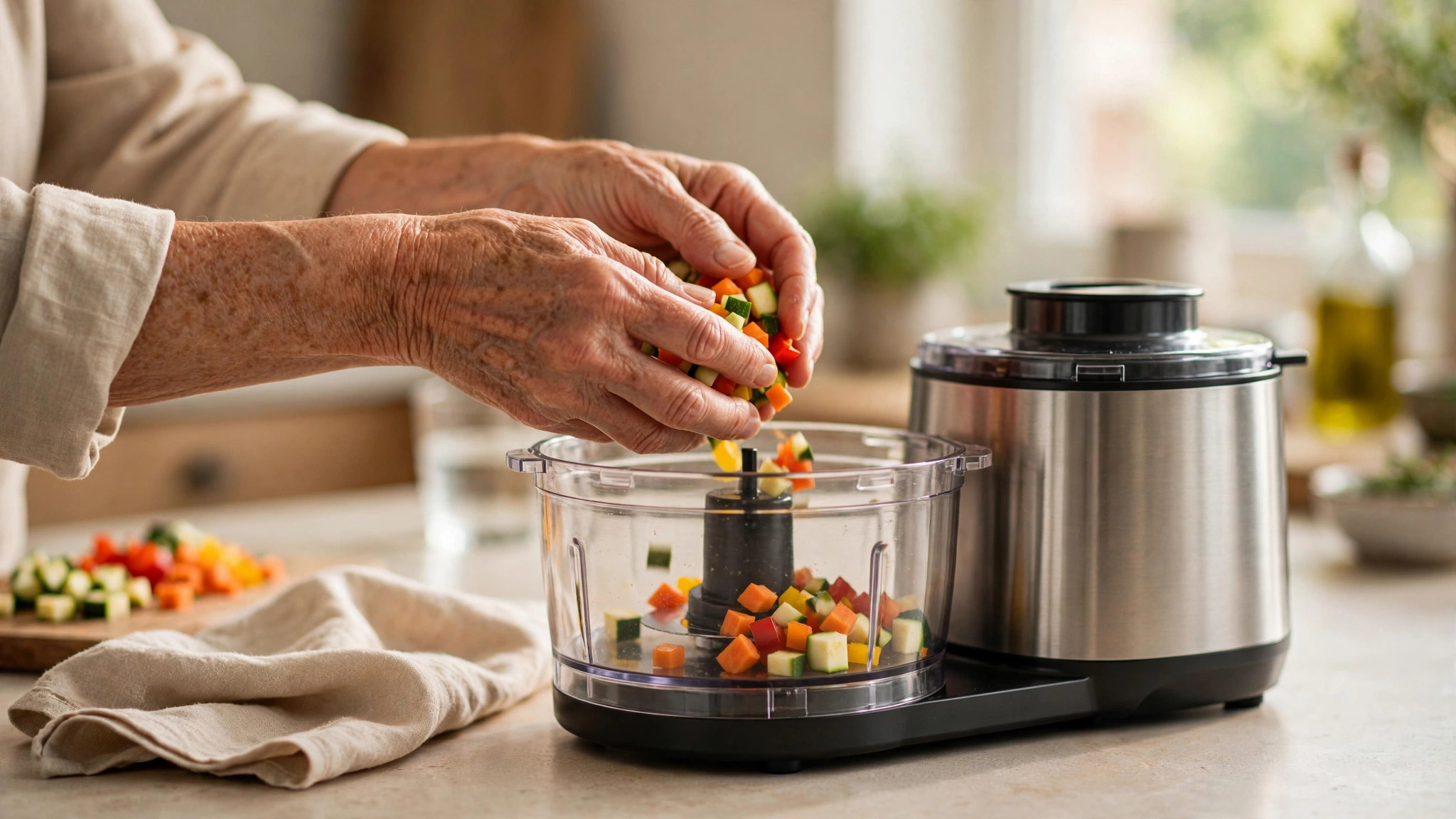
A food processor can be one of the most practical kitchen investments you make after 55. It takes over the repetitive chopping that tires your hands — dicing onions, slicing carrots, mincing garlic — while you simply feed ingredients through a tube and press a button. Less strain on your joints means you are more likely to keep cooking at home, which matters: eating well after 45 depends on regular home cooking, as covered in our guide on eating well after 45.
This guide explains exactly what to look for when choosing a food processor for older hands: bowl sizes, motor strength, pulse versus continuous controls, safety-lock lids, easy-clean designs, and the arthritis-friendly features that separate a good choice from a frustrating one. You’ll also find our top product picks at the end, matched to the buying criteria in this guide.
As an Amazon Associate, we earn from qualifying purchases.
Why chopping gets harder after 55
Aging hands face several compounding challenges. Arthritis can make gripping painful and reduce fine motor control. General grip strength declines with age, which makes controlling a knife safely harder. And reduced flexibility in the wrists can turn the rocking motion of chopping into an uncomfortable strain.
This is a bigger deal than convenience. A vegetable-rich diet like the Mediterranean pattern in our Mediterranean diet guide requires a lot of prep work. If chopping hurts, the temptation to reach for pre-packaged, higher-sodium alternatives grows.
The Arthritis Foundation encourages people with arthritis to use assistive kitchen tools and joint-protection strategies rather than pushing through pain. A food processor fits that philosophy perfectly: it transfers the work from your vulnerable joints to an electric motor.
What to look for: the five essentials
1. Bowl size
Food processors come in three broad size classes:
- Mini (3–4 cups): Good for one or two people and small jobs — mincing garlic, making pesto or dressing, chopping a handful of nuts. Light and easy to store, but too small for batch cooking.
- Compact/mid-size (7–9 cups): The sweet spot for many couples. Handles everyday tasks — slicing carrots, shredding cabbage, making hummus — without the weight of a full-size unit.
- Full-size (11–14 cups): Best if you cook for a family, batch-cook and freeze, or make dough. Heavier and bulkier, and the large bowl can be awkward to wash in a small sink.
For most older adults cooking for one or two, a compact or mid-size model offers the best balance of capability and manageability.
2. Motor power
A motor in the range of roughly 450–700 watts handles vegetables, nuts, and even light dough work comfortably. Mini models with 250–350 watts are fine for soft ingredients but may struggle with harder jobs like grating raw carrots or processing frozen fruit. The practical test: the motor should not sound strained or smell hot after a minute or two of vegetable processing. More powerful motors tend to run smoother, which means less vibration transferred to your hands.
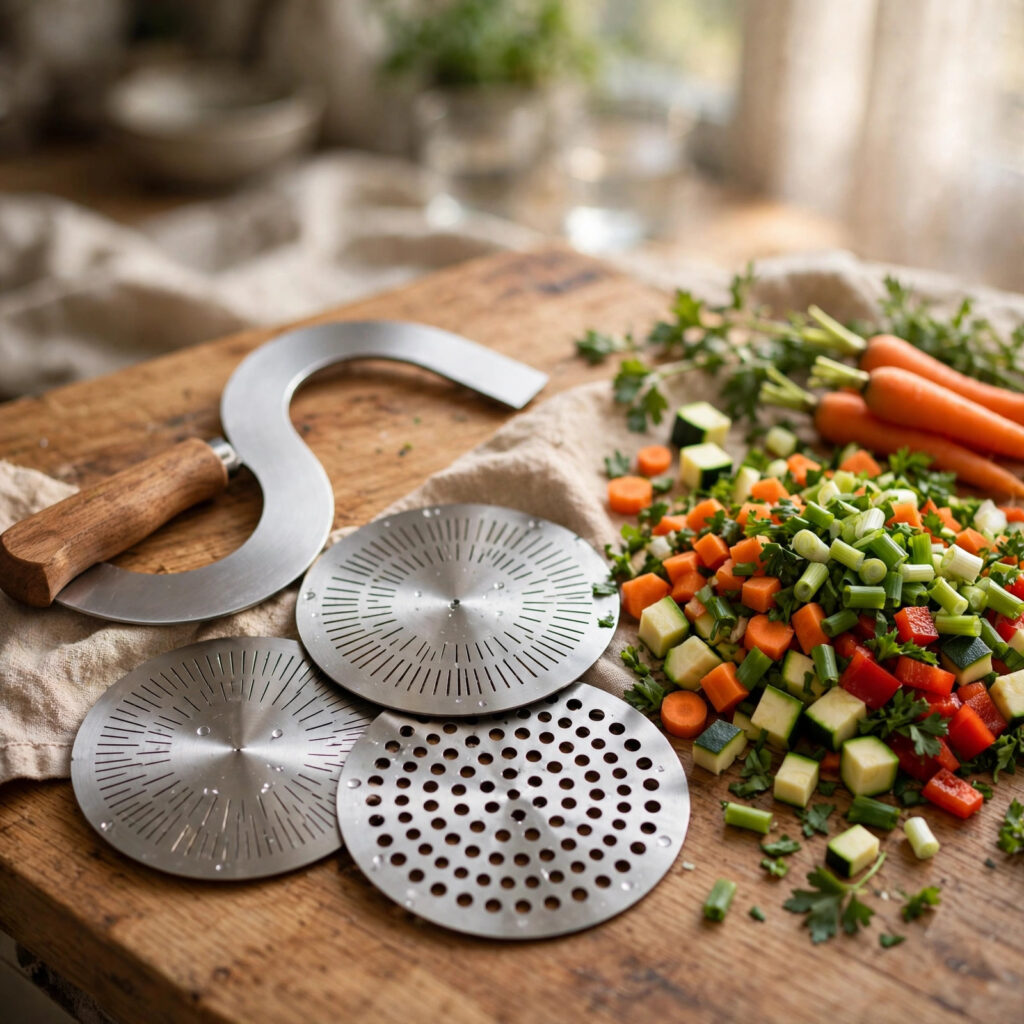
3. Blades and discs
At minimum, you want:
- A chopping (S-blade) for onions, herbs, nuts, and sauces
- A slicing disc for even vegetable slices
- A shredding/grating disc for cheese, carrots, and cabbage
Look for blades made of stainless steel that hold an edge and are labeled dishwasher-safe. Some models also include a dough blade, which is useful if you bake bread — but not essential.
4. Pulse vs. continuous settings
This matters more than most buyers realize. Pulse gives you short bursts of power — one press, the blades spin; release, they stop. It gives the best control over texture and prevents over-processing (the difference between chopped onions and onion puree). Continuous (on/off) runs until you switch it off, which is better for smooth sauces and long blends.
Choose a model with both. A pulse button is especially valuable for older users because it works in a single press-and-release motion — no holding a switch down — which is easier on stiff fingers.
5. Safety interlock lids
This is the most important safety feature, and you should treat it as non-negotiable. A safety interlock means the motor will not run unless the lid is fully locked in place. This prevents the blades from spinning when the bowl is open — the scenario that causes most food processor injuries.
Beyond the interlock, helpful safety details include a wide feed tube (so your fingers stay well away from the blades when pushing food in, with a pusher tool provided) and a lid that locks with a simple twist rather than requiring brute force to seat.
Types at a glance: which style suits you?
Rather than thinking in brand names, think in use cases:
- If you mostly do small jobs (chopping herbs, making dressings, mincing a few cloves of garlic): a mini processor is lighter, easier to clean, and takes up little storage. Its main limitation is capacity — you cannot do a full batch of anything.
- If you cook full meals for one or two: a compact 7–9 cup model with pulse and at least a slicing disc is the most versatile single appliance.
- If you batch-cook or make dough: a full-size unit with a stronger motor is worth the extra weight, as long as you have counter or low-cabinet space and can lift the bowl comfortably (try the motion before buying if you shop in person).
Note the distinction from a blender: blenders excel at liquids and smoothies, while food processors handle dry or thick chopping and slicing. If smoothies are your goal, see our guide to the best blenders for smoothies after 50. Many kitchens benefit from one of each rather than forcing one appliance to do both jobs.
Arthritis-friendly features worth prioritizing
Beyond the basics, these details make a real difference for stiff or painful hands:
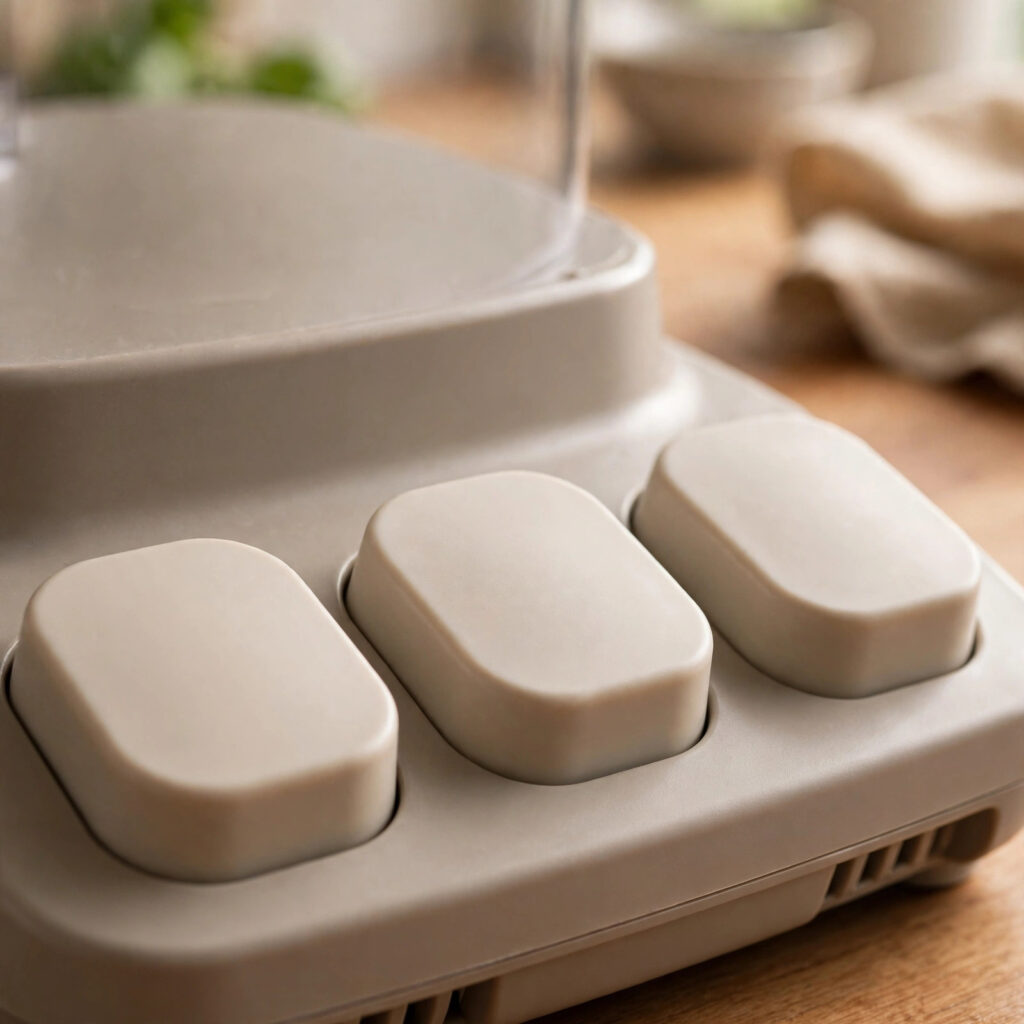
- Large, clearly marked buttons. Big paddle-style or oversized push buttons beat small dials or recessed controls needing fingertip pressure.
- One-touch pulse. A single press that runs a short burst with no holding down is gentler on fingers than switches you must keep pressed.
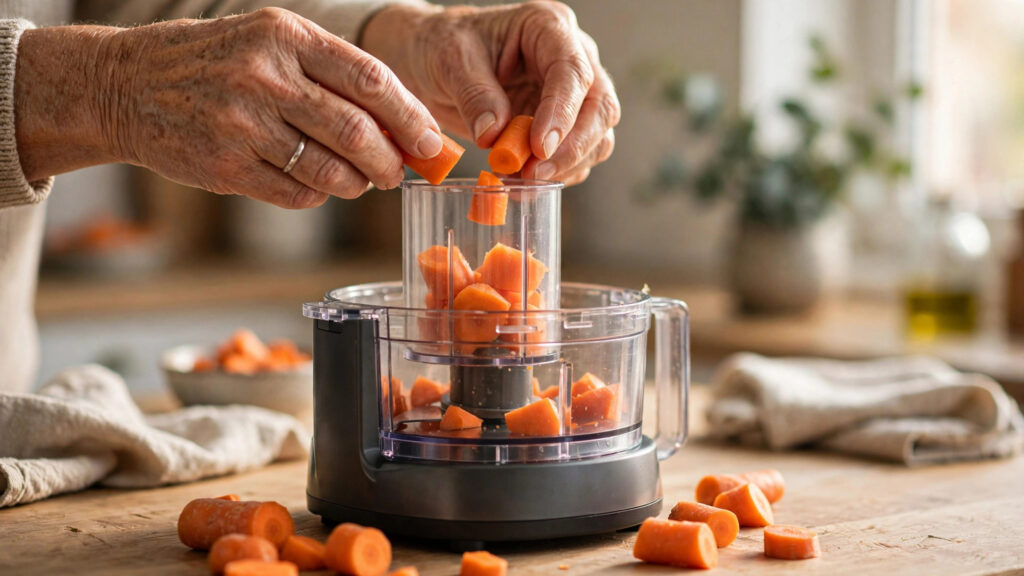
- Wide-mouth feed tube. Less need to pre-cut vegetables into small pieces — the tube accepts larger chunks, saving you knife work before the processor even starts.
- Stable, non-slip base. Suction-cup feet or a heavy rubber base keep the machine from walking across the counter while it runs, so you are not fighting vibration with your hands.
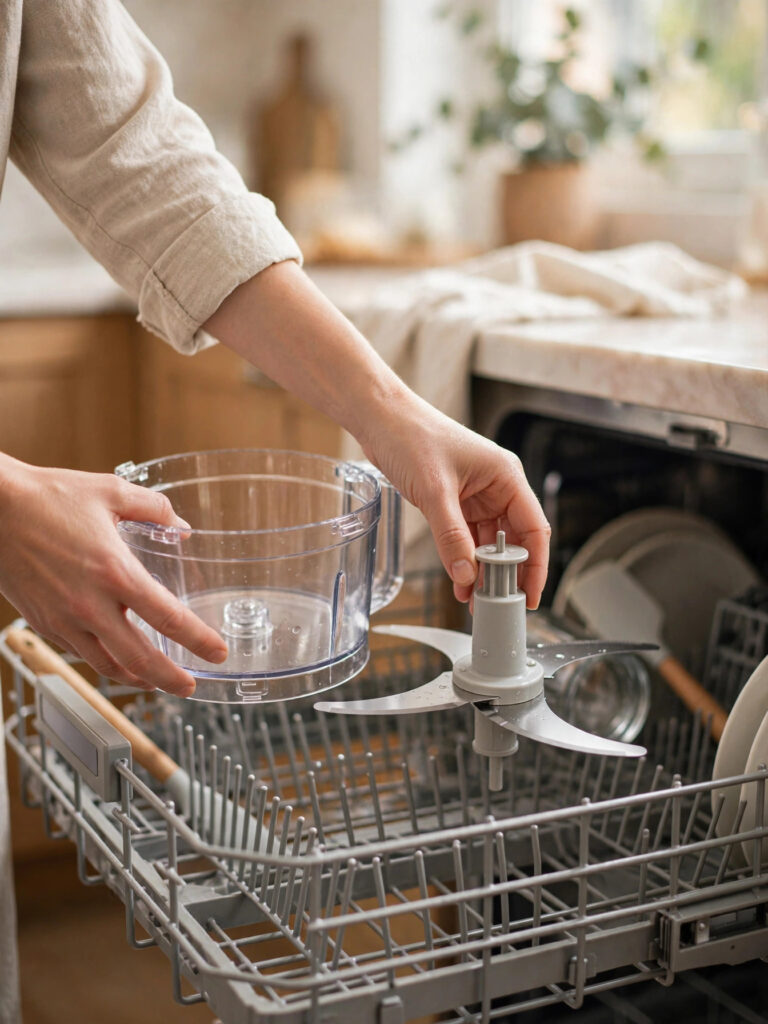
- Dishwasher-safe parts. Removable blades, bowls, and lids that go straight in the dishwasher eliminate the most dangerous cleaning step: hand-washing sharp blades. This is also the Arthritis Foundation’s general advice — let tools and machines do what strains your joints.
- Manageable weight. The bowl itself should be light enough for you to lift, pour from, and wash comfortably. In a store, try lifting the bowl as you would to empty it.
Safety tips for everyday use
Food processors are safe when used correctly, but a few habits keep them that way:
- Never reach into the bowl while the blade is attached. Remove the blade before scraping food out of the bowl — or use the spatula that often comes with the unit. Sharp blades deserve respect even when they are not spinning.
- Be careful with hot liquids. Hot ingredients can build up steam pressure inside a sealed processor. Let soups cool for several minutes before processing, fill the bowl no more than half full, and pulse in short bursts. Hot-liquid limits vary by model, so check your manual.
- Unplug before cleaning or changing blades. No fingers near the blade while plugging or unplugging — make unplugging the first step, always.
- Cut food to fit the feed tube. Forcing oversized pieces through the tube is how jams happen — and jams tempt people to reach in. Pre-cutting into chunks the tube accepts keeps everything moving smoothly.
- Keep the blade edges respected during washing. Even dishwasher-safe blades should be handled by their hub, not their edge. Use tongs or let the dishwasher do the work.
A note on food safety
Using a food processor does not change the basic rules of food safety from the USDA: wash fresh produce before chopping, clean the bowl and blades between raw meat and ready-to-eat foods (or better, process meats last), and refrigerate perishable preparations promptly. A processor makes food prep faster — but it does not make ingredients any less perishable.
Safety first: smart habits for any kitchen appliance
A food processor is an electrical appliance with a sharp blade, so treat it with the same common sense you would any power tool:
- Read the manual before first use. Every model’s lid-locking mechanism and hot-liquid limits are slightly different. Five minutes with the manual prevents most mistakes.
- Keep it stable and dry. Place it on a flat, dry counter away from the sink edge, and never run it with wet hands on the controls.
- Supervise when grandchildren visit. The interlock lid helps, but curious small hands and bladed appliances should never mix unsupervised.
- Retire a damaged machine. If the lid no longer locks securely, the bowl is cracked, or the motor sounds wrong, stop using it. A compromised interlock is a safety failure — replace the unit.
The bottom line
The best food processor for seniors is not the biggest or the most powerful — it is the one you will actually use without pain. Prioritize a safety-interlock lid, a simple pulse control, large easy-press buttons, a bowl size that matches how you cook, and parts that go in the dishwasher.
Take the time to test the motions in a store if you can: lock the lid, lift the bowl, press the buttons. Your hands will tell you more in thirty seconds than any specification sheet can.
Our top picks
These are real food processors sold on Amazon that fit this guide’s buying criteria – safety-interlock lids, simple pulse controls, arthritis-friendly buttons, and dishwasher-safe parts. Note all four are 7-8 cup models, the compact/mid-size sweet spot this guide recommends for most couples. Prices and ratings are approximate – check the live Amazon page.

1. Cuisinart 8-Cup Food Processor (FP-8GMP1, Gunmetal)
Chops a full meal’s worth of veggies in seconds – the 8-cup workhorse with a 350W motor.

2. Cuisinart 8-Cup Food Processor (FP-8SV, Silver)
Same trusted Cuisinart power, with medium-to-fine slicing discs for perfect salads.

3. Cuisinart Elemental 8-Cup Food Processor (White)
The compact 8-cup that handles daily chopping without hogging counter space.

4. KitchenAid 7-Cup Food Processor (KFP0718, White)
Blades store inside the bowl itself – no more digging through drawers. Clever design, easy cleanup.
Sources
- U.S. Centers for Disease Control and Prevention, “Arthritis” – https://www.cdc.gov/arthritis/basics/index.html
- Arthritis Foundation, “Joint Protection and Assistive Devices” resources – https://www.arthritis.org/health-wellness/healthy-living/managing-pain/joint-protection
- U.S. Department of Agriculture, Food Safety and Inspection Service, “Basics for Handling Food Safely” – https://www.fsis.usda.gov/food-safety/safe-food-handling-and-preparation/food-safety-basics/steps-keep-food-safe
- Cleveland Clinic, “Arthritis: Symptoms, Types, Causes & Treatment Options” – https://my.clevelandclinic.org/health/diseases/12061-arthritis
- National Institute on Aging, “Healthy Eating After 50” – https://www.nia.nih.gov/health/healthy-eating/healthy-eating-after-50
This article is for general information only and is not medical advice. Talk to your doctor or a registered dietitian about your personal nutrition needs.