Best Slow Cooker for Seniors: A Safe, Simple Buying Guide
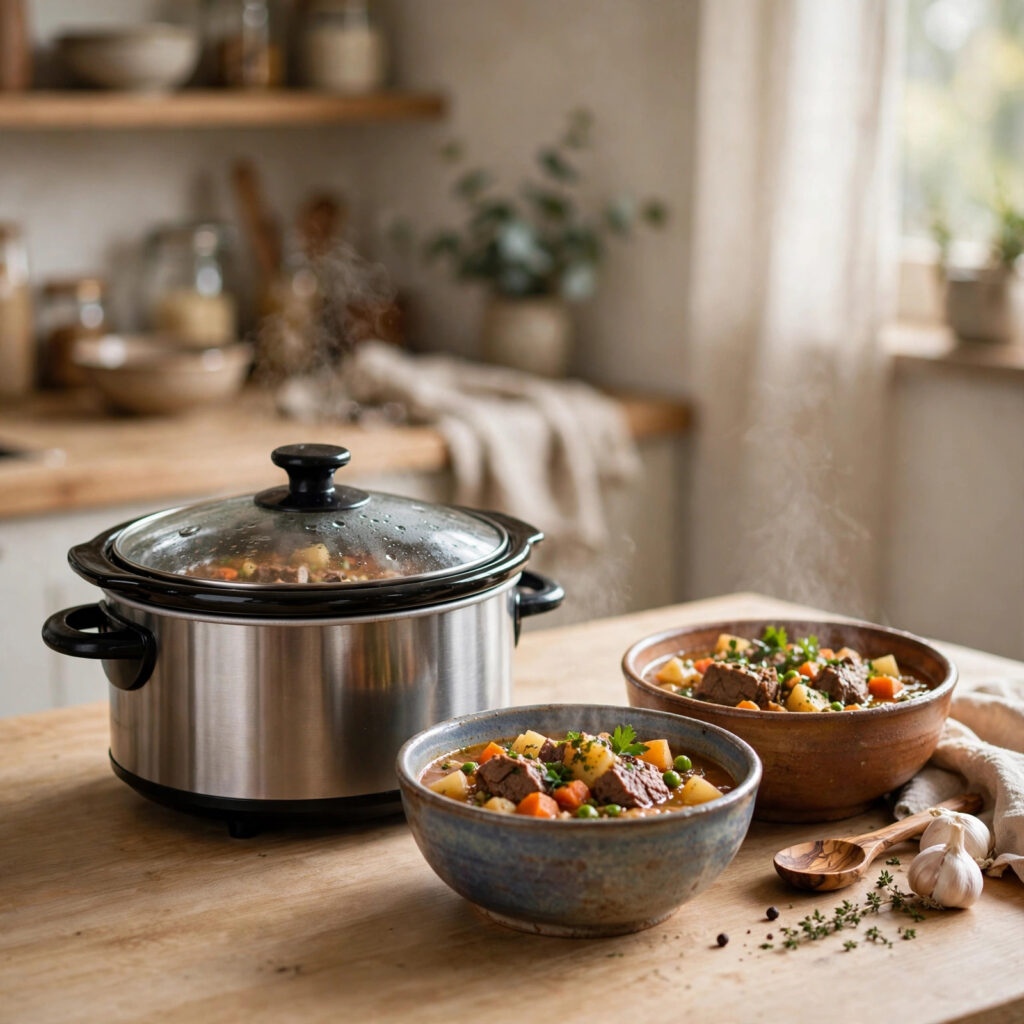
A slow cooker may be the most underappreciated appliance in a senior kitchen. You load it in the morning, walk away, and come back to a hot, home-cooked meal — no standing over a stove, no watching a pot that might boil over. For adults over 45 who want to eat well without spending hours cooking, that hands-off simplicity is genuinely useful.
But not every slow cooker suits a smaller household. The right size, a clear timer, a lid that seals well, and an easy-clean pot make the difference between an appliance you use weekly and one that gathers dust.
As an Amazon Associate, we earn from qualifying purchases.
Why a slow cooker suits cooking after 50
Cooking habits change with age: energy dips in the afternoon, long stretches of standing get harder on knees and backs, and appetite shrinks — yet cooking for one or two takes nearly as much effort as cooking for four.
A slow cooker helps on several fronts:
- Less standing. Prep takes 15–20 minutes in the morning, often seated at a counter, and the cooker does the rest.
- Tender results from cheaper cuts. The low, steady heat (roughly 170°F to 280°F, per USDA guidance) breaks down tougher, leaner cuts of meat, which tend to cost less and are often lower in saturated fat.
- Fewer dishes. Many recipes are genuinely one-pot meals.
- Steady, gentle heat. Unlike a burner you might forget, a slow cooker holds a steady temperature, and many models switch themselves to a warm holding setting when cooking time ends.
If you’re also weighing other small appliances, our roundup of the best kitchen gadgets for healthy cooking after 50 covers how a slow cooker compares with air fryers and other tools.
Getting the size right for one or two people
This is the single most important decision. Slow cookers are sold in "quarts," and recipes assume the pot is filled roughly one-half to two-thirds full — the USDA recommends this range so food cooks through properly. Too big for your recipe, and food cooks unevenly; too small, and it can overflow.
For one or two people who don’t want big batches of leftovers, a 3- to 3.5-quart cooker is usually about right. Most recipes can be halved to fit, and a 3-quart pot makes roughly 2–3 servings of a typical stew. Mississippi State University Extension calls this size "just right" for one to two people.
Consider a 4- to 5-quart model if you like cooking once and eating twice, make soups or stocks, or occasionally cook for grandchildren. Go to 6 quarts and up only if you regularly feed a crowd — an oversized cooker used for small recipes cooks less reliably, and a filled 6-quart ceramic pot is heavy. If lifting is a concern, smaller is genuinely better.
Tip: Check the weight of the removable inner pot, not just the whole appliance — you’ll lift it in and out for serving and washing.
Timer, warm setting, and controls: simpler is better
What to look for:
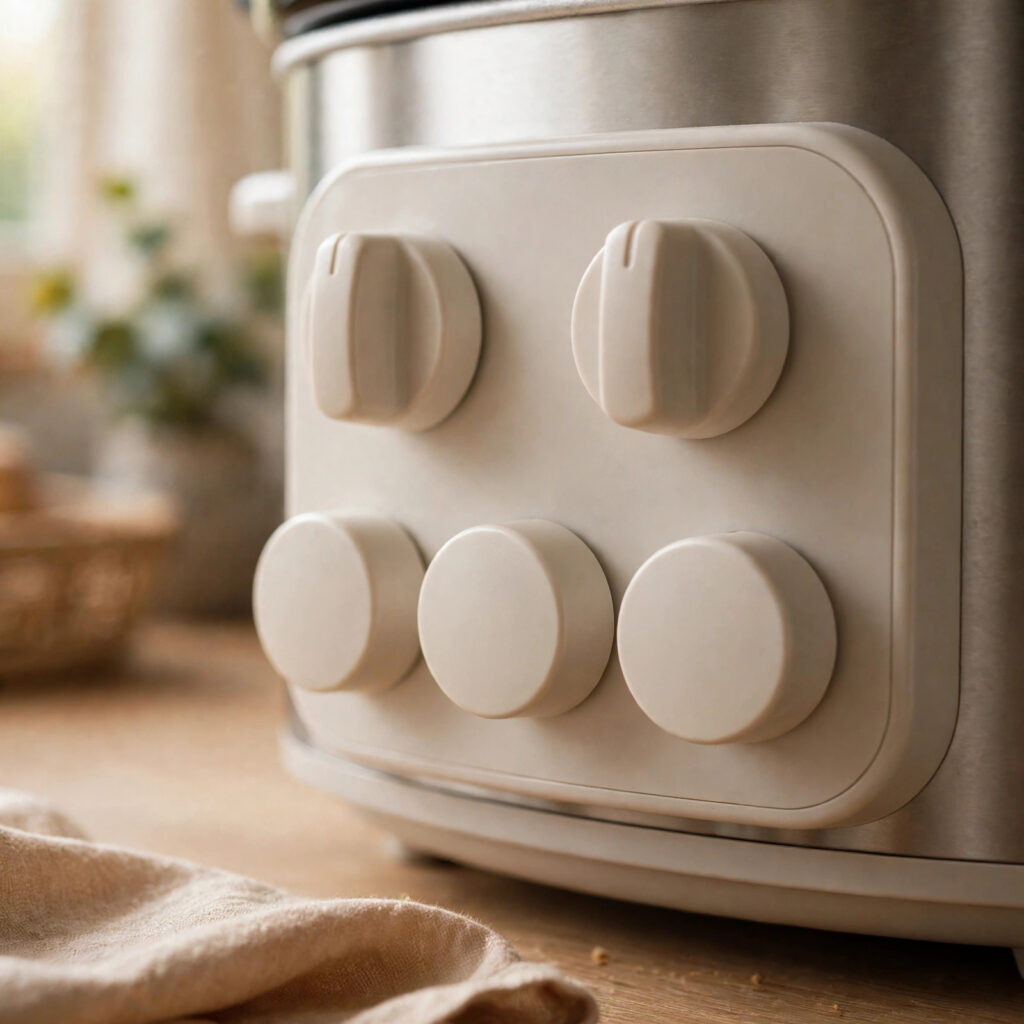
- A countdown timer with auto-switch to "warm." The single most useful feature for seniors. You set 6 hours, the cooker switches to a low holding temperature when time is up, and dinner waits safely instead of overcooking. (The USDA’s safe holding rule: keep hot food at or above 140°F.)
- Large, readable controls. A simple dial or a few big buttons beats a touchscreen with nested menus.
- High and low settings (plus warm). Most cooking happens on low; high is useful for the first hour if you’re in a hurry; warm is for holding, never for cooking.
- A power indicator light. Simple, but not universal — you want to know at a glance that it’s on.
What to skip: Wi-Fi apps and Bluetooth pairing. They add complexity and rarely work reliably enough to matter. A cooker that needs your phone to run its timer is solving a problem you don’t have.
The lid and seal: why it matters for safety
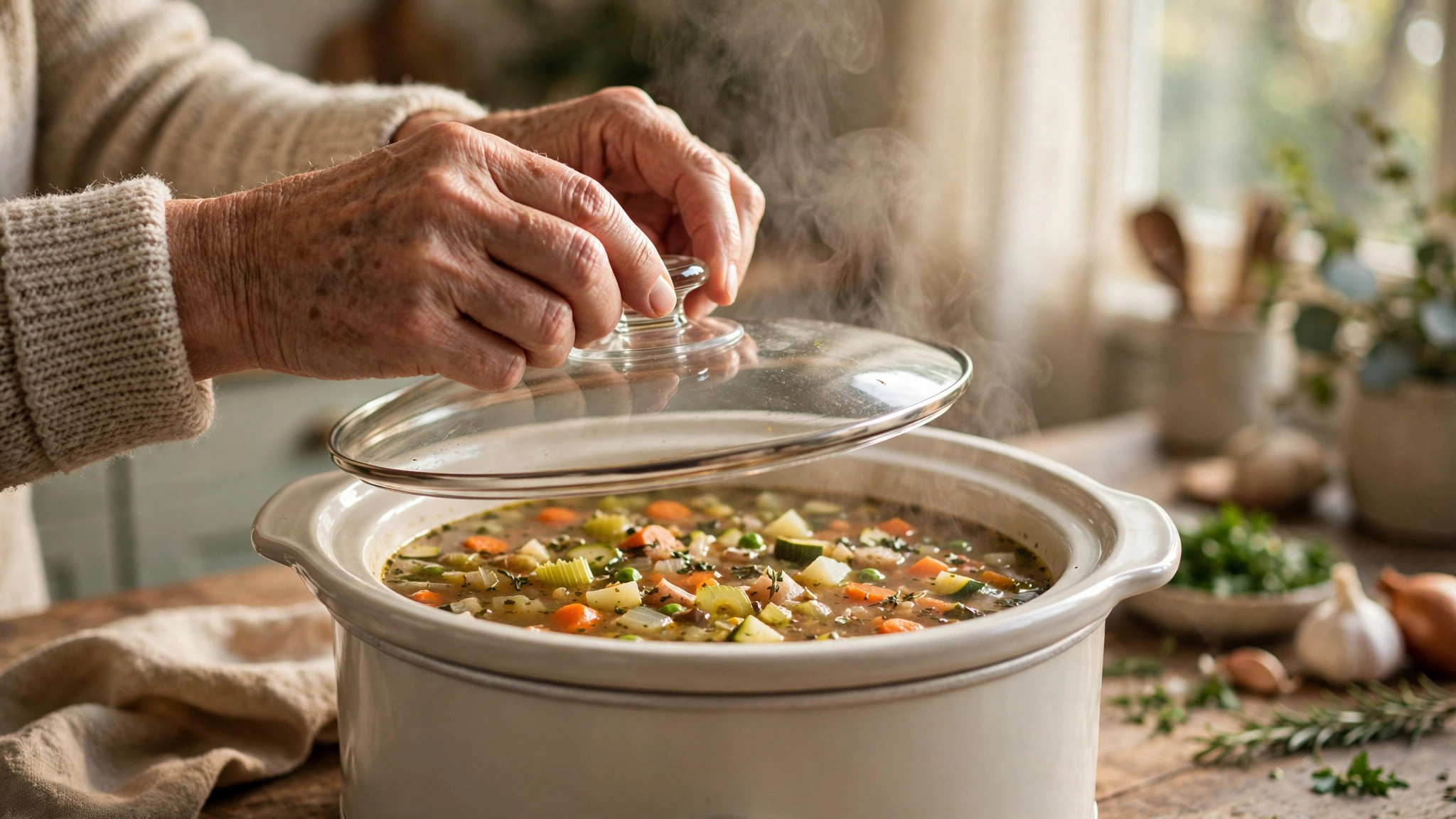
Steam trapped under a tight-fitting lid is part of what moves food through the temperature "danger zone" quickly enough to be safe. USDA guidance is explicit: keep the lid in place while cooking, removing it only to stir or check doneness — every lift releases heat and adds to cooking time.
When comparing models, check for a heavy, well-fitting lid (glass lets you peek without lifting), no wobble, and cool-touch lid handles. One caution: slow cookers a decade or older may run cooler than modern ones — if yours is a hand-me-down from the 1990s, a new cooker with a reliable thermostat is a worthwhile upgrade.
Easy-clean design: because nobody wants a chore after dinner
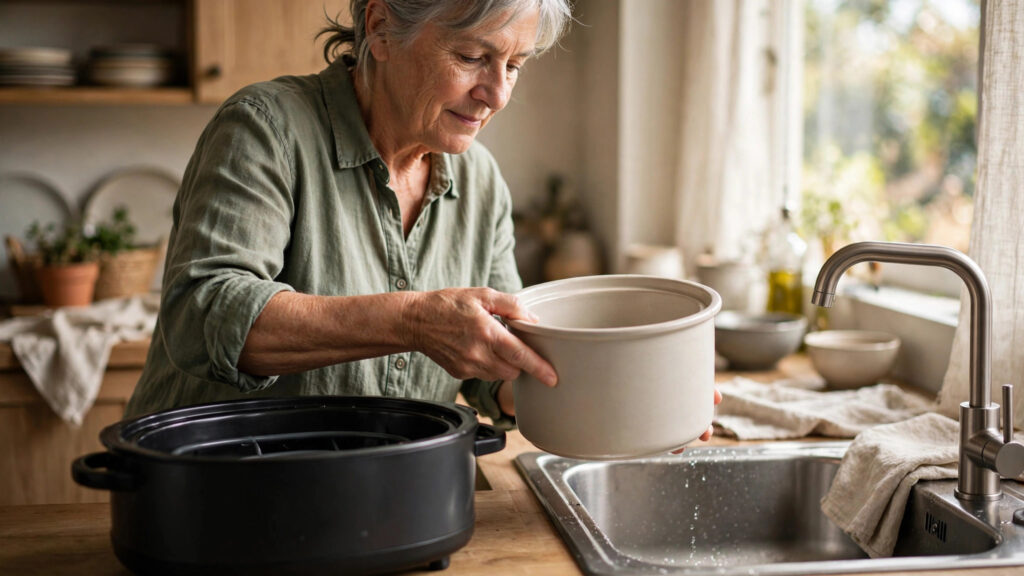
A cooker that fights you at the sink won’t get used. Insist on a removable inner pot (non-negotiable), a dishwasher-safe crock and lid, a wipeable base (the heating base never goes in water), and minimal crevices around the rim where splatter collects. A smooth-glazed interior cleans far more easily than an unglazed one — and for the messiest recipes, a slow-cooker liner bag is an optional convenience.
The three types: manual, programmable, and multi-cooker
Manual slow cookers have a dial: off, low, high, warm. They’re the least expensive and most reliable — but there’s no auto-switch to warm, so you need to be home (or use a separate plug-in timer) to change the setting.
Programmable slow cookers add a digital timer that switches from cooking to warm automatically — the sweet spot for most seniors.
Multi-cookers (pressure cooker plus slow cooker in one appliance) include a slow-cook function. If you already own one, you may not need a separate slow cooker — but their slow-cook mode can behave differently from a dedicated cooker, which is generally more forgiving for classic low-and-slow recipes. If you’re comparing appliances more broadly, our air fryer guide may help you decide where a slow cooker fits in your kitchen.
Bottom line on types: for most adults cooking for one or two, a small programmable slow cooker hits the best balance of simplicity, safety, and convenience.
Food-safety basics every slow-cooker user should know
Slow cookers are safe when used correctly — the combination of direct heat, trapped steam, and long cooking times destroys bacteria. But "set it and forget it" only works if food moves through the temperature danger zone (40°F to 140°F, where bacteria multiply fastest) reasonably quickly. These USDA core rules matter especially for older adults, whose immune systems may be less robust:
- Always thaw meat and poultry first. Never put frozen meat directly into a slow cooker — it spends too long in the danger zone while thawing. Thaw in the refrigerator overnight, in cold water, or in the microwave (cook immediately after microwave thawing).
- Keep perishable ingredients refrigerated until cooking time. Store meat and vegetables separately in the fridge; don’t leave the assembled crock out on the counter.
- Fill the cooker one-half to two-thirds full. Too little and food can burn; too much and it may not cook through in time.
- Keep the lid on. Every peek lets heat escape and extends cooking time.
- Layer dense vegetables on the bottom. Potatoes and carrots cook more slowly than meat.
- Cut large pieces of meat smaller. Big roasts may not cook through evenly.
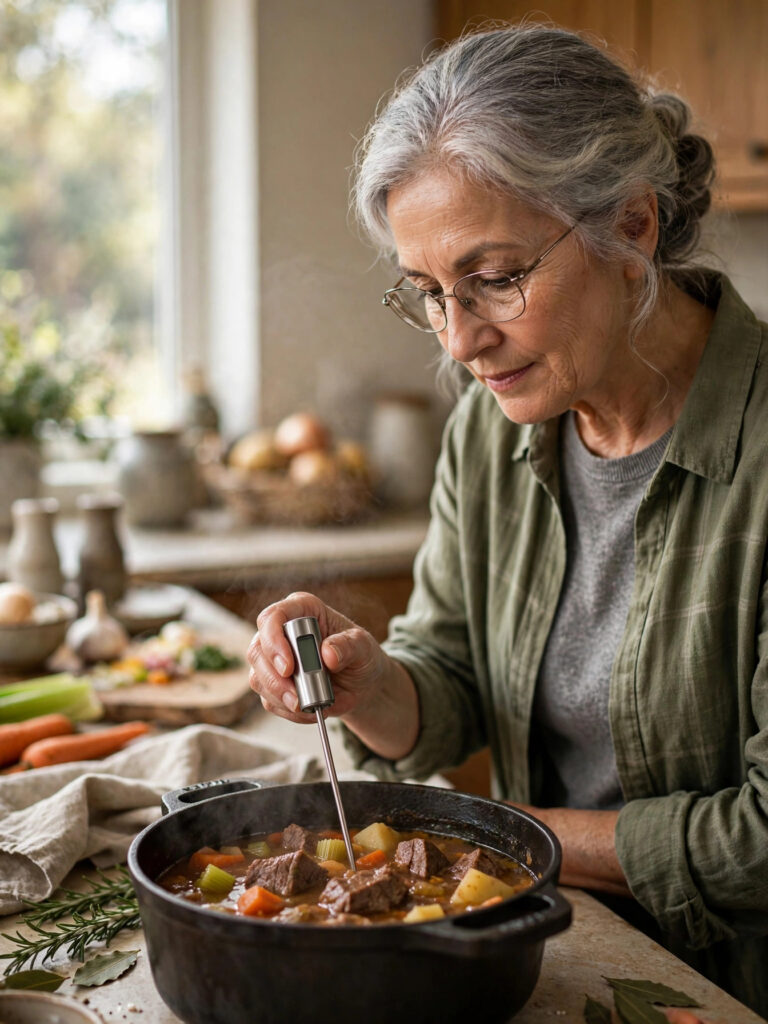
- Use the warm setting only for holding, never for cooking. A food thermometer is the only reliable way to check doneness.
- Refrigerate leftovers within 2 hours (1 hour if the kitchen is above 90°F), in shallow containers so they cool quickly. Leftovers keep 3–4 days in the refrigerator.
- Don’t reheat leftovers in the slow cooker — it’s too slow to move food through the danger zone. Reheat on the stove, in the oven, or in the microwave to 165°F.
- If the power goes out while you’re away, discard the food — you can’t know how long it sat uncooked. If you’re home, finish cooking immediately on the stove.
These aren’t fussy rules — they’re the difference between a safe meal and a preventable bout of foodborne illness, which hits older adults harder.
Safety first: cautions worth taking seriously
A slow cooker is one of the safer kitchen appliances, but a few cautions deserve attention:
- The exterior gets hot. Place the cooker where you won’t brush against it, and away from counter edges.
- Steam burns are real. Tilt the lid away from your face and hands when lifting; use oven mitts for the hot crock.
- Don’t leave food on warm indefinitely. Modern cookers are designed for unattended cooking, and auto-switch to warm makes this safer than it used to be — but food held for many hours is past its best. Plan recipes around your actual schedule.
- Check cords and plugs. A frayed cord, loose plug, or burning-plastic smell means it’s time to retire the cooker — not worth a repair attempt.
- Mind your grip. If you have arthritis or limited grip strength, test the lid and crock handles before committing — in a store if possible. A cooker you can handle comfortably is one you’ll actually use.
Getting the most from it: practical tips
- Brown meat first (optional). Searing adds flavor but isn’t required for safety — skip it on low-energy days without guilt.
- Dairy and fresh herbs go in last. Milk, cream, and cheese can curdle over long cooking; stir them in during the last 30 minutes.
- Use less liquid than you think. Slow cookers lose almost no moisture to evaporation, so cut the broth by about a third when converting stovetop recipes.
- Match recipes to the cooker size. A recipe written for 6 quarts won’t cook right in a 3-quart pot — halve it.
- Use it for healthy staples. Soups, stews, bean dishes, steel-cut oats, and vegetable-heavy curries are natural slow-cooker territory — and they line up well with the eating patterns in our guide to eating well after 45, where protein and fiber do the heavy lifting for aging bodies.
The bottom line
The best slow cooker for seniors isn’t the one with the most features — it’s the one that fits your household, switches itself to warm, seals in its heat, and cleans up without a struggle. A small programmable model (around 3 to 4 quarts) covers what most one- or two-person households need. Pair it with the USDA’s basics — thaw first, fill it halfway to two-thirds, keep the lid on, refrigerate leftovers promptly — and you’ve got one of the simplest, safest ways to keep home-cooked meals on the table after 50.
Our top picks
These are real slow cookers sold on Amazon that fit this guide’s buying criteria – small sizes suited to one- or two-person households, simple readable controls, and dishwasher-safe crocks. Note the article recommends 3 to 3.5 quarts as ideal; these 4-quart picks sit at the small end of the range and work well for couples or cook-once-eat-twice households. Prices and ratings are approximate – check the live Amazon page.

1. Crock-Pot 4-Quart Manual Slow Cooker (SCV400-B)
One dial. No apps, no menus, no learning curve – just turn it and come home to dinner.

2. Crock-Pot 4-Quart Manual Slow Cooker (SCV401-TR, Red)
The same dead-simple cooker buyers love, in a red finish that brightens up the kitchen.

3. Hamilton Beach 4-Quart Programmable Slow Cooker (33443)
Set the timer and walk away – it switches to warm all by itself. The true ‘set and forget’ pick.

4. Hamilton Beach 4-Quart Slow Cooker (33140G)
Three settings, nothing to figure out. The budget pick that does exactly what it promises.
Sources
- U.S. Department of Agriculture, “Cook Slow to Save Time: Four Important Slow Cooker Food Safety Tips” — https://www.usda.gov/about-usda/news/blog/cook-slow-save-time-four-important-slow-cooker-food-safety-tips
- Mississippi State University Extension, “Use slow cookers properly to avoid food-borne illness” — http://extension.msstate.edu/news/feature-story/2022/use-slow-cookers-properly-avoid-food-borne-illness
- U.S. Department of Agriculture, “Keep Your Team Safe During the Big Game” (danger zone 40°F-140°F, 2-hour/1-hour rule, reheat to 165°F) — https://www.USDA.GOV/about-usda/news/blog/2025/02/03/keep-your-team-safe-during-big-game
- U.S. Food Safety and Inspection Service fact sheet, “Slow Cookers and Food Safety” (via GovInfo) — https://www.govinfo.gov/content/pkg/GOVPUB-A110-PURL-gpo30229/pdf/GOVPUB-A110-PURL-gpo30229.pdf
- Centers for Disease Control and Prevention, “Preventing Food Poisoning” (four steps to food safety; danger zone 40°F-140°F; 2-hour/1-hour rule) — https://www.cdc.gov/food-safety/prevention/index.html
This article is for informational purposes only and is not a substitute for professional medical advice. Always talk to your doctor before changing your diet or routine.