
Best Knee Brace for Arthritis: A Choosing Guide
If you have knee arthritis, the brace aisle can feel overwhelming. Sleeves, hinges, straps, open-patella designs — dozens of options, all promising comfort. The honest truth is that no single design suits everyone. The best brace is the one that matches your particular symptom pattern, fits correctly, and that you will actually wear.
This guide covers the four main brace types, what each may help with, how to size one correctly, and when a brace isn’t enough on its own. You’ll also find our top product picks at the end, matched to the buying criteria in this guide.
As an Amazon Associate, we earn from qualifying purchases.
First, the honest part: what a brace can and can’t do
Osteoarthritis is the wear-and-tear deterioration of the cartilage cushioning your knee joint (Mayo Clinic). A brace cannot rebuild that cartilage or treat the arthritis itself. What it may do is make the knee feel and work better: supporting the joint, reducing swelling, and giving you more confidence while you walk.
Here’s how strong that evidence is:
- Harvard Health calls the evidence on braces “mixed,” but describes bracing as a noninvasive strategy worth trying when your relief goals are clear: compression reduces swelling, and less swelling means less pain and better movement.
- A 2019 review summarized by Medical News Today found low-grade evidence that braces can reduce knee osteoarthritis pain and stiffness and may improve function — though reviewers could not name an ideal brace type.
- The 2020 American College of Rheumatology / Arthritis Foundation guideline recommends a knee brace for knee osteoarthritis with mechanical instability, severe pain, or arthritis that limits walking, while the UK’s NICE guideline does not recommend braces. Experts disagree — worth knowing.
In short: a brace won’t heal your knee arthritis, and it isn’t certain to relieve your symptoms — but for some people it becomes an important tool for living with chronic knee pain.
The four brace types, matched to your symptoms
The Arthritis Foundation describes four common knee brace types, and Harvard Health’s expert review covers a nearly identical set. Start with how your knee feels, not just how much it hurts.
1. Compression sleeve — for mild aches and everyday swelling
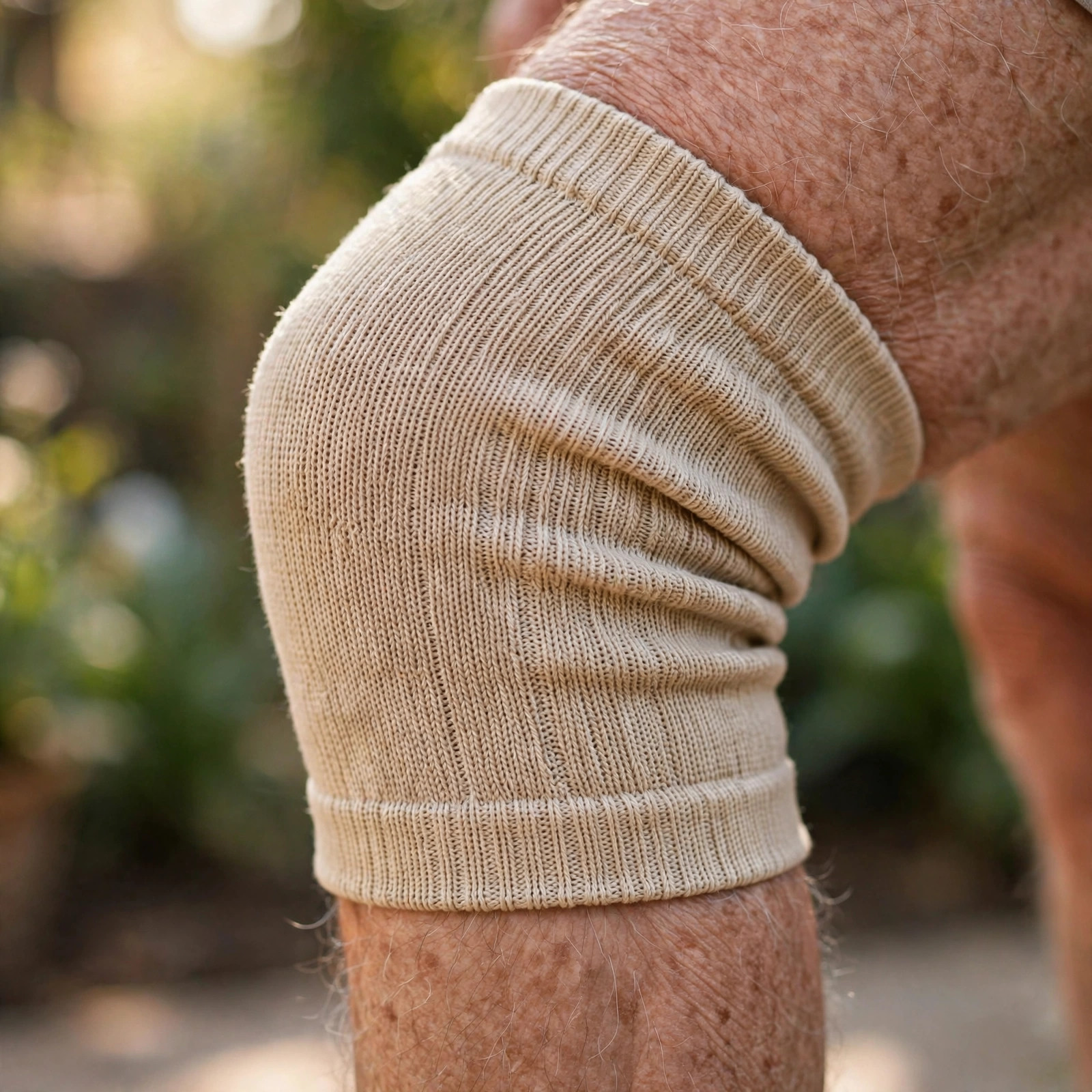
A compression sleeve is a stretchy tube you pull over the knee — typically extending about six inches above and below the joint, per Harvard Health. It gives warmth, a sense of support (though not true structural support), and compression that helps keep fluid out of the joint. Less swelling means less pain and better movement, and it helps the quadriceps muscles work more effectively.
Best for: mild, generalized arthritis aches; stiffness that eases once you get moving; swelling after activity. The Arthritis Foundation adds that a sleeve can serve as a useful reminder to be careful with your knee during the day.
What to look for: breathable knit fabric for all-day wear, an easy pull-on design, and no bunching behind the knee. This is the one brace type Harvard Health says you can reasonably try on your own.
2. Hinged brace — for a knee that feels wobbly or gives way
A hinged brace adds rigid metal or plastic hinges down both sides of the knee. The hinges let the knee bend normally while adding side-to-side stability for a joint that feels wobbly.
One honesty note: the Arthritis Foundation frames hinged braces mainly around ligament injuries, not everyday arthritis. They are still the standard suggestion when arthritis comes with a buckling sensation — but if your knee truly gives way, see a doctor before buying, since instability can signal a ligament or meniscus problem that needs evaluation rather than an off-the-shelf brace.
Best for: arthritis plus a knee that feels unstable or like it might buckle.
3. Unloader (offloader) brace — for arthritis worse on one side
It’s a longer frame running from mid-thigh to mid-shin, with rigid struts on both sides that hinge at the knee and straps to hold it in place. The struts are adjusted so the brace gently shifts pressure away from the damaged side of the joint toward the healthier side — the Arthritis Foundation credits this design with relieving pain and preventing the knee from giving out. It is designed for people whose arthritis is clearly worse on one side of the knee than the other.
Best for: one-sided pain — the inside or outside of the knee hurts much more than the other side, or a doctor has mentioned wear concentrated in one compartment.
What to know first: unloaders are bulkier than sleeves — Harvard Health’s expert suggests a light sleeve underneath to prevent skin irritation. You also need to know which side of the knee to unload, so a doctor or physical therapist should be part of the decision. A prescribed, custom-fitted brace may be partly covered by health insurance — worth checking.
4. Patella (kneecap) stabilizer — for pain around the kneecap
Some arthritis concentrates around the kneecap — pain flaring on stairs, when rising from a chair, or squatting. A patella stabilizer is worn like a sleeve but adds straps or pads that use gentle force to keep the kneecap tracking properly, redistributing pressure more evenly.
The Arthritis Foundation’s equivalent is the neoprene brace with a cutout for the kneecap, recommended for weak cartilage under the kneecap. They note a practical bonus: by keeping the knee aligned, it can let you do the quadriceps-strengthening exercises that support the joint long-term.
Best for: pain centered on the kneecap, where stairs, squatting, or standing up are the main problem.
Quick decision guide
| How your knee feels | Brace type to consider first |
|---|---|
| Mild ache, stiffness, or swelling after activity | Compression sleeve |
| Knee feels wobbly or buckles | Hinged brace (with a doctor’s input) |
| Pain clearly worse on one side of the knee | Unloader brace (doctor’s input) |
| Pain centered on the kneecap, stairs are the problem | Patella stabilizer |
A brace pairs well with movement. If the knee still feels weak, gentle strengthening is the natural next step — see our guide to low-impact exercises for bad knees. For the bigger picture, knee pain after 60: causes, relief, and when to see a doctor walks through the underlying causes.
Getting the fit right

A brace that doesn’t fit won’t help, whatever the type. Medical News Today stresses checking the manufacturer’s own sizing guide, because sizing varies between brands — your clothing size is not a reliable guide.
- Measure, don’t guess. With your leg straight, measure around the thigh about six inches above the center of your kneecap, around the kneecap itself, and about five to six inches below it. Match all three numbers to the brand’s chart.
- Check before wearing it out. You should be able to slide two fingers under any strap. The brace shouldn’t dig into the back of your knee, and you should be able to bend comfortably — nothing pinching or cutting off circulation.
- It should stay put. A well-fitting brace doesn’t slide down. If it migrates, the size or style is wrong. Wearing it under clothing rather than over pants often helps it stay in place.
- Keep it centered. Hinges and openings belong over the middle of your kneecap — a drifting brace loses most of its benefit.
- If between sizes, choose comfort. A brace you’ll wear every day beats a snugger one that ends up in a drawer. Read sizing reviews before ordering.
If pulling a tight sleeve over a sore knee is difficult, look for wraparound designs that fasten with straps instead — easier to put on, and gentler on arthritic hands.
Safety tips for wearing a brace after 45

- Wear it for activity, not all day. Harvard Health’s expert says a brace can be worn for any activity that loads the knee — housework, stairs, shopping, exercise. Unless your doctor says otherwise, take it off for rest and don’t sleep in it.
- Check your skin. Remove the brace daily and look for redness, irritation, or pressure marks where the straps sit.
- Numbness or tingling below the knee means the brace is too tight or mispositioned — loosen it or stop using it and get advice.
- A brace supports; exercise sustains. A brace is a tool for staying active, not a substitute for it. Gentle strengthening around the knee helps the joint more than any device alone — and the Arthritis Foundation notes that a well-chosen brace can make those exercises easier to do.
- Don’t ignore new symptoms. If the pain changes character — sharper, more localized, suddenly worse — get checked rather than tightening the straps.
- Be skeptical of special-fabric claims. Some sleeves advertise “copper-infused” fabrics as anti-inflammatory, but there is little clinical evidence for such claims — focus on fit, compression, and support instead.
Supporting measures matter too. Mayo Clinic points out that keeping extra pounds off is one of the best things you can do for your knees. Our review of what the evidence actually says about turmeric for joint pain is also a good reality check before buying any supplement.
When to see a doctor
A brace is for managing symptoms you understand — not for masking something new or serious. Mayo Clinic advises calling your doctor if you:
- Can’t bear weight on the knee, or it feels unstable or gives way
- Have marked swelling that doesn’t settle with rest
- Can’t fully straighten or bend the knee, or the knee locks or catches so it won’t move normally
- See an obvious deformity in your leg or knee
- Have a fever along with knee redness, pain, and swelling — this can signal a joint infection, which needs urgent care
- Have severe knee pain after an injury
Also see a professional if pain keeps worsening despite the brace, or if the cause of your knee pain is unclear. A 2016 review of brace research recommended that a healthcare professional check any brace for suitability — an X-ray or specialist visit may be needed to identify exactly where the arthritis sits, especially before choosing an unloader brace.
Our top picks
These are real braces sold on Amazon – sleeves for mild support, hinged models for unstable knees. Honest framing: no brace treats arthritis; braces manage comfort and confidence. Check the live Amazon page for sizes, prices, and reviews.

1. Mueller Hinged Wrap Around Knee Brace
Wraps around – no pulling it over your foot. Hinged support that stays put.

2. Mueller Self-Adjusting Hinged Knee Brace
Self-adjusting fit means no constant re-tightening. Set it and forget it.

3. Mueller Hg80 Hinged Knee Brace
Maximum hinged support for wobbly knees. The ‘I need real stability’ pick.

4. Copper Fit Mobilizer Knee Sleeve (ProSeries)
Slim sleeve with built-in stabilizers – support that hides under pants.

5. Copper Compression PowerKnit Knee Sleeve
Copper-infused knit for all-day comfort. The lightweight daily-wear pick.
Sources
- Harvard Health Publishing, “Can a knee brace ease arthritis pain?” – https://www.health.harvard.edu/pain/can-a-knee-brace-ease-arthritis-pain
- Medical News Today, “Types of Knee Braces for Arthritis” (summarizing Arthritis Foundation guidance) – https://www.medicalnewstoday.com/articles/knee-brace-for-arthritis
- Sports Med Review, “Knee Brace for Osteoarthritis” (reviews the 2020 American College of Rheumatology/Arthritis Foundation guideline and NICE guidance) – https://www.sportsmedreview.com/blog/knee-brace-for-osteoarthritis/
- Mayo Clinic, “Knee pain – Symptoms and causes” – https://www.mayoclinic.org/diseases-conditions/knee-pain/symptoms-causes/syc-20350849?ref=theglorun.com
This article is for general information only and is not medical advice. Talk to your doctor or a physical therapist about your knee pain.