
Turmeric for Joint Pain After 50: What the Evidence Actually Says
Turmeric has been a kitchen staple for centuries, but somewhere along the way it became a superstar of the supplement aisle — often sold as the natural answer to aching joints. If you’re over 50 and wondering whether that golden spice can really help your knees or hands, you’re asking the right question. The honest answer is nuanced: there’s real clinical evidence, it’s genuinely promising, and it comes with real caveats.
Let’s separate what the research shows from what the marketing claims.
What curcumin actually is
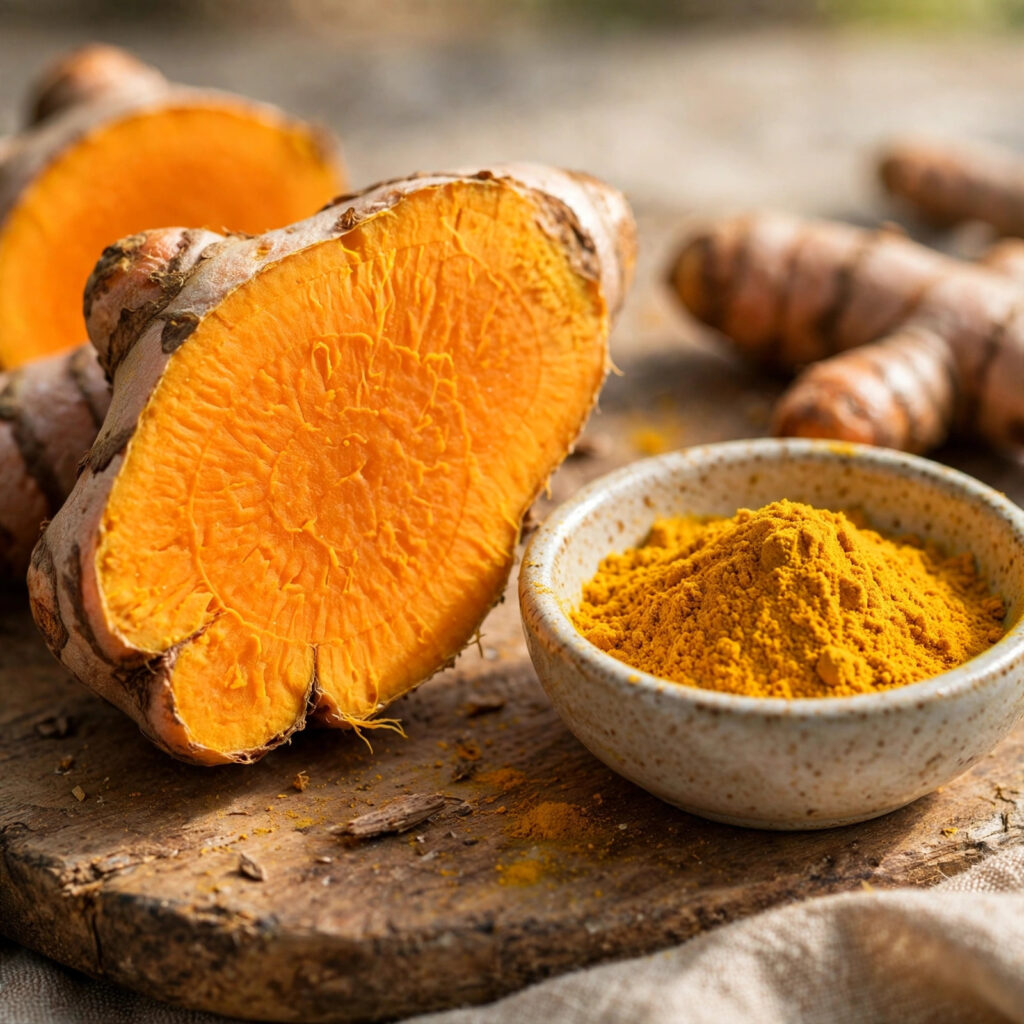
Turmeric is the root of the Curcuma longa plant, and its bright yellow color comes from a group of compounds called curcuminoids — mainly curcumin. A teaspoon of turmeric powder in your cooking contains only a small amount of curcumin (around 3–5% of the powder by weight), which matters a lot for understanding the research.
Nearly all trials use concentrated extracts or specially formulated supplements, not the spice from your kitchen cupboard. That distinction is the key to reading every claim about turmeric and joint pain: a result seen with one extract in a trial cannot automatically be applied to the turmeric in your curry, and it can’t be applied to a different supplement brand either.
How curcumin is thought to work
Curcumin’s appeal rests on its anti-inflammatory activity. Lab research suggests it can influence inflammatory signaling pathways, including NF-kB and COX-2 — the same enzyme targeted by common pain relievers. Human studies have also found that curcumin may modestly lower blood markers of inflammation such as C-reactive protein (CRP) and interleukin-6 (IL-6).
In plain terms: osteoarthritis pain is driven in part by chronic low-grade inflammation in and around the joint. If curcumin can calm some of that inflammation, it may help reduce pain and stiffness. That mechanism is plausible, and it’s why researchers keep studying it — but “plausible in the lab” and “proven in people” are two very different things.
What the oral evidence shows

The bulk of the research so far is on oral curcumin — capsules or extracts taken by mouth. The picture is encouraging but patchy:
- A 2021 systematic review and meta-analysis of 16 randomized controlled trials involving 1,810 adults with knee osteoarthritis found that turmeric extracts significantly reduced knee pain and improved physical function compared with placebo — with effects similar to those of non-steroidal anti-inflammatory drugs (NSAIDs) in the five trials that used NSAID comparators.
- A 2025 systematic review and meta-analysis of 10 randomized trials involving 786 people with knee osteoarthritis found Curcuma longa preparations improved pain scores versus placebo, though researchers flagged differences between studies and called for more research into optimal formulations and doses.
- A separate meta-analysis of 15 studies involving 1,670 participants likewise found that curcuminoids improved pain scores compared with placebo.
But there’s a serious caveat worth stating plainly. A critical review of these systematic reviews — published in Frontiers in Pharmacology in early 2026 — judged the underlying reviews to be of low methodological quality, with mostly low or very low quality evidence. So while the direction of the evidence is positive, the confidence we can place in it is limited. Large, rigorous, long-term trials are still missing.
What about topical curcumin?
Oral curcumin has a famous problem: poor absorption. The body breaks it down quickly, so very little of what you swallow reaches your tissues. Researchers have responded by testing topical curcumin — applying it directly over the painful joint, skipping the digestion problem entirely.
In 2026, an Australian team published results from a randomized, double-blind, placebo-controlled trial of VAS-101, an investigational topical curcumin gel, in Frontiers in Pain Research. Sixty adults aged 45–75 with knee osteoarthritis applied 0.1 mL of the gel around the kneecap every other day for 28 days.
The results: KOOS pain scores improved more in the curcumin group than in the placebo group (a statistically significant difference, p=0.041), and 39.3% of people using the real gel felt “much” or “very much” improved, compared with 13.3% in the placebo group (p=0.019). The gel was well-tolerated; the only side effect was yellow skin staining that faded two to three days after stopping.
Keep two things straight, though. First, topical and oral curcumin are different evidence bases — you can’t take the oral studies and apply them to a cream, or vice versa. Second, VAS-101 is investigational and in early testing; it is not a product you can buy. The trial was small (60 people) and short (four weeks), and it improved pain scores but not physical function.
What the latest 2026 trial found
Another 2026 study, published in Cureus by Bansal and colleagues, tested a bioavailability-enhanced curcumin product called CurcuBoost (500 mg once daily) added to standard care versus standard care alone in 50 adults aged 40–75 with moderate knee osteoarthritis (Kellgren-Lawrence grades II–III), over 8 weeks.
At week 8, the curcumin group showed substantially larger improvements than the standard-care-only group: WOMAC pain scores fell by 65.2% versus 44.0% from baseline, physical function by 59.1% versus 38.9%, and total scores by 59.9% versus 40.7% — all highly statistically significant (p<0.0001). All 50 participants completed the study.
Honest caveats, stated plainly:
- It was open-label. Everyone knew who was getting curcumin, which can inflate perceived benefits.
- It was small and short — 50 people, 8 weeks. That’s not enough to establish long-term safety or durability.
- CurcuBoost was an add-on, not a replacement. It was tested on top of standard care, not instead of it. And it was a branded, bioavailability-enhanced formulation — not the turmeric powder in your spice jar.
- The impressive percentage drops sound dramatic, but small open-label trials often overestimate effects. Treat these as promising early signals, not proof.
The bioavailability problem (and why your spice jar isn’t a study)
This is the point most marketing glosses over. Plain curcumin is poorly absorbed when swallowed — the body metabolizes and eliminates it quickly. That’s why trials use enhanced formulations: curcumin combined with piperine (from black pepper), phytosomes, or water-dispersible complexes.
What does this mean for you practically?
- Turmeric as food (curries, soups, golden milk) is healthy, but the curcumin dose is far lower than in trials. Enjoy it — just don’t expect trial-level results from a teaspoon.
- Standard curcumin capsules may offer only modest absorption. Formulations matter, and labels aren’t directly comparable — a “500 mg” label can describe different things on different products.
- Adding black pepper or fat to a turmeric dish modestly improves absorption, which is likely why traditional golden milk recipes pair turmeric with both. It’s a sensible kitchen habit, not a clinical intervention.
Safety: what to know before trying curcumin
Curcumin supplements are generally well-tolerated in trials, with mild digestive upset (nausea, loose stools) being the most commonly reported side effect. But “natural” doesn’t mean risk-free, and this is where the YMYL caution really matters:
- High-bioavailability formulations and the liver. The NIH’s NCCIH notes that liver injury has been reported in some people taking bioavailability-enhanced curcumin products — the same kind of formulations this article discusses. If you notice unusual fatigue, nausea, poor appetite, dark urine, or yellowing of the skin or eyes, stop the supplement and talk to your clinician.
- Curcumin is not a substitute for prescribed arthritis treatment. It has been tested as an add-on to standard care, not as a replacement for it. Don’t stop any prescribed medication to try a supplement.
- Blood thinners are the big interaction. Curcumin may have mild blood-thinning effects. If you take warfarin, apixaban, rivaroxaban, clopidogrel, or even daily aspirin therapy, check with your clinician or pharmacist before adding curcumin — the bleeding risk is real.
- Gallbladder and kidney-stone concerns. Curcumin stimulates bile production and is relatively high in oxalates, so people with gallbladder disease or a history of kidney stones should be cautious.
- Pregnancy and surgery. Avoid curcumin supplements in high doses during pregnancy, and stop them at least two weeks before planned surgery due to the bleeding interaction.
- Topical curcumin appears low-risk (skin staining aside), but the evidence base is tiny and products aren’t standardized.
If you’re considering a supplement, talk to your clinician or pharmacist first, especially if you take any daily medication.
When to see a doctor
Supplements aside, joint pain has its own warning signs that deserve professional evaluation. See a clinician promptly if you have:
- Joint pain that’s severe, sudden, or follows an injury
- A joint that’s swollen, red, or warm to the touch
- Pain that wakes you from sleep or limits walking and daily activities
- Stiffness lasting more than 30 minutes in the morning (a possible sign of inflammatory arthritis)
- Fever alongside joint symptoms, or a rash
- Pain that hasn’t improved after a few weeks of self-care measures
Early diagnosis matters. Osteoarthritis and inflammatory conditions like rheumatoid arthritis are managed very differently, and rheumatoid arthritis in particular benefits from early treatment that can slow joint damage. Don’t guess which one you have.
The bottom line
Turmeric’s reputation for joint pain rests on more than tradition: multiple clinical trials and meta-analyses suggest that bioavailability-enhanced curcumin preparations may help reduce knee osteoarthritis pain and improve function, with effects roughly comparable to NSAIDs in short-term studies. New 2026 trials — a small open-label oral study and an early topical gel trial — add cautious encouragement, but both are small, short, and preliminary.
What the evidence does not support: the idea that kitchen turmeric or any supplement cures arthritis, reverses joint damage, or replaces proper medical treatment. Bioavailability is the bottleneck, formulations aren’t interchangeable, and safety interactions (especially with blood thinners) deserve respect.
If you’re over 50 with aching joints, turmeric is worth discussing with your clinician — as one possible piece of a plan built around exercise, weight management, and proven treatments, not the plan itself. Want to compare it with another heavily marketed supplement? See our evidence review of glucosamine and chondroitin, and for a broader look at what’s behind knee pain and what actually helps, read Knee Pain After 60: Causes, Relief, and When to See a Doctor.
Sources
- Bansal et al. “Bioavailability-Enhanced Curcumin (CurcuBoost) as Adjunct Therapy Improves Symptoms in Knee Osteoarthritis: A Randomized Clinical Trial.” Cureus, July 2026. PDF
- “The effect of a topical curcumin formulation (VAS-101) on knee pain in adults with knee osteoarthritis: a randomised, double-blind, placebo-controlled study.” Frontiers in Pain Research, April 2026. PDF
- Vascarta, Inc. “Vascarta Announces Positive Clinical Trial Results for Topical/Transdermal Curcumin Gel (VAS-101) in Knee Osteoarthritis.” PR Newswire, April 1, 2026. Announcement
- Daily JW et al. “Efficacy of Turmeric Extracts and Curcumin for Alleviating the Symptoms of Joint Arthritis: A Systematic Review and Meta-Analysis of Randomized Clinical Trials.” Journal of Medicinal Food, 2016. (NIH PubMed: https://pubmed.ncbi.nlm.nih.gov/27533649/)
- Wang Z et al. “Efficacy and Safety of Turmeric Extracts for the Treatment of Knee Osteoarthritis: A Systematic Review and Meta-analysis of Randomised Controlled Trials.” Current Rheumatology Reports, 2021;23(2).
- Hidayat R et al. “Efficacy of Curcuma longa in relieving pain symptoms of knee osteoarthritis patients: a systematic review and metaanalysis of clinical trials.” Journal of Rheumatic Diseases, 2025;32(1):17–29. (NIH PubMed: https://pubmed.ncbi.nlm.nih.gov/39712249/)
- Feng J et al. “Efficacy and safety of curcuminoids alone in alleviating pain and dysfunction for knee osteoarthritis: a systematic review and meta-analysis of randomized controlled trials.” BMC Complementary Medicine and Therapies, 2022;22(1):276.
- Chen J et al. “A critical review of systematic reviews and meta-analyses of curcumin for knee osteoarthritis.” Frontiers in Pharmacology, 2026;16:1664319. (https://doi.org/10.3389/fphar.2025.1664319)
- National Center for Complementary and Integrative Health (NCCIH/NIH). “Turmeric.” https://www.nccih.nih.gov/health/turmeric
- Mayo Clinic. “Osteoarthritis: Diagnosis and Treatment.” https://www.mayoclinic.org/diseases-conditions/osteoarthritis/diagnosis-treatment/drc-20351930
This article is for general information only and is not medical advice. Talk to your clinician before adding any supplement to your routine, especially if you take prescription medications.