
Do Crossword Puzzles Help Brain Health After 60? The Evidence
If you do the crossword every morning, you have probably wondered whether it is actually doing your brain any good — or whether it is just a pleasant habit. It is a fair question, and for years the honest answer from scientists was “we’re not sure.”
That answer is getting clearer. In 2026, one of the largest trials ever to test everyday brain-stimulating activities — including crosswords — reported its results. Combined with an earlier head-to-head study of crosswords versus computer brain games, we now have better evidence than ever before. The short version: the evidence suggests crosswords may help support thinking skills, especially for people already noticing some memory slips. They are not a shield against dementia, and they cannot replace the other habits that protect your brain. Here is what the research actually says.
Why “brain exercise” sounds so convincing
The idea behind crosswords-for-brain-health is called cognitive reserve: the theory that mentally stimulating activities build a kind of buffer in the brain, so that age-related changes take longer to show up as everyday problems. In observational studies, people with more education, more complex work, and more stimulating hobbies tend to develop dementia symptoms later than others.
But observational studies have a catch: people who do crosswords regularly also tend to be more physically active, more social, and better educated. It is hard to separate the puzzle from the person. That is why researchers ran controlled trials — and why the latest ones are worth your attention.
The honest framing, before we go further: stimulating activities may delay the onset of decline, but they do not prevent dementia, and decline can still progress afterward. Nothing here should be taken as a promise that puzzles will keep Alzheimer’s away.
What the latest research says
The big 2026 trial: everyday activities, tested at scale
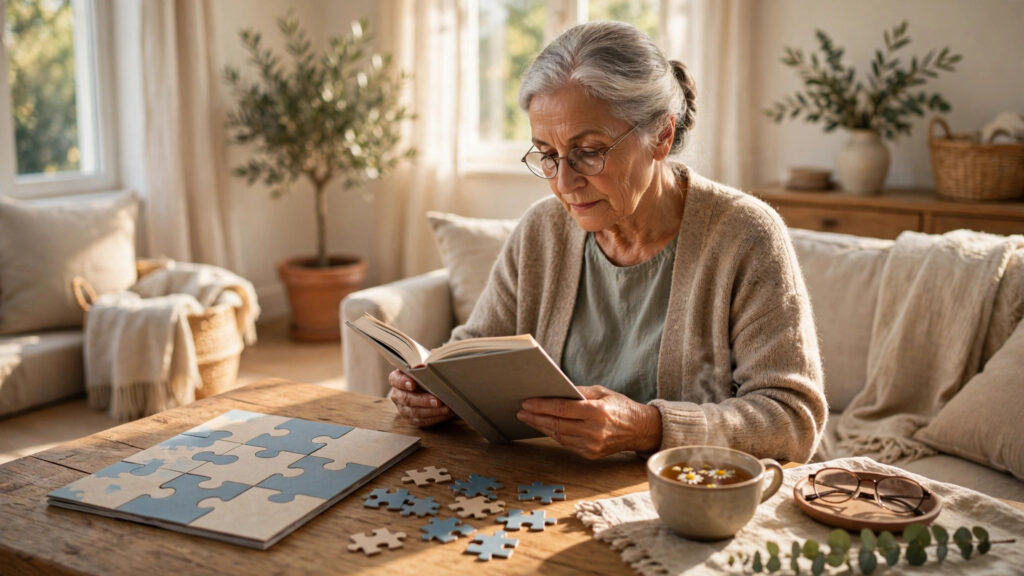
One of the largest trials of its kind to date, the Active Brains trial, was published in 2026 in The Lancet Primary Care. Run by researchers at the University of Southampton, it enrolled 11,563 patients aged 60 to 85 with mild to severe cognitive impairment, recruited through 670 primary-care practices in England, Wales, and Scotland between October 2020 and October 2023.
Participants were randomly assigned to one of three groups:
- Active Brains website: a web program encouraging physical activity, a Mediterranean-style diet, and cognitive exercises — crosswords, reading, music, brain games, and learning new skills.
- Website plus brief human support: the same program with three short email or telephone check-ins with a nurse.
- Control: evidence-based advice about protecting cognitive health, with no web program.
After 12 months, the primary outcome — a test of verbal reasoning — showed that all three groups had improved. In the website group, 32.8% of participants no longer met the criteria for cognitive impairment, compared with 31.6% in the supported group and 28.4% in the control group.
Two honest takeaways. First, the differences between groups are modest: even the advice-only control group improved substantially, which suggests that simply paying attention to brain health — or the reassurance of being in a study — can move the needle. Second, and more encouraging: a large share of people who started the trial with measurable cognitive impairment no longer met the criteria a year later. Improvement, not just slower decline, is possible. The authors note that the 5-year effect is still unknown, and the trial population was relatively healthy — so these results may not apply to everyone.
What this means for crosswords specifically: the trial did not test crosswords alone. Puzzles were one ingredient in a program that also promoted movement and diet. The evidence supports the package — not the puzzle in isolation.
The classic head-to-head: crosswords beat computer brain games
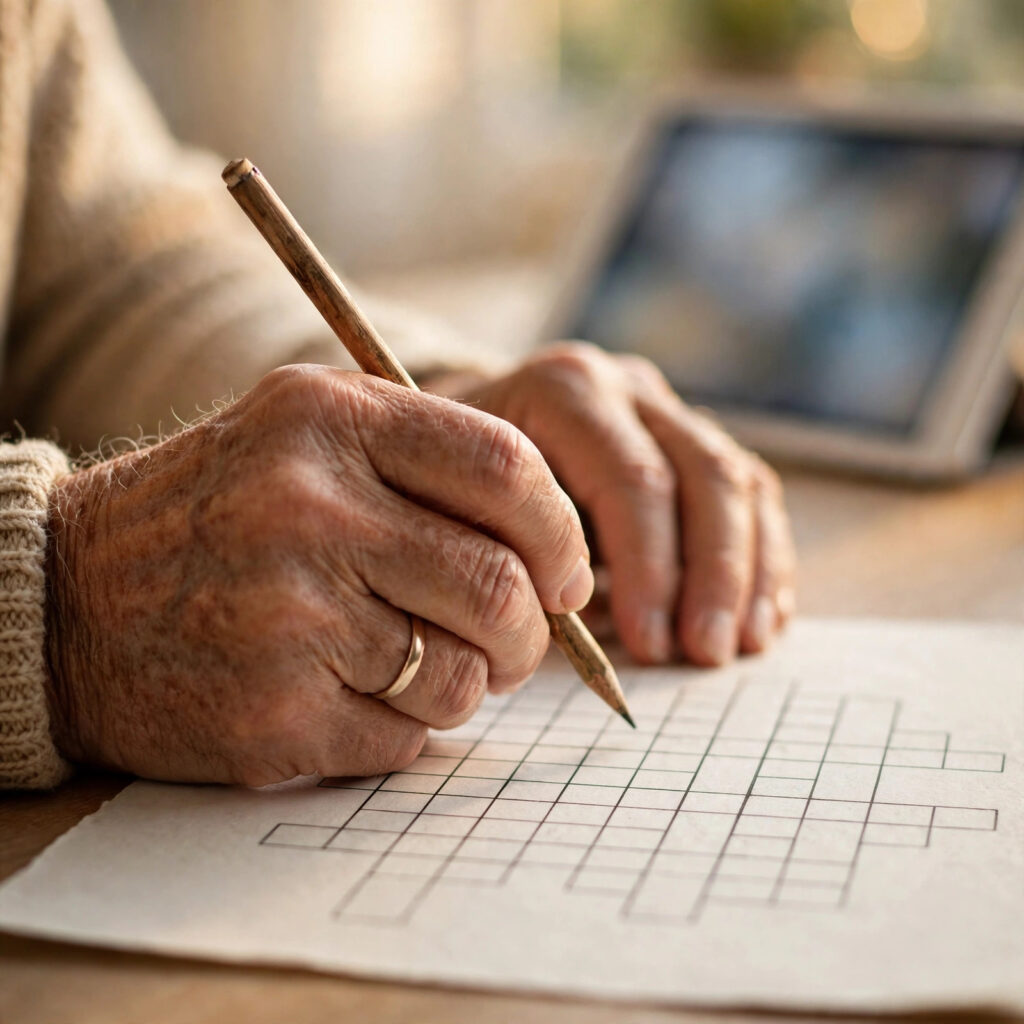
If you want evidence about crosswords specifically, the landmark study is from 2022. Researchers at Columbia and Duke Universities, led by D.P. Devanand, published a randomized trial in NEJM Evidence comparing web-based crossword puzzles against computerized cognitive games in 107 adults with mild cognitive impairment (average age 71).
Everyone trained intensively for 12 weeks, with booster sessions continuing to 78 weeks. The crossword group showed greater improvement on ADAS-Cog, the standard cognitive measure, at both 12 weeks and 78 weeks — and on a measure of daily functioning at 78 weeks. Brain imaging even suggested less shrinkage in the crossword group at 78 weeks.
This is the strongest evidence we have that crosswords, specifically, can help people with mild cognitive impairment — outperforming the very brain games marketed for the purpose. But note the limits: there was no group that received no training at all, the study was small, and the authors themselves called for replication in a larger trial. For a fuller look at what brain games can and cannot do, see Do Brain Training Games Really Work?.

An important caveat: thinking alone may not be enough
Here is the nuance worth hearing. York University sensorimotor neuroscientist Lauren Sergio, who studies how thinking and movement interact in the brain, has argued that cognitive-only training has shown limited transfer to everyday functional independence — and that combining thinking with movement (cognitive-motor integration) may matter more than puzzles alone. In her research with older adults, training that paired thinking tasks with goal-directed movement showed more promise for cognitive and functional abilities than basic cognitive training.
This does not mean crosswords are useless. It means they are incomplete as a brain-health strategy — a point that fits what the big 2026 trial found too: the program that helped combined puzzles with physical activity and diet. If your crossword habit sits on the couch, consider pairing it with the habits that carry the strongest evidence: regular walking and exercise, a Mediterranean-style eating pattern like the MIND diet, good sleep, and staying socially connected. Our guide to 12 habits linked to lower dementia risk puts the full picture together.
What this means for your crossword habit
So should you keep doing the crossword? If you enjoy it — yes. The evidence suggests it may help support your thinking skills, it costs nothing, and it has no side effects. A few practical points will help you get more out of the habit:
- Keep it challenging. If you breeze through the same puzzle every day, your brain is coasting. Step up the difficulty, try the cryptic, or switch to a new puzzle type — novelty is part of the stimulus.
- Vary the menu. The National Institute on Aging notes that in one study, older adults who learned demanding new skills — quilting or digital photography — showed more memory improvement than those who stuck to familiar social activities. Crosswords plus something new beats crosswords alone.
- Make it social. Doing puzzles with a partner, a grandchild, or a club adds the social engagement that research links to better cognitive health.
- Don’t buy the hype. The NIA specifically warns that there is not enough evidence that commercial brain-training apps match the benefits seen in research-grade cognitive training. A pencil and a newspaper may genuinely serve you better than a subscription.

When to see a doctor
Puzzles are a habit, not a diagnostic tool. Occasional forgetfulness — misplacing your keys, taking longer to recall a name — is a normal part of aging. But some changes deserve a clinician’s attention, and more puzzles are not the answer to them.
See your doctor if you or someone close to you notices:
- Getting lost in familiar places, or forgetting recent events entirely
- Repeating the same questions or stories within a short time
- Trouble managing bills, medications, or other familiar tasks
- Noticeable personality changes, withdrawal, or poor judgment
- Family members expressing concern about your memory
The Mayo Clinic notes that around 10% to 15% of people with mild cognitive impairment develop dementia each year — but also that MCI symptoms can stay stable for years or even improve, as the 2026 trial showed. Only a clinician can sort out what is going on, and catching changes early gives you the most options. For help telling normal aging from warning signs, see Memory After 60: Normal Aging vs. Warning Signs.
The bottom line
Do crossword puzzles help brain health after 60? The best current evidence says they may — particularly for people already experiencing mild cognitive impairment, where a head-to-head trial found crosswords outperformed computer brain games, and where a large 2026 trial found everyday activities including puzzles were linked to real improvement. But puzzles are one piece of a bigger picture: movement, diet, sleep, and social connection carry at least as much weight, and no activity can promise to prevent dementia. Keep the crossword. Just don’t let it be the only thing you do for your brain.
Sources
- Active Brains trial (2026), published in The Lancet Primary Care — 11,563 participants aged 60–85 across 670 primary-care practices; summary via McKnight’s: https://www.mcknights.com/news/study-crossword-puzzles-reading-can-improve-cognitive-function-among-adults-with-mci/
- Devanand D.P. et al., “Crossword puzzles vs. cognitive games for mild cognitive impairment,” NEJM Evidence, 2022 — summary: http://www.sciencedaily.com/releases/2022/10/221027093305.htm
- National Institute on Aging, “Cognitive Health and Older Adults” — https://www.nia.nih.gov/health/brain-health/cognitive-health-and-older-adults
- Mayo Clinic, “Mild cognitive impairment — Symptoms and causes” — https://www.mayoclinic.org/diseases-conditions/mild-cognitive-impairment/symptoms-causes/syc-20354578
- York University, Sergio lab — cognitive-motor integration training and cognitive health in older adults: https://www.yorku.ca/yfile/2018/07/27/can-dementia-be-reversed-york-u-researchers-say-there-may-be-a-way/
This article is for informational purposes only and is not medical advice. Talk to your clinician about memory concerns.