Best Exercise Bike for Seniors: A Buying Guide
If you want cardio exercise that is kind to your joints and easy to do at home, an exercise bike is one of the simplest choices after 45. No gym membership, no complicated movements, no weather to fight — you just sit and pedal.
But not every bike suits an older rider equally well. The right choice depends on your joints, your balance, your back, and your space. This guide covers the two main types, the features that matter most for adults over 45, and how to match a bike to your situation. You’ll also find our top product picks at the end, matched to the buying criteria in this guide.
As an Amazon Associate, we earn from qualifying purchases.
Why an exercise bike makes sense after 45
The CDC recommends that adults 65 and older get at least 150 minutes of moderate-intensity aerobic activity each week, and it lists riding a bike — indoors or outdoors — as an activity that counts. Steady pedaling gets your heart beating faster and your breathing deeper, which is the core of what aerobic exercise is supposed to do.
A stationary bike has practical advantages over many other forms of cardio:
- It is low impact. Your weight is supported by the seat, so knees, hips, and ankles take less pounding than they would from walking on hard pavement. Mayo Clinic guidance lists bicycling among the low-impact aerobic options suitable for people with arthritis.
- It is weather-proof. Rain, heat, darkness, or icy sidewalks never cancel your workout.
- It is easy to control. Set the resistance low on a tired day and raise it when you feel stronger — no hills to fight on the way home.
- It fits into daily life. Many riders pedal for 20 minutes while watching the news, which makes the habit easier to keep.
One honest note: a bike covers your aerobic base, not everything. The CDC also calls for muscle-strengthening activities on at least 2 days a week and balance activities. Consider pairing your rides with strength training at home.
The two main types: recumbent vs. upright
Almost every home stationary bike falls into one of two designs, and this is the most important decision in this guide.
Recumbent bikes

A recumbent bike puts you in a reclined, chair-like position: a wide seat with a backrest, and the pedals out in front of you rather than beneath you. You pedal with your legs extended forward, as if pushing your feet away from a recliner.
Best for: riders with knee or hip arthritis, lower-back discomfort, balance concerns, or anyone who simply prioritizes comfort. The backrest supports your spine, the wide seat avoids the pressure of a narrow saddle, and the low seat makes mounting and dismounting easier. Because the position is relaxed, many older adults find recumbent bikes the easiest type to ride consistently — and consistency is what counts.
Trade-offs: recumbent bikes are bigger. A typical frame needs about 4 to 5 feet of length and 2 to 3 feet of width, so measure your space before committing. The supported position also means your core muscles work a little less than they would on an upright bike.
Upright bikes
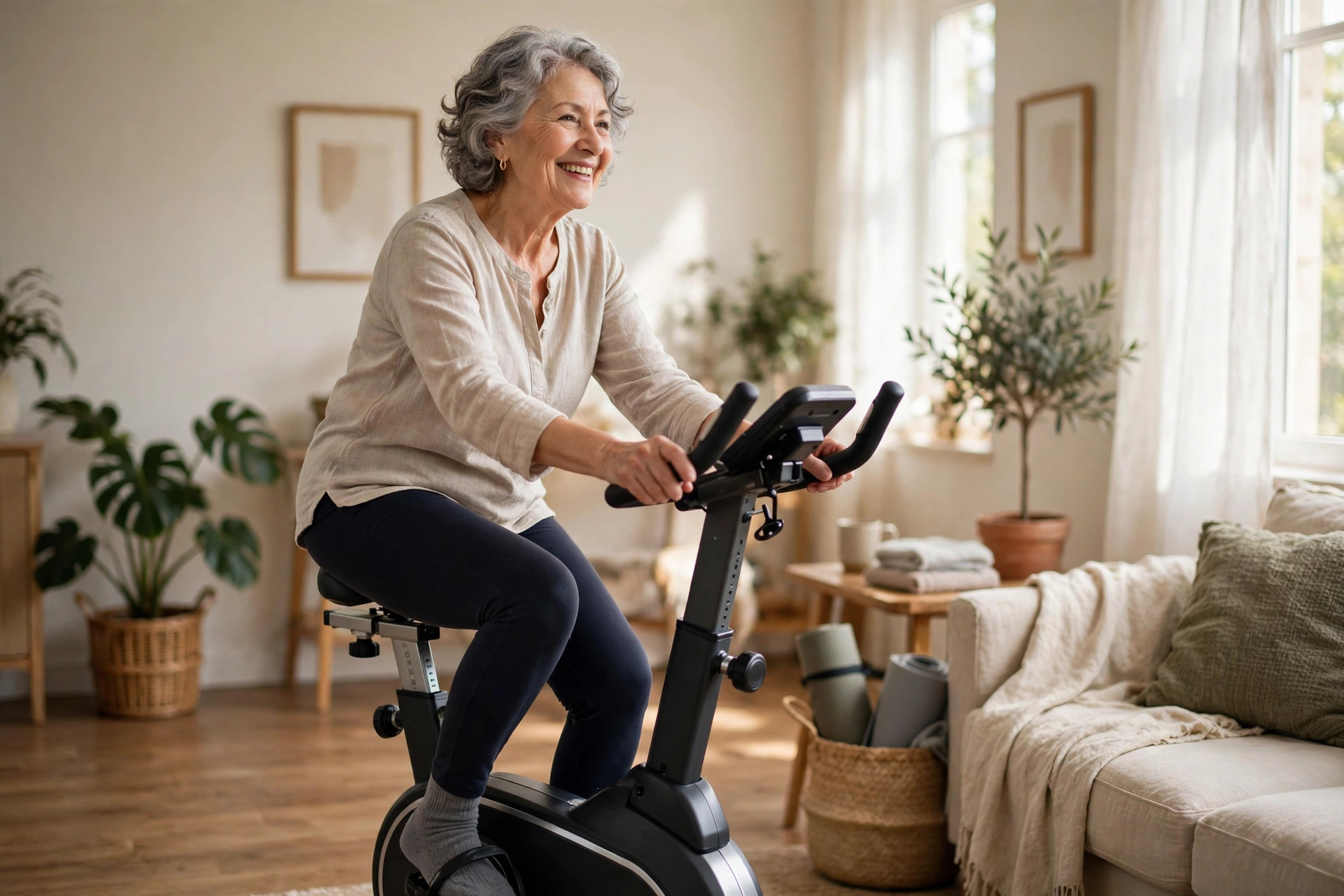
An upright bike positions you like a traditional bicycle: a smaller saddle, pedals beneath you, no backrest, handlebars in front.
Best for: riders with no major joint or balance limits who want a more active-feeling workout or are used to cycling, and for smaller rooms — upright models tend to be compact and are more likely to fold for storage.
Trade-offs: the smaller saddle can feel uncomfortable on longer rides, your wrists, shoulders, and lower back carry more of your weight, and mounting the bike requires a bit more balance.
A third option: under-desk pedal exercisers
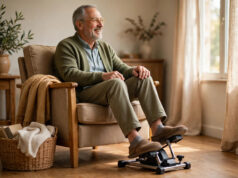
These are small pedal-only units that sit on the floor so you can pedal from your own chair. They are inexpensive and take almost no space, but resistance and stability are limited — best as a supplement to walking or a real bike, not a replacement.
Features that matter most for riders over 45
1. Step-through frame. The most senior-relevant feature there is: no high bar to swing your leg over — you simply sit down. If you have balance worries, stiff hips, or knee trouble, prioritize this. Most recumbent bikes have it by design; many upright bikes do not.
2. Seat comfort and backrest. On recumbent bikes, look for a wide cushioned seat with an adjustable backrest. On upright bikes, a wider padded saddle matters more than you might think — a sore seat is one of the top reasons people stop riding. Proper seat height means a slight bend in your knee at the bottom of each pedal stroke.

3. Quiet, smooth resistance. Magnetic resistance is the quietest — worth it if you share walls or ride while watching TV. A dozen or more resistance levels is plenty for most riders, so the bike can grow with you from gentle recovery rides to genuinely challenging workouts.
4. An easy-to-read display. Look for a large backlit screen showing time, distance, and speed, with simple buttons rather than a maze of menus. Skip fancy touchscreens you do not need — simpler electronics tend to be more reliable.
5. Weight capacity and stability. Check the stated maximum user weight and treat it as a ceiling to stay comfortably under. Many mid-range bikes are rated to 300 pounds or more; a sturdy, non-wobbly frame makes every ride safer and more pleasant.
6. Pedals with adjustable straps. Straps keep your feet from slipping, especially in socks or slippers, and oversized textured pedals add comfort. A small detail that noticeably affects confidence.
7. Heart-rate handles (optional). Pulse sensors in the handlebars are not perfectly accurate, but they give a rough sense of effort — useful for keeping yourself in a comfortable zone rather than overdoing it.
Matching the bike to your situation
Arthritis or bad knees: a recumbent bike with a step-through frame is usually the most comfortable starting point — the reclined position takes load off the knees and hips. Start at the lowest resistance and add more only as your joints allow. See also our guide to low-impact exercises for bad knees.
Lower-back trouble: the lumbar support of a recumbent seat is the key feature. Avoid upright bikes with aggressive forward-leaning postures, which can aggravate a sensitive back.
Balance worries: choose the lowest, widest-based bike you can find — typically a recumbent — and park it near a wall or sturdy furniture you can hold while mounting and dismounting. A low center of gravity feels far more stable.
Tight space: measure twice. Upright bikes, especially folding ones, can tuck into a corner; recumbent bikes need a permanent spot. Also think about getting the bike through doorways on delivery day.

Recovering from injury or surgery: get your doctor’s or physical therapist’s approval before buying, and ask whether they recommend a specific riding position or resistance range. A bike can be an excellent rehab tool — but only when the plan fits your situation.
Safety tips for getting started after 45
- Start short and easy. Ten to fifteen minutes at the lowest resistance is a perfect first ride. Add a few minutes per week before you raise the intensity.
- Warm up your joints. A minute of easy pedaling at no resistance, plus gentle ankle and knee circles before mounting, helps stiff joints loosen up.
- Keep good posture. Sit tall with relaxed shoulders and a light grip on the handlebars. Avoid hunching or white-knuckling the grips.
- Set the seat right. At the bottom of the pedal stroke your knee should have a slight bend — never locked straight, never deeply bent. Knee pain after riding usually means the seat is too low or too far forward.
- Hydrate and ventilate. Keep water within reach and make sure the room has airflow; a small fan makes longer rides far more comfortable.
- Stop if something feels wrong. Muscle tiredness is normal; sharp pain, dizziness, chest discomfort, or unusual shortness of breath are not. Stop and rest — and see the section below if they recur.
For ideas on building a consistent routine around your bike, see our guide to staying active after 60.
When to see a doctor
An exercise bike is gentle, but starting any new cardio program is still a physical stress — and after 45, a quick medical check is simply sensible. Talk to your doctor first if any of these apply:
- You have a heart condition — angina, a prior heart attack, heart failure, or an irregular heartbeat.
- Your blood pressure is not well controlled, or you take medication for it.
- You have diabetes that is not well managed.
- You have joint problems, arthritis flare-ups, a recent injury, or recent surgery affecting your legs, hips, or back.
- You experience chest pain, unusual shortness of breath, dizziness, or fainting during exertion.
- You feel unsteady on your feet or have a condition affecting balance.
If you have a chronic condition, the CDC notes it is wise to talk to a health care professional about the type and amount of activity that is right for you. One conversation can save months of guessing — and your doctor may be able to suggest an appropriate effort level for you.
Our top picks
Below are real exercise bikes sold on Amazon that match the criteria in this guide. Prices, ratings, and model specs change often – treat the figures as approximate and check the live Amazon page for today’s details before you buy.

1. YOSUDA Recumbent Exercise Bike
Pedal while leaning back in comfort – the low-impact bike that’s gentle on knees and backs.

2. YOSUDA Recumbent Exercise Bike (Black)
Same knee-friendly recumbent ride, in black. Quiet enough for the living room.

3. YOSUDA X-Bike Pro 5-in-1 Folding Exercise Bike
Folds flat when you’re done – a full workout that disappears into the closet.

4. Sunny Health & Fitness Magnetic Recumbent Bike (SF-RB4616S)
Grip sensors track your pulse as you pedal. Simple, sturdy, and easy on joints.
5. Sunny Health & Fitness Smart Recumbent Bike (SF-RB4616SMART)
Connects to the SunnyFit app for guided rides – a smart bike without the smart-bike price.
Sources
- Centers for Disease Control and Prevention — “What Counts as Physical Activity for Older Adults” (riding a bike indoors or outdoors counts as aerobic activity; intensity guidance): https://www.cdc.gov/physical-activity-basics/adding-older-adults/what-counts.html
- Centers for Disease Control and Prevention — “Older Adults: Adding Activity Recommendations” (150 minutes of moderate-intensity aerobic activity per week for adults 65+, plus muscle-strengthening and balance activities): https://www.cdc.gov/physical-activity-basics/adding-older-adults/
- Mayo Clinic Women’s HealthSource, via News-Medical — “Regular, modest exercise beneficial for people with arthritis” (low-impact aerobic options including bicycling; advises consulting a physician before starting a new exercise regimen): https://www.news-medical.net/news/20091230/Regular-modest-exercise-beneficial-for-people-with-arthritis.aspx
- Mayo Clinic Sports Medicine (Edward Laskowski, M.D.), via Consumer Reports — “The Best Exercise for Arthritis, COPD, and Type 2 Diabetes” (aim for 150 weekly minutes of low-impact activities such as walking, swimming, or cycling): https://www.consumerreports.org/health/exercise-bikes/best-exercise-for-arthritis-copd-diabetes-a1055337463/
- BarBend — “The 6 Best Recumbent Bikes for Seniors of 2026” (recumbent bike design and senior-priority features overview): https://barbend.com/best-recumbent-bikes-for-seniors/
- Senior Stride Academy — “Recumbent vs Upright Exercise Bikes: Everything Seniors Should Know” (detailed recumbent vs. upright comparison for older riders): https://seniorstrideacademy.com/recumbent-vs-upright-exercise-bikes/
This article is for general information only and is not medical advice. Talk to your doctor before starting a new exercise program.