
Yoga for Seniors Beginners: A Gentle, Safe Start
If you are over 60 and curious about yoga, you probably feel cautious too — the yoga you picture, young athletes twisting into pretzels, has little to do with your life. Here is the good news: the yoga that actually suits older beginners is nothing like that. It is slow, gentle, and often done sitting in a chair or holding onto a wall.
Recent 2025–2026 research has sharpened what we know about yoga, balance, and fall risk after 60 — including one cautionary finding every beginner should hear. This guide will help you choose the right style, try safe beginner poses, know what to expect in your first class, and understand what the science actually says.
Why Yoga Appeals After 60
Unlike high-impact exercise, yoga meets you where you are. There is no running, no jumping, and no need to be flexible already. A typical gentle class moves at half the speed of everyday life: hold a pose, breathe, notice how it feels, release. That pace is exactly why it suits aging joints and cautious beginners.
The National Center for Complementary and Integrative Health (NCCIH) links regular yoga with less stress and anxiety, better sleep, and improved balance and flexibility. It won’t cure arthritis or erase back pain — but it is one of the most sustainable ways for older adults to keep moving. Many people pair a weekly yoga class with 15-minute chair exercises at home and regular walks after 70 — covering flexibility, strength, and heart health together.
Which Styles to Start With (and Which to Skip)
Not all yoga is equal for older beginners. These are the safest starting points:
- Hatha: the classic slow-paced style; poses are held for several breaths with rest between.
- Chair yoga: an entire practice done seated (or standing with chair support) — the friendliest on-ramp.
- Gentle/restorative: props and blankets, long relaxing holds; excellent if you have stiff joints.
- Iyengar (beginner level): precise alignment with blocks and straps; great with an experienced teacher.
Skip for now: hot yoga, power/vinyasa flow, and advanced ashtanga — too fast, too hot, too demanding for most beginners over 60.
- Hot yoga and heated vinyasa. Heated rooms raise the risk of overheating and dehydration (the NCCIH flags special risks for hot yoga), which can be riskier with certain medications — check with your clinician.
- Vinyasa flow. Fast transitions between poses leave no time to check alignment — a fall waiting to happen for beginners.
Chair-Supported Beginner Poses
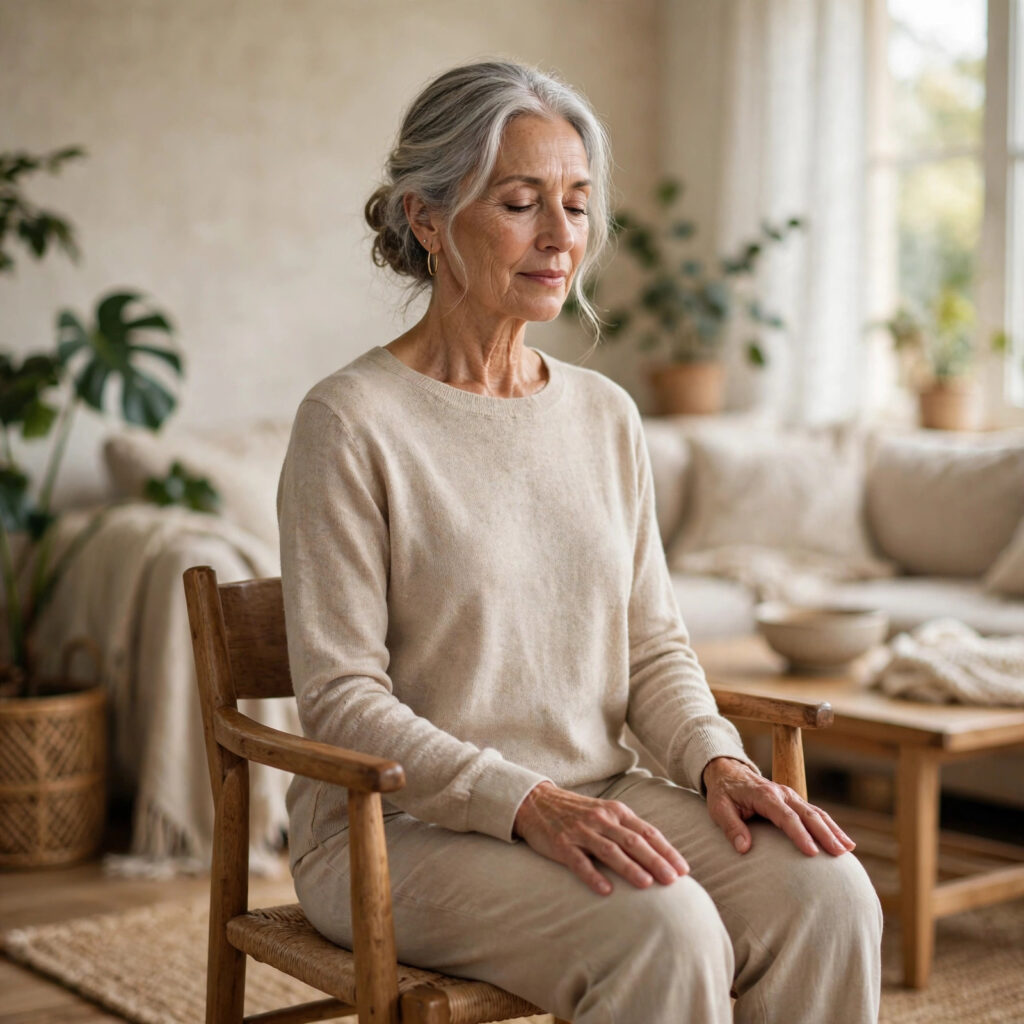
You can get a genuine yoga practice from a sturdy kitchen chair. Try these, holding each for 3–5 slow breaths:
- Seated mountain pose: sit tall, feet flat, crown lifted; feel the length in your spine.
- Seated side stretch: raise one arm overhead and lean gently sideways; repeat both sides.
- Chair cat-cow: hands on knees, round the spine on the exhale, arch gently on the inhale.
- Supported tree pose: stand behind the chair, one hand on the backrest, rest the sole of one foot against the ankle (not the knee); hold 20 seconds each side.
- Standing side stretch with wall support: one hand on the wall, reach the other overhead.

Props are tools, not crutches. Blocks, straps, and chairs are what experienced practitioners use routinely — and the supervised programs that showed benefits for older adults used props routinely too.

What to Expect in Your First Class
A senior-friendly class usually opens with a few minutes of seated breathing, moves through gentle warm-ups (neck rolls, shoulder circles, ankle circles), then 20–30 minutes of simple poses, and closes with 5–10 minutes of relaxation lying down. Instructors in these classes expect creaky knees, hearing aids, and bathroom breaks — nobody is judging.
Arrive early and tell the teacher you are new and over 60; a good instructor will offer modifications without being asked. Bring water, skip the big meal beforehand, and wear clothes you can move in. If anything hurts — not “stretch” discomfort but actual pain — stop the pose.
What the Latest Research Says
The encouraging study. In February 2026, researchers at India’s Kaivalyadhama Yoga Institute published a trial in Geriatrics: 64 adults aged 65–85, assigned by availability (a quasi-experimental, non-randomized design) to a 12-week program of preparatory movements, yoga postures, breathing practices, and meditation, or a waitlist control. After 12 weeks, the yoga group showed significant gains in balance and functional mobility, plus less fear of falling, anxiety, and depression symptoms. The waitlist group actually got worse on mobility and anxiety over the same period — a stark reminder of how fast fitness fades when we stay sedentary. It was a small study in a residential-care setting, not the final word — but the pattern is promising: gentle, structured, supervised yoga appears to help both body and mind in later life.
The cautionary study. The larger SAGE trial (University of Sydney, The Lancet Healthy Longevity, 2025) enrolled about 700 Australians aged 60 and older who were not currently practicing yoga (no weekly yoga in the past year): half got a 12-month Iyengar yoga-based exercise program delivered mostly online, the other half just two seated relaxation workshops. The surprise: the yoga exercise group recorded about a third more falls (87 per 100 people per year, versus 64). Injurious falls did not differ significantly, and one leading explanation is that yoga participants grew more confident and attempted more activities — raising their exposure to risk. Still, the lesson stands: a standing-posture-heavy program delivered without hands-on supervision can backfire for older beginners.
The honest bottom line. Together the studies say: gentle, supervised, prop-supported yoga shows real promise for balance and confidence; vigorous or unsupervised yoga carries genuine fall risk for older beginners. Yoga is not guaranteed to prevent falls — no exercise is — but started gently with a qualified instructor, evidence suggests it may help you move better and worry less.
Safety Rules for Yoga After 60
Get your clinician’s clearance first if you have osteoporosis, joint replacements, a balance disorder, glaucoma, a heart condition, or uncontrolled high blood pressure. Then follow these rules every session:
- Use a chair or wall for every standing balance pose — no exceptions in the first months.
- Keep both feet on the floor during inversions; skip headstands and shoulder stands entirely.
- Move in and out of floor poses slowly; getting up too fast is the classic dizzy moment.
- Never push into sharp pain; “good stretch” discomfort should fade within seconds of releasing.
- Practice on a non-slip mat, keep water nearby, and tell the instructor about any dizziness history.
When to See a Doctor
Talk to your clinician before starting if you feel dizzy when standing, have had a recent fall, take blood thinners or blood pressure medication, or live with osteoporosis or a joint replacement. Stop and seek care if yoga ever causes chest pain, severe dizziness, numbness, or a joint injury. A single pre-class check-in is cheap insurance — bring the class schedule so your clinician knows what you plan to do.
Sources
- National Center for Complementary and Integrative Health — “Yoga: What You Need To Know.” https://www.nccih.nih.gov/health/yoga-what-you-need-to-know
- CDC STEADI — “Older Adult Fall Prevention.” https://www.cdc.gov/steadi/
- National Center for Complementary and Integrative Health — “Yoga: Effectiveness and Safety.” https://www.nccih.nih.gov/health/yoga-effectiveness-and-safety
- Shete S, Verma A, Bhogal RS, Tiwari S. “Effect of Yoga Practices on Postural Stability, Fall Risk, and Psychological Wellbeing in Older Adults.” Geriatrics. 2026;11(1):16. https://doi.org/10.3390/geriatrics11010016
- Oliveira JS et al. “The effect of an Iyengar yoga-based exercise programme versus a seated yoga relaxation programme on falls in people aged 60 years and older (SAGE): a pragmatic, two-arm, parallel randomised controlled trial.” The Lancet Healthy Longevity. 2025. https://thelancet.com/journals/lanhl/article/PIIS2666-7568(25)00068-6/fulltext
This article is for informational purposes only and is not medical advice. Talk to your clinician before starting a new exercise program.