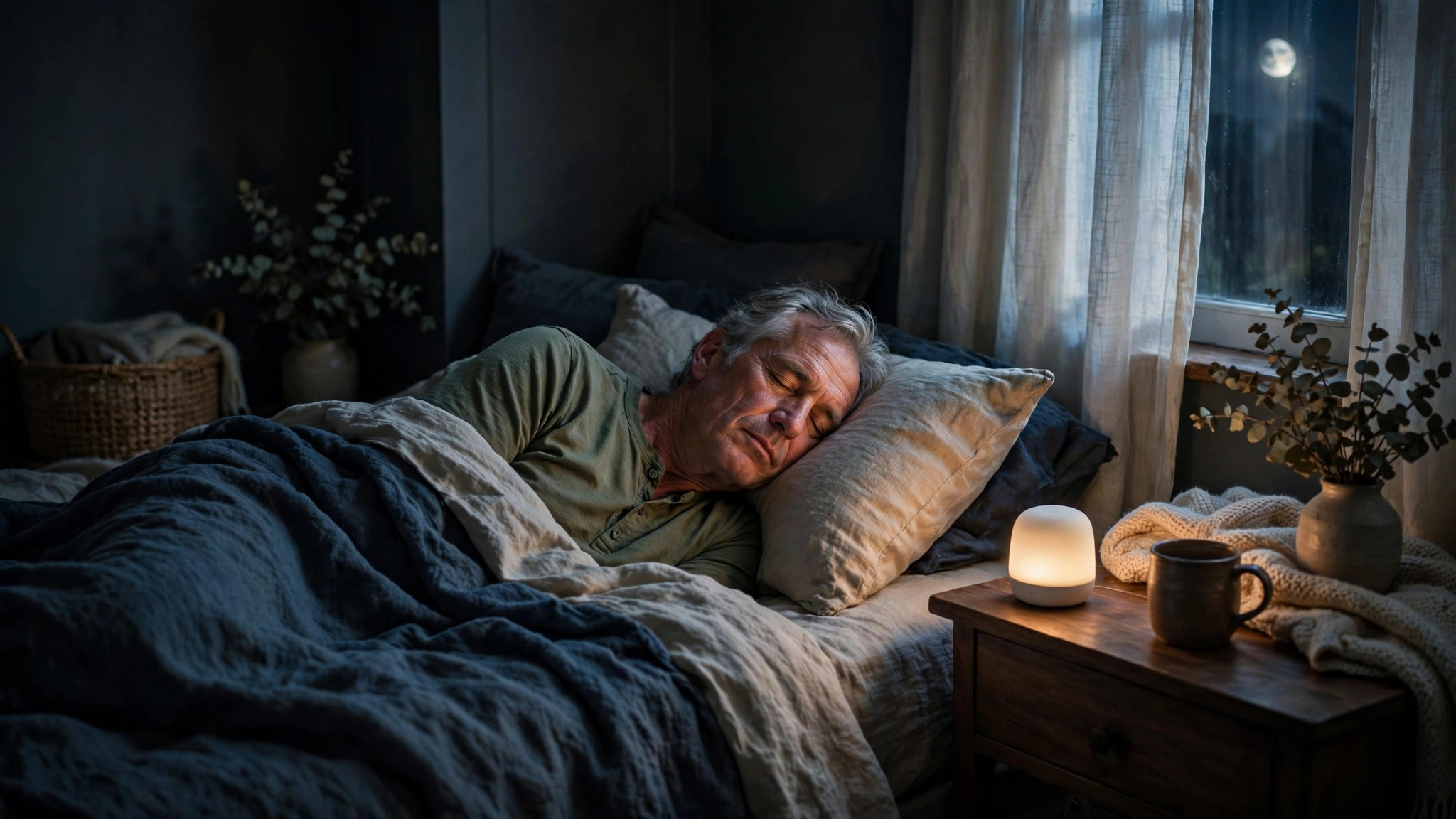
White Noise for Sleep After 60: Does It Actually Work?
If you have ever been jolted awake at 2 a.m. by a dog barking two streets over — or by the furnace clicking on, or a car door slamming outside — you already understand the problem white noise claims to solve. After 60, sleep naturally becomes lighter, which means the small sounds your brain ignored at 35 can now fragment your night.
White noise will not sedate you or deepen your sleep by magic. But by filling the room with a steady, neutral background sound, it may help cover the sudden noises that wake you. The question is whether the evidence backs up the hype, and how to use it safely. Here is what we actually know.
What white noise actually is — and what “sound masking” really means
White noise is a specific type of broadband sound that includes all the audible frequencies, as the Sleep Foundation explains. It is often compared to the static from an untuned radio or television. Its cousins have lower tones: pink noise (more low-frequency energy, like a waterfall) and brown noise (deeper still, like heavy rainfall).
The idea behind using it for sleep is called sound masking. Your hearing does not switch off when you sleep — your brain keeps processing sound all night. What wakes you is usually not sound itself but change: a sudden noise rising out of quiet. A passing car, a neighbor’s door, a partner’s snore — each one creates a spike that can trigger a brief arousal, sometimes without you fully waking.

A steady background sound may help by raising the floor that these spikes have to climb over. The spike still happens, but it no longer stands out as sharply against a neutral backdrop. Think of it less like a sleeping pill and more like closing a curtain: it does not remove the noise, it just makes it harder for sudden sounds to get your brain’s attention.
Why older adults may benefit the most
Here is where the case for white noise gets strongest. The National Institute on Aging notes that aging changes sleep architecture: older adults tend to spend less time in deep sleep and more time in lighter stages, and they wake up more easily and more often during the night.
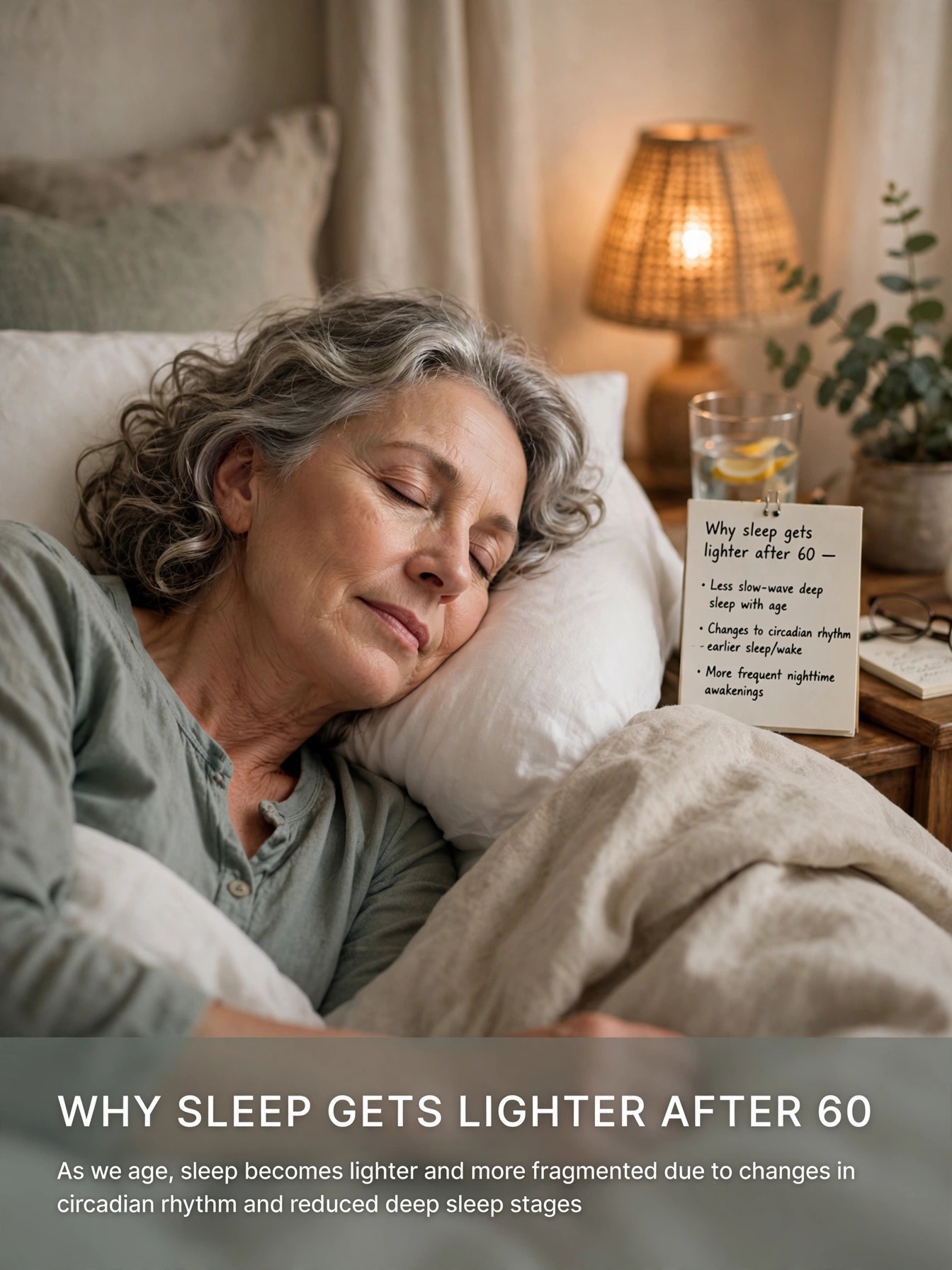
That combination makes sound masking especially relevant after 60. A sleeper who spends the night in light, fragmented sleep is far more vulnerable to every creak and rumble than someone sinking into deep, stable sleep. If you find yourself waking up at 3 a.m. every night — or half-waking at every small sound — a masking sound may plausibly smooth over the exact kind of disturbance your aging sleep is most sensitive to. This is also one reason sleep changes after 50 are worth understanding on their own terms: lighter sleep is normal, not a flaw you caused.
What the research actually shows: white, pink, and brown noise
Let us be honest up front: the evidence is early, modest, and mixed. White noise is a low-cost experiment, not a proven treatment.
White noise for sleep. A few small studies are encouraging. In one trial, broadband sound shortened the time it took healthy adults to fall asleep in a lab model of temporary insomnia. In a New York City study, people living in a noisy area fell asleep faster and spent more of their time in bed asleep while listening to white noise. In a hospital unit, white noise improved sleep quality for critically ill patients in a loud environment.
But a 2021 systematic review in Sleep Medicine Reviews — which pulled these studies together — produced mixed results. The authors questioned the quality of the existing evidence, noted that in some cases white noise disturbed sleep rather than helped, and concluded that more research is needed before it can be widely recommended as a sleep aid. In other words: promising signals, but the overall verdict is “not proven yet.”
Pink noise. This is the most interesting corner of the research for older adults. A small 2017 study at Northwestern University Medicine tested 13 adults aged 60 and older. Each participant received one night of pink-noise pulses synchronized to their brain waves during deep sleep, and one night of sham stimulation. The pink-noise night was linked to deeper slow-wave sleep, and word recall the next morning improved roughly three times more than after the sham night. The study appeared in Frontiers in Human Neuroscience.
Now the caveats, and they matter. Thirteen people is a tiny sample. It was a single night, in a lab, using specialized equipment that delivered sound pulses timed precisely to brain waves — nothing like playing a waterfall playlist from a phone. It suggests pink noise might have real effects on deep sleep in older adults, but it does not prove that listening to a pink-noise app will improve your memory.
Brown noise. This is the deepest of the three, often described as rainfall or a shower. Some research has linked brown noise to reduced symptoms in people with tinnitus (ringing in the ears) and to cognitive performance, but its effect on sleep has not been widely studied. Many people simply find it the least irritating of the three, which is a legitimate reason to prefer it.
The bottom line. White noise and its relatives may help some people fall asleep faster and wake up less — especially in noisy environments. The evidence is strongest for sound masking of disruptive noise and weakest for claims about deeper, “better” sleep. Expect a modest nudge, not a transformation.
How to try it safely: a practical checklist
If you want to experiment, a sensible trial runs two to three weeks. Here is how to do it without putting your hearing at risk.
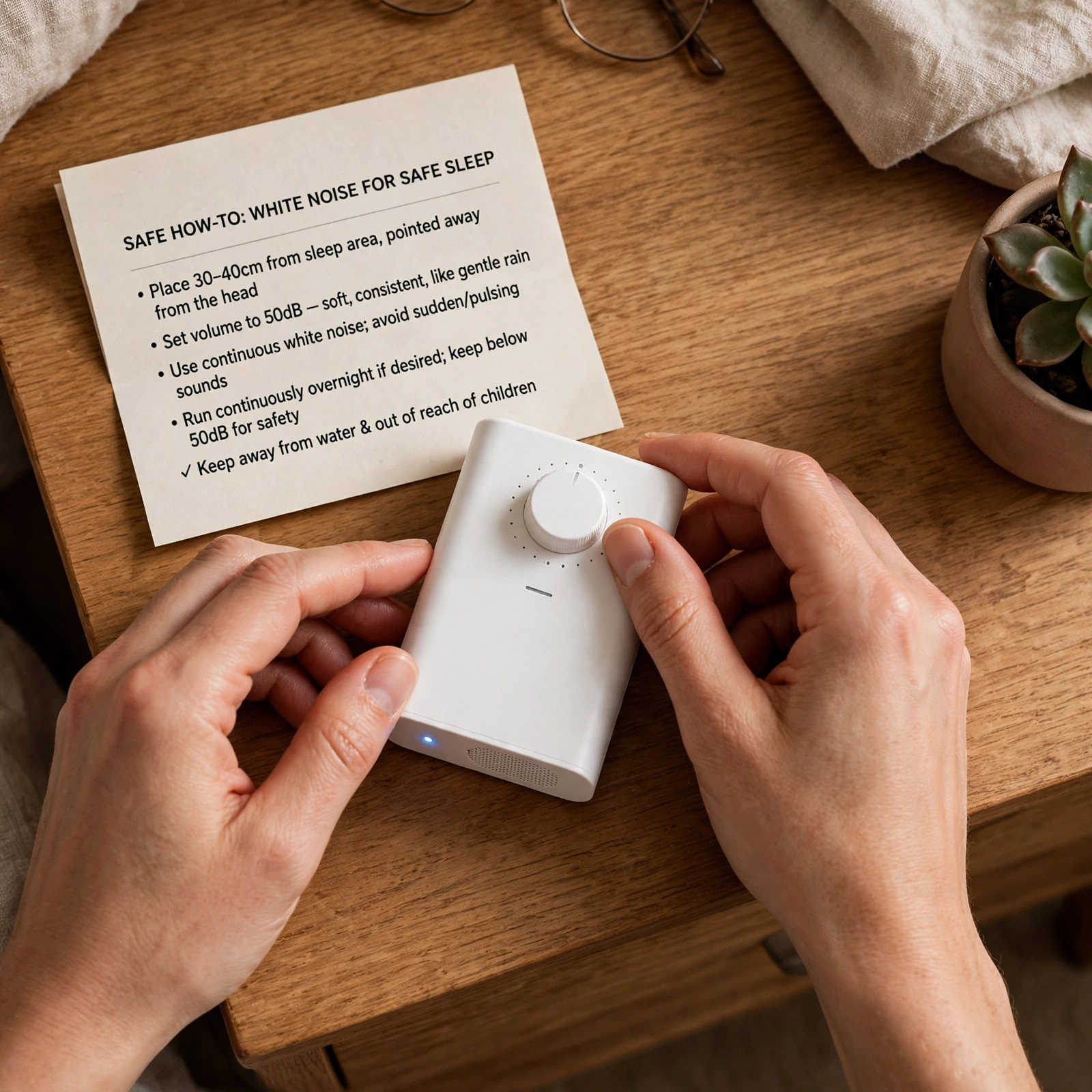
- Pick the sound you find least irritating. White noise can sound harsh and hissy. Many older adults prefer pink or brown noise for that reason. Play a few options during the day and choose the one you could imagine sleeping through.
- Keep the volume low — background-conversation level. The Sleep Foundation notes there are no official volume guidelines for sleep, but recommends keeping the sound similar to a background conversation and moving the device to a corner of the room rather than close to the bed. As a rule of thumb, stay well below a normal speaking voice: if you would need to raise your voice to talk over it, it is too loud. Regular exposure to noise at or above 70 decibels — roughly city traffic — can damage hearing over time.
- Place it across the room, never next to your pillow. Distance is the simplest form of protection. One study found that many white-noise devices can get surprisingly loud at maximum volume, especially when the listener sleeps very close to them.
- Consider a timer. If your main problem is falling asleep rather than staying asleep, a 60- to 90-minute timer may be enough. It also reduces how many hours your ears are exposed to continuous sound each night.
- Apps vs. dedicated machines vs. a fan. A dedicated machine tends to have better sound quality and no screen glow; a free app is fine for a trial; a simple fan doubles as a natural source of steady background sound. For a first experiment, an app or a fan costs nothing.
- If you use hearing aids or have tinnitus or hearing loss, check with your clinician first. Tinnitus and sleep sound do not always mix well, and continuous low-level sound could interfere with hearing-aid use overnight. This is one of those small decisions worth running past your clinician.
When white noise probably is not the answer
White noise works on noise. It does nothing about the other usual suspects behind broken sleep: caffeine after noon, a room that is too warm, scrolling on a phone in bed, or a bladder that insists on a 3 a.m. visit. If your bedroom is already quiet, a masking sound adds little — it is most plausible when there are actual sounds to mask.
Other simple tools cover the same ground:
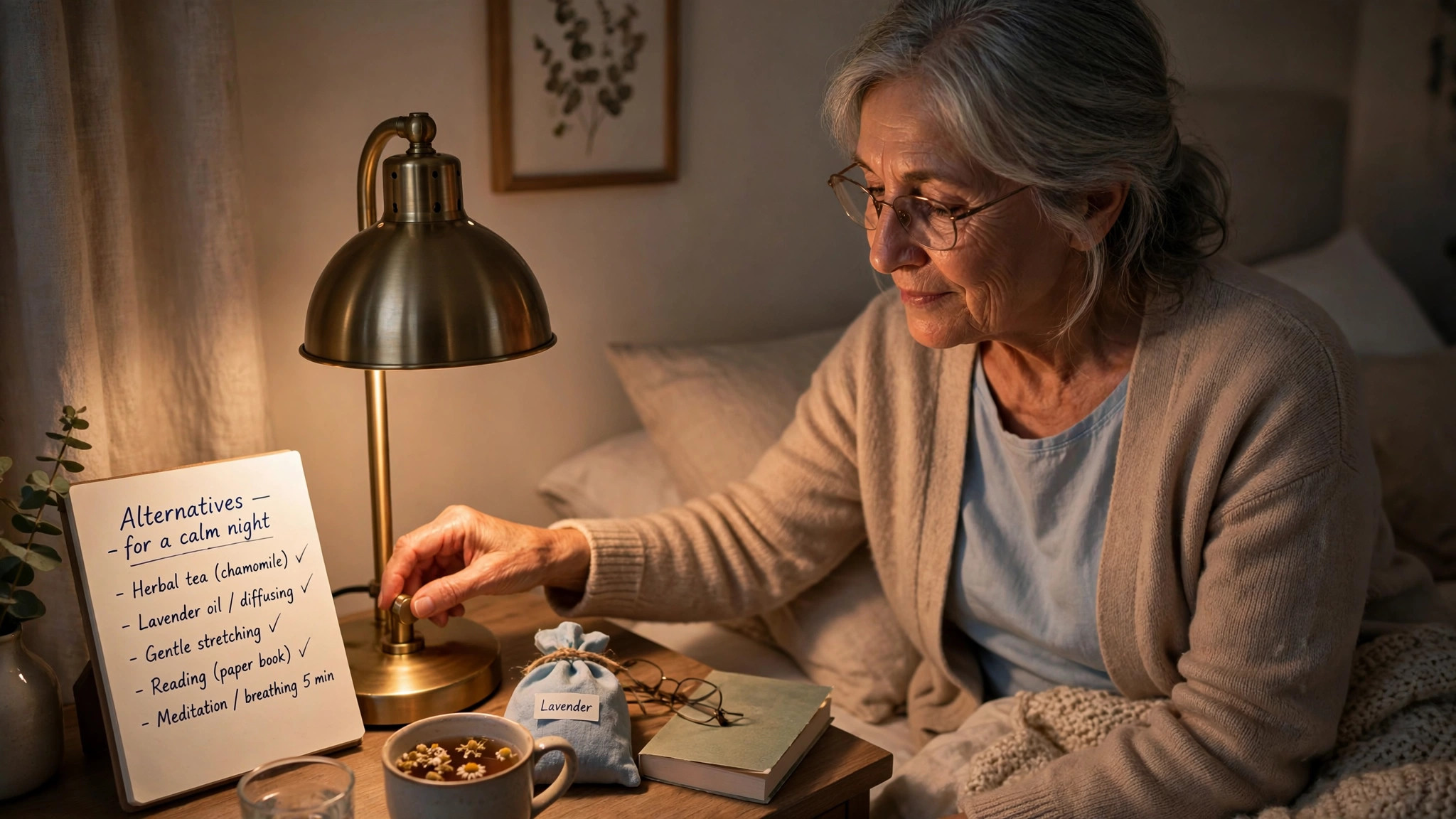
- Earplugs, if your sleep partner’s snoring is the problem.
- A quieter bedroom: heavy curtains, a closed door, moving a noisy device out of the room.
- A calmer wind-down routine: dim lights, no screens in the last hour, a consistent bedtime. Our guide to 9 evening habits that quietly ruin your sleep walks through the most common ones.
And if persistent sleep trouble sits alongside heavy daytime fatigue, loud habitual snoring with gasping, or long stretches of insomnia, those point to something that needs a professional look — which brings us to the next section.
When to see a doctor
Try the experiment for a few weeks, but do not let it become a way of ignoring a real problem. Talk to your clinician if you experience any of the following:
- Insomnia most nights for several weeks, despite consistent habits.
- Loud, nightly snoring with gasping, choking, or pauses in breathing — possible sleep apnea.
- Significant daytime sleepiness that affects driving or daily life.
- Restless legs, limb jerking, or unusual movements during sleep.
- Sleep problems alongside new depression, anxiety, or confusion.
- You use hearing aids or have tinnitus and are unsure whether overnight sound is safe for you.
A doctor can rule out conditions like sleep apnea — which no amount of white noise will fix — and review medications that may be disrupting your sleep.
Sources
- Sleep Foundation, “What Is White Noise?” — https://www.sleepfoundation.org/noise-and-sleep/white-noise
- National Institute on Aging, “A Good Night’s Sleep” — https://www.nia.nih.gov/health/sleep/good-nights-sleep
- Mayo Clinic, “Sleep tips: Steps to better sleep” — https://www.mayoclinic.org/healthy-lifestyle/adult-health/in-depth/sleep/art-20048379
- NHS, “How to fall asleep faster and sleep better” — https://www.nhs.uk/every-mind-matters/mental-wellbeing-tips/how-to-fall-asleep-faster-and-sleep-better/
- Riedy, S. M. et al. (2021), “Noise as a sleep aid: A systematic review,” Sleep Medicine Reviews — https://pubmed.ncbi.nlm.nih.gov/33007706/
- Northwestern University / MedicalXpress (2017), “Pink noise synced to brain waves deepens sleep and boosts memory in older adults” — https://medicalxpress.com/news/2017-04-pink-noise-synced-brain-deepens.html
This article is for informational purposes only and is not medical advice. Talk to your clinician about persistent sleep problems.