Best Pillow for Neck Pain After 50: What to Look For
If you wake up with a stiff, achy neck more often than you used to, your pillow deserves a closer look. Neck pain is common after 50, and the wrong pillow can quietly make it worse night after night. The good news: understanding what a pillow is supposed to do — and how it interacts with your sleep position — makes choosing the right one much simpler.
There is no single “best” pillow for everyone. The right pillow depends on your body, your sleep position, and how your neck feels in the morning. This guide explains how to find the one that fits you.
Why neck pain gets more common after 50
Several normal, age-related changes can make the neck stiffer and more sensitive over time:

- Cervical spondylosis (neck arthritis): The discs and joints in the neck gradually wear down with age, which the Mayo Clinic notes can cause stiffness and pain, especially in people over 60.
- Disc changes: Spinal discs lose some height and flexibility with age, leaving the neck less cushioned.
- Muscle stiffness and weaker deep neck muscles: Years of desk work and less movement can leave the small stabilizing muscles of the neck tighter and weaker.
- Sleep changes: As discussed in our article on why sleep changes after 50, older adults spend more time in lighter sleep stages and wake more easily — and morning stiffness becomes more noticeable.
None of this means neck pain is inevitable. But it does mean your pillow needs to work harder for you than it did at 30.
What actually matters: spinal alignment
Forget marketing claims about special materials. The one job of a pillow for neck pain is this: keep your neck aligned with the rest of your spine while you sleep.
Lie on your side and imagine a straight line running from the top of your head down through your spine. If your pillow is too thin, your head tips downward toward the mattress and the neck muscles strain to hold it. Too thick, and your head angles upward, compressing the other side. Either way, hours of poor alignment overnight can show up as stiffness or soreness in the morning.

For back sleepers, the same principle applies: the pillow should support the natural inward curve of the neck without pushing the chin toward the chest. The Cleveland Clinic recommends choosing a pillow that fills the space between your head and the mattress while keeping the neck in a neutral position — not bent up or down.
That is why “best pillow for neck pain” is a personal answer. The right pillow fills your gap, matches your shoulder width, and suits your position.
Match the pillow to your sleep position
Sleep position is the single most important factor in choosing a pillow.
Side sleepers
Side sleeping is the most common position — and the one where pillow choice matters most. Side sleepers have the largest gap to fill: the distance between the head and the mattress spans the full width of the shoulder. That means side sleepers usually need a thicker, firmer pillow to keep the head level and the neck straight.
Practical tip: if you sleep on your side, placing a pillow between your knees helps keep the hips aligned, which reduces the tendency to twist through the spine — a bonus for the neck too.
Back sleepers
Back sleepers need thinner support. A pillow that is too high pushes the head forward and flexes the neck all night. Look for a low-loft pillow that supports the natural curve of the neck, possibly one with a gentle neck roll or contour along the bottom edge. Some back sleepers find that tucking a small rolled towel under the neck — inside or outside the pillowcase — gives the targeted support a flat pillow cannot.
Stomach sleepers
Sleeping on your stomach forces the head to turn sharply to one side for hours, which is the worst position for neck pain. If you wake with neck stiffness and sleep on your stomach, switching position is likely to help more than any pillow. Our guide on the best sleep position for back pain covers how to make the side or back position feel more natural. If you cannot give up stomach sleeping, choose the thinnest pillow possible, or none at all.
Pillow types, explained
Forget brands. What matters is the fill and the shape:

- Memory foam: Contours closely to the shape of your head and neck, giving even support. Downsides: it can sleep warm, and some people dislike the slow “sinking” feel.
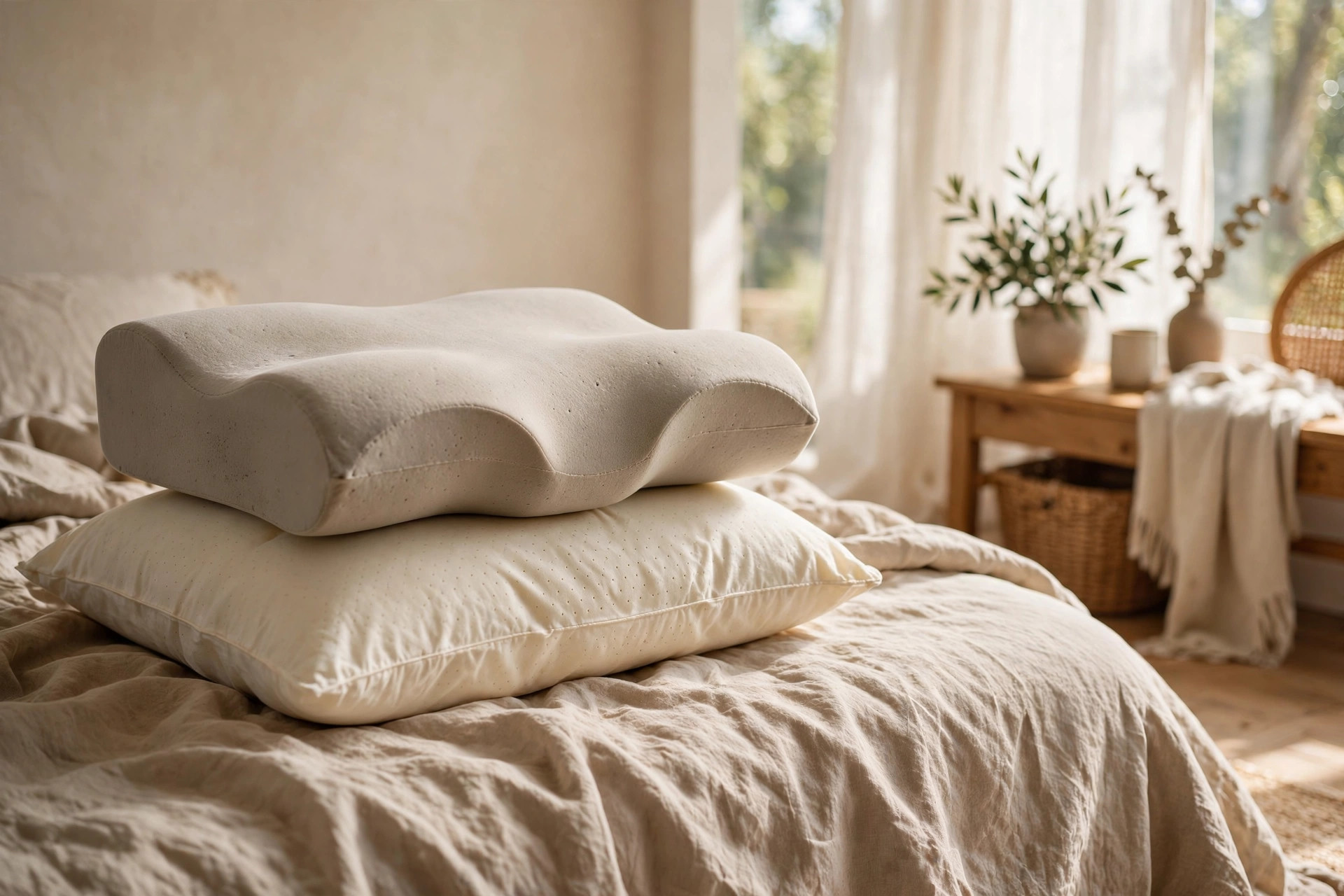
- Cervical / contour pillows: Shaped with a raised neck roll and a dip for the head, designed specifically to support the neck’s curve. They can be excellent for back sleepers but feel odd if you change position a lot at night — give yourself a week or two to adjust before judging.
- Latex: Responsive and bouncy with natural airflow, so it tends to sleep cooler than memory foam. Durable, but usually heavier and pricier to replace.
- Adjustable-loft / shredded fill: Filled with shredded foam or fibers you can add or remove to tune the height. Great if you are unsure what loft you need, because you can adjust it at home.
- Feather / down: Soft and moldable, easy to scrunch into shape. The trade-off is less consistent support — feathers compress overnight, so the neck may lose support by morning. Feather pillows may also be a poor choice for anyone with feather allergies.
Evidence on which fill “wins” is limited, and individual studies often show that personal comfort matters as much as the material. Treat this as a fit problem, not a ranking problem.
What to look for when you shop
Use this checklist to judge any pillow you are considering:
- Loft matched to your position. Side sleepers: thicker (typically 4–6 inches). Back sleepers: thinner (around 3–4 inches). Stomach sleepers: as thin as possible.
- Firmness that holds shape. A pillow for neck pain should support your head all night, not flatten by morning. Press it down — if it stays compressed, it will not support your neck.
- Breathability. If you sleep hot, lean toward latex or shredded fills with airflow, and look for a breathable cotton or bamboo-derived cover.
- Size. A standard size suits most people; larger pillows work well if you have broad shoulders or move around at night.
- Trial period and return policy. Neck comfort takes a few nights to judge. A retailer with a sleep trial lets you test the pillow without risk — this matters more than any marketing claim.
- When to replace. The National Sleep Foundation and sleep clinicians generally suggest replacing pillows every one to two years. Warning signs: lumps, flat spots that do not fluff back, a yellow tinge, or waking up sore despite no change in habits.
Practical tips that go beyond the pillow
The pillow is only part of the picture. These habits can reduce morning neck pain too:

- Morning neck stretches: Gentle chin tucks, slow ear-to-shoulder tilts, and shoulder rolls each morning can ease overnight stiffness. Keep movements slow and pain-free — never force a stretch.
- Check the mattress interplay. A sagging mattress lets the whole body sink, changing the angle your pillow must correct. If your mattress is past its prime, even a great pillow cannot fully compensate.
- Watch daytime posture. Hours of looking down at a phone or hunching over a laptop (“tech neck”) load the same joints that ache at night. The Harvard Health view on neck pain emphasizes posture and movement breaks as part of management.
- Stay active. Gentle daily activity — walking, swimming, or a senior-friendly exercise routine — keeps neck and shoulder muscles conditioned to support the head all day.
When to see a doctor
Most morning neck stiffness is mechanical and improves with better support and movement. But see your clinician if you experience:
- Neck pain after a fall, injury, or sudden trauma
- Pain that radiates down the arm, with numbness, tingling, or weakness
- Pain that persists beyond a few weeks despite changes in pillow and position
- Fever, unexplained weight loss, or severe headache alongside neck pain
- Difficulty with balance, coordination, or bladder/bowel control
These signs can indicate a pinched nerve, spinal cord involvement, or other conditions that need professional evaluation — a new pillow is not the answer for them. The NHS advises seeking prompt care for neck pain with these red-flag symptoms.
Sources
- Mayo Clinic — Cervical spondylosis: symptoms and causes. https://www.mayoclinic.org/diseases-conditions/cervical-spondylosis/symptoms-causes/syc-20370787
- Cleveland Clinic — How to choose the best pillow for neck pain. https://health.clevelandclinic.org/is-your-pillow-hurting-your-neck-7-tips-for-better-sleep
- National Institutes of Health / MedlinePlus — Neck pain. https://medlineplus.gov/ency/article/003025.htm
- NHS — Neck pain: causes and when to get help. https://www.nhs.uk/conditions/neck-pain-and-stiff-neck/
- Harvard Health Publishing — Neck pain: when to worry. https://www.health.harvard.edu/pain/6-ways-to-ease-neck-pain
This article is for informational purposes only and is not medical advice. Talk to your clinician about persistent neck pain.