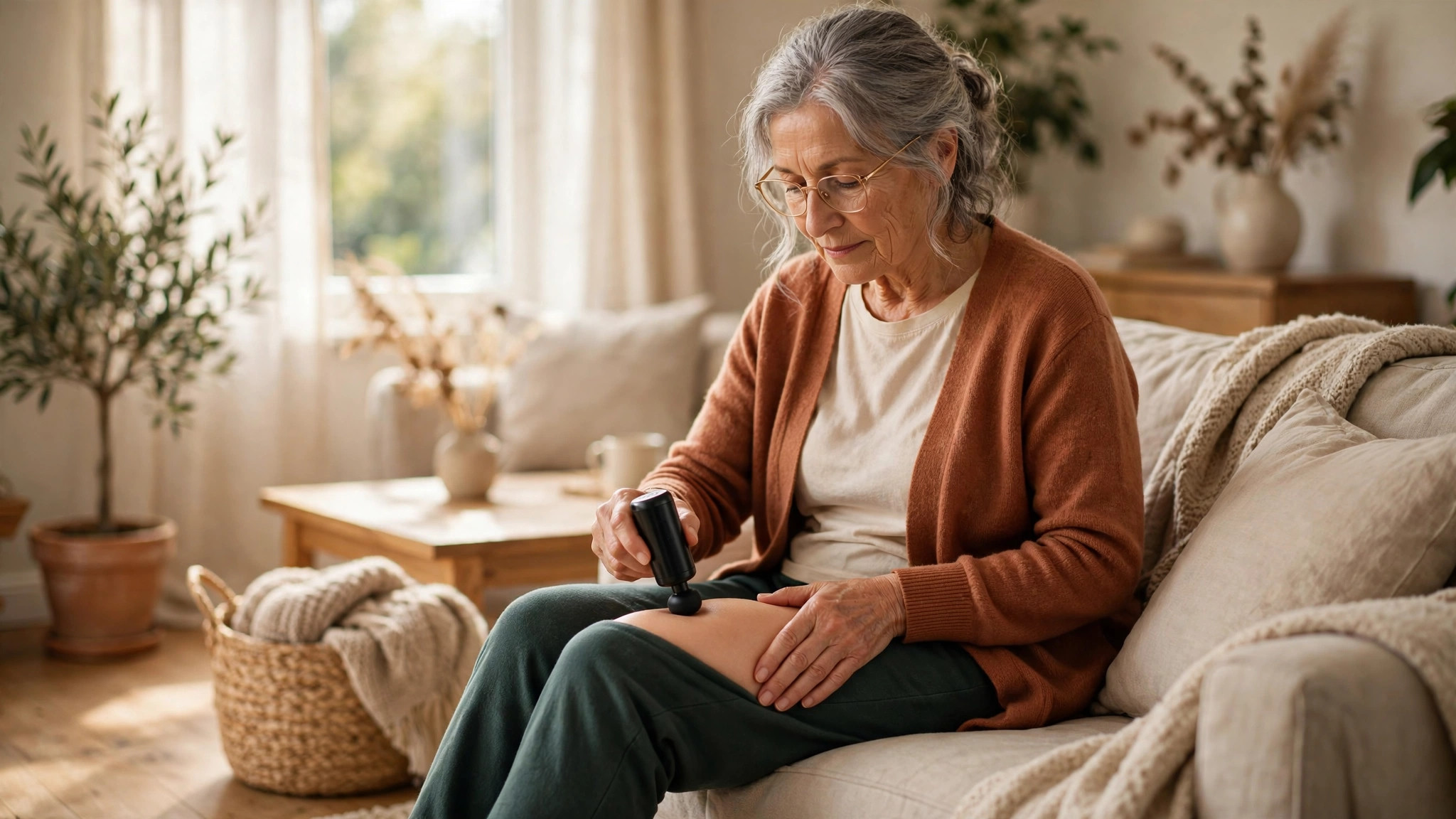
Massage Guns for Seniors: A Safety-First Buying Guide
Percussive massage guns are everywhere now — in gyms, on late-night TV, in gift guides for grandparents — marketed as a simple fix for sore muscles and stiff joints. But for adults over 55, the full story is more complicated than the ads suggest.
Recent case reports describe real injuries from these devices, including eye damage (reported June 2026) and a stroke linked to neck use (reported 2025). At the same time, the scientific evidence that they meaningfully help recovery is thinner than most people assume.
This guide takes the safety-first approach the topic deserves. Read the risks first, then decide — with eyes open — whether one of these devices belongs in your routine, and how to use one carefully if so.
What happened: the case reports every older adult should know
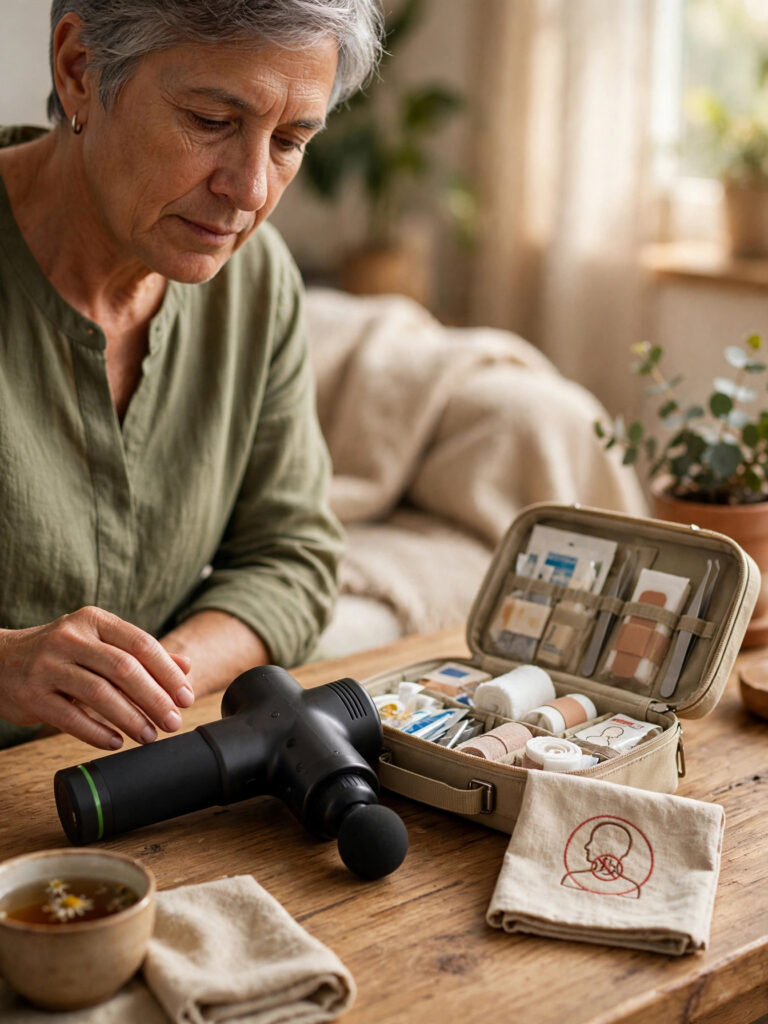
Massage guns deliver rapid, forceful pulses deep into tissue — fine for a young athlete’s thick quadriceps, but potentially harmful near vulnerable structures like the eyes, the front of the neck, or the spine.
Eye damage. In June 2026, BMJ Case Reports published a striking new case: a man in his 20s developed multiple retinal tears and bruising in both eyes — plus a tear along the outer rim of the right retina — after using a massage gun on and around his eyes for several minutes at a time weekly for about three months, “to relieve tiredness.” Doctors sealed the tears with laser treatment, and he was fortunate his sight was spared. The report also noted two earlier cases: cataracts and detached retinas in a younger man, and a cataract and glaucoma in a man in his late 60s. The authors wrote that “little is known regarding the safety profile of percussive massage guns” and called for “clear manufacturer warnings against improper application” (drugs.com summary, June 2026).
Neck use and stroke. A 2025 report from the University of Rochester Medical Center described a 65-year-old man with high cholesterol who developed sudden vertigo after light stationary cycling and using a percussion massager on his neck. Imaging showed a right vertebral artery dissection — a tear in an artery running through the neck to the brain — with a clot that caused a cerebellar stroke. The authors called it the first reported case of MRI-proven stroke tied to traumatic vertebral artery dissection after use of a handheld massage device, and they called for biomechanical studies of how force from percussive tools spreads through the body (Medical Daily, via the Rochester report). One caveat worth knowing: his device was unusually old — a model from around 1950, based on a 1934 design rated at 3,600 to 7,200 oscillations per minute — while modern devices top out at about 3,200 per minute.
The pattern. Force applied near the eyes, the arteries running through the neck, or the spine is the danger zone. Older adults are more vulnerable: arteries become less elastic with age, and conditions common at 55+ — high cholesterol, high blood pressure, vascular disease — may raise the stakes further.
What the evidence actually shows: the benefits are thin
A 2023 controlled study by Leabeater and colleagues in the Journal of Athletic Training tested 5 minutes of percussive therapy on the calves (65 active young adults, treated leg vs. untreated leg) and found no significant benefit on any measured outcome — range of motion, calf circumference, isometric strength, or endurance. The only notable difference was a small increase in perceived muscle soreness in the treated leg, both immediately and 4 hours after use. The authors concluded the devices “appeared to have little effect” in this setting and recommended caution when using them right after strenuous lower-body exercise.
There is no established clinical protocol for percussive therapy in older adults — so a conservative approach is the sensible one: large muscle groups only, 30–60 seconds per area, two to three times per week, at low intensity, and with caution throughout. Anything more aggressive is untested territory for this age group.
The honest framing: a massage gun is a comfort tool, not a treatment. It may feel good on tired legs after a walk, but the evidence that it speeds recovery is thin — and the documented injuries are real.
Who should be extra careful — or skip it entirely
Percussive devices may pose higher risk for people who:
- Take blood thinners (warfarin, apixaban, rivaroxaban, clopidogrel, or daily aspirin therapy) — higher bruising and internal bleeding risk
- Have osteoporosis or low bone density — forceful percussion over thin tissue near bones can cause fractures or deep bruising
- Have vascular disease, high blood pressure, or peripheral artery disease
- Have neuropathy or reduced sensation (common with diabetes) — if you can’t feel the force, you can’t judge what’s too much
- Have varicose veins, skin infections, open wounds, or unexplained swelling
- Have had a blood clot, stroke, or transient ischemic attack (TIA) — check with your clinician first
And the absolute rule, for everyone: never use a massage gun on the neck, face, head, or eyes — not to relieve a stiff neck, not near the sinuses, not around the temples. Keep it away from the spine, bony areas, and over varicose veins or bruises.
If you still want one: what actually matters when buying
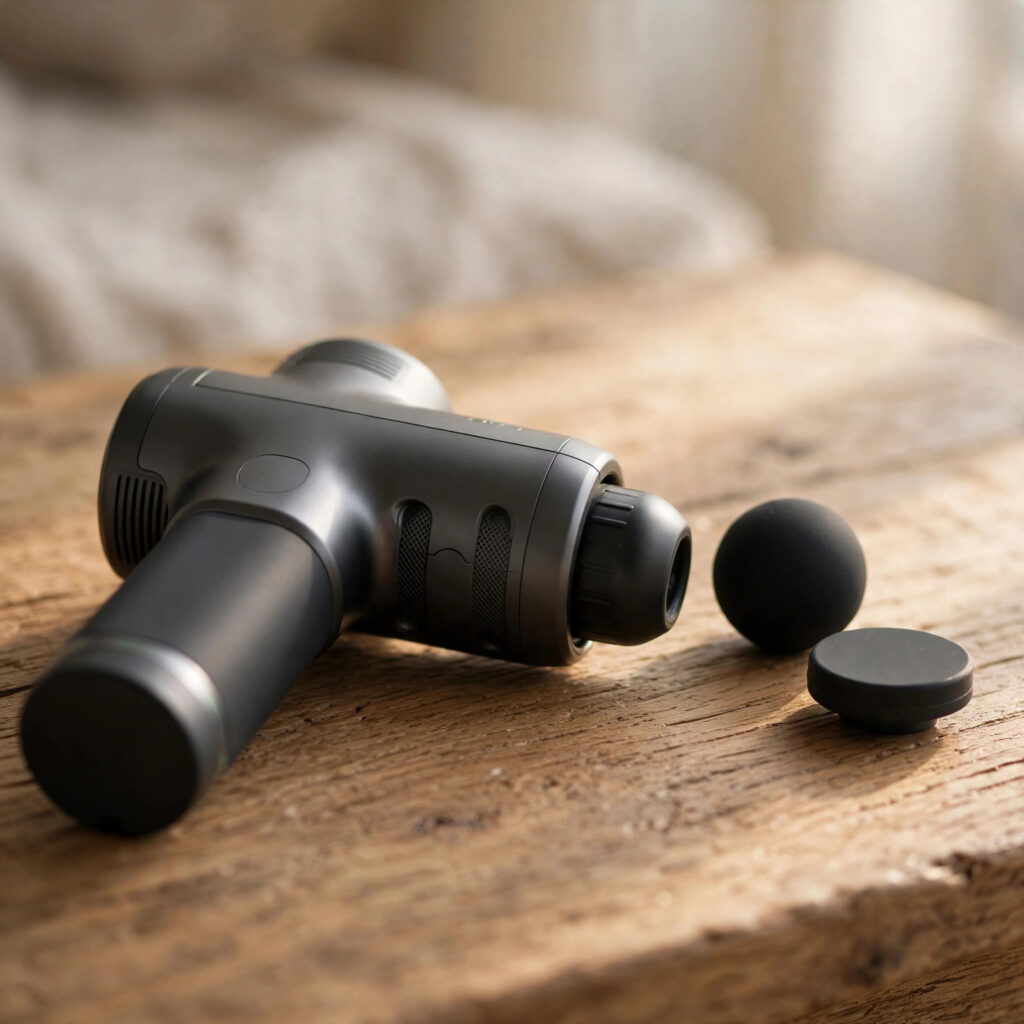
If the safety picture hasn’t scared you off, the right device choice matters. Here’s what the features mean in plain language, viewed through a safety lens.
Low-speed start (under 1,800 pulses per minute). This is arguably the most important spec for older users: devices that start gently let you stay in the low-intensity zone. Avoid devices whose lowest setting still feels aggressive.
Weight (under 2 lbs / 900 g is ideal). Heavier guns are harder to control, and arm fatigue makes accidents more likely. A lighter, compact model is easier to guide precisely where you want it — and only where you want it.
Amplitude. This is how far the head travels in and out with each pulse — typically 8 to 16 mm. Smaller amplitude (under 10 mm) delivers a shallower, gentler massage. For a senior buyer, gentler is better.
Stall force. This measures how much pressure stops the motor. High stall force means the device keeps hammering even when pressed hard — which sounds powerful but raises injury risk in thin, bony areas. You don’t need or want it.
Noise. Loud devices (many exceed 65 dB) can make sessions less relaxing and may encourage rougher handling. Quieter operation — look for claims under about 60 dB — makes for a calmer, more controlled session.
Battery life and auto shutoff. Longer battery life is convenient but less critical than an automatic shutoff timer. A 10- or 15-minute auto-off prevents the most common misuse: zoning out and hammering one spot far too long.
Attachments. A soft round-ball head is the most versatile and forgiving for larger muscle groups. Bullet or cone heads concentrate force into a small point — avoid them entirely. More attachments isn’t better; the right two or three is.
Simple controls. Large, clearly labeled buttons beat apps and touchscreens for many older users. If you need a manual to change settings, the device isn’t for you.
Note: this guide deliberately names no products and lists no prices. What matters is knowing which specs protect you and which marketing terms to ignore.
How older adults should use one safely
If you buy one, follow this conservative approach (large muscles only, brief sessions, low intensity):
- Large muscles only — thighs, calves, glutes, and the broad muscles of the upper back. Never the neck, face, head, spine, chest, or joints.
- Low intensity, always start there. Begin at the lowest setting. If it hurts, stop — discomfort is a signal, not a target.
- 30–60 seconds per area, moving slowly. Total session: keep it under about 10 minutes.
- Two to three times per week, not daily — especially at first, while you learn how your body responds.
- Keep the device moving. Never press and hold in one spot; constant light pressure, slow passes.
- Stop immediately if you feel dizziness, sharp pain, vision changes, numbness, or unusual bruising — and seek medical care promptly for dizziness or vision changes.
- Check your skin afterward. Older skin bruises more easily; if you’re developing bruises, the intensity is too high or the area is too thin.
Gentler alternatives worth considering
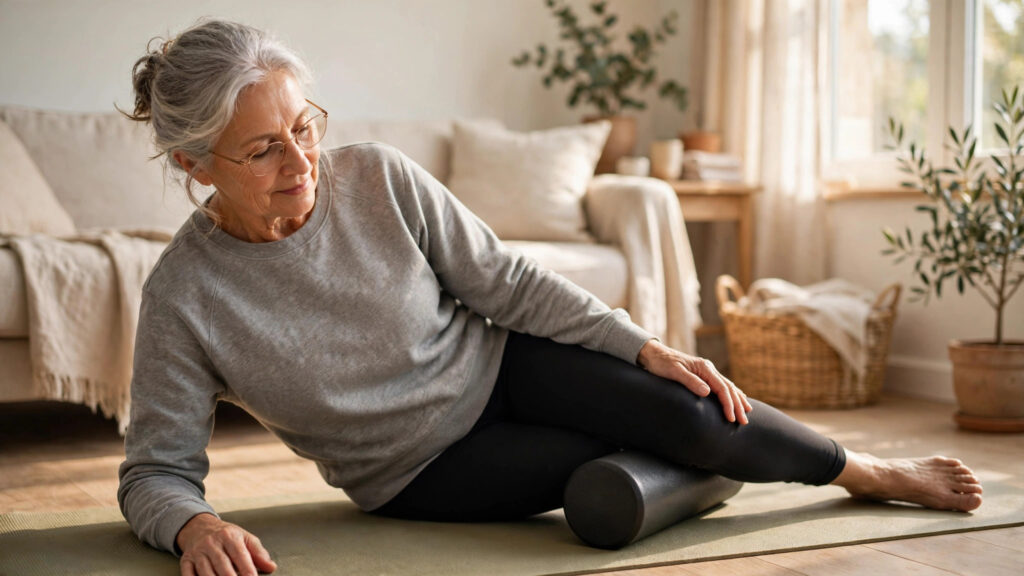
Most older adults can get the comfort they’re after with less risk:
- Foam rollers — a slower, self-controlled way to work large muscles, with far less force concentration. See our guide to foam rollers, a gentler alternative.
- Warmth — a warm bath, heat pad, or warm towel on sore muscles is well-tolerated and avoids the impact-related risks discussed in this guide.
- Gentle stretching and walking — regular movement does more for stiffness than any device.
- Professional massage — a licensed therapist adjusts force to your body in real time, something no device can do.
If your goal is relief for persistent joint or shoulder pain, a device won’t address the underlying issue — and a clinician’s evaluation will help more.
When to see a doctor
Seek prompt medical care if you experience any of the following during or after using a massage gun:
- Dizziness, vertigo, or faintness
- Any vision change — blurriness, flashes, floaters, partial vision loss
- Sudden severe headache, neck pain, or one-sided weakness or numbness
- Unusual bruising, swelling, or a lump that doesn’t fade
- Numbness or tingling that persists after the session
Also check with your clinician before buying one if you take blood thinners, have vascular disease or osteoporosis, have had a stroke or blood clot, or have diabetes with reduced sensation.
Sources
- BMJ Case Reports, June 18, 2026 — case report of retinal tears and bruising in both eyes after repeated massage-gun use on and around the eyes; notes two earlier cases of massage-gun–linked eye injury (cataracts/detached retinas in a younger man; cataract/glaucoma in a man in his late 60s). drugs.com summary
- University of Rochester Medical Center, 2025 — 65-year-old man, vertebral artery dissection and cerebellar stroke after light cycling and neck use of a percussion massager (unusually old device, rated above modern devices); first reported MRI-proven stroke of this kind. Medical Daily report
- Leabeater et al., 2023, Journal of Athletic Training — 5-minute percussive therapy on calves in 65 active adults: no significant benefit vs. the untreated leg on any measured physical or perceptual outcome; slightly higher perceived soreness immediately and 4 hours after use.
- Cleveland Clinic — guidance on blood thinner use and bleeding risk with massage devices. clevelandclinic.org
- National Institute on Aging (NIH) — exercise and physical activity guidance for older adults. nia.nih.gov
This article is for general information only and is not medical advice. Talk to your clinician before using a massage gun, especially if you take blood thinners or have vascular disease.