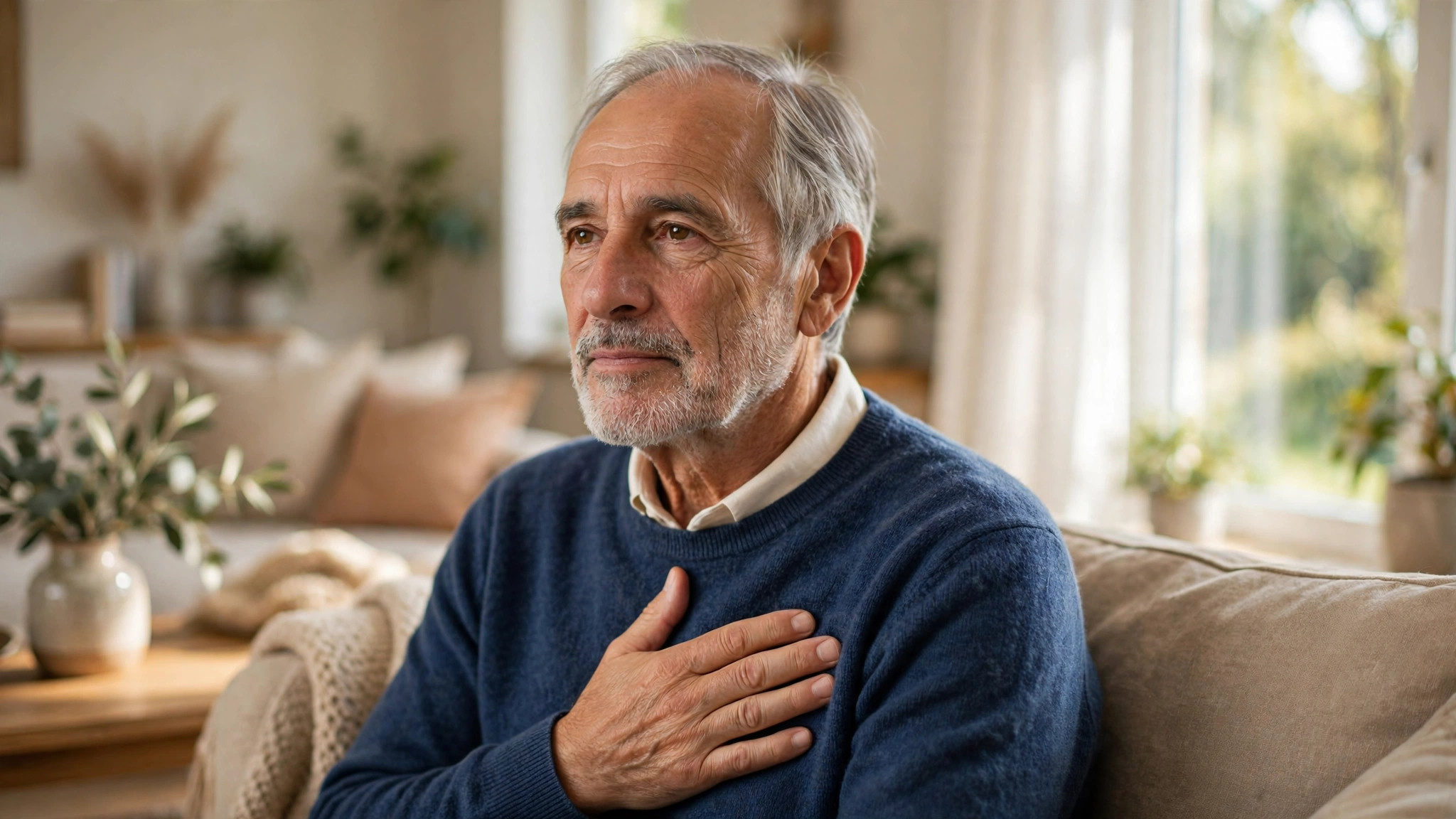
Chest Pain After 60: Causes, Warning Signs, and When to Call for Help
Chest pain after 60 should never be brushed aside as “just getting older.” Some causes are minor, like a strained muscle or heartburn; others involve the heart or lungs and need urgent care. Heartburn can feel alarming, and a heart problem can feel surprisingly mild.
Call for emergency help immediately if chest pain is new, severe, or crushing, or comes with shortness of breath, sweating, nausea or vomiting, or pain spreading to your arm, jaw, neck, or back. In the United States, call 911; elsewhere, call your local emergency number. Do not wait to see whether it passes, and do not drive yourself unless there is no other way.
Why chest pain deserves attention after 60
Heart and blood-vessel disease risk rises with age. The NHS notes heart problems are more likely if you are older or at risk of coronary heart disease — for example, if you smoke, live with obesity, have high blood pressure, diabetes, or high cholesterol, or have a family history of early heart disease. The NHS also points out that most chest pain is not caused by the heart — but because the most dangerous causes involve the heart or lungs, the Mayo Clinic advises getting medical help rather than working it out on your own.
Heart-related causes
Angina. Angina is chest pain from too little blood flow to the heart muscle, usually because narrowed coronary arteries cannot deliver enough oxygen when the heart works harder. It often feels like squeezing, pressure, heaviness, or tightness, sometimes spreading to the arms, neck, jaw, or back. The Cleveland Clinic notes angina can warn of a heart attack — sometimes days or weeks in advance.
- Stable angina follows a predictable pattern: it comes on with exertion or stress, feels the same each time, and eases within a few minutes of rest — nearly always less than 30 minutes, per the Mayo Clinic.
- Unstable angina is a medical emergency: it can happen without warning, including at rest, may last 20 minutes or longer, and does not ease with rest or usual angina medicines. Chest pain that comes on with less effort than before, at rest, or more often needs emergency care.
Heart attack. A heart attack happens when blood flow to part of the heart muscle is suddenly blocked, most often by a blood clot at a fatty plaque buildup in a coronary artery. The Mayo Clinic notes it generally causes chest pain over 15 minutes. For more, see our guide to heart attack warning signs in older adults.
Pericarditis — inflammation of the thin sac around the heart — usually causes sharp pain that worsens when you breathe in, cough, or lie down, and may ease sitting up and leaning forward. A rare but life-threatening cause is aortic dissection, a tear in the aorta’s inner layer, causing sudden severe chest or upper-back pain — an emergency.
Digestive causes
The esophagus runs right behind the heart, so digestive problems are a common source of chest pain.
Gastroesophageal reflux disease (GERD). When stomach acid washes back up into the esophagus, it causes heartburn — a burning feeling in the chest. The pain often starts after eating or when lying down, and may come with a sour taste in the mouth. Because reflux pain can feel very similar to heart pain, new chest pain should still be checked by a clinician rather than assumed to be reflux.
Gallbladder problems. Gallstones or inflammation of the gallbladder or pancreas can cause stomach pain that spreads into the chest.
Lung-related causes
Several lung conditions can cause chest pain, and some are emergencies too.
Pulmonary embolism. A blood clot stuck in a lung artery can block blood flow to lung tissue. The Mayo Clinic notes its symptoms may feel like a heart attack, often with sudden shortness of breath and sharp pain that worsens when breathing in.
Pleurisy and pneumonia. Pleurisy is irritation of the thin layers of tissue separating the lungs from the chest wall, causing sharp pain that worsens when you breathe in or cough. Pneumonia, a lung infection, can cause the same kind of pain, often with a high temperature and coughing up yellow or green mucus.
Collapsed lung. A collapsed lung — air leaking into the space between the lung and the ribs — typically causes sudden pain lasting hours, usually with shortness of breath.
Muscle and bone causes
The chest wall itself — muscles, ribs, and cartilage — can also be the source.
Costochondritis. This is inflammation of the cartilage joining a rib to the breastbone. The Mayo Clinic notes it can cause chest pain that might feel like a heart attack, most commonly on the left side. It is often tender to the touch — a useful clue, though tenderness alone does not rule out a heart problem.
Injured ribs and strained muscles. A bruised or broken rib, or a strained chest muscle from heavy lifting, coughing, or unusual exercise, can cause pain that worsens when you breathe in or move, and usually eases with rest.
Anxiety and panic attacks
A panic attack can cause chest pain with a fast, pounding heartbeat, fast breathing, sweating, shortness of breath, nausea, and dizziness. It can feel very like a heart problem — and the Mayo Clinic stresses it can be hard to tell a panic attack from a heart attack. If you are not sure of the cause, always get medical help. Stress can also trigger angina in people with heart disease, so the two are hard to separate without a medical assessment.
How the pattern can hint at the cause
No pattern proves a diagnosis, but these clues can help you describe symptoms to a clinician:
| Pattern | Possible cause |
|---|---|
| Pressure, squeezing, or heaviness, often with exertion; eases with rest | Angina |
| Pain over 15 minutes, at rest, with sweating, nausea, breathlessness | Heart attack — call emergency services |
| Burning after eating or when lying down, sour taste | Heartburn or reflux |
| Sharp pain worse on breathing in, with fever | Pleurisy or pneumonia |
| Sharp pain worse when lying down, better sitting up and leaning forward | Pericarditis |
| Tender to touch, worse with movement, after injury or lifting | Muscle strain or costochondritis |
| Sharp, continuous pain with a racing heart during stress or worry | Panic attack or anxiety |
These are only pointers — a heart attack can feel like burning indigestion, and reflux can feel crushing. That overlap is why self-diagnosis is risky.
Chest pain can look different in women and older adults
The American Heart Association states that chest discomfort — pressure, squeezing, fullness, or pain in the center of the chest lasting more than a few minutes, or going away and coming back — is the most common heart attack symptom. But symptoms vary: women are more likely than men to also have shortness of breath, nausea or vomiting, and back or jaw pain.
Older adults may have subtler presentations: breathlessness while resting or climbing stairs may be the main symptom rather than pain — easy to dismiss as an age-related complaint. Unusual tiredness, lightheadedness, or a cold sweat can also be part of the picture. Treat a new pattern like this seriously and seek advice promptly.
What to do while waiting for help
If you think you or someone near you may be having a heart attack, the Mayo Clinic’s first-aid guidance is straightforward:
- Call emergency services first. Do not wait to see if symptoms pass. If an ambulance cannot reach you, have someone drive you to the nearest hospital. Drive yourself only if there is no other option.
- Sit or lie down and rest; avoid exertion.
- Take aspirin only if a healthcare professional or the emergency operator tells you to — it can interact with other medicines, and should never delay your call for help.
- Take nitroglycerin if prescribed, as directed.
- If the person is not breathing or has no pulse, start hands-only CPR — push hard and fast in the center of the chest about 100 to 120 times a minute — and use an AED if nearby.
What a doctor visit usually involves
When you see a clinician about chest pain, expect questions about when it started, what it feels like, what brings it on, and whether it spreads. They will usually check your blood pressure and heart rhythm, and may order an electrocardiogram (ECG), blood tests, or a chest X-ray. Before your visit, note when the pain happens, how long it lasts, and what makes it better or worse, and bring a list of your medicines. If you have high blood pressure, our guide to blood pressure after 60 explains the numbers clinicians look at, and heart palpitations after 60 covers another symptom that often appears alongside chest discomfort.

Lowering your heart risk over time
Once the cause is known, reducing heart risk is a long-term project: not smoking, keeping blood pressure and cholesterol in a healthy range, staying active as your body allows, eating plenty of vegetables, whole grains, and fish, and managing stress and sleep. Regular movement does not have to be intense — a daily walk counts. Our guide to lowering blood pressure naturally after 60 covers practical steps, from cutting back on salt to building walking into your routine.


When to see a doctor
Call emergency services right away if chest pain is sudden, severe, or crushing; lasts more than a few minutes or keeps coming back; spreads to your arm, jaw, neck, back, or stomach; or comes with shortness of breath, sweating, nausea, vomiting, dizziness, or fainting.
See a clinician promptly — the same day if possible — if chest pain is new, keeps coming back, has changed from its usual pattern, or appears with less exertion than before. The NHS advises seeing a GP for chest pain that comes and goes, or pain that passes quickly but still worries you. Do not try to diagnose chest pain yourself. A check that turns out to be reflux or a strained muscle is a good outcome — the dangerous mistake is the one that never gets checked.
Sources
- Mayo Clinic, “Chest pain — Symptoms and causes” — https://www.mayoclinic.org/diseases-conditions/chest-pain/symptoms-causes/syc-20370838
- Mayo Clinic, “Chest pain: First aid” — https://www.mayoclinic.org/first-aid/first-aid-chest-pain/basics/art-20056705
- NHS, “Chest pain” — https://www.nhs.uk/conditions/chest-pain/
- American Heart Association, “Warning Signs of a Heart Attack” — https://www.heart.org/en/health-topics/heart-attack/warning-signs-of-a-heart-attack
- Cleveland Clinic, “Angina” — https://my.clevelandclinic.org/health/diseases/21489-angina
- MedlinePlus (NIH), “Angina” — https://medlineplus.gov/angina.html
This article is for general information only and is not medical advice. Talk to your doctor before changing your health routine, and seek emergency care right away for chest pain that is new, severe, or comes with breathlessness, sweating, nausea, or pain spreading to your arm or jaw.