
Oatmeal After 60: A Simple Breakfast for Heart and Gut Health
Breakfast gets harder to get right after 60. Appetite is often smaller, chewing can be more work, blood sugar is less forgiving, and cholesterol numbers now matter. Oatmeal answers all of those concerns at once: soft, cheap, quick to prepare, and unusually well studied for a breakfast food.
Why oats suit older adults
Most breakfast foods ask you to choose between soft, filling, quick, and nutritious. Oatmeal manages to be all four.
Easy to eat. Cooked oatmeal is soft and spoonable, with no hard crust and nothing that demands strong chewing — a real advantage for anyone with dentures or missing teeth. If swallowing is difficult, thin it with extra milk or water; ask your doctor about the right thickness.
Easy to prepare. Rolled oats take about five minutes on the stove or two minutes in the microwave. Overnight oats take no cooking at all: stir oats with milk in a jar the night before and eat them cold in the morning.
Gentle on the stomach. Oats are bland and low-acid, so they rarely trigger heartburn the way citrus, coffee, or fried breakfast foods can. Their soluble fiber forms a soft gel in the gut, which tends to be kind to digestion.
Cheap and filling. A large canister of plain oats costs a fraction of most breakfast cereals per serving and keeps for months. Fiber plus slow-digesting starch also means a bowl holds off hunger longer than toast, pastries, or sugary cereal.
Beta-glucan: the fiber behind the heart-health claim
Oats contain a soluble fiber called beta-glucan. In your gut it forms a thick gel that binds cholesterol-rich bile acids and carries them out of the body, so the liver pulls more cholesterol from the bloodstream to replace them. It also slows digestion, softening the rise in blood sugar after a meal.
A meta-analysis of 28 randomized controlled trials in the American Journal of Clinical Nutrition found that at least 3 grams of oat beta-glucan a day lowered LDL (“bad”) cholesterol by about 0.25 mmol/L — roughly 10 mg/dL — and total cholesterol by about 0.30 mmol/L. HDL (“good”) cholesterol and triglycerides were not affected, and the effect was larger in people who started with higher cholesterol.
The FDA allows oat foods to carry a health claim that 3 grams of beta-glucan a day, as part of a diet low in saturated fat and cholesterol, may reduce the risk of heart disease. Oats were the first food ever to receive an FDA health claim, in 1997, and Harvard Health lists oats first among foods that lower cholesterol. In practice, roughly a cup and a half of cooked oatmeal delivers around 3 grams of beta-glucan.
Keep it in perspective: the drop is modest, around 5 to 7 percent lower LDL. That is meaningful, but it is not a substitute for medication — if you take a statin, keep taking it.
A half cup of dry rolled oats gives you about 165 calories, 4 grams of fiber, and 6 grams of protein, according to Mayo Clinic Health System. U.S. guidelines suggest about 22 grams of fiber a day for women over 50 and 28 grams for men over 50; the NHS recommends 30 grams a day. Most people get only about half that, so one bowl is a solid start — with water alongside it, since fiber without enough fluid can worsen constipation. Our guide to high-fiber foods that lower cholesterol lists more easy sources.
Types of oats compared: instant vs. rolled vs. steel-cut vs. overnight
All oats start as the same whole grain — the oat groat. What differs is how much the groat has been cut, steamed, and flattened. The less processing, the slower the oats digest and the gentler they are on blood sugar.
| Type | What it is | Cook time | Glycemic index (approx.) | Best for |
|---|---|---|---|---|
| Steel-cut oats | Whole groats chopped into 2–3 pieces | 20–30 min | ~55 | Slowest blood-sugar rise |
| Rolled (old-fashioned) oats | Groats steamed and flattened into flakes | ~5 min | ~53 | Everyday balance |
| Quick oats | Rolled oats cut thinner, pre-steamed | 1–3 min | ~71 | Busy mornings |
| Instant oatmeal | Precooked, rolled paper-thin, often flavored | 1 min | ~75 | Convenience — choose plain only |
| Overnight oats | Rolled oats soaked in milk overnight | 0 min (soaked) | Similar to rolled | Make-ahead, no cooking |

In a systematic review of glycemic index tests, steel-cut oats scored about 55 and rolled oats about 53, both low, while quick oats scored about 71 and instant oatmeal about 75, both high. That gap matters if you watch your blood sugar: in one small 1999 study of teenagers, participants ate 53 percent more calories in the five hours after a high-GI instant oatmeal breakfast than after a steel-cut oat breakfast.
Steel-cut oats have the best blood-sugar profile but take 20 to 30 minutes to cook, so cook a big batch ahead and reheat portions through the week. Rolled oats are the sweet spot for most people — five minutes, low glycemic index, soft texture. All types contain beta-glucan, so the cholesterol benefit is not limited to one form.

Toppings that add protein
Plain oatmeal has only about 5 to 6 grams of protein per serving. Expert groups recommend roughly 1.0 to 1.2 grams of protein per kilogram of body weight a day for older adults, spread across meals, and breakfast is where most people fall short.

Greek yogurt (about 15–20 g protein per cup). Stir a spoonful into hot oatmeal or layer it over overnight oats for creaminess, protein, and calcium.
An egg on the side (about 6 g protein). A soft-boiled or poached egg turns a light breakfast into a complete one.
Nuts and seeds (about 5–7 g protein per small handful). Walnuts, almonds, pumpkin seeds, and chia seeds add protein, healthy fats, and crunch. A tablespoon or two is enough — nuts are calorie-dense.
Milk instead of water. Cooking oats in milk adds roughly 8 grams of protein per cup, plus calcium.
Peanut or almond butter (about 7–8 g protein per 2 tablespoons). Choose varieties with no added sugar — the ingredient list should be short.
Aim for 20 to 25 grams of protein at breakfast — oatmeal cooked in milk with Greek yogurt and walnuts gets you there.
The flavored-packet sugar trap
Plain instant oatmeal has almost no sugar — about 0 to 1 gram per packet. Flavored packets are a different product wearing the same name: a typical flavored packet, such as apples and cinnamon, carries around 10 to 12 grams of total sugar per serving, most of it added sugar, according to label data. Some varieties reach 12 to 14 grams — roughly three teaspoons of sugar before you have added anything yourself.
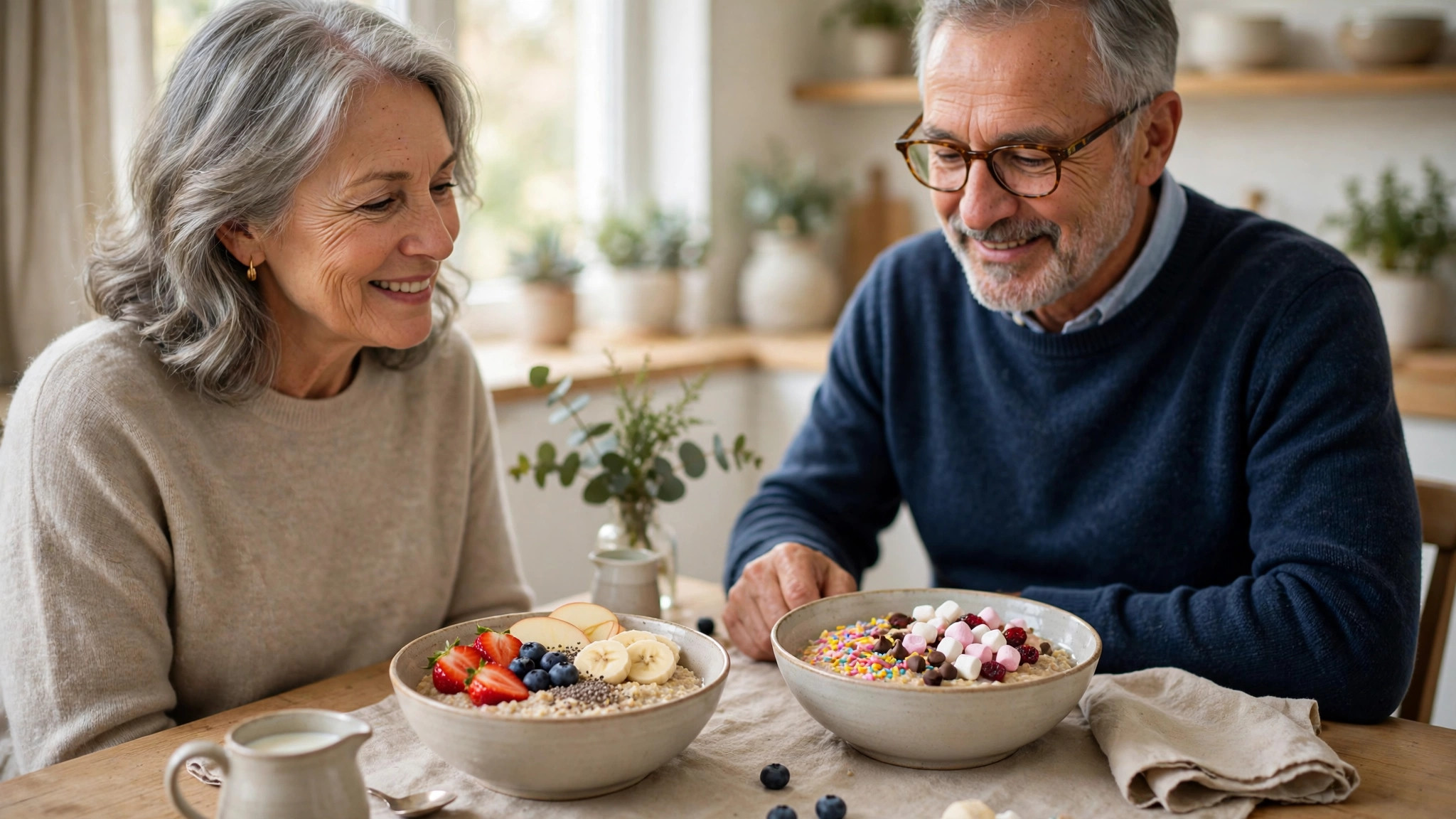
Over a week of daily packets, that adds up — and it blunts the blood-sugar advantage that makes oats attractive.
The fix is simple. Buy plain oats and flavor them yourself: cinnamon, vanilla extract, and nutmeg add flavor with no sugar at all. Sweeten with fruit, not sugar — half a sliced banana, a handful of berries, or diced apple adds natural sweetness plus fiber and vitamins. Check the “Added Sugars” line, not just “Total Sugars” — plain oats list zero. Our guide to how much sugar is safe after 60 explains daily limits in plain terms.
A simple way to start
Start with rolled oats, cooked in milk, with a sliced banana and a spoonful of peanut butter. That is five minutes, one pot, and a breakfast with fiber, protein, and staying power. Add fiber gradually over a week or two, with extra water — a sudden jump can cause bloating and gas.
Frequently asked questions
Is oatmeal good for cholesterol? Evidence suggests yes, in a modest way. At least 3 grams of oat beta-glucan a day has been linked to lower LDL cholesterol in pooled trials, and the FDA allows a heart-health claim for it. Think of oatmeal as one helpful piece of a heart-healthy eating pattern, not a treatment on its own.
Are steel-cut oats really better than instant? For blood sugar, yes — steel-cut and rolled oats have a much lower glycemic index than instant oatmeal. For cholesterol, the difference is small, since all oat types contain beta-glucan. If time is short, plain rolled oats are an excellent compromise.
Can I eat oatmeal if I have diabetes? Many people with diabetes do eat oatmeal. Steel-cut or rolled oats are better choices than instant, and toppings matter: nuts, seeds, and Greek yogurt slow digestion, while sugar and honey do the opposite. Check your blood sugar after eating and ask your doctor or dietitian about portions.
Is overnight oatmeal as healthy as cooked oatmeal? Yes, broadly — overnight oats use rolled oats soaked in liquid, so their nutrition is very similar to cooked rolled oats. Just watch the add-ins: sweetened yogurt or honey can quietly add sugar.
When to see a doctor
Oatmeal is a food, not a treatment. See your doctor or a registered dietitian if you have diabetes or prediabetes and want to work out the right portion and oat type; if you have high cholesterol and wonder whether diet changes are enough; or if you have celiac disease — oats are naturally gluten-free, but most are processed where wheat is handled, so you need certified gluten-free oats. Also seek advice for trouble swallowing, unexplained weight loss, persistent bowel changes after increasing fiber, or if you take medication that must be taken on an empty stomach — fiber can affect how some medicines are absorbed.
The bottom line
Oatmeal after 60 is a rare thing: a breakfast that is soft, quick, cheap, and genuinely supported by research. Its beta-glucan fiber is linked to lower LDL cholesterol at around 3 grams a day, and its slow-digesting starch steadies morning energy. Choose steel-cut or rolled oats when you can, add protein with yogurt, nuts, or an egg, and skip the flavored packets — plain oats with fruit taste better anyway.
Sources
- Harvard Health Publishing, “11 Foods That Lower Cholesterol” — https://www.health.harvard.edu/heart-health/11-foods-that-lower-cholesterol
- Mayo Clinic Health System, “Start your day with healthy oatmeal” — https://www.mayoclinichealthsystem.org/hometown-health/speaking-of-health/start-your-day-with-healthy-oatmeal
- Whitehead A. et al., “Cholesterol-lowering effects of oat β-glucan: a meta-analysis of randomized controlled trials,” American Journal of Clinical Nutrition, 2014 — https://pubmed.ncbi.nlm.nih.gov/25411276/
- NHS, “Starchy foods and carbohydrates” — https://www.nhs.uk/live-well/eat-well/food-types/starchy-foods-and-carbohydrates/
- NHS, “How to get more fibre into your diet” — https://www.nhs.uk/live-well/eat-well/digestive-health/how-to-get-more-fibre-into-your-diet/
This article is for general information only and is not medical advice. Talk to your doctor or a registered dietitian about your personal nutrition needs.