Best Rowing Machine for Seniors: A Buying Guide
If you want one machine that trains your heart, legs, back, and arms at the same time — without pounding your joints — a rowing machine is hard to beat. It suits adults over 60 well: the motion is smooth, your feet never leave the footplates, and you can dial the effort down to genuinely easy.
But not every rowing machine is a good fit for an older body. Seat heights designed for 25-year-old athletes, loud fans, hard-to-read monitors, and poor technique can turn a great idea into a dusty purchase. This guide walks you through what actually matters when choosing a rowing machine for seniors — and who should think twice before buying one.
As an Amazon Associate, we earn from qualifying purchases.
Why rowing suits older joints
Most cardio forces a trade-off. Running and stair machines load the knees on every step. A recumbent bike is gentle but trains mainly the legs. Rowing is the rare exercise that gives you a full-body workout with essentially zero impact: your feet stay strapped to the footplates, so nothing lands and nothing jars.
One stroke recruits the legs, hips, core, back, shoulders, and arms in a single flowing sequence. That matters because muscle naturally declines with age, and rowing works against resistance — a bit like light strength training plus cardio in one session. It is the kind of activity that can help you toward the CDC’s guideline for adults 65 and older: at least 150 minutes of moderate-intensity aerobic activity each week, plus muscle-strengthening activities on two or more days, plus balance work (see CDC guidelines).
That said, rowing moves the lower back through repeated flexion and extension — form matters, and we cover the essentials below.
The one spec that matters most: seat height

Most rowing-machine roundups open with a debate about resistance types. For older buyers, the more decisive number is rarely in the listing: how high the seat sits off the floor.
A typical rowing machine seat sits about 14 inches off the ground. For comparison, an ordinary dining chair is 17 to 19 inches. That means getting onto the machine is not sitting down — it is lowering yourself most of the way to the floor, and then standing back up from there at the end of a tiring workout. Some manufacturers offer taller leg options that raise the seat to about 20 inches, which is closer to normal chair height and far easier for stiff knees or hips (these are standard published specifications; for example, Concept2 lists its standard seat at 14 inches and its tall-leg option at 20 inches).
Before you buy, ask the seller a single question: “How many inches is it from the floor to the top of the seat?” If you cannot get an answer, assume a low seat. Try this home test first: sit in an armless dining chair and stand up without using your hands. If that is already difficult, a 14-inch rowing seat will be harder — at the end of a workout rather than the start.
Resistance types: what each one means for seniors
There are four common resistance types. Here is how they compare for older adults.
Magnetic — the safest default. Magnets create smooth, silent resistance with clearly marked levels, from very light upward. There is no minimum effort required to get moving, and the effort stays predictable on every stroke. For apartments and shared homes, quiet is a genuine benefit.
Water — the most natural feel. A paddle flywheel spins inside a water tank, so the harder you pull, the more resistance you get — much like rowing a boat. The sound is a soft wave slosh rather than mechanical noise. Water rowers also tend to sit higher off the floor, which helps with the seat-height problem. The trade-off: resistance is adjusted by changing the tank’s water level rather than turning a knob, and the machines tend to be bulkier.
Air — powerful but loud. A fan flywheel creates resistance that rises with how hard you pull. These are excellent machines, but the fan noise is a real consideration in a shared home.
Hydraulic — compact and affordable, but limited. Piston cylinders create resistance, often with independently moving arms. A reasonable way to find out whether you enjoy rowing — but the motion is less smooth than a sliding-seat machine.
Other senior-friendly features to check
- Monitor readability. At minimum you want time, stroke count, distance, and pace on screen. Look for a large, backlit display you can read from the seat. Adjustable monitor arms help if your eyesight is not what it was.
- Seat comfort. A contoured, padded seat and smooth-running wheels make longer sessions pleasant. This is one area where trying before buying pays off.
- Adjustable footplates. Feet should be secure and comfortable; adjustable straps or pivoting footrests accommodate different shoe sizes and stiff ankles.
- Listed weight capacity. Check the manufacturer’s rated capacity against your body weight, and leave a comfortable margin.
- Footprint and storage. A full-size machine needs roughly 8 feet by 2 feet in use, plus clearance to get on and off from at least one side. Many models fold upright or split in two for storage — worth confirming if space is tight. Transport wheels make moving one far easier.
How a rower compares with other home machines
Rowing beats the recumbent bike and elliptical on one front: it trains the upper body and the muscles that hold you upright, which bikes largely ignore. But the bike wins on pure ease of use — you sit onto it at chair height, and the back stays supported the whole time. A treadmill wins on familiarity but loads the knees every step. Be honest about your weak points: bad knees favor rowing over the treadmill; a cranky back favors the recumbent bike over the rower. If you want to round out a home setup, our guides to low-impact exercises for bad knees, strength training at home after 60, and the best resistance bands for seniors can help.
Technique that protects your back

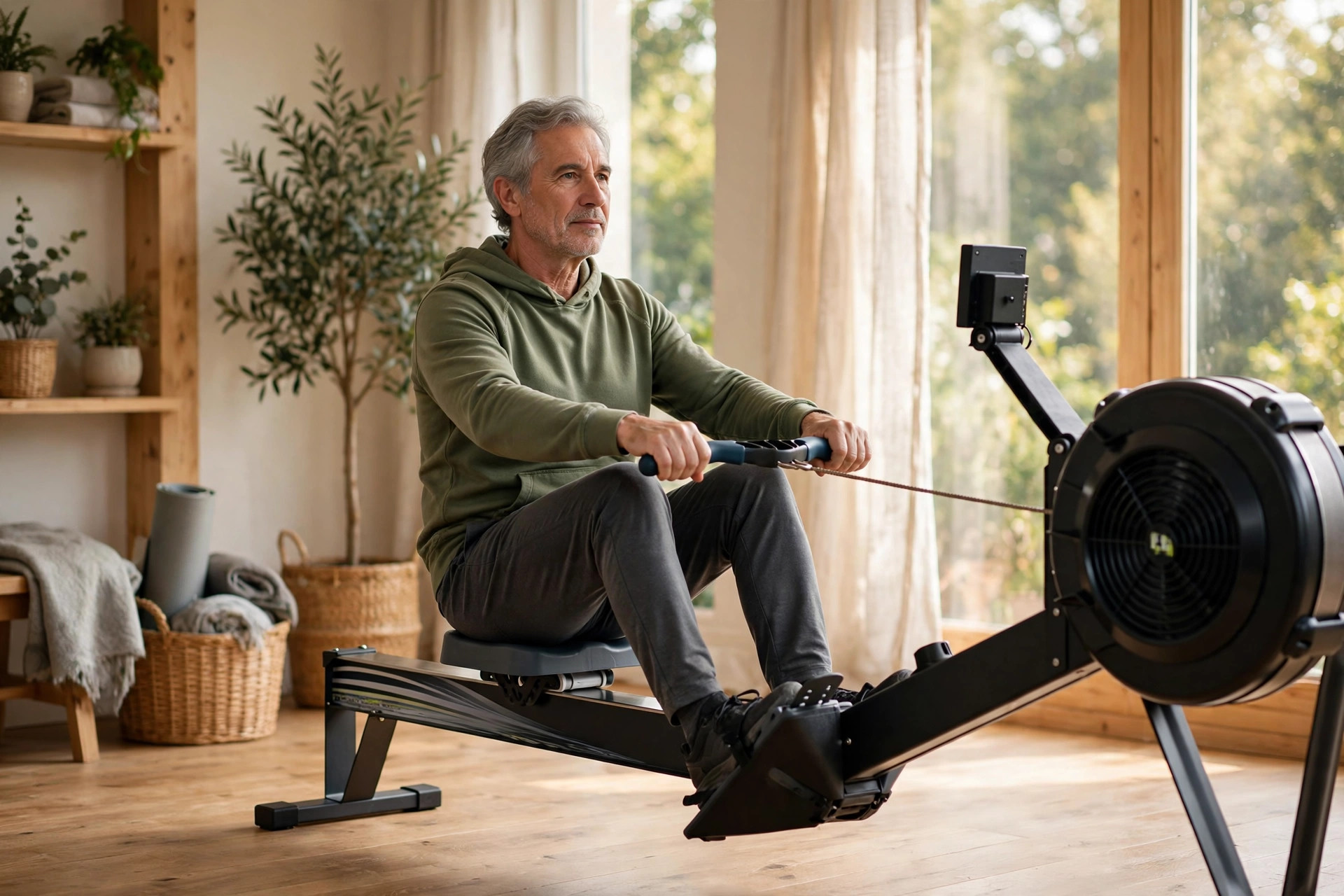
Most rowing back pain comes from poor form, not from rowing itself. The single most useful correction: your torso should travel only between 11 o’clock and 1 o’clock. Older rowers should stop well short of 11 — lean back barely at all. The extra lean adds nothing but lumbar strain.
The stroke sequence, in order:
- The catch. Sit tall, shins vertical, arms straight, shoulders relaxed, spine long rather than rounded.
- The drive. Push with your legs first, as if doing a leg press. The legs should do most of the work — if your arms tire before your thighs, the order is wrong.
- The body swing. Swing the torso back slightly, well short of 11 o’clock.
- The arms. Pull the handle to the bottom of your ribs, elbows past the body.
- The recovery. Reverse it — arms extend first, torso pivots forward from the hips, then knees bend to slide back. The recovery should take about twice as long as the drive.
Keep your core gently braced and your chest open throughout. On air rowers, avoid maxing out the damper — a middle setting keeps the stroke smooth and spares the back. If you want a bigger picture on getting started with home exercise, read staying active after 60.
A sensible first month

Rowing is easy to overdo in week one because nothing hurts while you are doing it. Build slowly:
- Week 1: 5 minutes, very light resistance, three times. The goal is the movement pattern, not the workout.
- Week 2: 8 to 10 minutes at the same resistance.
- Week 3: 12 to 15 minutes, resistance up one notch.
- Week 4: 15 to 20 minutes, three to four times a week.
Twenty minutes four times a week is a genuinely strong cardiovascular base — and gets you more than halfway to the 150 weekly minutes the CDC recommends. Pair rowing with two short strength sessions and you have covered the main elements of the older-adult activity guidelines. Stop when your form goes, not when the timer does — fatigue is exactly when the back is most vulnerable.
When a rowing machine is the wrong choice
Retailers rarely print this, but it matters more than any feature list. Rowing is not for everyone:
- Acute or recent back pain. If your back is currently painful, do not row — “row gently” is not the answer. A recumbent bike or walking is the better call until things settle.
- Severe arthritis in the shoulders, elbows, or wrists. The pulling motion can aggravate these joints.
- Knee or hip replacements. Rowing is low-impact and often recommended after recovery, but the deep knee bend at the compressed “catch” position is real. Shorten the stroke so your knees never close past a comfortable angle, and get clearance from your surgeon first.
- Balance or dizziness problems. Getting on and off a low sliding seat is a fall risk if you are unsteady; a higher-seat machine or a stationary bike is safer.
When to see a doctor
- Before you buy if you have a heart condition, uncontrolled high blood pressure, or a history of heart attack — rowing is real cardio and raises the heart rate.
- Before you start if you have a spinal condition (such as herniated disc, spinal stenosis, or osteoporosis with prior fractures), a recent joint replacement, or persistent joint pain.
- Promptly if rowing causes chest pain, unusual shortness of breath, dizziness, numbness, or sharp pain in the back, hips, or knees that does not ease within a day or two.
Our top picks
These are real rowing machines sold on Amazon that match this guide’s criteria – note seat height and resistance type. Magnetic models are the quiet apartment pick. Prices and specs change – check the live Amazon page before you buy.

1. Concept2 RowErg
The gold standard rowers swear by. Tracks every stroke – built to last decades.

2. Sunny Health & Fitness Smart Compact Magnetic Rowing Machine (SF-RW521020)
Extra-long rail fits taller users. 8 resistance levels, app-connected, stores compact.

3. Sunny Health & Fitness Flip & Foldable Magnetic Rowing Machine (SF-RW522016)
Flips and folds for storage – full-body cardio that doesn’t eat your living room.

4. Sunny Health & Fitness Magnetic Rowing Machine (SF-RW5622)
Magnetic resistance so quiet you can row while watching TV. Smooth, simple, effective.
Sources
- Centers for Disease Control and Prevention — Older Adult Activity: An Overview: at least 150 minutes of moderate-intensity aerobic activity per week, muscle-strengthening on 2+ days, plus balance activities. https://www.cdc.gov/physical-activity-basics/guidelines/older-adults.html
- BarBend — The 7 Best Rowing Machines for Seniors of 2026 (Expert Tested): resistance type comparison (air, water, magnetic, hydraulic) and senior-specific buying considerations. http://barbend.com/best-rowing-machines-for-seniors/
- Concept2 RowErg published specifications (via authorised retailer spec sheets): seat height 14 in with standard legs / 20 in with tall legs; assembled footprint 8 ft × 2 ft, clearance 9 ft × 4 ft. https://www.factoryweights.co.uk/products/concept2-rowerg
- Home Gym Foundry — Best Rowing Machines for Seniors: Seat Height First: seat-height guidance (target 15–20 in), resistance ranking for seniors, back-pain contraindications. https://homegymfoundry.com/blog/best-rowing-machines-seniors
- Hydrow — Five Benefits of Rowing Machines for Seniors: low-impact full-body benefits and adjustability for older adults. https://hydrow.com/en-GB/blog/the-five-benefits-of-rowing-machines-for-seniors/
- Dr. Ronald Tolchin, Medical Director, Baptist Health Center for Spine Care (via Health Channel interview): keep the back straight and spine neutral; correct form is essential to avoid injury. https://allhealthtv.com/is-rowing-good-for-back-pain
This article is for general information only and is not medical advice. Talk to your doctor before starting a new exercise program.