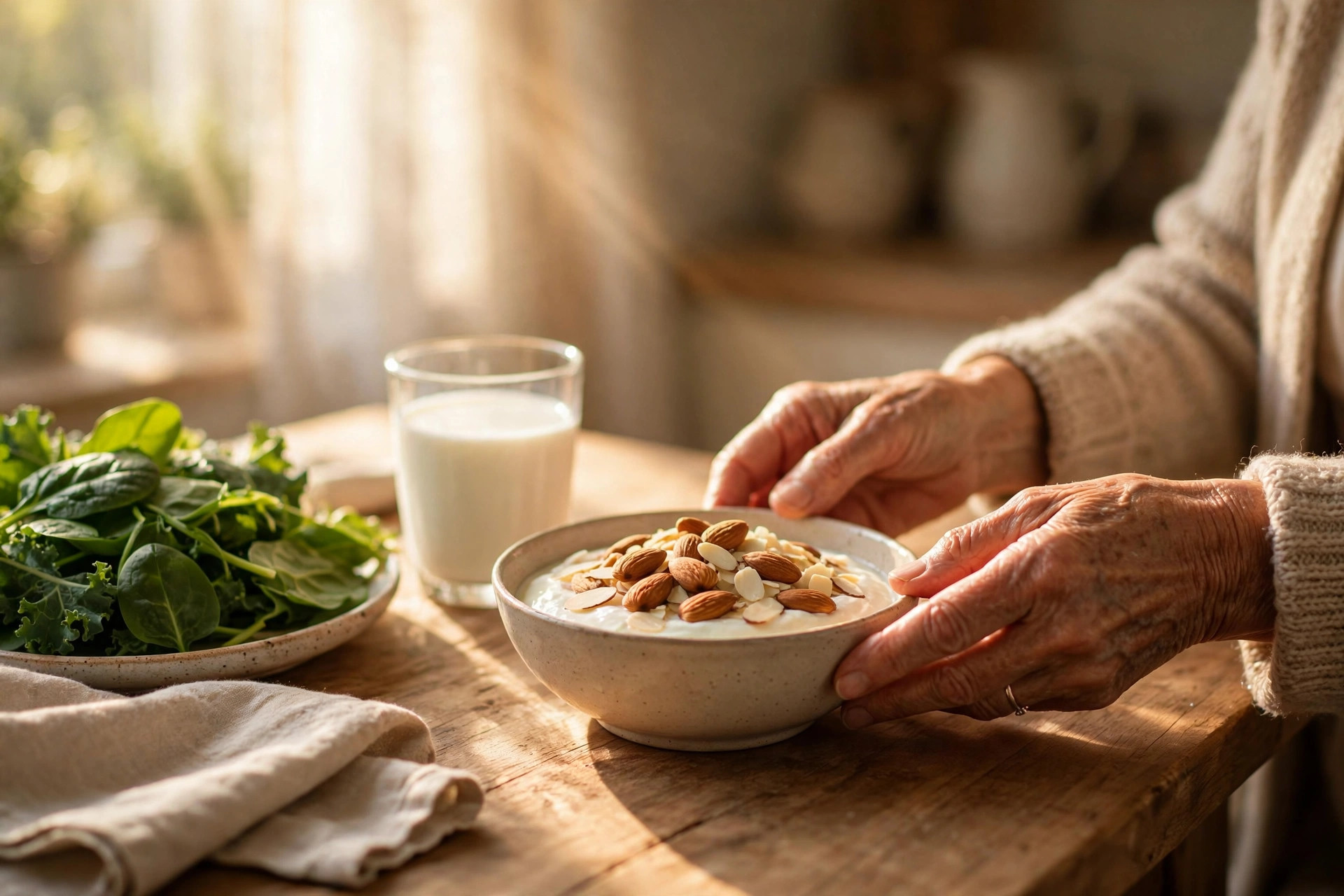
Calcium-Rich Foods After 50: Beyond Dairy
When most of us think of calcium, we picture a glass of milk. Dairy still earns its reputation — but after 50, relying on dairy alone can leave real gaps. Appetites change, lactose tolerance drops for many people, and your need for calcium rises just as your body’s absorption declines.
The good news: plenty of calcium-rich foods beyond dairy can help you hit your daily target. Canned sardines and fortified orange juice deliver as much calcium per serving as a glass of milk. Below: why calcium needs change after 50, the dairy standbys worth keeping, and the best non-dairy sources — with approximate amounts per serving from the U.S. National Institutes of Health.
Why Your Calcium Needs Change After 50
Calcium is the most abundant mineral in your body, and almost all of it is stored in your bones and teeth. It also helps muscles contract, nerves send messages, and blood vessels move blood — so a steady supply matters for more than bone density.
Menopause changes bone balance. According to the NIH, falling estrogen after menopause reduces calcium absorption, increases urinary calcium loss, and accelerates calcium pulled from bone. Women lose about 1% of bone mineral density per year after menopause, and roughly 30% of postmenopausal women in the U.S. and Europe have osteoporosis.
Absorption declines with age. Net absorption of dietary calcium is about 25% in adulthood and keeps falling with age. Older adults also tend to have lower stomach acid and less sun exposure, which can mean less of the vitamin D needed for calcium absorption.
Recommended amounts go up. The NIH Office of Dietary Supplements sets these daily targets:
- Men aged 51–70: 1,000 mg per day
- Women aged 51 and older: 1,200 mg per day
- Men aged 71 and older: 1,200 mg per day
Falling short is common: national survey data found that 39% of Americans aged 4 and older consume less calcium than the estimated average requirement. Possible signs of inadequate intake include muscle cramping and weakness, tingling or numbness in the fingers, and a poor appetite, per Mayo Clinic guidance citing NIH figures.
Dairy First: The Reliable Standbys

There is nothing wrong with starting at the dairy aisle. Dairy products are among the most concentrated and best-absorbed calcium sources — about 72% of calcium intake in the United States comes from dairy and foods with added dairy ingredients. Typical servings, per the NIH — see the full table below for exact comparisons: plain yogurt (8 oz, ~415 mg) and part-skim mozzarella (1.5 oz, ~333 mg) top the dairy list, followed by a cup of milk (~276–299 mg depending on fat content), with cottage cheese (1 cup, ~138 mg) further down.
Yogurt is often the easiest choice for older adults: soft, easy to eat, and one cup covers roughly a third of the daily target. Hard cheeses are dense in calcium per bite but higher in sodium, so they work best as part of a wider pattern. And if dairy upsets your stomach, lactose-free milk and yogurt contain the same calcium as regular versions, according to the NIH.
Beyond Dairy: 7 Calcium-Rich Foods to Add to Your Plate

Dairy is not the only game in town. The foods below are all backed by the NIH’s reference values.
1. Canned sardines with bones — ~325 mg per 3 ounces. The tiny soft bones are entirely edible and packed with calcium. Mash on whole-grain toast with lemon, or toss into a salad.
2. Calcium-fortified orange juice — ~349 mg per 1 cup. One of the strongest non-dairy sources per serving. Check the label — not all orange juices are fortified.
3. Calcium-fortified soymilk — ~299 mg per 1 cup. Fortified plant milks aim to match cow’s milk in calcium. Shake the carton — added calcium settles — and check the label, since content varies by brand.
4. Firm tofu made with calcium sulfate — ~253 mg per ½ cup. Check the ingredient list: tofu set with calcium sulfate is a strong source; tofu made with other salts provides far less.
5. Canned salmon with bones — ~181 mg per 3 ounces. Less than sardines, but a practical lunch staple that also adds vitamin D, which helps your body absorb calcium.
6. Cooked leafy greens — ~94 mg per cup of cooked kale, ~99 mg per ½ cup of cooked turnip greens. Greens add up when you eat them often. But not all greens are equal for calcium: the calcium in spinach is only about 5% absorbed (versus roughly 30% from dairy), because oxalic acid binds to calcium and forms salts your body cannot break down. Kale, bok choy, and broccoli are better bets.
7. Chia seeds and beans — ~76 mg per tablespoon of chia seeds, ~54 mg per ½ cup of canned pinto beans. Supporting players rather than headliners, but easy to sprinkle over oatmeal or add to soups — with fiber and protein along for the ride.
Calcium content at a glance
| Food | Serving | Approximate calcium |
|---|---|---|
| Plain low-fat yogurt | 8 oz | ~415 mg |
| Fortified orange juice | 1 cup | ~349 mg |
| Part-skim mozzarella | 1.5 oz | ~333 mg |
| Sardines, canned with bones | 3 oz | ~325 mg |
| Nonfat milk | 1 cup | ~299 mg |
| Fortified soymilk | 1 cup | ~299 mg |
| Firm tofu (calcium sulfate set) | ½ cup | ~253 mg |
| Salmon, canned with bones | 3 oz | ~181 mg |
| Cottage cheese (1% milkfat) | 1 cup | ~138 mg |
| Kale, cooked | 1 cup | ~94 mg |
| Chia seeds | 1 tbsp | ~76 mg |
| Bok choy, raw | 1 cup | ~74 mg |
| Pinto beans, canned | ½ cup | ~54 mg |
| Broccoli, raw | ½ cup | ~21 mg |
(Figures rounded from the NIH Office of Dietary Supplements calcium fact sheet.)
Help Your Body Actually Use the Calcium You Eat

To get more from each serving:
Pair calcium with vitamin D. Vitamin D is required for calcium to be absorbed in the gut by active transport, and low vitamin D status reduces absorption significantly. Fatty fish, fortified milk, and fortified cereals help; if you are unsure about your levels, read our guide on Vitamin D After 50: Deficiency Signs.
Spread calcium throughout the day. Absorption is highest with doses of 500 mg or less, according to the NIH — so two glasses of milk at separate meals serve you better than one large dairy load.
Do not count on spinach alone. It is healthy for other reasons, but its calcium is largely locked up by oxalates. Kale, bok choy, turnip greens, and broccoli deliver their calcium far more efficiently.
Watch the coffee timing. High caffeine intake can slightly reduce calcium absorption. No need to give up your morning cup — just avoid drinking it right alongside your main calcium sources if you consistently fall short of your target.
Build balanced plates. A calcium-rich diet should still look like a balanced one overall. For broader meal-planning ideas, see Eating Well After 45, and remember protein matters for bone structure too — Protein Requirements for Older Adults explains how much you may need.
Should You Take a Calcium Supplement?
Food first: the NIH says nutritional needs should be met primarily through diet, including fortified foods — supplements help when food alone cannot fill the gap, for example for people who avoid dairy entirely.
If you are considering one, keep these points in mind:
- Talk to your doctor first. Calcium supplements can interact with medications, including thyroid hormone (levothyroxine) and certain antibiotics (quinolones), according to the NIH.
- Dose in small amounts. Supplements are best absorbed at doses of 500 mg or less at a time. Two smaller doses at different times of day beat one large pill.
- Stay under the upper limit. The tolerable upper intake level is 2,000 mg per day for adults 51 and older, food plus supplements combined. Consistently exceeding it is linked to risks rather than benefits.
- Be cautious about kidney stones. The NIH notes that higher intakes of supplemental calcium might increase the risk of kidney stones — evidence from the Women’s Health Initiative trial pointed in that direction, although later reviews did not confirm it. One more reason to lean on food sources and keep supplement doses modest.
Calcium carbonate needs stomach acid to be absorbed well, so take it with meals; calcium citrate can be taken with or without food and is often gentler for older adults, whose stomach acid tends to run lower.
When to See a Doctor
Make an appointment with your clinician if any of the following apply:
- You have had a fracture from a minor fall or bump, which can signal fragile bones.
- You have frequent muscle cramps, persistent tingling or numbness in your hands and feet, or unusual fatigue.
- You have lost height, developed a stooped posture, or have back pain possibly linked to vertebral bone changes.
- You are considering a calcium supplement, especially if you take thyroid medication, antibiotics, or osteoporosis drugs — doses and timing matter.
- You have a history of kidney stones, since high-dose supplements may be risky for you.
It is also sensible to have vitamin D levels checked alongside calcium, since they work as a team — see Vitamin B12 and Calcium After 50 for how these nutrients overlap in older adults.
The Bottom Line
After 50, your calcium target rises while absorption falls — but the answer is variety, not volume. A day with a cup of yogurt, a serving of sardines or calcium-set tofu, a glass of fortified juice or milk, and a side of kale or bok choy can get you to 1,200 mg without megadoses. Lean on food first, pair calcium with vitamin D, spread it across meals, and talk to your doctor before reaching for supplements.
Sources
- NIH Office of Dietary Supplements — Calcium Fact Sheet for Health Professionals. Source for the RDAs by age and sex, upper intake levels, food calcium values, absorption factors (vitamin D, dose size, oxalates, age-related decline), menopause effects, and supplement risks (kidney stones, medication interactions). https://ods.od.nih.gov/factsheets/Calcium-HealthProfessional/
- NIH Office of Dietary Supplements — Calcium Fact Sheet for Consumers. Confirmed the daily targets for ages 51–70 and 71+ and the key food sources. https://ods.od.nih.gov/pdf/factsheets/calcium-consumer.pdf
- Mayo Clinic News Network — “Calcium intake and absorption: Are you getting enough?” Source for keeping single calcium intakes at 500 mg or less and symptoms of inadequate intake. https://newsnetwork.mayoclinic.org/discussion/calcium-intake-and-absorption-are-you-getting-enough/?sf186977579=1
This article is for informational purposes only and is not medical advice. Talk to your clinician before starting supplements.