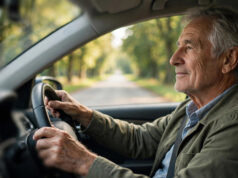
Travel Health After 60: Staying Well on Trips
Travel after 60 can be one of the great pleasures of this stage of life — more time, more freedom, and trips you may have waited years to take. It can also ask more of your body than it used to: long flights, new time zones, different food and water, and days packed with walking.
Most travel health problems are preventable with simple preparation: a short chat with your doctor, a well-packed carry-on, regular movement, and a realistic pace. This guide covers the steps that matter most.
Before you go: medicines, lists, and a doctor chat
Medicines are the most important part of travel preparation: according to CDC data, nearly 9 in 10 older adults take at least one prescription medicine.
See your doctor 4 to 6 weeks before you leave. The CDC recommends booking with your healthcare provider or a travel health specialist at least 4 to 6 weeks before international travel. That lead time matters: some vaccines need several weeks to take full effect. Tell your doctor about any chronic conditions and ask whether the climate, altitude, or activity level poses any risk.
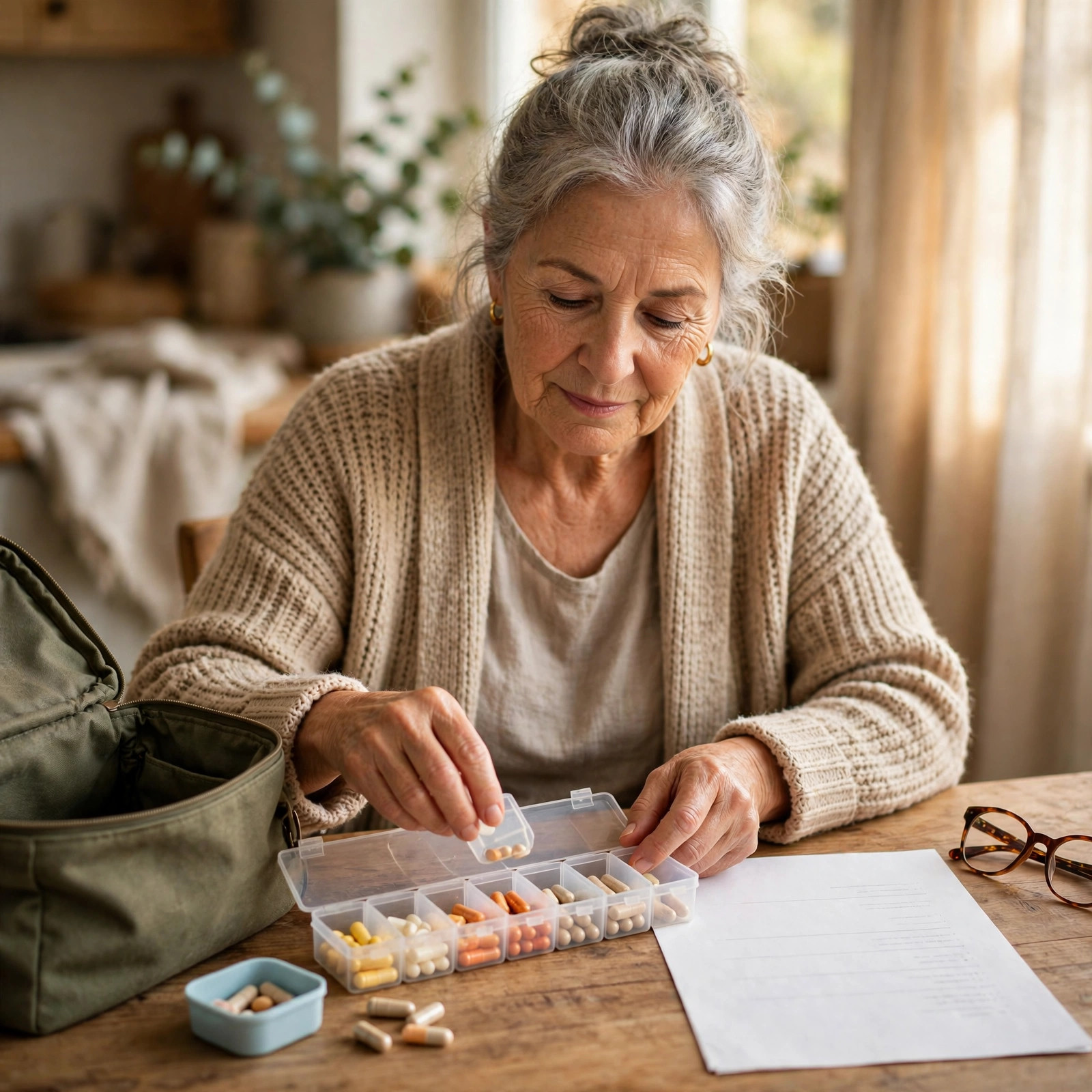
Carry medicines in your hand luggage, never in checked bags. Keep medicines with you at all times — the National Council on Aging advises packing them in your carry-on, where you can reach them easily and an airline cannot lose them. Pack enough for the trip, plus extra for delays, in original labelled bottles. Bring a written list of every medicine, its dose, and the condition it treats — a printed list from your pharmacist, with a photo of it on your phone as backup.
Check vaccines and destination advice. The CDC notes that routine vaccines for older adults include the pneumococcal pneumonia vaccine, the shingles vaccine, and an annual flu shot. Check the CDC’s destination pages for what your destination may call for, and bring a copy of your immunisation records.
Pack a small travel health kit — plasters, remedies you normally use, hand sanitiser, and a copy of your prescriptions. For a condition that might not be obvious, such as diabetes, consider a medical alert bracelet or wallet card.
Moving on long journeys: walking breaks and circulation
Sitting still for hours is the main health risk of long-distance travel: blood can pool in the veins of your legs, raising the risk of a blood clot in a deep vein (deep vein thrombosis, or DVT). The CDC notes that these clots are rare but very serious.
The risk is highest on journeys over about four hours, and the prevention is simple:
- Stand up or walk every 2 to 3 hours. Choose an aisle seat when you can, and on road trips build in breaks with a short walk at every stop.
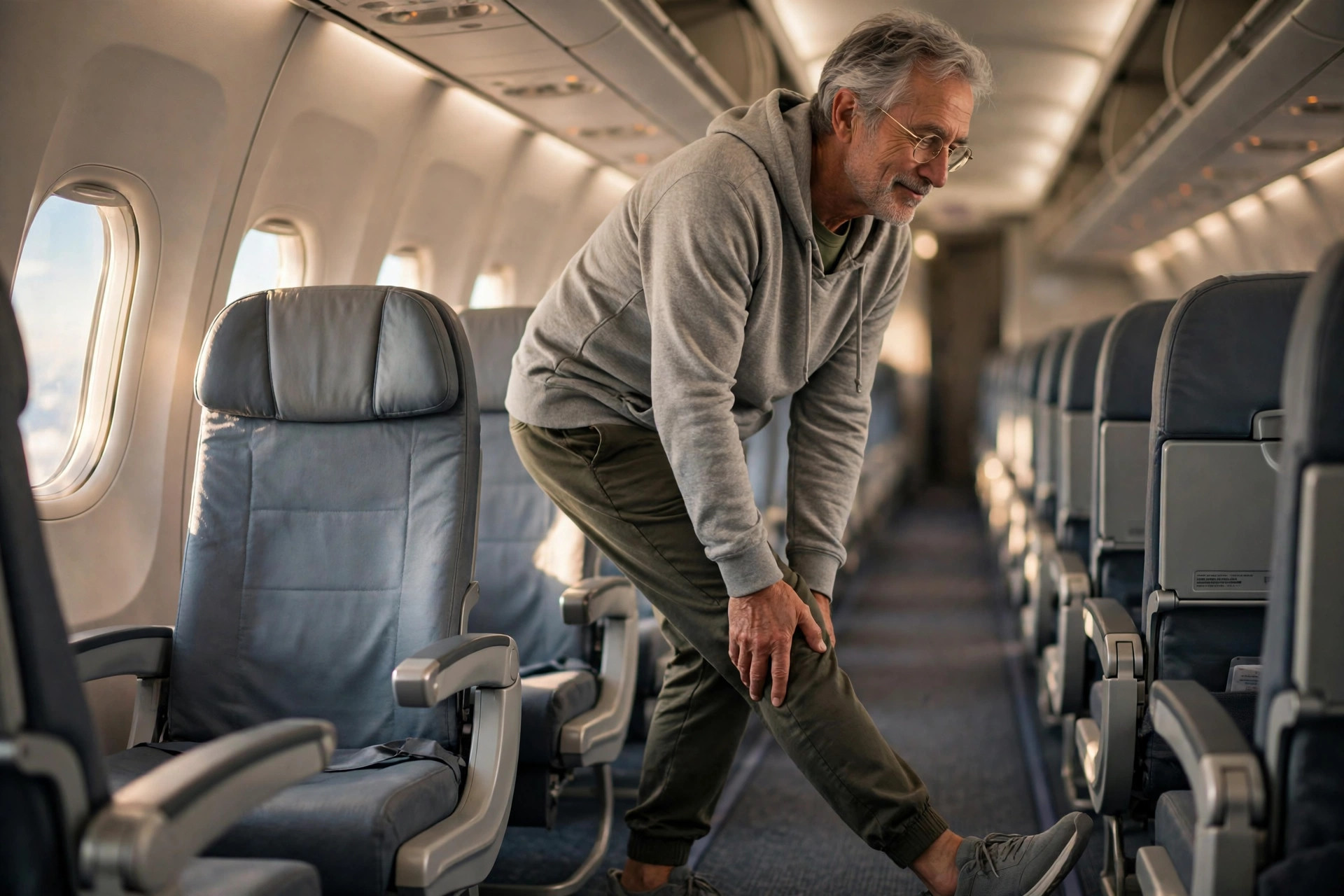
- Exercise your calf muscles while seated. Flex and point your feet, circle your ankles, and lift your knees gently. These small movements keep your calf muscles pumping blood back up from your legs.
- Stay hydrated and wear loose, comfortable clothing. Drink water through the journey and limit alcohol.
- Talk to your doctor about compression stockings if you have extra risk factors for blood clots — a previous clot, recent surgery, or a clotting disorder. Your doctor may also advise on medicine before departure.
The CDC is clear that taking aspirin to prevent blood clots when travelling is not recommended — if you already take it for other reasons, check with your doctor. If you have had a blood clot before, talk to your doctor before booking — flights are usually delayed for at least two weeks after a diagnosis.
On road trips, stop roughly every two hours to stretch, walk, and drink water — our guide to driving safety after 70 covers how to judge when a driving day is too long.
Eating and drinking well while travelling
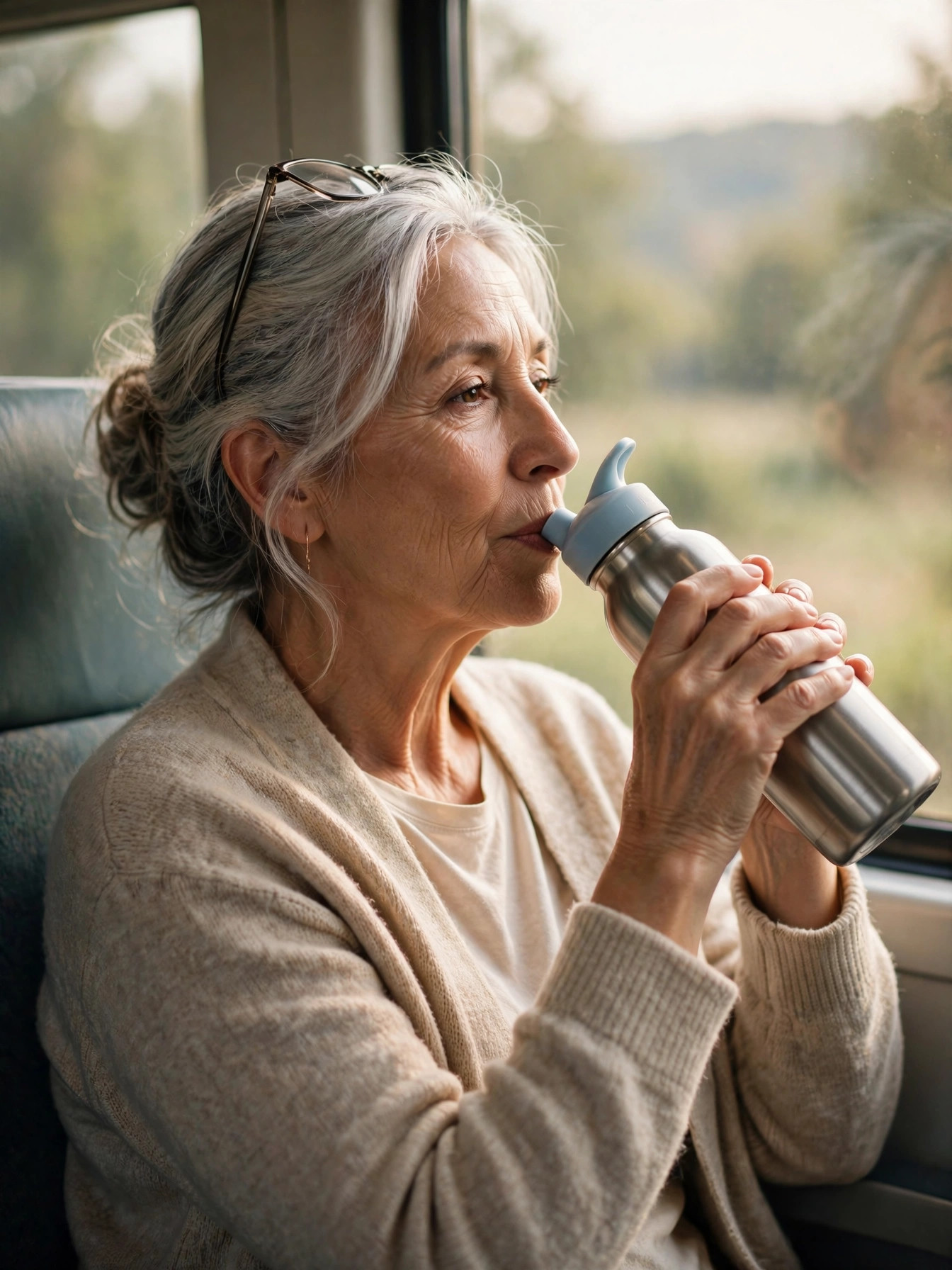
Drink water regularly, even when you do not feel thirsty. Thirst tends to dull with age and aeroplane cabins are very dry, so waiting until you feel thirsty usually means you are already behind — carry a refillable bottle and sip through the day. Our guide to how much water older adults need explains why the “eight glasses” rule is only a rough guide.
Eat regular, moderate meals. Skipping meals and then eating one very large one can leave you sluggish and uncomfortable — keep a small snack, such as fruit or nuts, in your bag for long gaps.
Be careful with food and water abroad. The CDC’s food and water safety advice is simple: choose food that is freshly cooked and served hot; where the water supply is uncertain, drink bottled or boiled water and avoid ice made from tap water. Wash your hands often, especially before eating — handwashing is one of the simplest ways to reduce the spread of illness while travelling.
Plan for constipation. Changes in routine, less fluid, and long sitting often slow digestion down. Water, fibre-rich foods, and movement help — and if you normally use a fibre supplement or mild laxative at home, pack it.
Sleep and time zones: handling jet lag
Jet lag is what happens when your internal clock is still set to home time in a new time zone. The Mayo Clinic explains that it can occur whenever you cross two or more time zones, with symptoms usually appearing within a day or two of travel. It is temporary and usually improves within a few days — the Mayo Clinic notes it generally takes about a day to recover for each time zone crossed.
You cannot prevent jet lag entirely, but these steps may reduce its effects:
- Rest well before you travel — starting a trip sleep-deprived makes jet lag worse.
- Gradually shift your schedule. A few days before you leave, move bedtime and mealtimes by about an hour a day toward your destination’s time — earlier for east, later for west.
- Use daylight to reset your clock. Sunlight is the strongest influence on your internal clock — the Mayo Clinic advises morning light after travelling east, and evening light after travelling west. A walk outside on your first day may help you adjust faster than staying indoors.
- Live on local time as soon as you arrive — eat and sleep by the destination clock, not home time.
- Limit caffeine and alcohol. Both can make jet lag worse, and alcohol can also disturb your sleep and add to dehydration.
- Avoid sleeping pills on the flight. The Mayo Clinic warns that their drowsiness may affect your ability to react in an emergency and may linger after landing, particularly in older adults.
Melatonin is sometimes used for jet lag, but it interacts with many medicines and the NHS does not recommend it, because the evidence is limited — ask your doctor first. For more on how sleep changes with age, see our guide to sleep changes after 50.

Travel insurance and health documents
The CDC advises travellers to find out whether their health insurance covers medical care abroad — many domestic plans do not, or cover only emergencies. Before you buy a policy, check these points:
- Medical cover and emergency evacuation. Make sure the policy covers medical treatment at your destination and, if needed, transport home — evacuation cover matters most on cruises and in remote areas.
- Pre-existing conditions. Declare your conditions honestly. A policy that does not know about a condition may not pay out for treatment linked to it. Some policies ask for a medical screening; allow time for this when you book.
Keep documents in two places: originals with you, copies — paper or on your phone — in a separate bag. Your health documents should include your medication list, insurance details and emergency numbers, your doctor’s contact information, and the address of at least one hospital or clinic near your destination. For international trips, the CDC also suggests enrolling in the State Department’s Smart Traveler Enrollment Program (STEP).
Pace yourself: the trip you actually enjoy
A common mistake is planning a trip for the person you were ten years ago. Three sights before lunch, a long walk after it, and a late dinner may have worked at 50 — at 65 or 70, it often means spending day three in the hotel room.
Build rest into the plan: one main activity a day, with a quiet afternoon, usually beats a packed itinerary. Choose accommodation with a lift or a ground-floor room, and check whether sights involve long walks or stairs. If you enjoy walking holidays, our guide to hiking after 60 covers how to judge a route honestly — but the same rule applies to any sightseeing trip: match the day to your body, not to the brochure.
Travel with a companion when you can, and leave your itinerary with someone at home.
When to see a doctor
Most travel health problems are minor and settle on their own. Get medical help promptly at your destination if you notice:
- Chest pain, sudden breathlessness, or a rapid heartbeat, especially after a long flight
- One leg that becomes painful, swollen, warm, or red after a long journey — possible signs of a blood clot
- A fever, vomiting or diarrhoea that does not settle within a day or two, or signs of dehydration such as dizziness or confusion
- A cut or bite that becomes increasingly red, swollen, or painful, or any animal bite abroad
Before you travel, see your doctor if you have a new or worsening symptom, a recent hospital stay or surgery, or doubts about your fitness for the trip.
The bottom line
Travelling well after 60 is mostly preparation, not luck. See your doctor a few weeks before you go, keep your medicines in your hand luggage with a written list, move and drink water on long journeys, allow time to adjust to a new time zone, and carry insurance that actually covers you. Do those things, pace your days honestly, and the trip is far more likely to be the one you imagined.
Sources
- Centers for Disease Control and Prevention, “Older Adults and Healthy Travel” — https://wwwnc.cdc.gov/travel/page/senior-citizens/
- Centers for Disease Control and Prevention, “Blood Clots During Travel” — https://wwwnc.cdc.gov/travel/page/dvt
- Mayo Clinic, “Jet lag disorder — Symptoms and causes” — https://www.mayoclinic.org/diseases-conditions/jet-lag/symptoms-causes/syc-20374027
- Mayo Clinic, “How to stay healthy while traveling: Tips for flights, cruises, and road trips” — https://mcpress.mayoclinic.org/living-well/how-to-stay-healthy-while-traveling-tips-for-flights-cruises-and-road-trips/
- National Council on Aging, “How to Travel Safely as an Older Adult” — https://www.ncoa.org/article/safe-travel-tips-for-older-adults/
This article is for general information only and is not medical advice. Talk to your doctor before travelling if you have a health condition or take regular medication.