Best Dumbbells for Seniors: A Practical Buying Guide
If you are thinking about starting strength training after 60, dumbbells are one of the simplest and most flexible tools you can buy. They are inexpensive, they take up almost no space, and they let you work the muscles that matter for everyday life — the ones you use to stand up from a chair, carry groceries, and keep your balance.
The tricky part is choosing the right set. Dumbbells come in dozens of shapes, coatings, and weight ranges, and what works for a twenty-something at the gym is not necessarily what works for someone picking up weights for the first time at 65. This guide walks through what actually matters: which weights to start with, which types suit older hands and joints, and the safety basics that keep lifting beneficial instead of risky.
Why dumbbells are a good fit after 60
The case for strength training at this stage of life is strong. The National Institute on Aging notes that older adults should do muscle-strengthening activities at least two days a week, alongside about 150 minutes of moderate aerobic activity. It also emphasizes that you see benefits even at levels below the full target — any activity is better than none.
The Mayo Clinic explains why this matters with age: lean muscle mass and strength tend to decline as we get older, and strength training can help you keep and build muscle mass and strength, while also supporting bone health, balance, and independence. It may also protect joints from injury and lower the risk of falls.
Dumbbells suit this job well because they allow small, gradual increases — often one pound at a time — which is exactly how older beginners should progress. Unlike machines, they let your arms move naturally, and many basic moves can be done seated, which helps if balance is a concern. If you want exercise ideas to pair with your new set, our guide to dumbbell exercises for seniors using light weights covers simple, joint-friendly moves.
What weight should you start with?
This is the question every buyer asks first, and the honest answer is: start lighter than you think. Most trainer-written buying guides suggest that older beginners start in the 1–5 pound (roughly 0.5–2.5 kg) range per hand, especially for overhead and shoulder work, where form is hardest to control. A set that covers 3, 5, and 8 pounds is a popular beginner configuration because it gives you room to progress without jumping too far between levels.
A more useful rule of thumb than any fixed number: pick a weight you can lift 8 to 12 times with controlled, steady form while still feeling some effort in the last two or three repetitions. Exercise-science literature on resistance training for older adults notes that a single set of 8–12 repetitions per exercise is an effective starting point. If the final reps feel easy, you have room to go slightly heavier; if you cannot finish the set without straining, the weight is too heavy.
Two important cautions here. First, a CDC guide on physical activity and arthritis advises choosing weights that do not cause joint pain and increasing difficulty only in small amounts over time — sound advice for anyone, not just those with arthritis. Second, these are general ranges, not prescriptions. If you have a heart condition, joint problems, or a history of falls, talk to your doctor or a qualified trainer about an appropriate starting weight before you buy.
The main types of dumbbells
Dumbbells for home use fall into three broad categories. Each has trade-offs worth understanding before you spend money.
Hex dumbbells. These have six-sided heads, usually in metal or rubber-coated cast iron. The hex shape is the standout feature: the weight cannot roll away on the floor, which is a real safety advantage if you set weights down between sets. Rubber-coated versions are also kinder to floors. They are typically sold in fixed weights, so a “set” means several pairs — which takes more storage space but means the dumbbells themselves are simple, durable, and ready to grab.
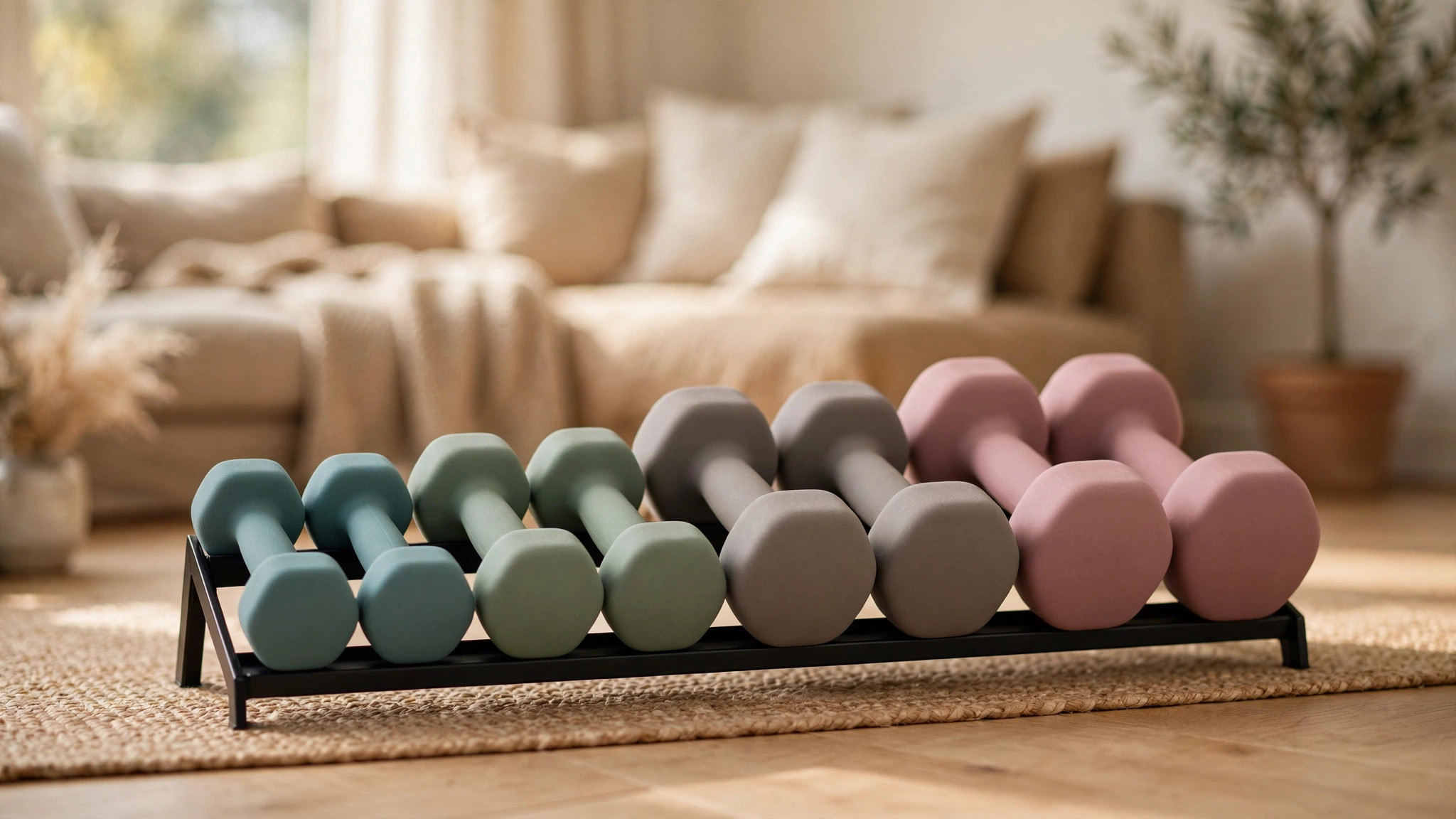
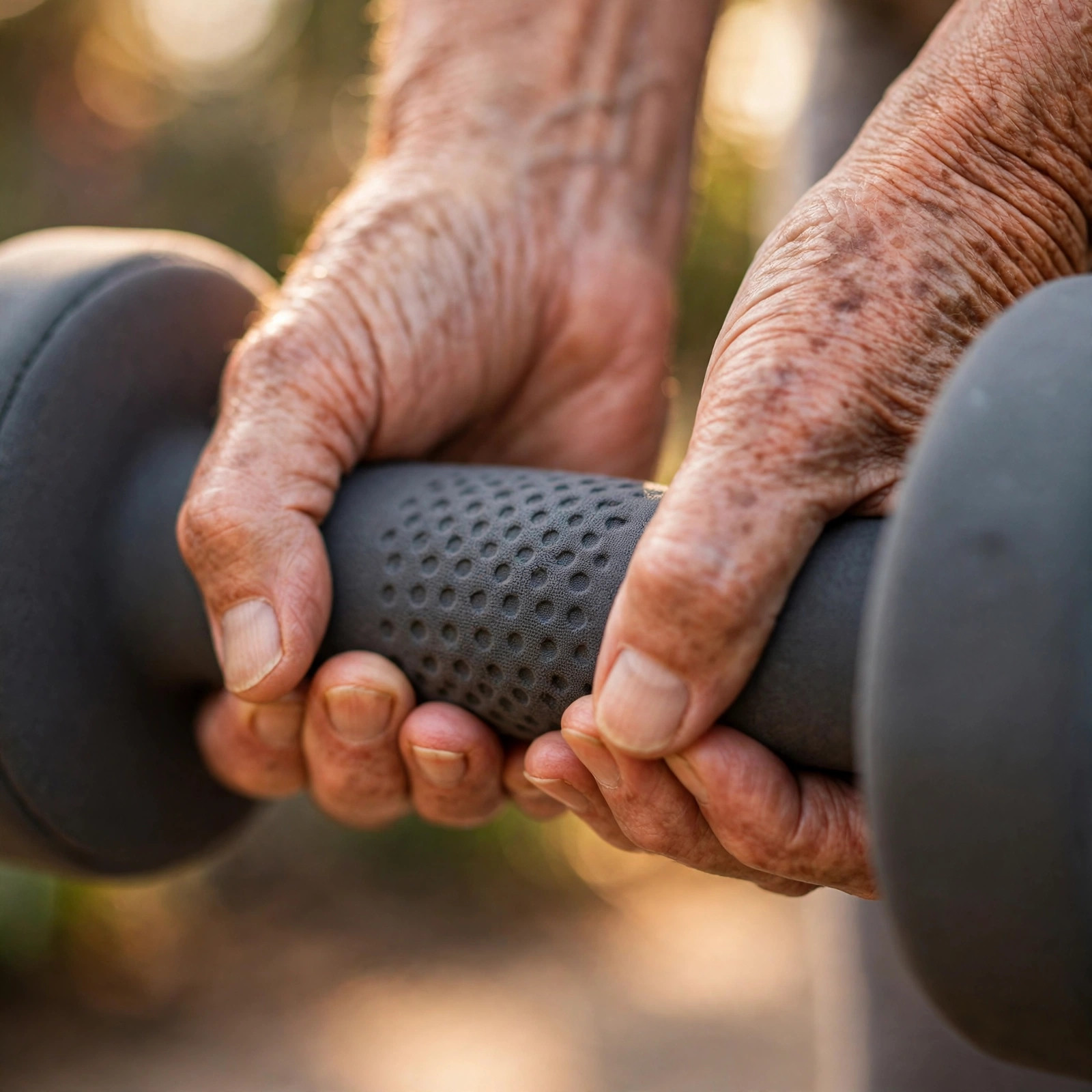
Neoprene- or foam-coated dumbbells. These are fixed-weight dumbbells with a soft, colorful coating over the handle and head. The coating is the selling point for older adults: it feels warmer and more comfortable in the hand than bare metal, gives a secure grip even with slightly sweaty palms, and will not rust or chip your floor. Most neoprene sets are color-coded by weight, so you can grab the right pair at a glance. They usually come in light ranges (1–10 pounds), which makes them an excellent beginner choice — though very strong users will eventually outgrow the heaviest pair.
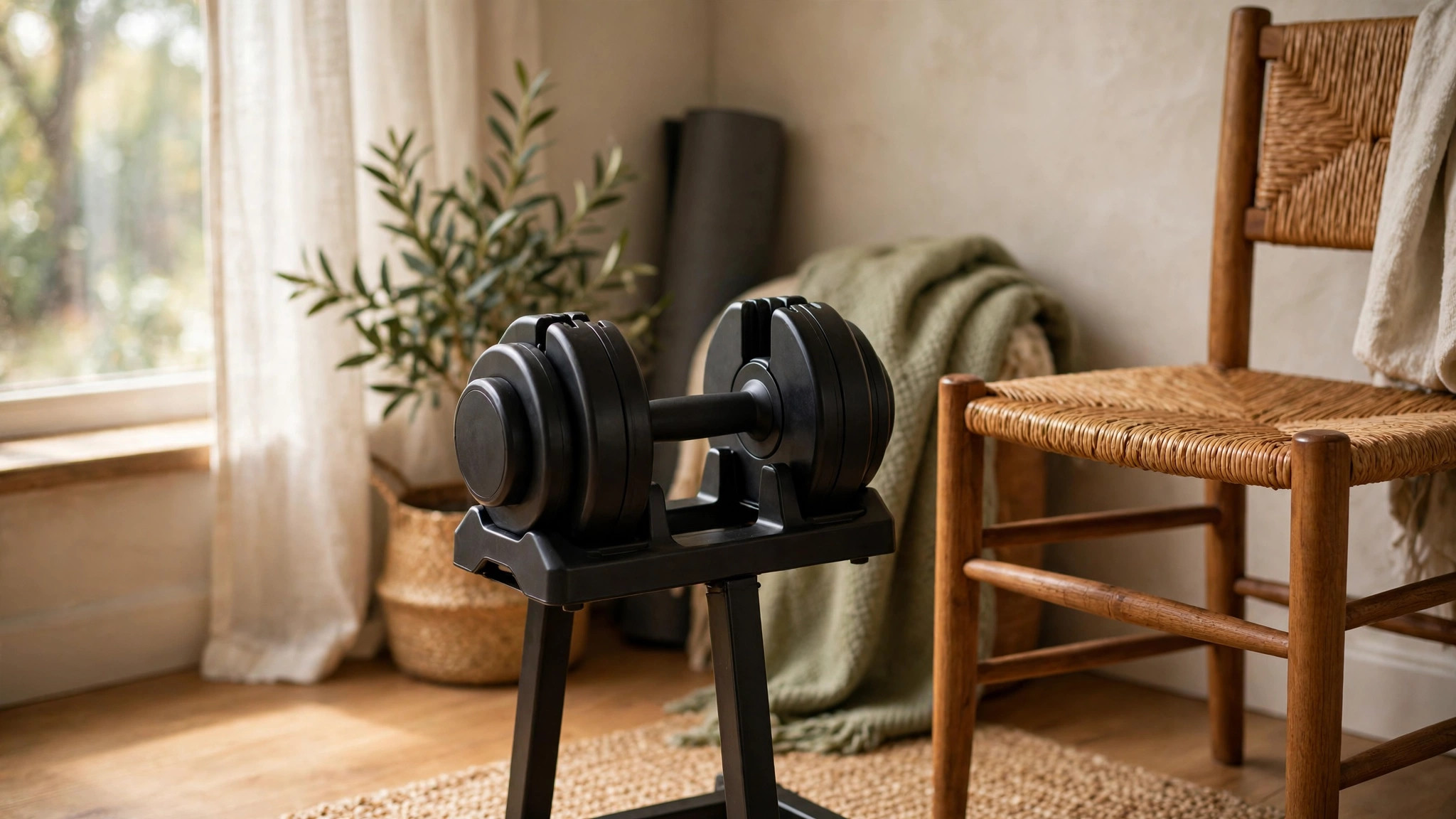
Adjustable dumbbells. These replace a whole rack of fixed weights with a single pair whose weight changes via a dial, twist, or selector mechanism. The appeal is obvious: one pair grows with you, and they take up far less room than a set of fixed pairs. The downsides matter for this audience, though. Adjustable models can feel bulky in the hand, the adjustment mechanism adds complexity (and cost), and some models should not be dropped. If you choose this route, look for a smooth, easy-to-use mechanism and a weight range that goes low enough for your current level — many start at 5 pounds or higher, which may be too heavy for a complete beginner.
What to look for when you shop
Beyond the type, a few details separate a set you will use for years from one that gathers dust:
- Handle grip size and texture. The handle should feel secure without forcing you to squeeze hard. A lightly textured or rubberized grip helps, especially if grip strength is reduced. Handles that are too thick are a common complaint among older buyers — look for standard or slim handles, and contoured shapes that fit the natural curve of the hand.
- Coating. Neoprene, vinyl, or foam coatings are more comfortable and floor-friendly than bare chrome or cast iron. Rubber-coated hex dumbbells are a good middle ground: durable, anti-roll, and gentle on floors.
- Anti-roll shape. Hex heads or flat-sided designs stay where you put them. Round “dumbbell” shapes can roll under furniture or into ankles — a small hazard that is easy to avoid.
- Color coding. Bright, distinct colors per weight make it easy to tell pairs apart without squinting at small printed numbers. It is a small convenience that makes workouts smoother.
- Storage. Fixed-weight sets multiply quickly. Check whether the set includes a rack or storage stand — a cheap, sturdy stand that keeps weights off the floor is worth it for both safety and tidiness. Adjustables solve this problem by design.
- Warranty and build quality. Cast-iron cores with solid coatings last for years. For adjustables, check the warranty on the adjustment mechanism, since that is the part most likely to wear.
Safety basics for 45+ lifters
A good set of dumbbells is only half the equation. How you use them matters more:
- Start light and master form first. Controlled, slow movements with a light weight build more useful strength than struggling with a heavy one. Keep your back straight, core engaged, and never jerk the weight.
- Warm up before lifting. Five minutes of gentle movement — marching in place, arm circles — prepares muscles and joints and may reduce soreness.
- Clear your space. Work out on a non-slip surface with the floor around you free of rugs, cords, and clutter. Keep weights in one spot, not scattered around the room.
- Sit when in doubt. Many dumbbell exercises can be done seated in a sturdy chair, which removes balance from the equation while your muscles do the work.
- Do not lift alone when frail. If you have balance problems, a history of falls, or a condition that could make you dizzy, have someone nearby when you train — at least until your routine feels completely routine.
- Get medical clearance if it applies. The NIA advises talking with your doctor before starting if you have a chronic condition. Heart disease, uncontrolled blood pressure, joint replacements, and osteoporosis all warrant a conversation first — not to stop you, but to set safe boundaries.
- Rest and recover. Train the same muscle groups with at least a day of rest between sessions. Mild muscle tiredness the next day is normal; sharp or increasing joint pain is a signal to stop and reassess. Our strength training at home after 60 guide goes deeper into building a safe weekly routine.

When to see a doctor
Dumbbell training is low-risk for most healthy adults, but get medical advice before or during your program if:
- You experience chest pain, pressure, or unusual shortness of breath during exercise
- You feel dizzy, lightheaded, or faint while lifting
- A joint becomes swollen, hot, or sharply painful — rather than mildly sore
- You have been told you have osteoporosis, a heart condition, or uncontrolled blood pressure and have not yet discussed strength training with your doctor
- You have had a recent surgery, fracture, or joint replacement
These are not reasons to give up on strength training — they are reasons to get professional guidance so you can train safely.
The bottom line
The best dumbbell set for a senior is not the most expensive or the most advanced — it is the one that matches your current strength, feels comfortable in your hands, and invites you to use it regularly. For most beginners over 60, that means starting light (a few pounds per hand), favoring comfortable coatings and anti-roll shapes, and progressing gradually. Buy for where you are now, not where you hope to be in a year; strength built slowly is strength that lasts.
Sources
- National Institute on Aging, “How Older Adults Can Get Started With Exercise” — https://www.nia.nih.gov/health/exercise-and-physical-activity/how-older-adults-can-get-started-exercise
- Mayo Clinic, “Strength training: Get stronger, leaner, healthier” — https://www.mayoclinic.org/healthy-lifestyle/fitness/in-depth/strength-training/art-20046670
- Centers for Disease Control and Prevention, “About Physical Activity and Arthritis” — https://cdc.gov/arthritis/prevention/
- National Strength and Conditioning Association, “Resistance Training for Older Adults” position statement — https://www.nsca.com/contentassets/2a4112fb355a4a48853bbafbe070fb8e/resistance_training_for_older_adults__position.1.pdf
This article is for general information only and is not medical advice. Talk to your doctor or a qualified exercise professional before starting a new strength-training program.