
Knee Replacement Recovery: A Realistic Timeline for Adults Over 60
Knee replacement surgery has one of the highest satisfaction rates in orthopedics — the American Academy of Orthopaedic Surgeons (AAOS) notes that most people report a major drop in knee pain and a big improvement in everyday activities. But the payoff does not arrive overnight. Recovery follows clear phases: most people resume many daily activities within about 6 weeks, keep improving through months 3 to 6, and reach full recovery somewhere between 6 and 12 months.
A note on timelines: every person heals differently. Treat each number below as a range, not a deadline.
How long does knee replacement recovery take?
Here is how the major stages usually break down, based on guidance from the AAOS and Cleveland Clinic:
| Stage | Typical range | What it feels like |
|---|---|---|
| Hospital stay | Same day to a few days | Groggy, sore; walking with help on day one |
| First 2 weeks at home | Hardest stretch | Pain, swelling, stiffness peak then start easing |
| Weeks 3–6 | Rapid early gains | Steadier improvement; walking aids come off |
| Months 2–3 | Functional recovery | Most daily activities return |
| Months 3–12 | Full recovery | Strength and endurance keep building |
Cleveland Clinic puts it this way: many usual activities return in about six weeks, but full recovery usually takes around a year.
Phase 1: The hospital (day 0 to day 2 or 3)
Hospital stays are shorter than they used to be — some people go home the same day, most within a day or two (Cleveland Clinic).
What happens right away:
- You get moving fast. A physical therapist usually has you standing and taking steps with a walker within hours of surgery — early movement helps prevent blood clots and stiffness.
- Pain is managed with a plan. Expect a combination of medications — often anti-inflammatories, acetaminophen, and short-term stronger painkillers — with the goal of reducing the stronger ones as soon as possible.
- Simple exercises start immediately. Early movements like ankle pumps and quad sets can begin in the recovery room; ankle pumps keep blood circulating in your legs and help prevent clots.
- You learn the discharge checklist. Before going home, you typically need to get in and out of bed, walk with your walker, manage a few stairs, and control pain with oral medication.
You will also usually be prescribed a blood thinner and may get compression stockings or boots — standard measures to prevent blood clots in the early days.
Phase 2: The first two weeks at home (often the hardest)
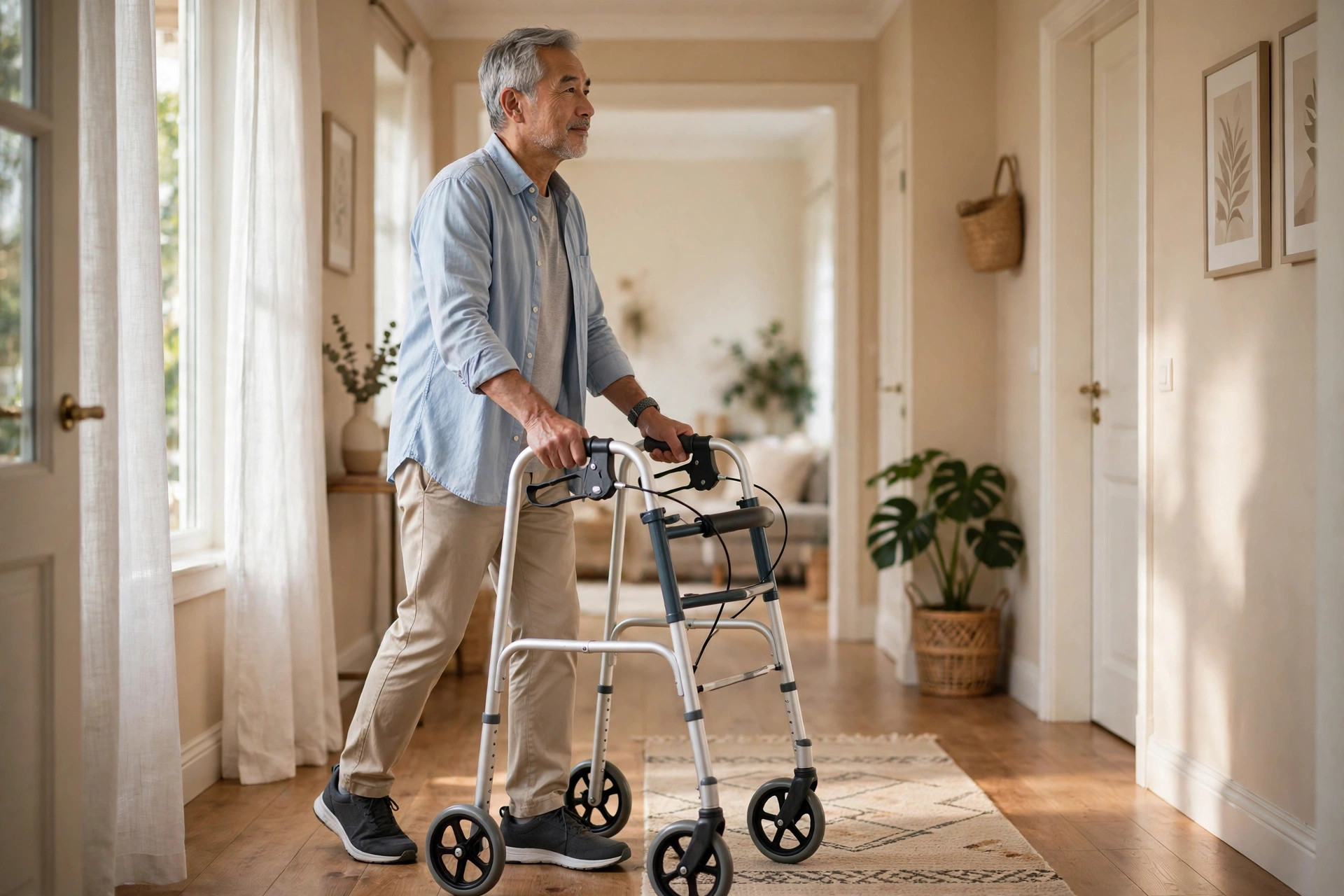
The first one to two weeks at home are widely considered the most demanding part: pain, swelling, and stiffness peak, sleep is often disrupted, and simple tasks feel like projects. That is normal — and it gets better.
What this phase looks like:
- Pain management stays ahead of the pain. Take medications on schedule, not just when pain spikes. Many patients step down from stronger pain medication within the first week or two. Reasonably controlled pain lets you do the exercises — and the exercises are what restore your knee.
- Ice and elevate, daily. Ice the knee a few times a day for about 20 minutes at a time, and keep it elevated above heart level as often as possible (Cleveland Clinic guidance).

- Walking is constant but gentle. Start indoors and slowly extend distance. You will use a walker or crutches at first; most people transition to a cane over the coming weeks.
- Physical therapy intensifies. Many patients do formal PT sessions plus prescribed home exercises several times a day. The early goals are modest but crucial: reduce swelling, and start bending and straightening the knee.

- A typical early milestone: many rehabilitation programs aim for roughly 90 degrees of knee bend by around the two-week mark, along with progress toward a straight leg. If your motion lags, your therapist will adjust the plan — hitting the number is not as important as steady progress.
Practical help matters enormously here: arrange for someone to stay with you for at least the first week, stock easy meals, and remove tripping hazards before surgery.
Phase 3: Weeks 3–6 — the turning point

This is where most people feel the fog lifting. Pain fades week by week (though a busy day can still bring a flare), swelling continues to ease, and independence returns in visible steps.
Typical milestones in this phase:
- Walking aids come off. Most people move from a walker to a cane in weeks 2–4, and many walk unaided by around 4–6 weeks — though a slight limp from stiffness or quad weakness is common and usually temporary.
- Daily life opens up. Most people resume many normal activities of daily living within 3 to 6 weeks (AAOS) — sitting, standing, climbing stairs, light household tasks.
- Driving returns. The AAOS says most people resume driving approximately 4 to 6 weeks after surgery — once you can bend the knee enough to get in and out of the car comfortably and your muscle control gives you proper braking reaction time. Two hard rules: you must be off narcotic pain medication, and your surgeon must clear you. (If the operated knee is your left and you drive an automatic, some surgeons clear patients sooner.)
- Work, depending on the job. People with desk jobs often return in 2–4 weeks; jobs involving standing or physical labor typically take 6–12 weeks. Your surgeon and your employer’s leave policies set the final timeline.
- Exercise gets more ambitious. PT progresses to strengthening — sit-to-stand exercises, stationary bike, step-ups, balance work — usually 2–3 supervised sessions a week plus daily home exercises.
Phase 4: Months 2–3 — getting your life back
Between weeks 7 and 12, rehabilitation often shows its biggest payoff: range of motion and strength improve noticeably, stairs get manageable, and longer walks, shopping, and housework feel routine.
- Supervised PT often wraps up. PT programs commonly run 6–12 weeks; after that, most people continue home exercises to keep building strength.
- A common flexibility target is around 120 degrees of knee bend by about 3 months, with a fully straight leg — the bend needed for comfortable stairs and sitting.
- Low-impact activities return. Once your surgeon gives the go-ahead, the AAOS encourages walking as much as you like, swimming (after the wound is fully healed), cycling, and golf. These activities are good for the new joint. High-impact activities — running, jumping, skiing — are generally discouraged to protect the implant.
- Pain fades to background. Sharp surgical pain is usually gone; what remains is typically mild aching or stiffness after long days, which keeps fading for months.
Phase 5: Months 3–12 — the long finish
By three months, the acute healing is largely done, but soft tissues keep remodeling for months. Mild stiffness, occasional twinges after strenuous activity, or sensitivity in cold weather can linger — these are normal parts of healing, not warning signs.
What to expect in the long run:
- Strength, endurance, and confidence keep improving through the rest of the first year.
- Keep exercising. The AAOS advises continuing the prescribed exercises for at least two months after surgery — and keeping up leg strengthening and walking indefinitely is what protects the result.
- One common question: kneeling. Many surgeons allow kneeling once the incision is fully healed, but it often feels strange on a replaced knee. Ask your surgeon rather than assuming.
- Annual follow-ups with your surgeon are standard to check the implant.
What actually helps recovery
No secrets here — the things that speed recovery are the boring ones:
- Do the exercises, even when sore. Rehabilitation adherence is the single biggest controllable factor in how well you recover. Skipping sessions because you feel stiff is backwards: the exercises are what reduce the stiffness. If pain is blocking you, talk to your team about adjusting the plan rather than stopping.
- Control pain well enough to move. Pain management is not about being pain-free; it is about keeping pain low enough that you can participate in therapy and walk. Report pain that is worsening instead of gradually improving.
- Ice and elevate, especially early. A few 20-minute icing sessions a day plus elevation above heart level, particularly in the first weeks, helps keep swelling — the enemy of knee bend — under control.
- Walk, but don’t substitute. The AAOS is explicit: walking is excellent, but it is not a substitute for the prescribed exercises. Walking builds endurance and circulation; the targeted exercises rebuild the strength and range of motion the new knee needs.
- Prevent blood clots. Take any prescribed blood thinner exactly as directed, do the ankle-pump and early-movement exercises, and get up regularly. These small actions matter.
- Eat and rest. Appetite often dips after surgery, but healing needs fuel — a balanced diet with enough protein supports tissue repair, and steady sleep supports everything.
When to see a doctor / call your surgeon
Most recoveries are uneventful, but two complications — infection and blood clots — need fast action. Call your surgeon’s office promptly if you notice any of these:
Possible infection — call the same day:
- Fever, or chills and feeling generally unwell
- Increasing redness, warmth, or swelling around the knee — especially if it is spreading outward from the incision
- Drainage from the incision that continues past the first few days, or looks cloudy or smells bad
- Pain that was getting better and then gets clearly worse again
- Wound edges that separate or will not seal
Possible blood clot — call promptly; go to the ER for lung symptoms:
- New pain, swelling, tenderness, or redness in the calf of either leg
- Shortness of breath or chest pain — these can signal a clot that has traveled to the lungs; treat as an emergency and call 911
Also call if you fall on the knee, cannot bear weight when you previously could, or notice instability. When in doubt, call.
The bottom line
Knee replacement recovery is a marathon with an encouraging finish line: most people walk independently within about 6 weeks, return to many daily activities by 3 months, and keep improving through the first year. Move early, do your exercises, manage pain and swelling, and call your surgeon fast if something looks wrong.
If you are still deciding whether surgery is right for you, start with our guides to knee pain after 60 and low-impact exercises for arthritic knees.
Sources
- American Academy of Orthopaedic Surgeons (AAOS), “Total Knee Replacement” — https://www.orthoinfo.org/treatment/total-knee-replacement/
- American Academy of Orthopaedic Surgeons (AAOS), “Activities After Knee Replacement” — https://www.orthoinfo.org/recovery/activities-after-knee-replacement/
- American Academy of Orthopaedic Surgeons (AAOS), “Total Knee Replacement Exercise Guide” — https://www.orthoinfo.org/recovery/total-knee-replacement-exercise-guide/
- Cleveland Clinic, “Knee Replacement (Arthroplasty): What It Is & Recovery Time” — https://www.clevelandclinic.org/health/treatments/8512-knee-replacement
- NHS, “Knee replacement” — https://www.nhs.uk/conditions/knee-replacement/
This article is for general information only and is not medical advice. Talk to your doctor or orthopaedic surgeon about your personal situation before and after knee surgery.