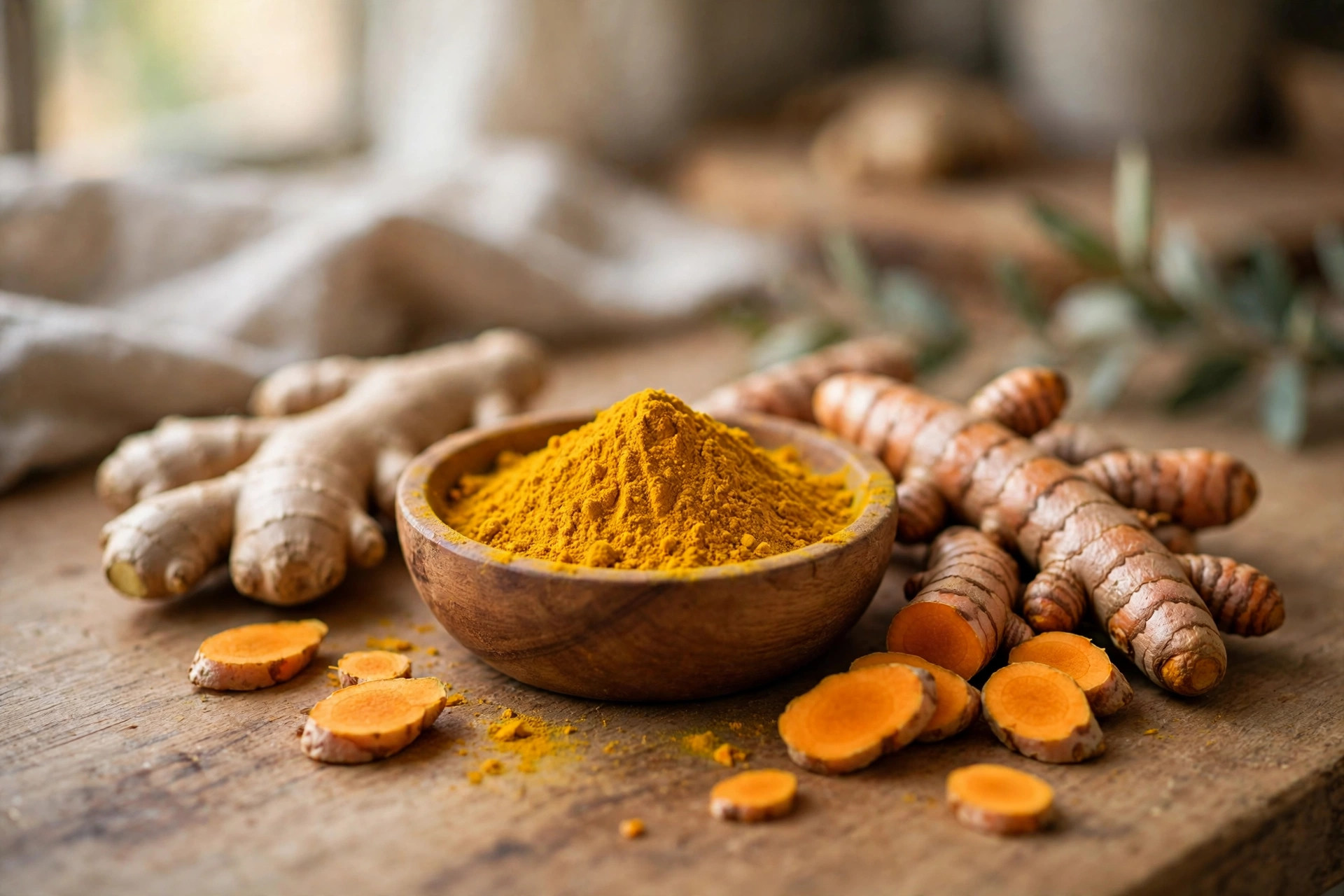
Turmeric vs Ginger for Inflammation: Which One Deserves a Spot in Your Routine?
Turmeric and ginger sit side by side in the spice aisle, and they actually belong to the same plant family. Both have centuries of use in traditional medicine, and both are now marketed as natural answers to inflammation. But they are not interchangeable — their active compounds behave differently, the clinical research points in different directions, and each carries its own safety caveats.
If your main concern is achy, stiff joints, turmeric has the deeper trial record. If nausea or sluggish digestion is the bigger problem, ginger is the stronger pick. And if you are thinking of taking both as concentrated supplements, the safety section below matters more than any benefit claim.
Turmeric: The Slow-Building Joint-Pain Candidate

Turmeric (Curcuma longa) is the golden-yellow spice familiar from curries. Its color comes from curcumin, a major component of the plant, and most of turmeric’s health effects are commonly attributed to curcuminoids — the group of compounds that includes curcumin (NCCIH, 2025). Oral turmeric is promoted as a dietary supplement for a range of conditions, including osteoarthritis, but promotion is not proof.
What the trials show. Several meta-analyses have evaluated oral turmeric or curcumin for knee osteoarthritis — pain, stiffness, joint strength, and mobility. The initial evidence is positive, but the U.S. National Center for Complementary and Integrative Health concludes that higher-quality evidence is needed for definitive conclusions, and more research is required on how curcumin’s poor absorption affects its benefits (NCCIH, updated April 2025).
In plain terms: turmeric may help with osteoarthritis-related knee pain, but the evidence is promising rather than proven. And no supplement cures arthritis — turmeric is, at best, a complement to proven approaches like staying active, keeping a healthy weight, and following your clinician’s treatment plan. Our overview of foods that may help ease arthritis pain covers the dietary side of joint care in more detail.
The absorption problem. The body absorbs curcumin poorly on its own, which makes comparing studies difficult — products also vary in how much curcumin they actually contain. One established way to improve curcumin’s bioavailability is combining it with piperine, the compound in black pepper (NCCIH, 2025). This is why many turmeric formulas include black pepper extract.
The liver caveat. This is the part turmeric marketing usually skips. The NCCIH states plainly that highly bioavailable formulations of curcumin — products engineered for maximum absorption — may harm your liver. A 2023 case series from the U.S. Drug-Induced Liver Injury Network, cited on NCCIH’s turmeric page, documented ten cases of liver injury associated with turmeric supplements. If you notice symptoms such as unusual fatigue, nausea, poor appetite, dark urine, or yellowing of the skin or eyes while taking turmeric or curcumin products, stop taking them immediately and talk with your health care provider.
Conventionally formulated oral turmeric (not modified to enhance absorption) is likely safe in recommended amounts for up to 2 or 3 months, but even standard products can cause nausea, vomiting, acid reflux, stomach upset, diarrhea, or constipation. Turmeric supplements during pregnancy may be unsafe — concentrated supplements warrant a conversation with your clinician.
Ginger: The Nausea-and-Digestion Specialist

Ginger (Zingiber officinale) is the other rhizome on the shelf. Its bioactive compounds work differently from curcumin, and — notably — the NCCIH reviews ginger trials without flagging the same bioavailability barrier it flags for turmeric. Ginger is promoted for nausea and vomiting, osteoarthritis, and menstrual cramps (NCCIH, 2025).
What the trials show. Nausea is ginger’s strongest suit. Research shows that ginger may be helpful for nausea and vomiting associated with pregnancy (NCCIH, 2025). On other fronts, the record is weaker: most studies of ginger for motion sickness have not shown it to be helpful, and it remains uncertain whether ginger adds benefit to standard treatments for chemotherapy-related nausea or nausea after surgery.
For pain, the picture is mixed. Research suggests ginger dietary supplements might help reduce the severity of menstrual cramps. For knee osteoarthritis, ginger supplements might be helpful — but the NCCIH cautions that much of that research has been of poor quality, so treat modest claims with skepticism. Ginger used topically has not been shown to help knee osteoarthritis symptoms.
Side effects and cautions. Ginger is generally well tolerated, but oral ginger can cause abdominal discomfort, heartburn, diarrhea, and mouth or throat irritation. Ginger supplements during pregnancy may be safe according to current research — but check with your health care provider first (NCCIH, 2025).
Turmeric vs Ginger: Side by Side
| Turmeric (curcumin) | Ginger | |
|---|---|---|
| Best-studied use | Knee osteoarthritis pain and stiffness | Nausea and vomiting in pregnancy |
| Evidence strength | Several meta-analyses; initial evidence positive, but higher-quality trials still needed | Fair for pregnancy-related nausea; weak or uncertain for motion sickness and post-surgical nausea |
| Absorption | Poor on its own; improves with piperine (black pepper) or fat | No major absorption barrier flagged in reviews |
| Liver caution | Highly bioavailable formulations may harm the liver; liver injury cases reported | No liver-injury signal reported in NCCIH reviews |
| Pregnancy caution | Supplements may be unsafe | Supplements may be safe, but check with a clinician |
| Side effects | Nausea, reflux, stomach upset, diarrhea | Heartburn, abdominal discomfort, diarrhea, mouth/throat irritation |
Neither is a proven treatment for general inflammation, and neither has enough evidence to support definitive conclusions about most health claims made for it. Choosing between them is really about matching the better-studied use to your need — joint discomfort points toward turmeric; nausea or digestive queasiness points toward ginger.
Can You Take Both?

Nothing in the institutional reviews forbids combining turmeric and ginger — as culinary spices in food, both are ordinary ingredients with long safety records. The question gets more complicated with concentrated supplements: each brings its own cautions, and combining two supplement regimens means managing two interaction profiles, not zero.
A practical approach: use both freely in cooking (curries, teas, stir-fries), and treat supplements as a separate, more serious decision. If you are considering turmeric or ginger capsules — especially more than one at a time, and especially at high doses — discuss the full list with your clinician or pharmacist first. The NIH Office of Dietary Supplements recommends keeping a written record of every supplement and medicine you take to share with your providers. Also tell your surgical team about any supplements before a planned procedure.
What to Look For on a Label
Without naming brands, here is how to read a turmeric or ginger product honestly:
- Check the Supplement Facts panel. It lists the active ingredients and the amount per serving. Products vary widely in how much curcumin or ginger they actually contain — and many turmeric products include other plant substances such as piperine from black pepper (NCCIH, 2025).
- Look for a third-party testing seal (for example, U.S. Pharmacopeia, NSF International, or ConsumerLab). The NIH Office of Dietary Supplements notes these seals indicate a product was properly manufactured and contains what the label claims — though they do not guarantee safety or effectiveness.
- Don’t chase the highest absorption number. The liver-injury reports involve high-bioavailability curcumin formulations. A conventionally formulated product used for a defined period is the more conservative choice.
- Follow the label and your clinician, not the hype. Doses used in trials vary widely across studies, so there is no single “proven” dose. Anyone telling you otherwise is selling something.
Blood Thinners: Read This Before Either One

This warning applies to both spices. Ginger and turmeric supplements may slow how quickly blood clots, raising bleeding risk — particularly with blood-thinning medications such as warfarin or aspirin. The NIH Office of Dietary Supplements warns that some supplements increase bleeding risk and can interact with medicines in harmful ways, and the NCCIH advises on both its turmeric and ginger pages: if you take any type of medicine, talk with your health care provider before using any herbal product.
Practical rules: if you take warfarin, aspirin, or another anticoagulant, do not add turmeric or ginger supplements without your clinician’s explicit approval. If you notice unusual bruising, nosebleeds, or bleeding gums after starting a supplement, stop it and seek medical advice. And never stop a prescribed blood thinner in favor of a spice — that trade could be dangerous.
When to See a Doctor
Supplements are not a substitute for medical evaluation. See your clinician if you experience:
- Joint pain with swelling, warmth, or redness, or pain that limits daily activities or worsens over weeks
- Nausea or vomiting with signs of dehydration, or that persists beyond a day or two
- Possible liver-injury symptoms after starting a supplement: unusual fatigue, poor appetite, nausea, dark urine, or yellowing of the skin or eyes — stop the supplement and seek care promptly
- Unusual bruising or bleeding, especially if you take blood thinners
A clinician can check what is behind your inflammation and whether a supplement interacts with your medications.
Sources
- National Center for Complementary and Integrative Health (NCCIH). “Turmeric: Usefulness and Safety.” Updated April 2025. https://www.nccih.nih.gov/health/turmeric — verified live.
- National Center for Complementary and Integrative Health (NCCIH). “Ginger: Usefulness and Safety.” Updated February 2025. https://www.nccih.nih.gov/health/ginger — verified live.
- NIH Office of Dietary Supplements. “Dietary Supplements: What You Need To Know” (consumer fact sheet). https://ods.od.nih.gov/factsheets/WYNTK-Consumer/ — verified live.
This article is for informational purposes only and is not medical advice. Talk to your clinician before adding any supplement to your routine.