
Does Lack of Sleep Cause High Blood Pressure? What the Evidence Says
It is a question many of us ask after a few rough nights: does lack of sleep cause high blood pressure? The honest answer is that sleep and blood pressure are clearly connected, but the relationship is an association, not a proven one-way cause. Years of research — including studies that followed hundreds of thousands of people — show that people who sleep too little are more likely to develop high blood pressure. Here is what the evidence actually says, and what you can reasonably do with it.
What studies say about short sleep and high blood pressure
Researchers have been studying sleep and blood pressure for decades, and several large reviews of the research point in the same direction.
In a 2013 meta-analysis published in Hypertension Research, scientists combined the results of 11 prospective studies — the kind that follow healthy people over time to see who develops a condition. They found that people who habitually slept short hours had a 21% higher relative risk of developing hypertension (relative risk 1.21, 95% CI 1.05–1.40) than people who slept a normal amount. The same review found that insomnia symptoms, such as trouble staying asleep or waking up too early, were also linked to a higher risk of developing high blood pressure.
A more recent systematic review, published in 2025 in the Journal of General Internal Medicine, looked at 23 cohort studies covering 173,734 adults, of whom 41,528 developed hypertension during the study periods. Compared with people sleeping 7–8 hours a night, those sleeping fewer than 6 hours had a pooled risk estimate of 1.17 (95% CI 1.06–1.28) — roughly 17% higher risk. People sleeping 6–7 hours showed a smaller increase (1.04, 95% CI 1.02–1.07). The link appeared stronger in people under 60 who slept under 6 hours, with a pooled risk of 1.24 (95% CI 1.10–1.39).
In 2025, researchers also presented a combined analysis at the American College of Cardiology’s Annual Scientific Session that pooled 16 studies and more than one million people from six countries, followed for a median of five years. None of the participants had high blood pressure at the start. The finding: people sleeping less than 7 hours a night had a 7% greater chance of developing hypertension, and for those sleeping fewer than 5 hours, the risk was 11% higher. This held even after accounting for age, sex, weight, smoking, and other heart risks.
A controlled study from Mayo Clinic researchers tested this more directly. Volunteers spent nine nights sleeping only four hours, then nine nights sleeping nine hours. During the short-sleep phase, their nighttime systolic blood pressure averaged about 10 mm Hg higher than during the well-rested phase — and the usual healthy dip in blood pressure that happens at night was noticeably blunted.
Taken together, the pattern is consistent: shorter, poorer sleep is linked to higher hypertension risk, and the shorter the sleep, the stronger the link tends to be.
The sleep-apnea connection
The strongest and most direct connection between a sleep problem and high blood pressure involves obstructive sleep apnea (OSA) — the disorder in which breathing repeatedly stops and starts during sleep.
The CDC notes that sleep apnea reduces the oxygen your body gets during sleep and increases the risk of high blood pressure, heart attack, and stroke. Harvard Health explains why: every time breathing stops, oxygen levels drop and the body releases epinephrine (adrenaline), a stress hormone. Over time, those repeated adrenaline surges can contribute to high blood pressure, and repeated blood-pressure spikes can damage the lining of blood vessels.
Sleep apnea is also considered one of the treatable contributors to high blood pressure. If you snore loudly, wake up gasping, feel exhausted despite a full night in bed, or have morning headaches, sleep apnea is worth discussing with your clinician — it may be part of your blood pressure picture.
You can read more about the warning signs in our guide to sleep apnea warning signs in older adults.
Why researchers think the link exists
Scientists do not have every detail worked out, but a few explanations fit the evidence well:
- Your blood pressure is supposed to dip at night. During healthy sleep, blood pressure falls, giving the heart and blood vessels a nightly rest. When sleep is too short or repeatedly interrupted, blood pressure stays higher for more of the night — and stays elevated longer overall.
- The nervous system stays on alert. Mayo Clinic experts explain that sleep helps the body regulate the hormones that control stress and metabolism. Without enough sleep, the sympathetic nervous system — the “fight or flight” branch — stays more active, keeping heart rate and blood pressure up.
- Stress hormones swing. When you do not get enough quality sleep, your body may produce more stress hormones, including cortisol and adrenaline. Over time, Mayo Clinic notes, hormone changes like these can lead to high blood pressure and other heart-disease risk factors.
- Poor sleep feeds poor habits. The CDC points out that poor sleep over time is also linked to higher stress, less motivation to be physically active, and less healthy food choices — each of which nudges blood pressure upward on its own.
None of this means a single bad night will give you hypertension. The research is about patterns — months and years of too little sleep.
An important note about what these studies can (and cannot) prove
Nearly all of the research above is observational: it follows people and looks for associations. These studies adjust for known confounders like age, weight, and smoking, but they cannot fully rule out other factors, and they cannot prove that short sleep causes hypertension.
It is also worth noting that results are not identical everywhere. Some studies find the link stronger in women, others in men; some find the link strongest in middle-aged adults. And in one large survey-based study, insomnia symptoms alone were not linked to higher blood pressure once other factors were considered — suggesting that how long you sleep may matter more than how well you think you sleep.
So the fair summary is this: short sleep is a risk factor associated with higher blood pressure, alongside many others — not a proven cause, and not a guarantee in either direction.
Habits that help both sleep and blood pressure
The encouraging news is that many of the same daily habits support healthy sleep and healthy blood pressure. The CDC’s sleep and heart health guidance recommends:
- Keep a consistent sleep schedule. Go to bed and get up at the same time every day — including weekends. A regular rhythm helps your body settle into deeper, more restorative sleep.
- Get morning light. Step outside or take a walk in daylight, especially earlier in the day. Morning light helps set your body’s sleep-wake clock.
- Be active during the day. Regular physical activity helps you fall asleep faster and sleep more soundly. Try not to do vigorous exercise within a few hours of bedtime.
- Watch late-evening habits. Avoid alcohol and heavy, fatty, or sugary foods within a few hours of bedtime, and cut back on afternoon and evening caffeine. None of these are friends to either sleep or blood pressure.
- Make the bedroom sleep-friendly. Cool, dark, and quiet is the classic formula — and turn down screens or use a blue-light filter in the evening.
- Keep a healthy weight. Excess weight raises the risk of both sleep apnea and high blood pressure, and losing even a modest amount can help both.



These habits will not guarantee lower blood pressure, but they are low-risk steps that support both. For more evidence-backed ways to support healthy blood pressure through daily life, see our guide on how to lower blood pressure naturally after 60.
When to see a doctor
Sleep and blood pressure are both worth taking seriously. See your clinician if you:
- Snore loudly, gasp, or stop breathing during sleep (or your partner notices this) — these are classic signs of sleep apnea, a treatable condition closely tied to high blood pressure.
- Wake with morning headaches, feel exhausted despite a full night in bed, or struggle with daytime sleepiness — especially if you already have high blood pressure.
- Have known hypertension and consistently poor sleep. Mayo Clinic notes that if you already have high blood pressure, sleeping poorly may make it worse. Bring your sleep pattern to your next appointment.
- Are consistently getting under 6 hours of sleep. Mayo Clinic advises talking to your doctor about ways to improve your rest if short sleep is your norm, not the exception.
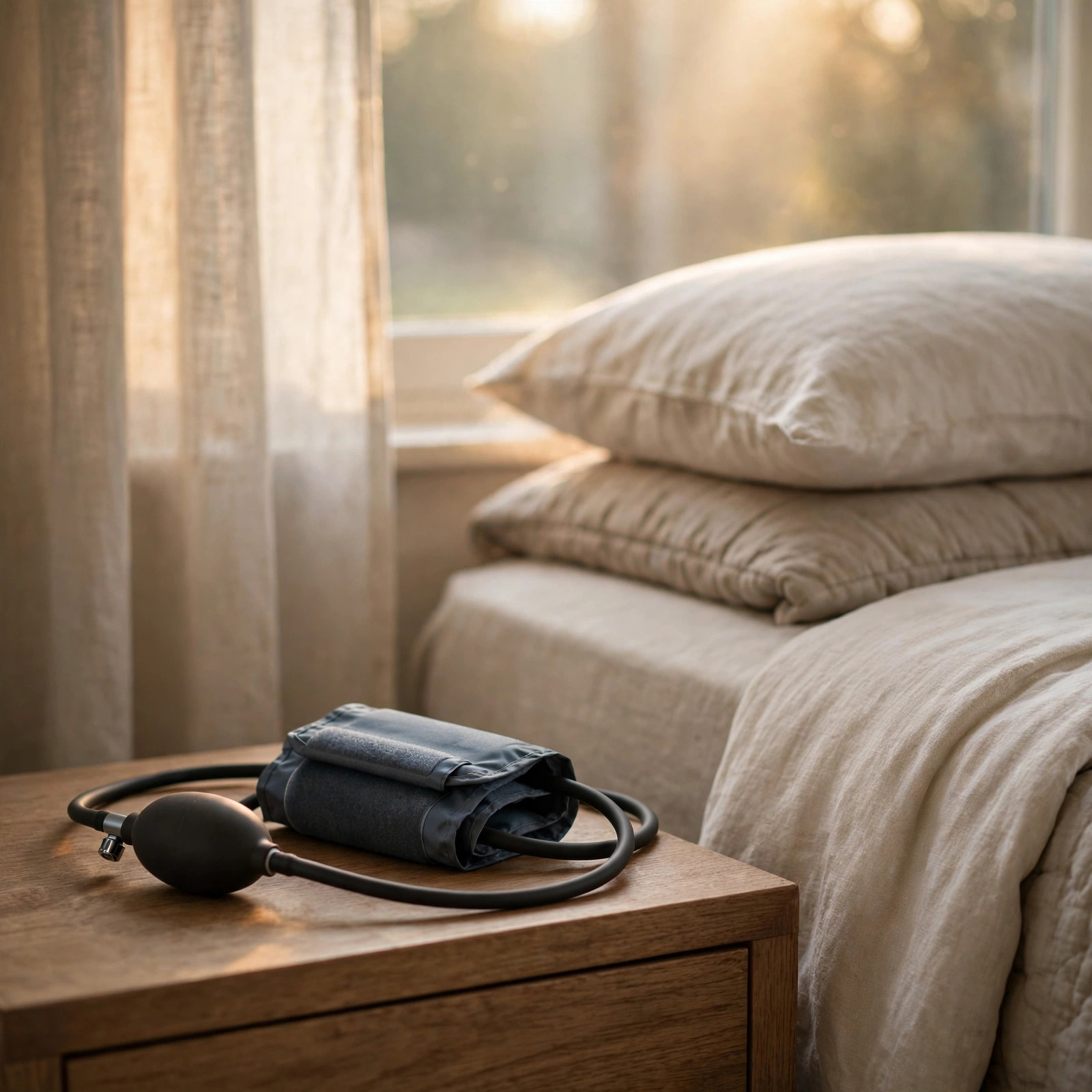
If you have high blood pressure, ask your clinician whether a home blood-pressure monitor makes sense for you. Checking your pressure regularly — and noting how it lines up with your sleep — can give your doctor a fuller picture than occasional office readings alone.
Sources
- Mayo Clinic — “Can a lack of sleep cause high blood pressure?” https://www.mayoclinic.org/diseases-conditions/high-blood-pressure/expert-answers/sleep-deprivation/faq-20057959
- CDC — “About Sleep and Your Heart Health” https://www.cdc.gov/heart-disease/about/sleep-and-heart-health.html
- American Heart Association — “American Heart Association adds sleep to cardiovascular health checklist” (Life’s Essential 8, 2022) https://newsroom.heart.org/news/american-heart-association-adds-sleep-to-cardiovascular-health-checklist
- Harvard Health — “How does sleep apnea affect the heart?” https://www.health.harvard.edu/heart-health/how-does-sleep-apnea-affect-the-heart
- Meng L, Zheng Y, Hui R. “The relationship of sleep duration and insomnia to risk of hypertension incidence: a meta-analysis of prospective cohort studies.” Hypertension Research 2013;36:985–995. https://doi.org/10.1038/hr.2013.70
- “The Association Between Sleep Duration and the Risk of Hypertension: A Systematic Review and Meta-analysis of Cohort Studies.” Journal of General Internal Medicine 2025. https://link.springer.com/article/10.1007/s11606-025-09398-6
This article is for general information only and is not medical advice. Talk to your doctor about your blood pressure and sleep concerns.