
Ginkgo Biloba for Memory: What the Research Actually Shows
Every year, millions of people over 50 buy ginkgo biloba hoping it will sharpen their memory. The bottles sit on pharmacy shelves next to multivitamins, promising “mental clarity” and “brain support” in confident letters. It is one of the best-selling herbal supplements in the world — and one of the most studied.
That makes it an ideal test case for one question: does the evidence match the marketing? Scientists have run the trials, pooled the results, and updated their reviews as recently as 2026. The answer is clearer than most supplement stories. No hype in either direction.
What ginkgo biloba actually is

Ginkgo biloba comes from the leaves of one of the oldest tree species on earth — a “living fossil” that has existed for more than 200 million years, according to the U.S. National Institutes of Health. Modern supplements use a concentrated leaf extract, not the tree’s seeds (which can be toxic when eaten raw).
Most clinical trials have tested the same thing: a standardized extract known as EGb 761, usually at doses of 120 to 240 milligrams per day, split into two or three doses. This matters, because products on the supplement aisle often do not match what was studied.
Why would anyone think a leaf extract helps memory in the first place? The proposed mechanism sounds plausible: one component — ginkgolide B — blocks platelet-activating factor, which reduces how readily blood platelets clump together. The theory was that better blood flow to the brain, plus antioxidant effects, might protect memory. Plausible is not proven, so researchers ran the trials.
What the trials actually found: the honest version

In February 2026, researchers at Georgetown University published an updated Cochrane systematic review — the gold standard of evidence summaries — pooling 82 randomized controlled trials involving 10,613 participants, with literature searched through November 2024. Their conclusions were split along a sharp line:
- For people already diagnosed with dementia, ginkgo may offer modest, short-term improvements in thinking, daily functioning, and overall clinical status — mostly seen at around six months of use. But the certainty of this evidence is low, the results varied widely between trials, and longer-term effects remain uncertain.
- For healthy adults with everyday memory complaints, and for people with mild cognitive impairment (MCI) — the very groups most likely to buy ginkgo off the shelf — the review found little to no benefit. The same was true for multiple-sclerosis-related cognitive problems.
- Across conditions, ginkgo was not associated with more serious harm than placebo in the trial settings.
An earlier Cochrane review from 2009, covering 36 trials, had reached a bleaker verdict: the evidence was “inconsistent and unreliable,” with no predictable, clinically significant benefit. The 2026 update improves on that only slightly — and only for diagnosed dementia. “May help a little, in some people, for a while” is about as far as the honest evidence goes.
The prevention question: ginkgo does NOT prevent dementia
This is the claim that matters most to healthy adults buying the supplement.
Two large, long-term trials — one funded by the U.S. National Institutes of Health, the other in Europe — each followed several thousand people aged 70 and older, with either normal thinking or mild cognitive impairment, for five to six years. Half took ginkgo; half took placebo. The question: did ginkgo slow the slide toward dementia?
It did not. Neither trial found that ginkgo lowered the chance of developing dementia. The National Center for Complementary and Integrative Health (NCCIH) states plainly that ginkgo has not been shown to prevent dementia or slow its progression in healthy people.
A product can be modestly useful for symptoms in diagnosed dementia and still be completely ineffective as prevention — and that is exactly where the evidence points for ginkgo.
The safety side: bleeding risk is the real concern
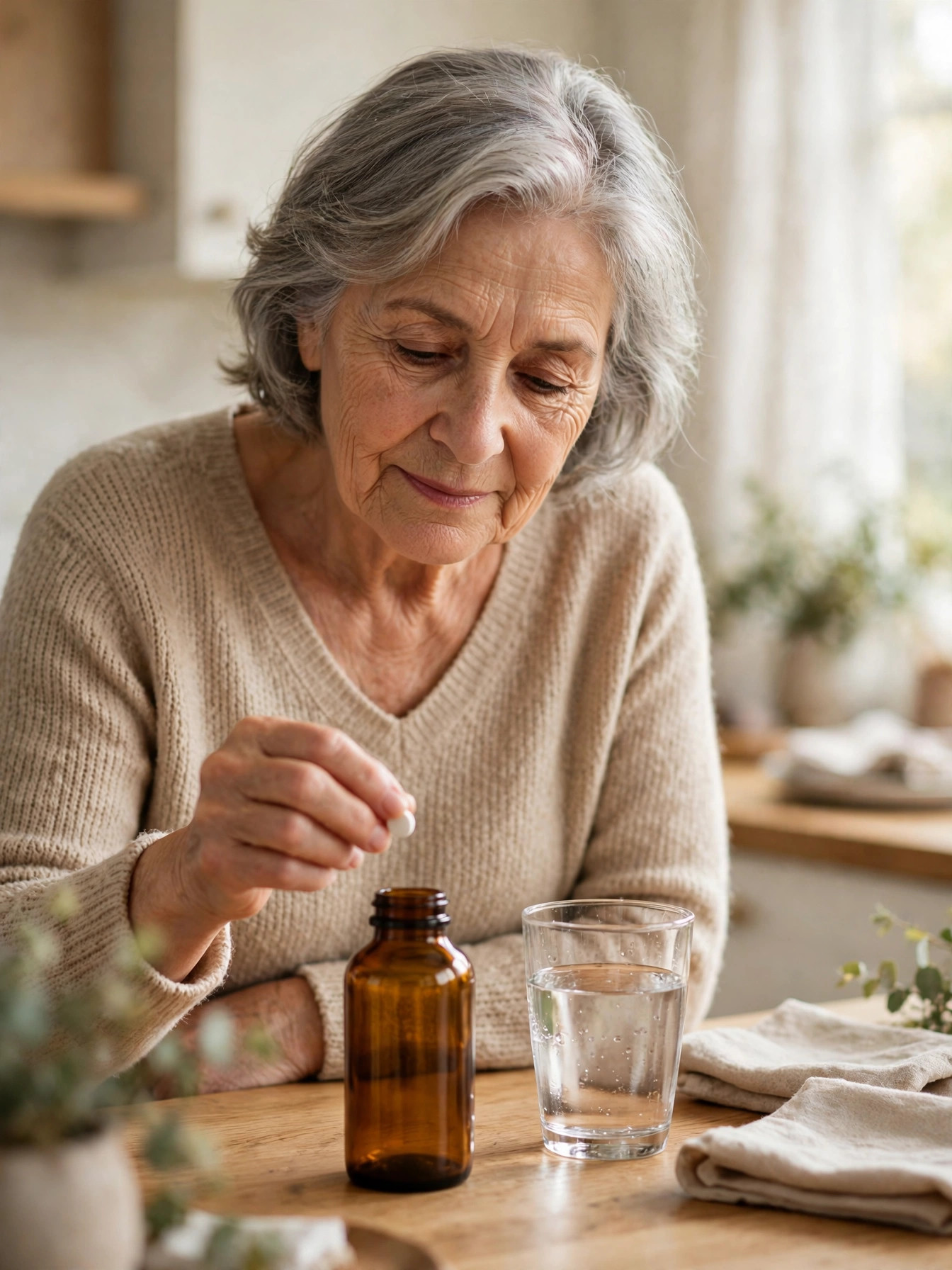
Ginkgo’s safety record in clinical trials is actually reasonable. The NIH’s LiverTox database notes that side effects are uncommon and mild — typically stomach upset, nausea, headache, dizziness, or rash — and that in trials, both common and serious side effects were no more frequent with ginkgo than with placebo.
But “no worse than placebo in trials” is not the same as “safe for everyone.” The main concern is bleeding: by reducing platelet clumping, ginkgo may increase bleeding risk — especially combined with drugs that do the same thing.
The NCCIH warns that ginkgo may increase the risk of bleeding in people taking anticoagulant drugs such as warfarin. The Mayo Clinic lists ginkgo among the supplements that can interact with warfarin. A large U.S. veterans’ database study of people on warfarin linked ginkgo use to roughly double the bleeding risk (though observational studies like this cannot prove cause and effect). Medical case reports include a 78-year-old on warfarin who developed bleeding inside the brain after starting ginkgo, and isolated reports of spontaneous bleeding in the eye and prolonged bleeding after surgery.
This leads to practical rules:
- Blood thinners (warfarin, apixaban, rivaroxaban, and similar drugs) and daily aspirin or other antiplatelet drugs: do not combine with ginkgo without explicit guidance from your clinician or pharmacist. For the full list, see our guide to supplement–drug interactions after 50.
- Surgery or dental procedures: tell your surgical team about every supplement you take. Supplements that slow clotting are usually stopped well before a procedure.
- Signs of excess bleeding — unusual bruising, nosebleeds that won’t stop, blood in urine or stool — deserve prompt medical attention whether or not ginkgo is the cause.
Who should NOT take ginkgo
Given the evidence and the risks, ginkgo is a poor choice for several groups:
- Anyone taking blood thinners or antiplatelet medication without their clinician’s explicit approval.
- People with bleeding disorders, or with a history of bleeding problems.
- Anyone scheduled for surgery, unless the surgical team has cleared it.
- People who are pregnant or breastfeeding — there is not enough safety information, and the blood-thinning effect is a concern.
- Healthy adults hoping to prevent dementia or sharpen everyday memory — the evidence simply does not support this use, and your money buys more elsewhere.
If you have diagnosed dementia and are considering ginkgo as an add-on (never a replacement for prescribed care), that is a conversation for your neurologist — and note that trial benefits were tied to standardized extracts like EGb 761, not typical shelf products.
What the evidence says helps memory instead

Here is the encouraging part of the story. While ginkgo’s evidence for healthy adults is thin, several other strategies have far stronger backing — and most are free:
Move regularly. If there is one habit with the broadest evidence for protecting thinking as you age, it is physical activity. The World Health Organization recommends regular exercise specifically for reducing the risk of cognitive decline, and several large studies have linked it to lower dementia risk. A daily brisk walk that you actually keep up beats any pill. See our roundup of 12 habits linked to lower dementia risk.
Protect your hearing. This surprises many people, but hearing loss carries one of the largest shares of modifiable dementia risk of any single factor. The link is strong and consistent, even as researchers debate the mechanism. If you are turning the TV up, get your hearing tested; hearing aids, worn regularly, may help.
Sleep well and treat sleep problems. Poor sleep — from insomnia, sleep apnea, or simply short nights — is linked to worse memory and thinking. Most adults do best with 7 to 9 hours of good-quality sleep. Loud snoring and daytime sleepiness are worth mentioning to your doctor, because sleep apnea is common and treatable in older adults.
Eat a balanced pattern. Observational studies have linked Mediterranean-style eating — vegetables, fruit, whole grains, legumes, fish, olive oil — with lower dementia risk, though no single food has been shown to protect against dementia. Treat diet as one supporting habit among many, not the star of the show.
None of these is as easy as swallowing a capsule — which is precisely why the capsule sells so well.
When to see a doctor
Everyday forgetfulness — misplacing keys, blanking on a name for a moment — is common at every age and is not a reason to start a supplement. See your clinician if you notice persistent changes (our guide to memory after 60: normal aging vs. warning signs can help you tell the difference): getting lost in familiar places, repeating the same questions, trouble handling money or medications, or personality changes that concern people close to you.
Two reasons make the visit worthwhile. First, some causes of memory problems are treatable — thyroid issues, vitamin B12 deficiency, depression, sleep apnea, and medication effects can all impair thinking, and fixing them can improve it. Second, an early evaluation gives you the most options, whatever the cause turns out to be. If you are considering ginkgo or any supplement for memory, bring the bottle and ask directly — your clinician or pharmacist can check your specific medications for interactions.
The verdict
Ginkgo biloba is one of the rare supplements with enough research to judge fairly — and the judgment is mixed in an instructive way. For people already diagnosed with dementia, the latest Cochrane review suggests modest, short-term symptom help — though the evidence is low-certainty and inconsistent. For healthy adults hoping to prevent dementia or sharpen everyday memory, the large trials say plainly: it does not work for that purpose.
The bleeding risk with blood thinners is the part that deserves the most respect. An herb that makes platelets less sticky is a poor companion for warfarin, aspirin, and their cousins — and older adults are exactly the group most likely to be on both.
The honest bottom line: ginkgo is not a brain breakthrough, and it is not poison either. It is a heavily marketed extract with narrow, modest benefits for a specific group — and real, underappreciated risks for the much larger group buying it off the shelf. If your goal is a sharper mind after 60, the best evidence still points to the unglamorous fundamentals: move your body, protect your hearing, sleep well, and get memory changes checked rather than supplemented away.
Sources
- Wieland L.S. et al. — Ginkgo biloba for cognitive impairment and dementia, Cochrane Database of Systematic Reviews, updated February 2026 (82 randomized trials, 10,613 participants; modest short-term benefit in dementia, little to no benefit for mild cognitive impairment or subjective memory complaints).
- Birks J., Grimley Evans J. — Ginkgo biloba for cognitive impairment and dementia, Cochrane Database of Systematic Reviews, 2009, Issue 1 (CD003120; evidence inconsistent and unreliable).
- National Center for Complementary and Integrative Health (NCCIH) — Ginkgo: effectiveness and safety information, including increased bleeding risk with anticoagulant drugs such as warfarin.
- Mayo Clinic — “Warfarin side effects: Watch for interactions” (ginkgo listed among supplements that can interact with warfarin).
- National Institutes of Health, LiverTox — Ginkgo (botanical background, typical dose 120–240 mg/day in 2–3 divided doses, side-effect profile).
This article is for information only and is not medical advice. Talk to your clinician or pharmacist before starting any supplement, especially if you take blood thinners or have a bleeding disorder.