Magnesium Rich Foods: What to Eat After 50 (With Real Portions)
If you remember only one thing about magnesium, let it be this: it does far more work in your body than almost any other mineral, yet a large share of older adults simply don’t get enough of it. The good news is that the fix is one of the easiest in all of nutrition — you don’t need exotic superfoods or a cabinet full of pills. You need a grocery list.
This is a food-first guide to magnesium rich foods for adults 50 and up: which foods actually deliver, how much is in a real serving, how much you need each day, and what one widely discussed study found about magnesium and brain aging — reported honestly, with its limits included.
Why Magnesium Matters More After 50
Magnesium is a cofactor in more than 300 enzyme systems in the body, according to the National Institutes of Health (NIH) — regulating muscle and nerve function, blood glucose, blood pressure, energy production, bone structure, and normal heart rhythm.
And aging works against you on two fronts. The NIH notes that older adults eat less magnesium than younger adults, absorb less of it from the gut, and lose more of it through the kidneys. Add in chronic diseases and medications that further deplete the mineral, and it’s no surprise older adults are one of the groups at highest risk of low intake.
Analysis of U.S. dietary survey data cited by the NIH found that 48% of Americans consume less magnesium from food and beverages than the estimated average requirement — and men age 71 and older are among the most likely to fall short.
The early warning signs are easy to miss: loss of appetite, fatigue, weakness. As deficiency worsens, it can progress to muscle cramps, numbness, and abnormal heart rhythms. Because symptoms overlap with so many other conditions, food intake is usually the best practical measure of your status — a standard blood test captures only a small fraction of the body’s magnesium and reflects total-body levels poorly.
What the Brain-Aging Study Actually Found (and Didn’t)
In 2023, researchers at the Australian National University published a study in the European Journal of Nutrition that got a lot of attention, and for good reason. Here’s what it did — and what it didn’t prove.
The team, led by Khawlah Alateeq, followed more than 6,000 cognitively healthy adults in the United Kingdom, aged 40 to 73. Over 16 months, participants completed five detailed diet questionnaires, each covering around 200 foods, from which researchers estimated average daily magnesium intake.
The headline finding: people whose diets provided a high amount of magnesium — more than 550 mg per day — showed less age-related brain shrinkage than those with a normal intake of about 350 mg per day. The high-intake group consumed roughly 41% more magnesium. By age 55, their estimated “brain age” was about one year younger than that of the normal-intake group. The researchers said the findings suggest higher dietary magnesium may support neuroprotection earlier in the aging process. The effect appeared more pronounced in women, particularly post-menopausal women, possibly because of magnesium’s anti-inflammatory effects.
Now the honest part: this was an observational study. It found an association between magnesium-rich diets and healthier-looking brain aging — it did not prove that magnesium causes slower brain aging, and it certainly did not prove that magnesium prevents dementia. People who eat lots of magnesium-rich foods also tend to eat more vegetables, exercise more, and live healthier in other ways, and those factors are hard to fully separate. No one has shown that raising your magnesium intake will protect your brain; what we know is that the two tend to go together.
Still, it lines up with a broader pattern. The Alzheimer’s Drug Discovery Foundation’s Cognitive Vitality panel, updated in November 2025, notes that many older adults are magnesium-deficient — from lower intake of magnesium-rich foods, impaired absorption, medications such as diuretics and proton pump inhibitors, and chronic conditions. It links lower magnesium status to inflammatory markers, oxidative stress, and systemic inflammation, and cites studies associating dietary magnesium with a lower incidence of frailty (Souza et al., 2023) and lower all-cause mortality (Bagheri et al., 2021, with a pooled effect estimate of 0.87). Again, these are associations, not proof — but the direction is consistent. Eating magnesium rich foods is a sensible bet for aging well: one piece of a bigger picture, not a magic fix.
The Top Magnesium Rich Foods, With Real Portions
Serving sizes matter more than food rankings. Here are the foods that deliver meaningful magnesium in portions you’d actually eat, with amounts based on the NIH’s food tables:
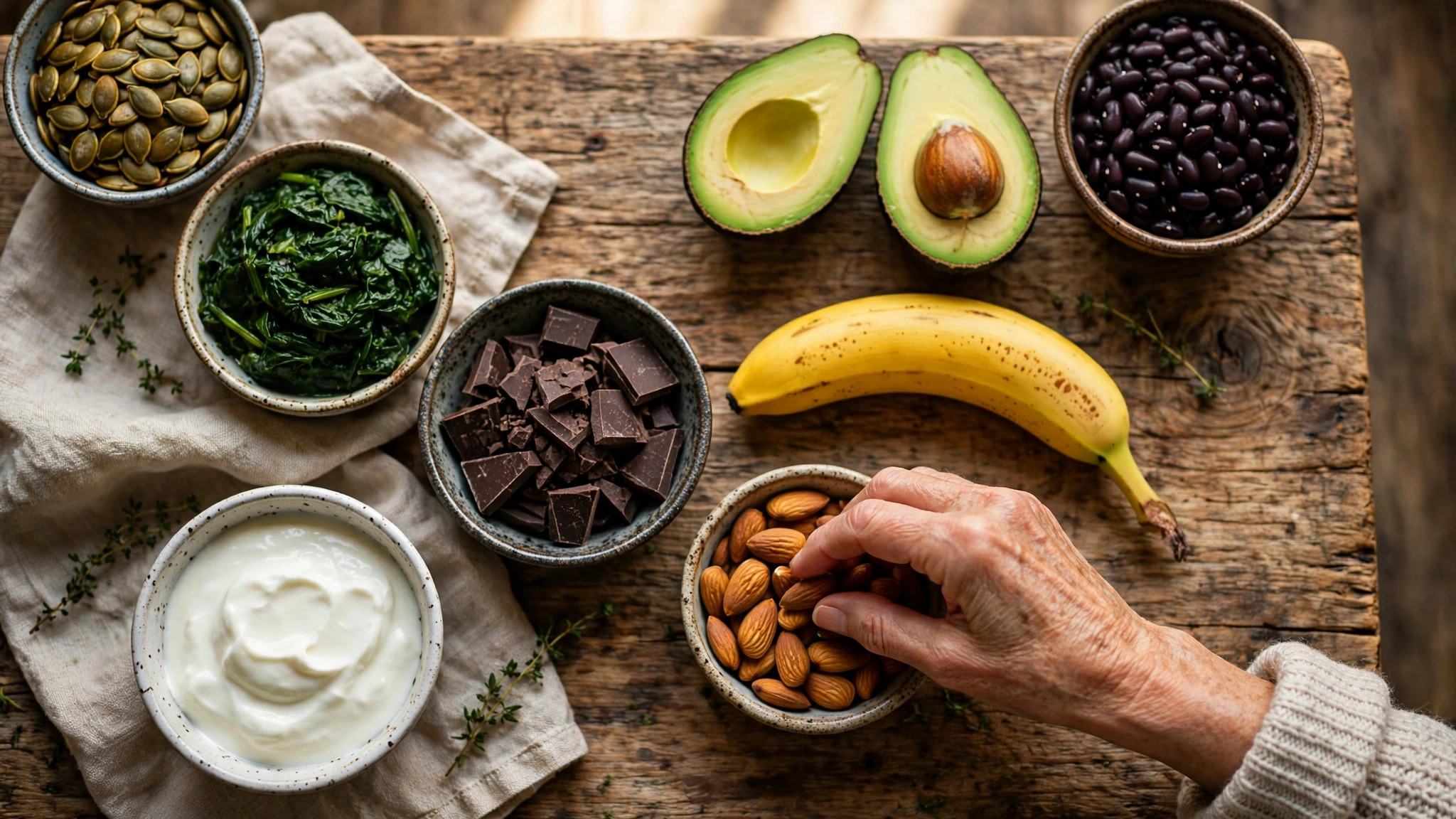
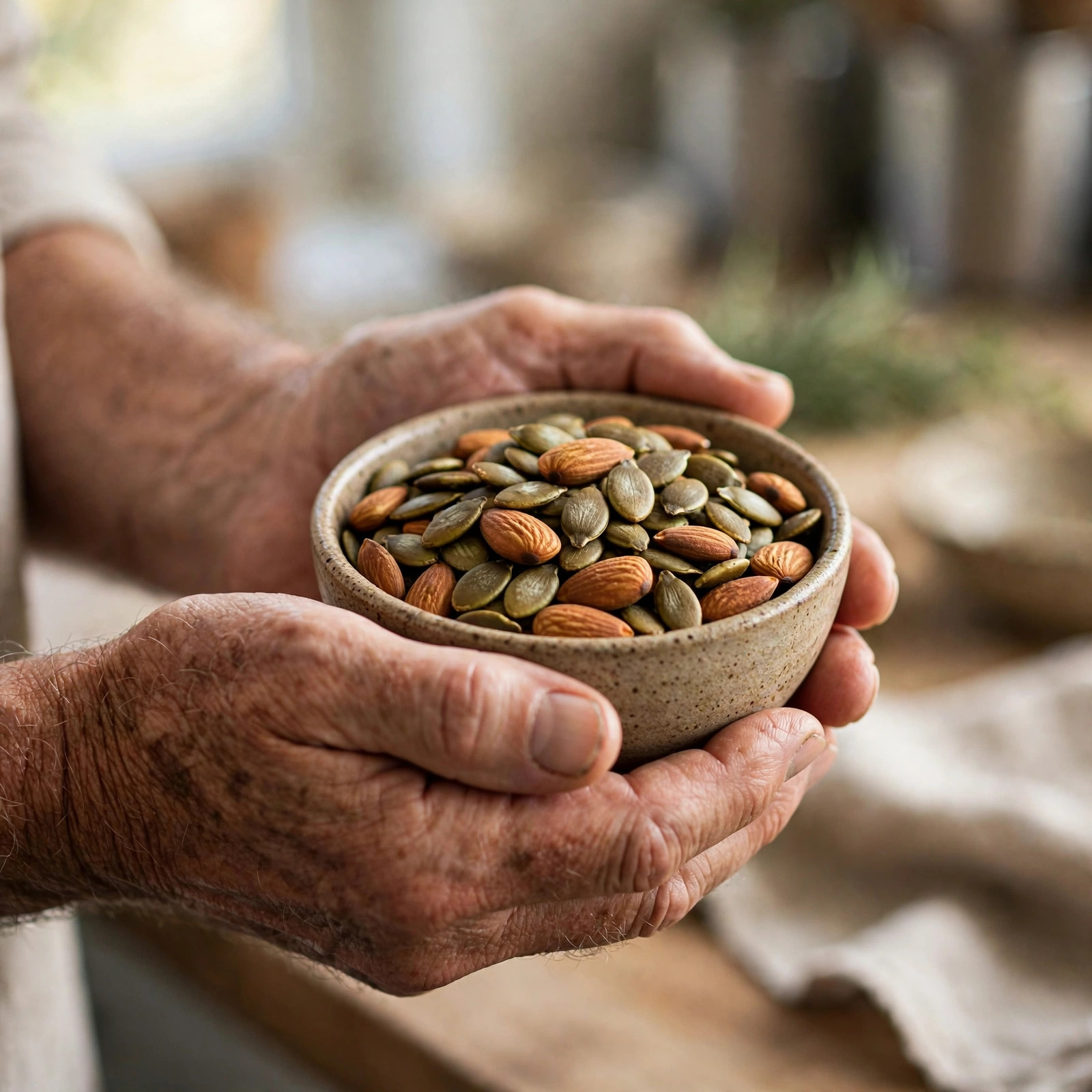
Nuts and seeds (the heavy hitters) – Pumpkin seeds, roasted — 1 ounce (a small handful): 156 mg. The single best food source on this list. – Chia seeds — 1 ounce (2 tablespoons): 111 mg. Great stirred into yogurt or oatmeal. – Almonds, dry roasted — 1 ounce (about 23 almonds): 80 mg. – Cashews, dry roasted — 1 ounce: 74 mg. – Peanut butter, smooth — 2 tablespoons: 49 mg.
Vegetables – Spinach, cooked — ½ cup: 78 mg (a full cup gives roughly 156 mg). Cooking shrinks it down so you can eat far more than raw. – Edamame, shelled and cooked — ½ cup: 50 mg. – Baked potato with skin — 3.5 ounces: 43 mg.

Beans and whole grains – Black beans, cooked — ½ cup: 60 mg (a full cup: about 120 mg). – Brown rice, cooked — ½ cup: 42 mg. – Oatmeal, instant — 1 packet: 36 mg. – Whole wheat bread — 1 slice: 23 mg.
Dairy and fruit – Yogurt, plain, low fat — 8 ounces (1 cup): 42 mg. – Banana — 1 medium: 32 mg. – Avocado — one medium (cubed): about 44 mg. – Dark chocolate (70%+ cacao) — 1 ounce: about 65 mg. Yes, dessert counts.

Notice a pattern: these are ordinary foods. A breakfast of oatmeal with a tablespoon of chia seeds and a few almonds, a lunch with black beans and avocado, and an afternoon handful of pumpkin seeds can take you well past the halfway mark of your daily target. Our anti-inflammatory breakfast ideas guide shows how several of these fit into one meal.

Your Daily Target: How Much Do You Actually Need?
The NIH sets the Recommended Dietary Allowance (RDA) for magnesium at:
- Men age 31 and older: 420 mg per day
- Women age 31 and older: 320 mg per day
That number covers food and supplements combined. There is also an important safety boundary: the tolerable upper limit for supplemental magnesium is 350 mg per day — above that, supplements commonly cause diarrhea and digestive upset. This limit applies only to pills and powders. Magnesium from food has no such ceiling; in healthy people, the kidneys simply clear the excess.
Put another way: it is very hard to overdo magnesium from food. It’s much easier to get too little of it.
What Quietly Drains Your Magnesium
Getting magnesium in is only half the story; several common habits and medications drain it:
- Chronic stress. Stress hormones increase urinary magnesium loss — and low magnesium may in turn make you more stress-sensitive.
- Alcohol. Chronic alcohol use is one of the most common causes of magnesium deficiency, combining poor intake with increased losses.
- High-sugar diets. Refined foods contain almost no magnesium yet displace magnesium-rich whole foods on the plate.
- Diuretics (“water pills”). Widely prescribed for blood pressure, they increase magnesium excretion in urine.
- Proton pump inhibitors (PPIs). Long-term use of acid-reducing drugs like omeprazole has been linked to lower magnesium absorption.
If you take any of these medications long-term, your magnesium status is worth discussing with your doctor — not as a reason to stop a needed medicine, but as a reason to pay attention to your intake. And if you’ve ever had your magnesium “tested,” know that the standard serum blood test captures less than 1% of the body’s magnesium and doesn’t reflect total-body levels well. A red blood cell (RBC) magnesium test is considered a more accurate measure, though no single test is perfect.
Food First, Pill Second — and Knowing Which Battle Is Which
Here’s my honest position: for most people, food is the best magnesium “supplement” there is. Food delivers magnesium alongside fiber, potassium, and dozens of other nutrients that work together, and — unlike pills — it can’t push you past the supplemental safety limit.
That said, supplements have their place. Some people can’t meet their needs from food alone, and magnesium is one of the nutrients most often discussed for sleep support in older adults. That’s exactly why this guide has a partner article: our companion piece on magnesium for sleep after 60 walks through the supplement forms, doses, and timing — so this guide can stay focused on the plate. (A fair warning from both articles: never start a magnesium supplement if you have kidney disease without your doctor’s approval — impaired kidneys can’t clear excess magnesium properly.)
If you’re building a magnesium-friendly eating pattern from scratch, the Mediterranean diet after 50 is a natural fit: it’s built around leafy greens, legumes, nuts, seeds, and whole grains — precisely the foods at the top of this list.
When to See a Doctor
See your doctor promptly if you experience any of the following:
- Persistent muscle cramps, twitches, or numbness and tingling
- An irregular or racing heartbeat
- Unusual fatigue, weakness, or loss of appetite that doesn’t improve
- You take diuretics, PPIs, or other long-term medications and wonder whether your magnesium status should be checked
- You have kidney disease — this is essential, because your kidneys may not be able to handle extra magnesium from supplements
- You are considering a magnesium supplement and take other medications, since magnesium can interact with some drugs, including certain antibiotics
Bring a rough list of what you typically eat in a day. For magnesium, diet history is often more informative than a blood test.
Sources
- National Institutes of Health, Office of Dietary Supplements. Magnesium: Fact Sheet for Health Professionals. https://ods.od.nih.gov/factsheets/Magnesium-HealthProfessional/
- Avery St. Onge. “High Dietary Magnesium Intake May Help Prevent Dementia.” Integrative Practitioner, summarizing the Alateeq et al. study in the European Journal of Nutrition (2023). https://www.integrativepractitioner.com/brain-health/high-dietary-magnesium-intake-may-help-prevent-dementia/
- Alzheimer’s Drug Discovery Foundation. Magnesium: Cognitive Vitality Report for Researchers, updated November 30, 2025. https://www.alzdiscovery.org/uploads/cognitive_vitality_media/Magnesium-Cognitive-Vitality-For-Researchers.pdf
- Mayo Clinic. Magnesium: Drug and Supplement Information. https://www.mayoclinic.org/drugs-supplements-magnesium/art-20360400
This article is for informational purposes only and is not medical advice. Always talk to your doctor or a qualified health professional before making changes to your diet, medications, or supplements.