Best Back Braces for Seniors: Support Without the Bulk
A back brace can feel like a simple answer to a complicated problem: you strap it on, your back feels steadier, and getting up from a chair or walking to the mailbox seems easier. A brace is a support tool, not a treatment. It may help you move with more confidence for a few hours, but no brace cures back pain, rebuilds a weak core, or replaces a conversation with your doctor.
Official guidance is more cautious than the advertising. NICE advises health professionals not to offer belts or corsets for low back pain, with or without sciatica, and a 2026 Cochrane review of eight trials (501 adults) found insufficient evidence for routine use of lumbar supports for chronic low back pain — used alone, they may make little to no difference. Buy one with open eyes: for comfort during specific activities, not as a fix for your back.
What a back brace actually does — and what it doesn’t
A brace works in three modest ways: gentle compression and a sense of stability around your lower back; a reminder — the pressure prompts you to move carefully and avoid sudden twists; and, in some designs, a limit on how far you can bend or twist, reducing strain during tasks such as gardening or carrying groceries.
What it does not do matters just as much. A brace does not strengthen the muscles that support your spine, straighten a curved spine, or repair a damaged disc, and the benefit mostly lasts only while you wear it: a 2025 review of ten studies found posture braces tend to improve posture while worn, with little evidence the improvement lasts once the brace comes off. The same applies to lumbar belts.
The four main types
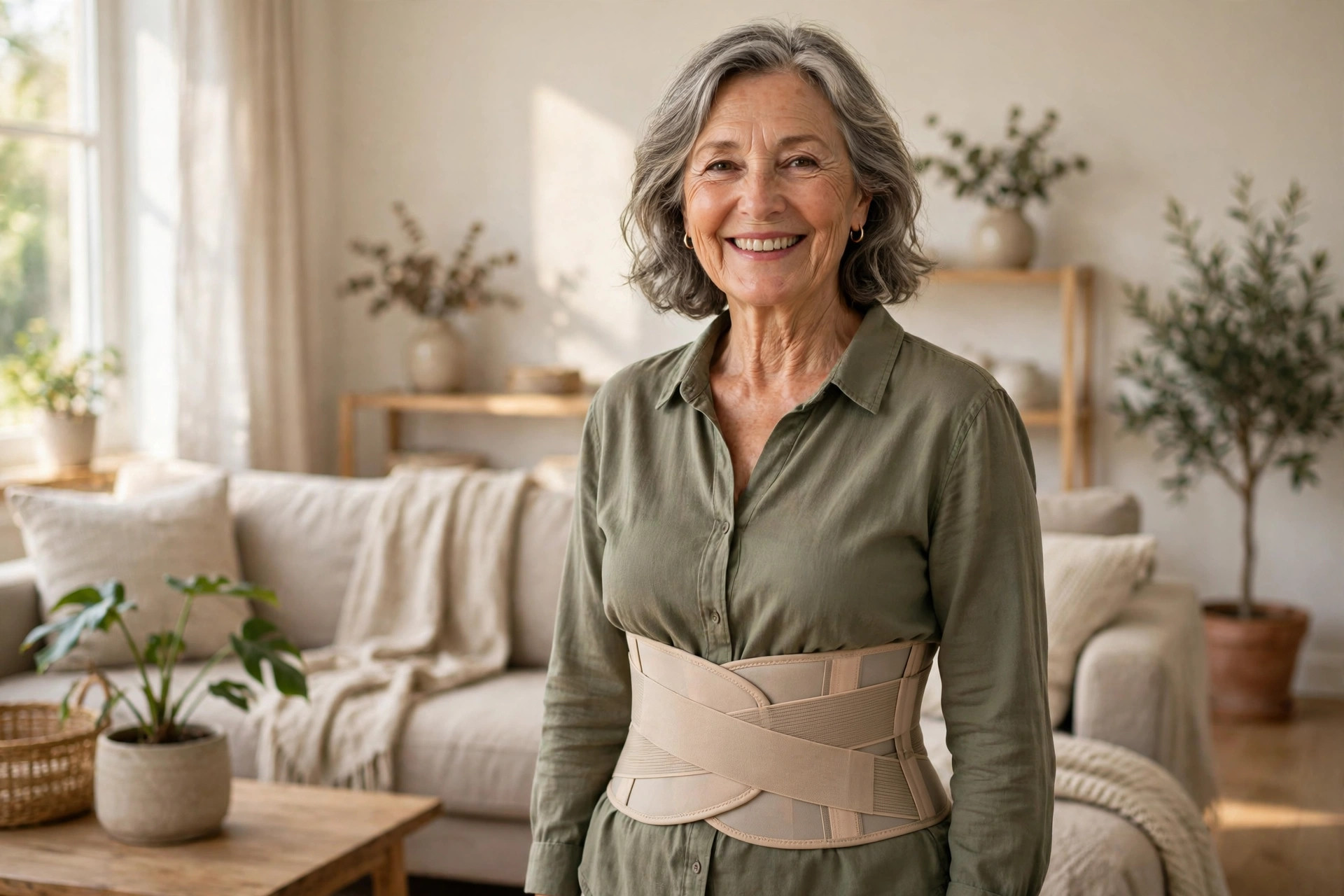
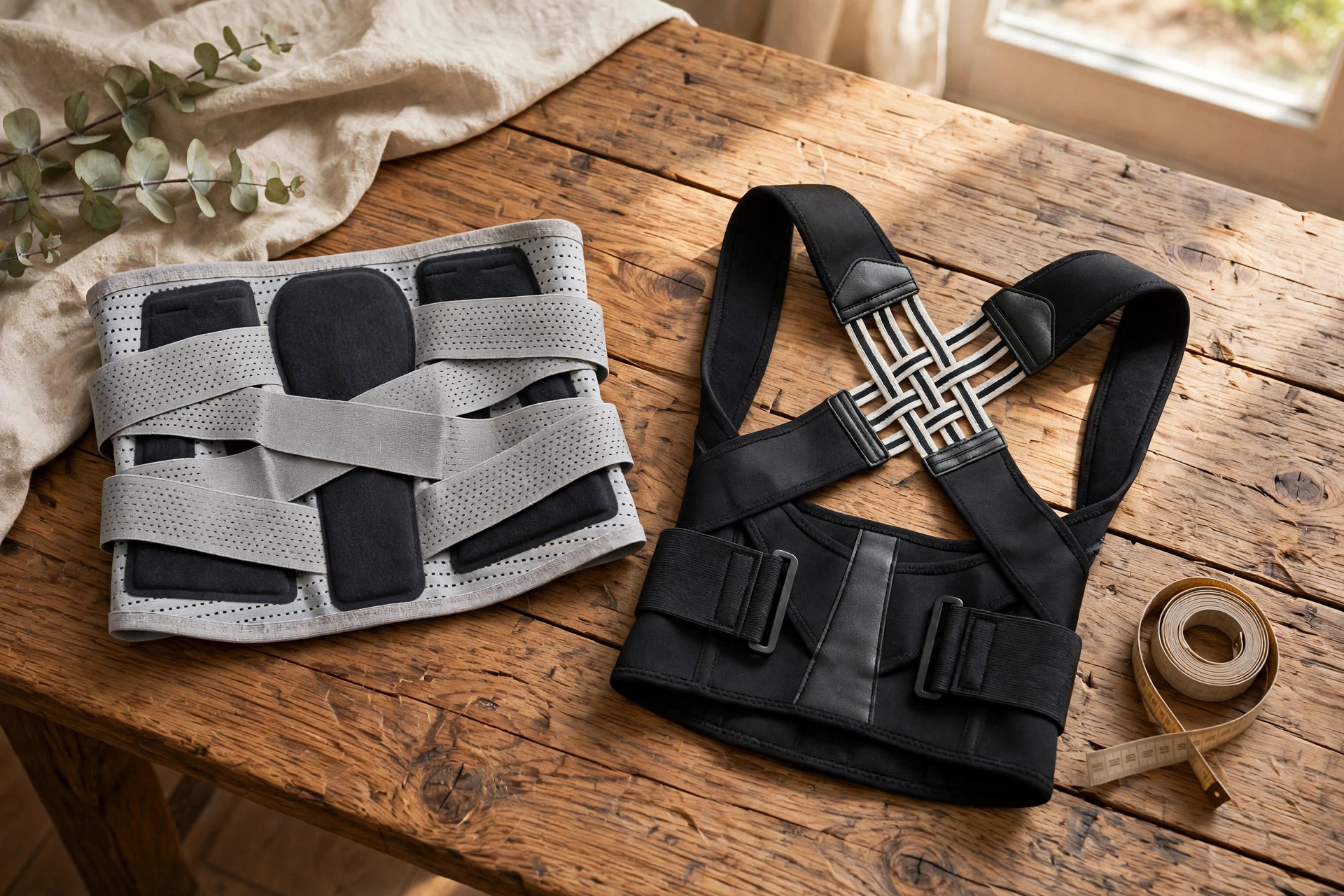
Lumbar support belts. Wide elastic or neoprene bands that wrap around your lower back and fasten at the front, often with extra pull straps — the most common type for everyday use, suited to general lower-back aching, gardening, walking, and light lifting. A removable pad against your lower back spreads pressure more evenly than a plain band.
Posture correctors. These pull your shoulders back with straps over your upper back, sometimes extending to a waist belt. They target rounded shoulders and upper-back fatigue from sitting — not lower-back pain — and only hold you upright while you wear them. If your main problem is your lower back, a posture corrector is probably the wrong purchase.
Rigid vs. flexible braces. Flexible braces use elastic panels and thin stays that bend with you; rigid ones use hard panels or a molded shell and restrict movement much more. Rigid braces are usually prescribed after a fracture, surgery, or a diagnosed spinal problem — medical devices, not something to pick up on your own. For everyday aches, a flexible brace is almost always the right level.
Sacroiliac (SI) belts. Narrower belts worn low across the hips, not the waist, to support the joints where your spine meets your pelvis. Some people find them helpful for pain deep in one buttock or at the very bottom of the back, especially when walking or standing. They are a specialist item: if your pain is mainly in that spot, ask a doctor or physical therapist first.
How to choose one that fits
A poor fit means a brace that rides up, pinches, rubs, and ends up in a drawer. Fit matters more than any feature on the box.
Measure at your navel, not your trouser size. Wrap a soft tape measure around your waist at belly-button level, standing relaxed and breathing normally. Trouser sizes run smaller than your real waist measurement, so sizing by them is the most common mistake. Between sizes, size up — a brace that is too tight is hard to breathe in and harder to fasten.
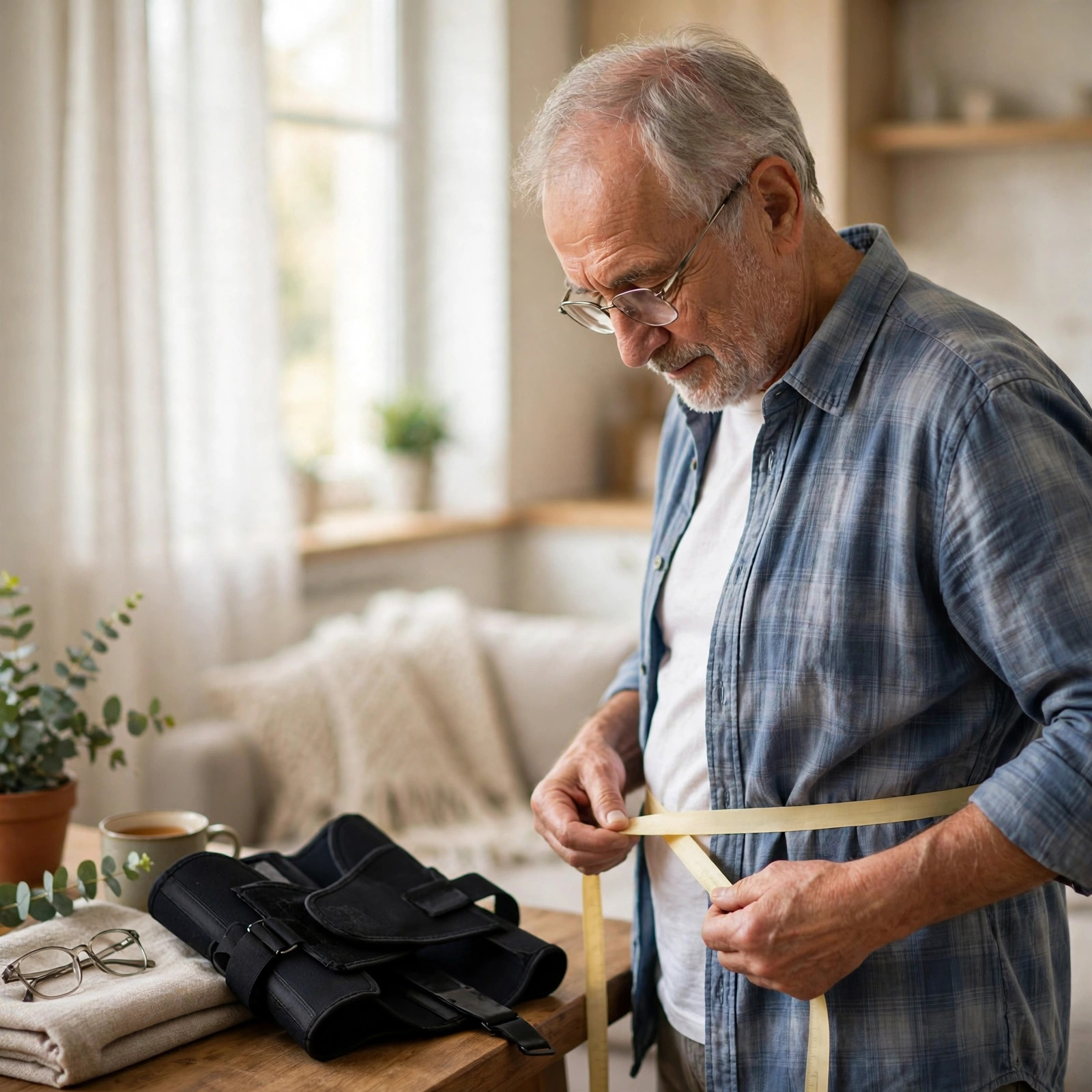
Check the fastening with your own hands. Large hook-and-loop panels, wide pull tabs, and D-ring handles are far easier than small buckles or fiddly clips, especially if arthritis affects your fingers. Try fastening and unfastening the brace while seated, since that is how you will put it on at home. A pulley or double-pull strap system usually means less pulling force, not more.
Look for adjustability and breathability. Your waist changes through the day, and a brace should adjust with it: extra elastic side panels or a second set of pull straps let you tighten it for a task and loosen it when you sit down. Breathable mesh matters too — a brace traps heat, and sweaty, irritated skin is a common reason people stop wearing one. A thin layer of clothing underneath also helps prevent rubbing, as NHS orthotics leaflets advise for prescribed spinal supports.
Make sure you can put it on yourself. Front-closing designs beat ones that fasten behind your back, and lightweight models are more comfortable. If you use a walking aid, check the brace does not clash with it. Before you buy, sit in it, bend forward, and walk a few steps: it should feel snug, never tight enough to restrict breathing, and if it rides up when you sit, it is the wrong size.
How long to wear it — and why all day is a bad idea
No guideline gives a universal wear time for shop-bought braces — so if a product promises it is safe to wear all day, every day, that promise has no clinical backing. The sensible pattern, echoed in NHS patient leaflets for prescribed spinal supports, is to wear a brace for the activity that needs support, then take it off. Put it on before a walk, a gardening session, or a shopping trip, and take it off when you sit down to rest. Do not sleep in one unless a clinician has told you to.
The reason is partly about your muscles: when a brace holds your trunk steady, your own back and stomach muscles do less work. NHS orthotics guidance warns that wearing a support all the time carries a risk that those muscles could become weaker over time. That said, the evidence is not settled: a 2017 systematic review of 35 studies found no conclusive evidence that lumbar braces weaken trunk muscles. So muscle weakening is a plausible concern rather than a proven effect — and the advice is the same either way: use the brace for specific tasks, and let your own muscles do the work the rest of the day.
Red flags: when a brace is the wrong tool
A brace is meant for ordinary, mechanical back aches — the kind that come and go with activity.
Do not buy a brace first if your pain followed a fall or a blow to your back — a fracture needs assessment, not compression. Do not rely on a brace if pain spreads down one or both legs, or comes with weakness, tingling, or numbness in a leg or foot — or with new bladder or bowel problems, numbness around the groin, fever, or unexplained weight loss. The same goes if your pain is getting steadily worse, or has not improved after a few weeks of self-care. If you have osteoporosis, a diagnosed spinal condition, or take blood-thinning medicine, ask your doctor or pharmacist first. And if a brace makes your pain worse, or causes skin breakdown, numbness, or tingling, take it off and get advice.
The long-term answer: gentle core strength
The most reliable way to support your back over time is to strengthen the muscles the brace is standing in for. Strong core muscles — the muscles of your abdomen, back, hips, and buttocks — support your lower back and help you stand, get out of a chair, bend, lift, and keep your balance. Harvard Health recommends three gentle moves for older adults in particular: bridges, planks (including a modified plank on your knees), and the opposite arm and leg raise on hands and knees. Sit-ups and crunches are not recommended for older adults.

You do not need a gym or a long routine: a few minutes of gentle core work, two or three times a week, is a realistic start, and our guide to strength training at home after 60 walks through safe ways to begin. Think of it as a handover: the brace helps you stay active today; the strengthening helps you need the brace less tomorrow. If you are unsure which exercises are safe for you, a physical therapist can design a short routine for your specific back problem.
Also see our guides to heating pads for back pain, knee braces for arthritis, and the best sleep position for back pain.
When to see a doctor
Most back pain settles with self-care: the NHS notes back pain usually improves within a few weeks, and staying active helps. See your doctor within four weeks if your pain has not improved with self-care, keeps coming back, or stops you doing day-to-day activities — and much sooner with a history of cancer or a recent change in bladder function.
Seek care immediately if your back pain comes with a fever of 100.4°F (38°C) or higher for more than 48 hours, spreads down one or both legs, causes weakness, tingling, or numbness in a leg, gets worse when you rest, follows a fall or a blow to your back, or comes with new bowel or bladder problems.
The bottom line
The best back brace for seniors fits well, is easy to put on, breathes comfortably, and helps you do a specific activity with more confidence — and then comes off. Start with a flexible lumbar belt for lower-back pain, a posture corrector only if rounded shoulders are the real problem, and a rigid brace only if a clinician prescribed it. Measure at your navel, test the fastening, and wear it for tasks, not all day.

Sources
- National Institute for Health and Care Excellence (NICE). Low back pain and sciatica in over 16s (NG59), recommendation 1.2.3: “Do not offer belts or corsets for managing low back pain with or without sciatica.” https://www.nice.org.uk/guidance/NG59/chapter/Recommendations
- NHS. Back pain — usually improves within a few weeks; stay active; do not stay in bed for long periods. https://www.nhs.uk/conditions/back-pain/
- Mayo Clinic. When to see a doctor for back pain. https://www.mayoclinic.org/connected-care/when-to-see-a-doctor-for-back-pain/cpt-20470965
- Mayo Clinic Health System. When should I be seen for back pain? https://www.mayoclinichealthsystem.org/hometown-health/speaking-of-health/when-should-i-see-a-doctor-about-back-pain
- Harvard Health Publishing. The best core exercises for older adults. https://www.health.harvard.edu/healthy-aging-and-longevity/the-best-core-exercises-for-older-adults
- Bradford Teaching Hospitals NHS Foundation Trust. Spinal braces, corsets and abdominal supports. https://digitalpatientinformationhub.bradfordhospitals.nhs.uk/leaflets/spinal-braces-corsets-and-abdominal-supports/
This article is for general information only and is not medical advice. Talk to your doctor before buying or wearing a back brace, especially if you have osteoporosis, a diagnosed spinal condition, or pain that is new, severe, or getting worse.