Best Jar Openers for Seniors: Arthritis-Friendly Grip That Works
You know the scene: a jar of pickles, pasta sauce, or jam sits on the counter, the lid will not budge, and your hands ache before you have even started. For many adults over 60, this small daily battle is one of the first signs that grip strength is changing — and one of the easiest to solve. The right jar opener does the hard work for your hands.
This guide compares the main types of jar openers, explains who each one suits best, and shows what to check before you buy.
As an Amazon Associate, we earn from qualifying purchases.
Why jars get harder after 60
Opening a jar asks a lot of your hands at once: grip to hold it, force to break the vacuum seal, and steady finger joints to press a smooth metal lid. When any part of that chain weakens, the lid wins.
Arthritis is the most common reason. According to the U.S. Centers for Disease Control and Prevention, about 1 in 4 American adults — an estimated 58.5 million people in 2016–2018 — has doctor-diagnosed arthritis, and about 4 in 10 of them say it limits their usual activities. Osteoarthritis, the most common form, wears down the cartilage that cushions joints and often affects the small joints of the hands first, causing pain, stiffness, and a weaker grip.
Grip strength also tends to decline with age, even without arthritis. Muscles lose some power, tendons stiffen, and conditions such as carpal tunnel can add numbness that makes a smooth lid feel impossible to hold. Add a vacuum-sealed lid — manufacturers seal jars tightly to keep food safe — and even healthy hands can struggle. A jar opener does not ask your hands to get stronger; it changes the physics, with more leverage, more friction, or a motor that twists for you.
The main types of jar openers
Five broad designs solve different problems. Match the design to what your hands find hardest: holding, twisting, or both.
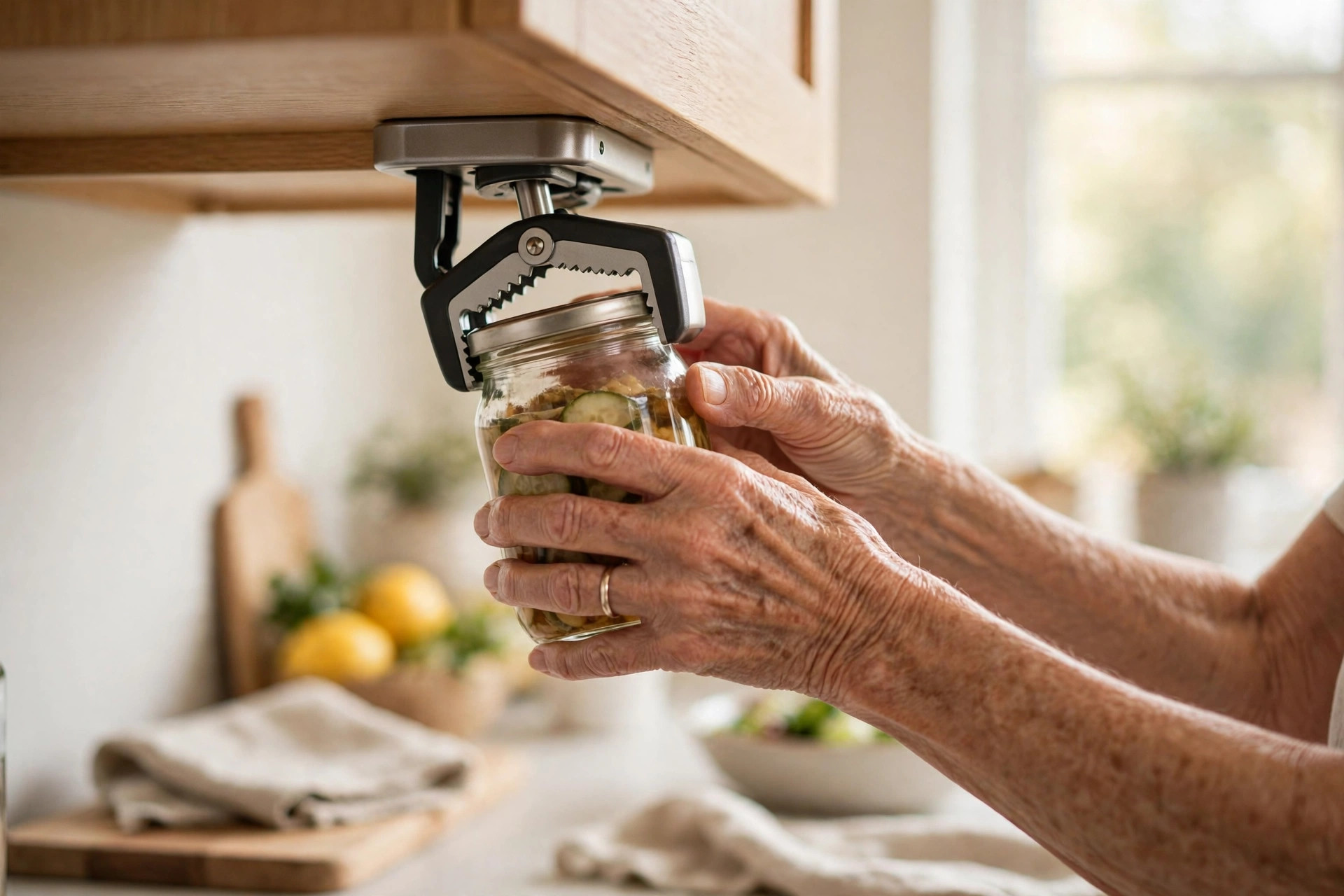
1. Under-cabinet openers
These mount permanently beneath a kitchen cabinet or shelf. A V-shaped metal grip with small teeth holds the lid while you turn the jar itself, with both hands or with one hand and your body weight. Because the cabinet does the holding, your fingers never have to squeeze a lid.
They suit people who can grip a jar body but cannot twist a lid, and they work well one-handed, with no batteries needed. The trade-offs: they need installation with screws or strong adhesive, and the metal teeth can leave small marks on lids. Check clearance below the cabinet for your tallest jars.
2. Handheld twisting openers
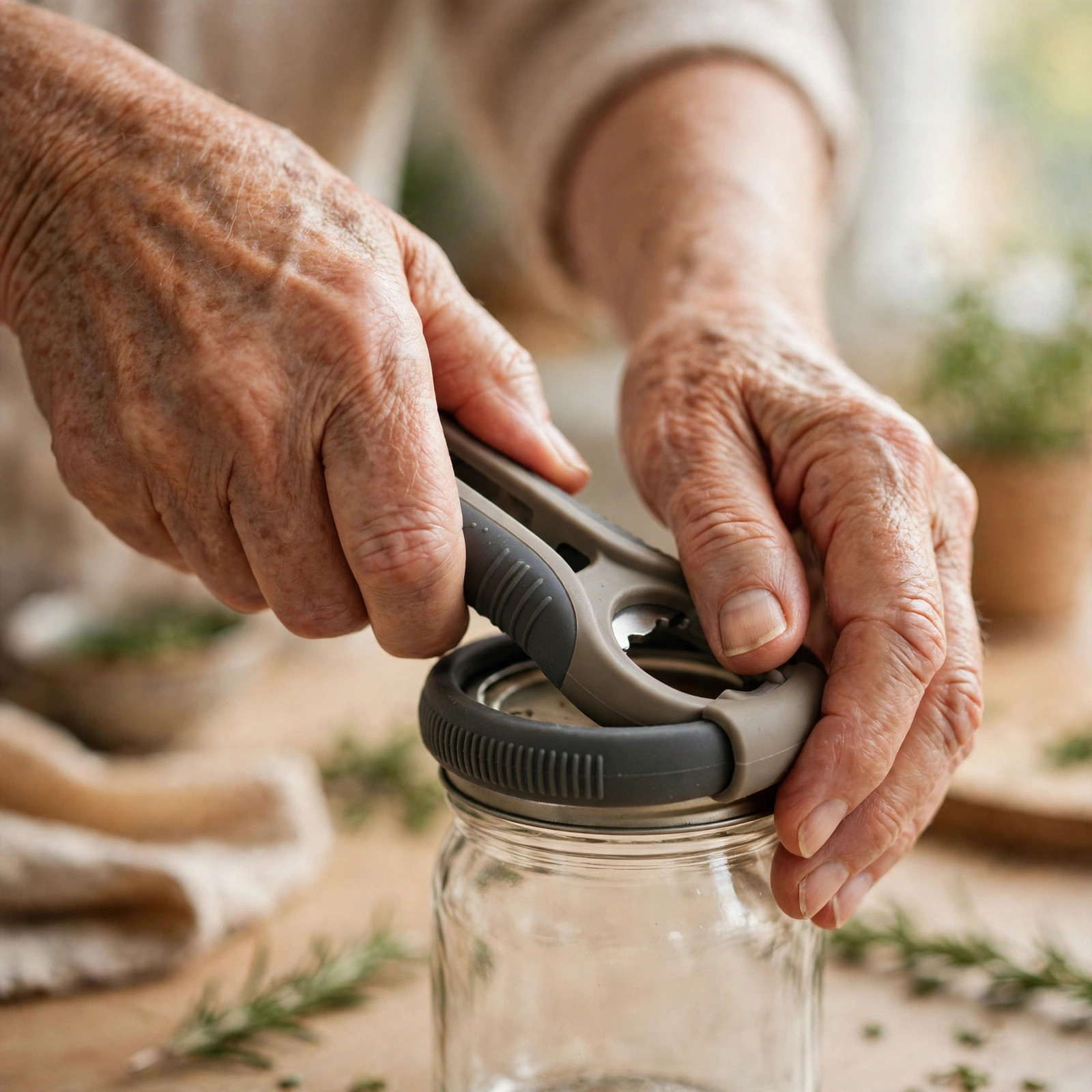
The most familiar type: a handle you hold while a toothed ring or clamp grips the lid, plus, in some designs, a non-slip pad that stops the jar spinning. A long, soft handle spreads pressure across your palm instead of concentrating it in sore finger joints.
They are cheap, need no installation or power, and fit a wide range of lid sizes. The catch: you still need two usable hands and some grip strength, and if twisting itself is the painful part, this style may help only a little. For a broader look at arthritis-friendly kitchen tools, see our ergonomic kitchen tools buying guide.
3. Electric and automatic openers
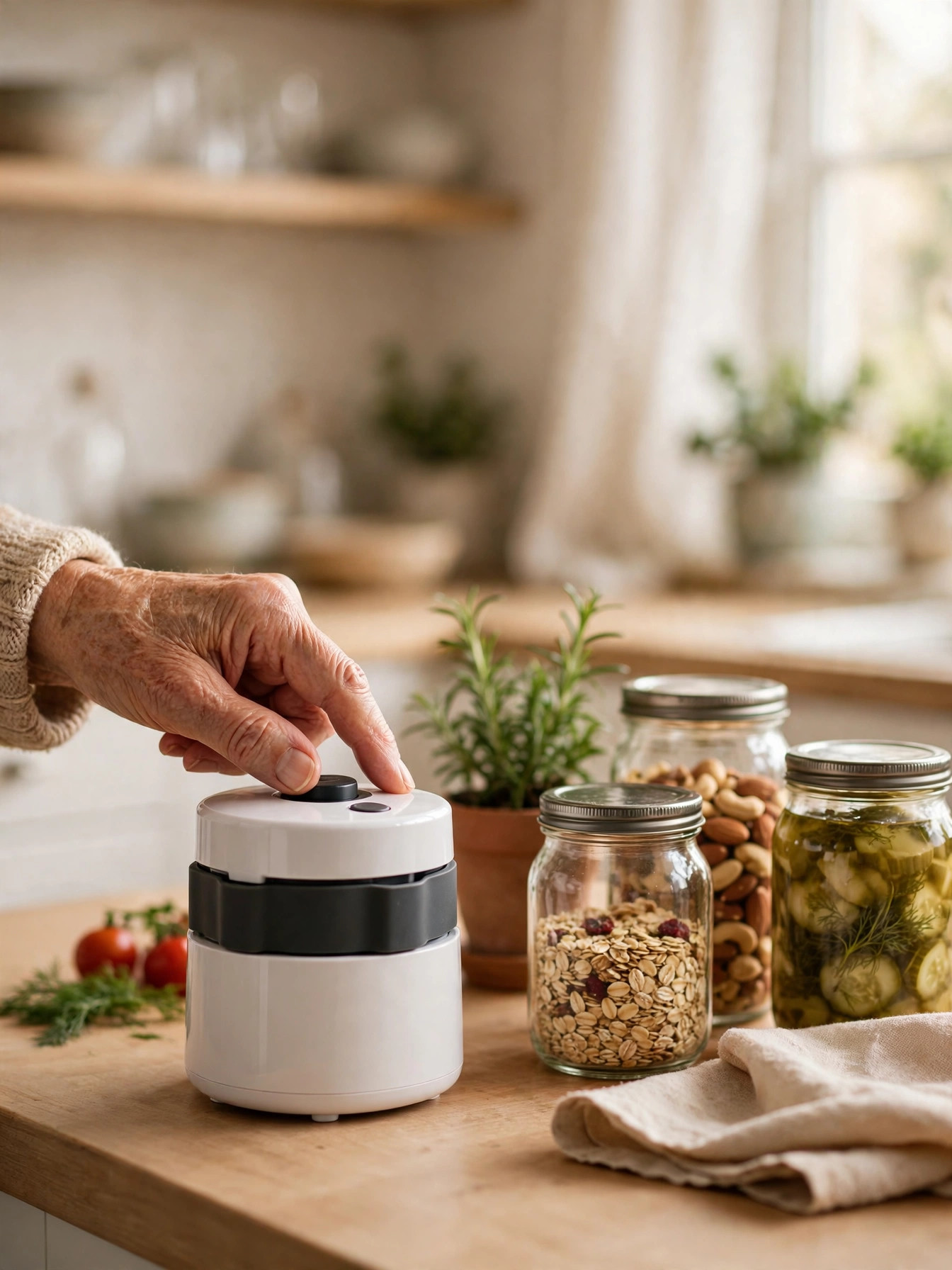
An electric opener sits on top of the jar, clamps the lid, and a small motor turns it for you at the press of a button. This is the lowest-effort option by a clear margin, and usually the best choice when grip is very weak, when tremor makes holding a tool hard, or when twisting causes sharp pain.
Most run on batteries and adjust to a stated lid-size range, often roughly 1 to 3.5 inches — check it against your own jars first, since very small or very wide lids may not fit. They are the bulkiest to store and need fresh batteries now and then.
4. One-handed and basepad openers
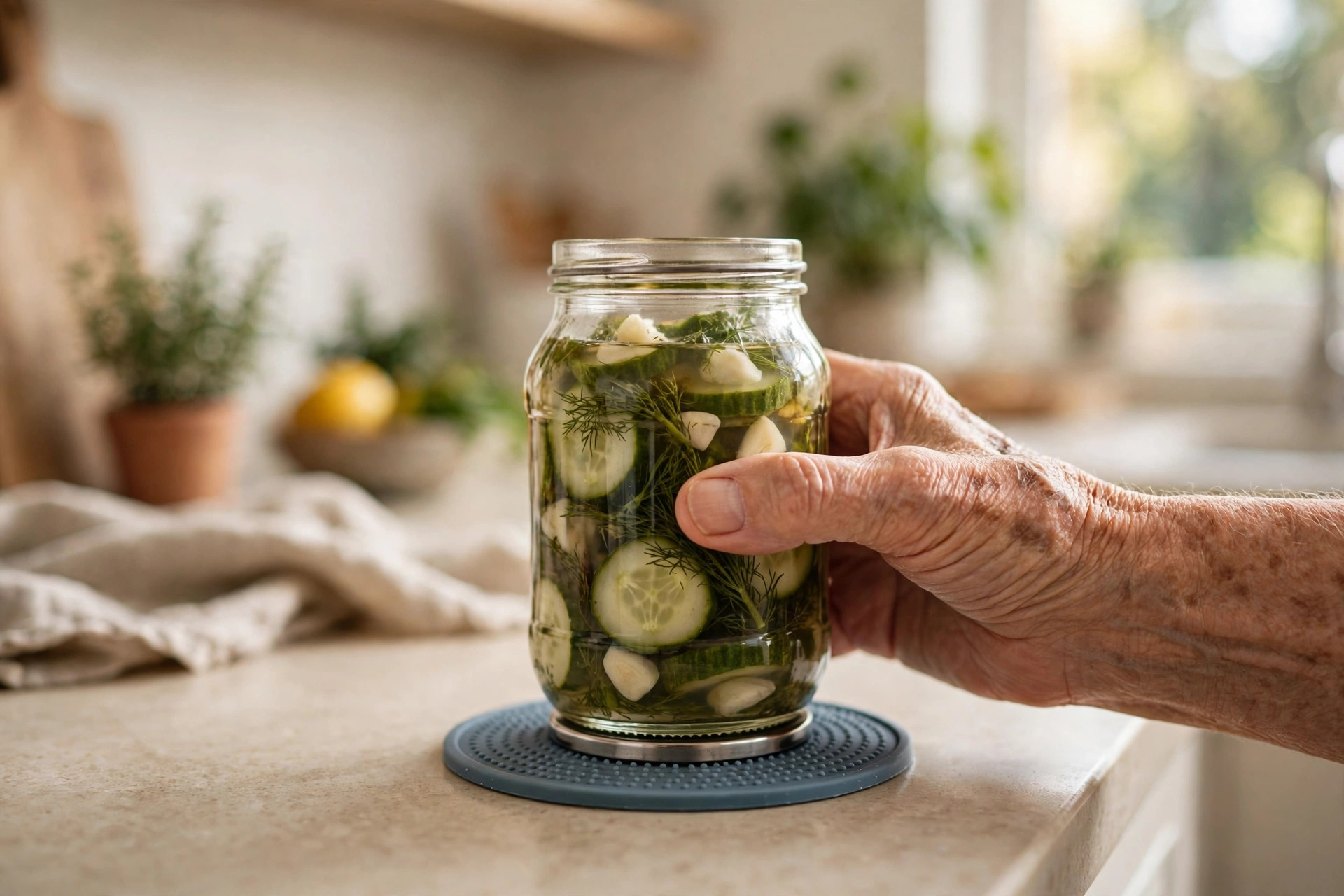
This group solves a different problem: holding the jar still. A heavy non-slip basepad grips the counter and the bottom of the jar, so the jar cannot spin while you twist the lid with your free hand. Some designs combine the pad with a twisting handle, so one product steadies the jar and turns the lid.
They suit anyone with one stronger hand and one weaker one. They are simple, silent, and easy to clean. Their limit is that they only steady the jar — breaking a tight vacuum seal still takes some twist, so pair a basepad with a grip aid or twisting tool if your lids are very stubborn.
5. Strap, lever, and multi-tool openers
Strap openers loop a rubber or fabric strap around the lid and use a handle as a lever; lever-style openers hook under the lid edge to break the vacuum seal with a small lift, after which the lid turns easily. Flat multi-tools combine several ring sizes for jars and bottles, a seal-breaking hook, and sometimes a pull-tab lifter in one drawer-sized piece.
These are light, cheap, and useful for releasing a vacuum seal — often the hardest single moment in opening a jar. But a seal-breaker alone does not twist the lid off, so many people use one together with a rubber grip pad.

1. OXO Good Grips Twisting Jar Opener with Basepad
Grips any lid size – twist off stubborn jars without the hand pain.
As one example readers can check, the opener above pairs a large soft handle with a non-slip basepad — the combination described in the handheld section. We have not lab-tested it against every other opener, so treat it as a starting point, not a tested verdict.
How to choose the right one
Start with your hands, not the product page. If you cannot hold the jar steady, a basepad or under-cabinet design helps most; if you can hold it but cannot twist, look at long-handled twisting tools or an electric model; if both are hard, an electric or mounted opener is usually the better bet.
Then check the practical details:
- Lid-size range. Measure the widest lids you actually open — pickle jars and large sauce jars are often wider than jam jars — and compare them with the range the maker states.
- Grip and handle size. Look for a thick, soft, non-slip handle that fills your palm. Thin, hard handles concentrate force on sore finger joints and slip when hands are damp.
- Mounting and storage. Under-cabinet openers need a suitable cabinet and someone to install them. Electric openers need a shelf spot and occasional batteries.
- One-handed use. If you often cook with one hand free, favor designs that hold the lid or the jar for you — mounted openers and basepads — over tools that need both hands at once.
- Cleaning. Smooth surfaces and removable pads wipe clean easily; fabric straps and deep teeth take more effort.
Start with the cheapest fix that matches your problem — often a basepad and a twisting tool — and step up only if that is not enough. Many households keep two: a simple grip aid for everyday jars and a powered one for the stubborn few. Our easy-grip knives guide follows the same principle.
Safety tips for sore hands
- Never force a lid with a knife or a sharp edge. Prying under a lid can slip and cut your hand, and it can chip glass into food. Use a seal-breaking hook made for the job instead.
- Dry your hands and the jar. Wet glass is slippery glass. A quick towel-dry before you start gives every opener a better grip.
- Watch hot jars. Freshly heated jars build extra pressure. Let them cool a little, use a towel or oven mitt, and never twist a very hot jar with bare hands.
- Keep the tool clean and dry. Sticky residue on teeth, straps, or pads reduces grip and can harbor bacteria. Rinse or wipe the tool after use.
- Mind sharp teeth. Under-cabinet and clamp-style openers use metal teeth that can scratch lids and nick fingers. Mount them where children will not reach, and keep fingers clear of the grip while turning.
- Pair the tool with hand care. Gentle hand exercises may help keep fingers mobile — our hand arthritis exercises walk through a few — and pace yourself through kitchen tasks.
When to see a doctor
A jar opener solves a mechanical problem, not a medical one. See your clinician promptly if you notice:
- Hand pain, swelling, or stiffness that lasts more than a few days or keeps coming back
- Numbness, tingling, or weakness in your fingers or hand
- A sudden loss of grip strength, or dropping things you used to hold easily
- A finger or thumb joint that looks deformed, locks, or will not straighten
- Pain that wakes you at night or does not ease with rest
These can be signs of arthritis, nerve compression such as carpal tunnel, or another condition that deserves assessment rather than a stronger tool. The Mayo Clinic advises making an appointment if joint pain or stiffness does not go away, and the NHS recommends seeing a GP for persistent osteoarthritis symptoms. Early advice may help protect the joints you have, and an occupational therapist can suggest tools matched to your hands. And remember, no opener cures arthritis.
The bottom line
A stubborn lid is a small problem with an outsized effect — it decides what you cook and what you buy. Match the opener to your hands: a basepad or mounted opener if holding is the hard part, a long-handled twisting tool for mild to moderate arthritis, and an electric opener when twisting itself hurts. Check the lid-size range and the handle before you buy. With the right grip, the lid stops being the boss of your kitchen.
Sources
- Theis KA, et al. “Prevalence of Doctor-Diagnosed Arthritis and Arthritis-Attributable Activity Limitation — United States, 2016–2018.” CDC, MMWR 2021;70(40):1401–1405 — https://stacks.cdc.gov/view/cdc/159515/cdc_159515_DS1.pdf
- National Institute of Arthritis and Musculoskeletal and Skin Diseases, “Osteoarthritis” — https://www.niams.nih.gov/health-topics/osteoarthritis
- Mayo Clinic, “Osteoarthritis — Symptoms and causes” — https://www.mayoclinic.org/diseases-conditions/osteoarthritis/symptoms-causes/syc-20351925
- NHS, “Osteoarthritis” — https://www.nhs.uk/conditions/osteoarthritis/
- Cleveland Clinic, “Osteoarthritis: What It Is, Symptoms & Treatment” — https://my.clevelandclinic.org/health/diseases/5599-osteoarthritis
This article is for general information only and is not medical advice. Talk to your doctor about your personal health needs before changing how you manage a health condition.