Best Raised Toilet Seats for Seniors: Safer, Easier Bathrooms
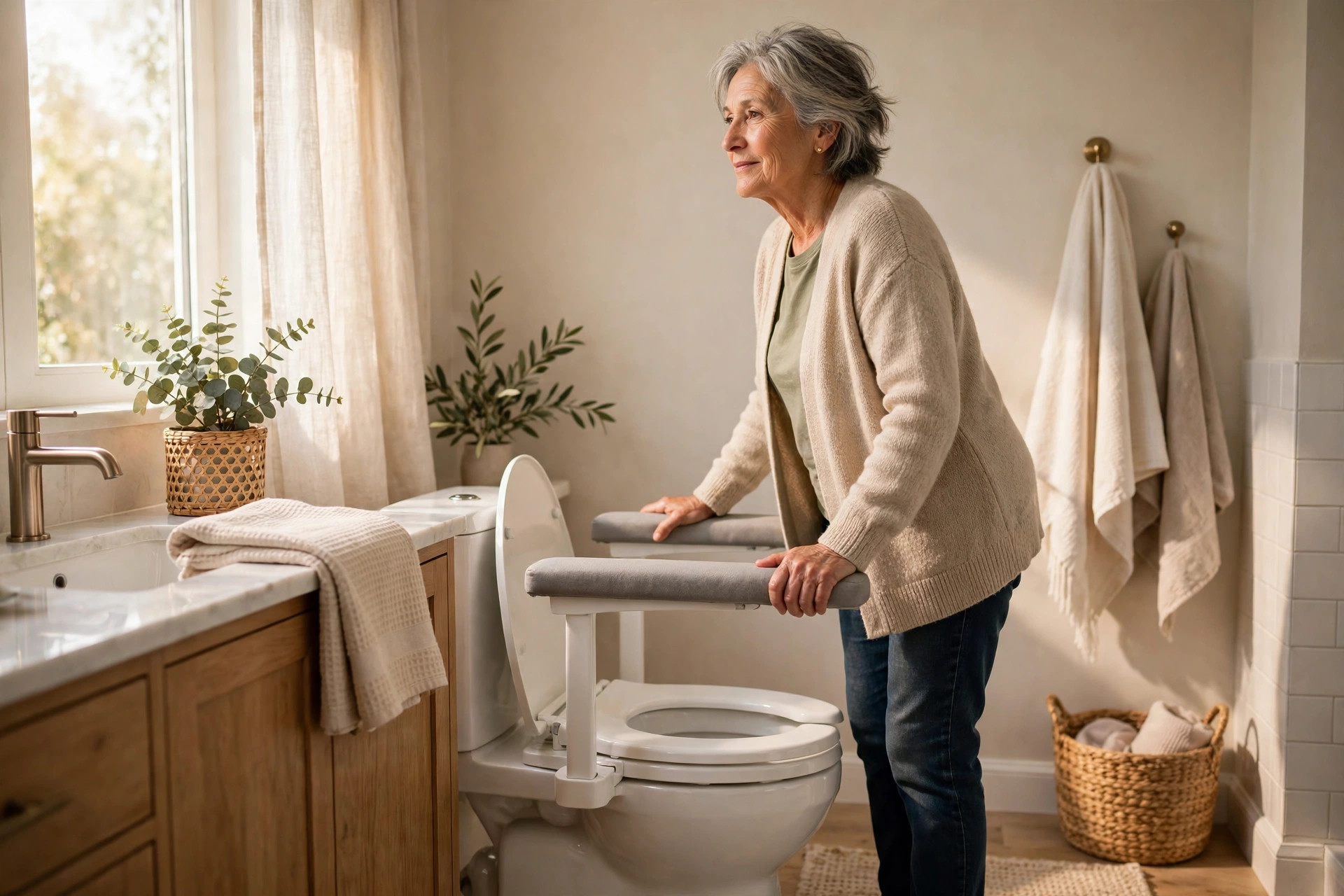
The toilet is one of the most-used seats in any home — and one of the hardest to get up from when your knees, hips, or balance are not what they used to be. A standard seat sits low, so every visit asks your legs to do a deep squat, then push you back up.
A raised toilet seat is one of the simplest, cheapest fixes in bathroom safety. It is a ring or seat that sits on your existing bowl and lifts the sitting surface by a few inches. No plumbing, no remodeling, and most models install in minutes. This guide covers choosing the right height and attachment, whether you need armrests, and how to make sure it fits your toilet.
Why a raised seat helps
A low seat forces a deep bend at the hips and knees; a higher seat makes that bend shallower, so there is less strain on sore joints and less work for your thigh muscles. That matters in three common situations:
- Arthritis in the knees or hips. A higher seat means less bending at sore joints, which may make each trip less painful.
- Recovery after hip or knee surgery. After a hip replacement, most patients are advised not to bend the hip past 90 degrees for the first weeks. NHS guidance notes that most will need a raised toilet seat, because sitting too low bends the hip past that safe angle.
- Weaker legs or balance problems. When standing up is hard, people grab whatever is nearby — a towel rail, a sink edge. None of those is built to hold your weight. A raised seat with sturdy armrests gives you something designed for the job.
The CDC notes that about 1 in 4 adults aged 65 and older report a fall each year, and a raised seat shortens the riskiest part of the trip — the move between sitting and standing.
How much height do you need?
Raised seats typically add about 2 to 6 inches (roughly 5 to 15 cm), in standard rises of around 2 inches, 3 to 4 inches, or 5 to 6 inches. Some models are adjustable, with legs or spacers that let you change the height.
The right height lets you sit with your feet flat on the floor and your hips slightly above your knees. A simple test: sit on your current toilet — if your knees sit above your hips, the seat is too low. If you are tall, or recovering from hip surgery, you will usually need the taller end of the range.
Too much height is its own problem: if your feet dangle, you lose the leverage your legs need to push you up. If you cannot try two heights first, the medium rise is the safer starting point; an adjustable model removes the guesswork.
Locking vs clamp-on: how the seat stays put
A raised seat is only safe if it does not move. There are two main ways seats attach.
Locking seats clamp onto the rim of the bowl with a built-in mechanism — usually a lever or dial that tightens against the underside of the rim. Once locked, the seat should not shift sideways at all. These tend to be the most stable option — the better choice if the user has limited balance or leans to one side.
Clamp-on (or bolt-on) seats attach with brackets that grip the bowl, sometimes with rubber pads for grip. They are quick to install and remove, which suits a shared bathroom, but they can work loose — check them weekly with a firm sideways push and retighten if the seat moves.
Test any seat before you trust it: sit down slowly, shift your weight side to side, and stand up using the armrests or a grab bar. If the seat rocks, slides, or creaks, it is not fitted correctly — check the clamps are gripping the rim properly, and return it if it still moves. A seat that shifts under you is worse than no seat at all.
Seats with arms: worth it for most people
Some raised seats are just a ring. Others come with built-in armrests — two padded handles you push on to lower yourself and stand up. For most older adults, the version with arms is worth the extra cost:
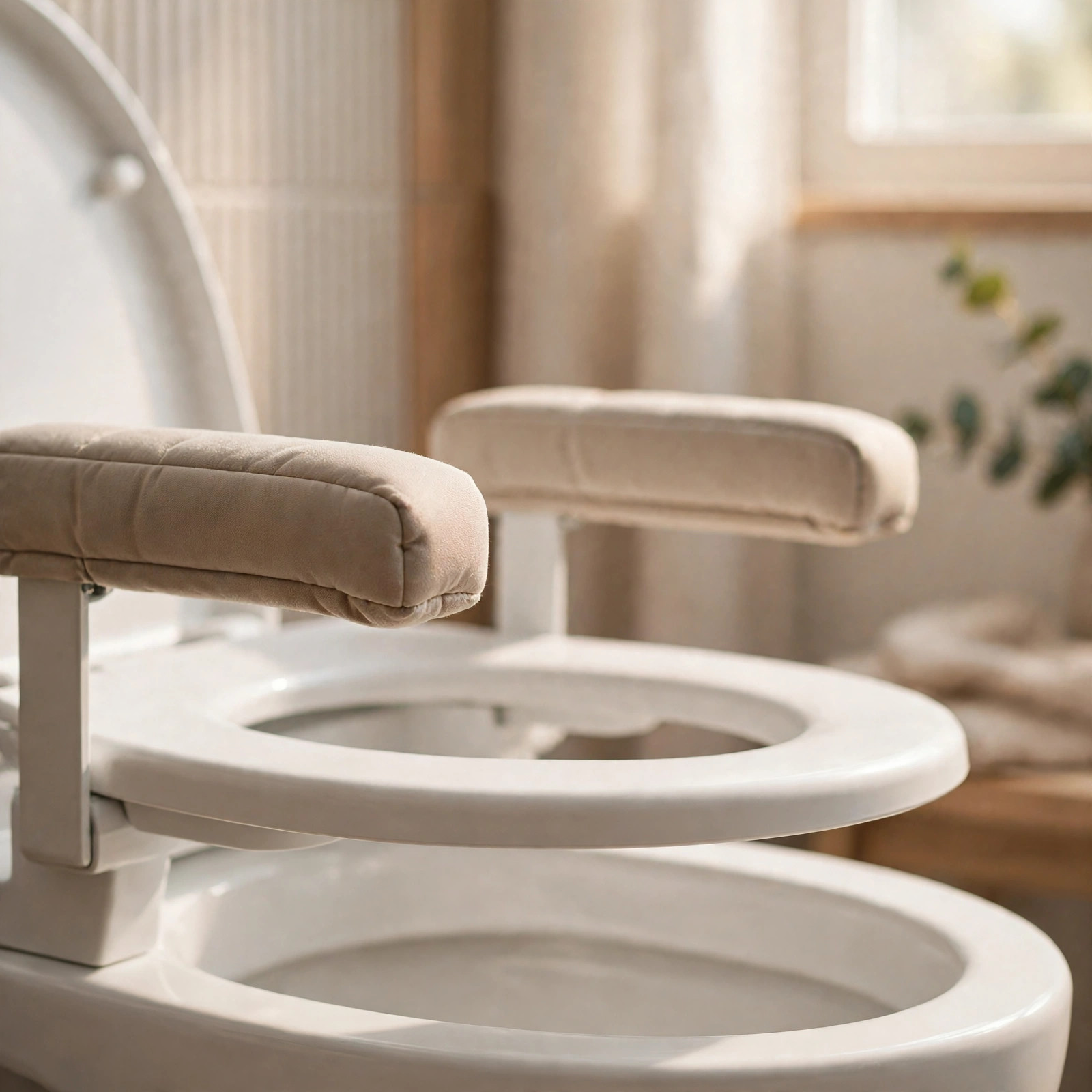
- You push with your arms, not just your legs. That takes a real share of the work off your knees and hips.
- You have something to hold onto mid-transfer. The riskiest moment is halfway up, when your balance is changing.
- They help you sit down slowly — dropping the last few inches onto a hard seat jars the spine and hips.

Check that the armrests are wide enough apart and that the unit fits between the toilet and any wall or vanity beside it. In a very narrow bathroom, a wall-mounted grab bar beside the toilet (see our grab bar guide) may be the better companion to a plain raised ring.
Measuring your toilet: round vs elongated
The most common reason a raised seat gets returned is the wrong bowl shape. Toilets come in two shapes, and seats are made to match:
- Round bowls are shorter front to back — roughly 16.5 inches (about 42 cm) from the bolt holes to the front edge.
- Elongated bowls are longer — roughly 18.5 inches (about 47 cm) over the same measurement.
Check yours in under a minute: lift the lid and seat, then measure from the center of the bolt holes to the front of the rim. About 16 to 17 inches means round; about 18 to 19 inches means elongated. Buy the matching shape — a round seat on an elongated bowl leaves a gap at the front, while an elongated seat on a round bowl overhangs.
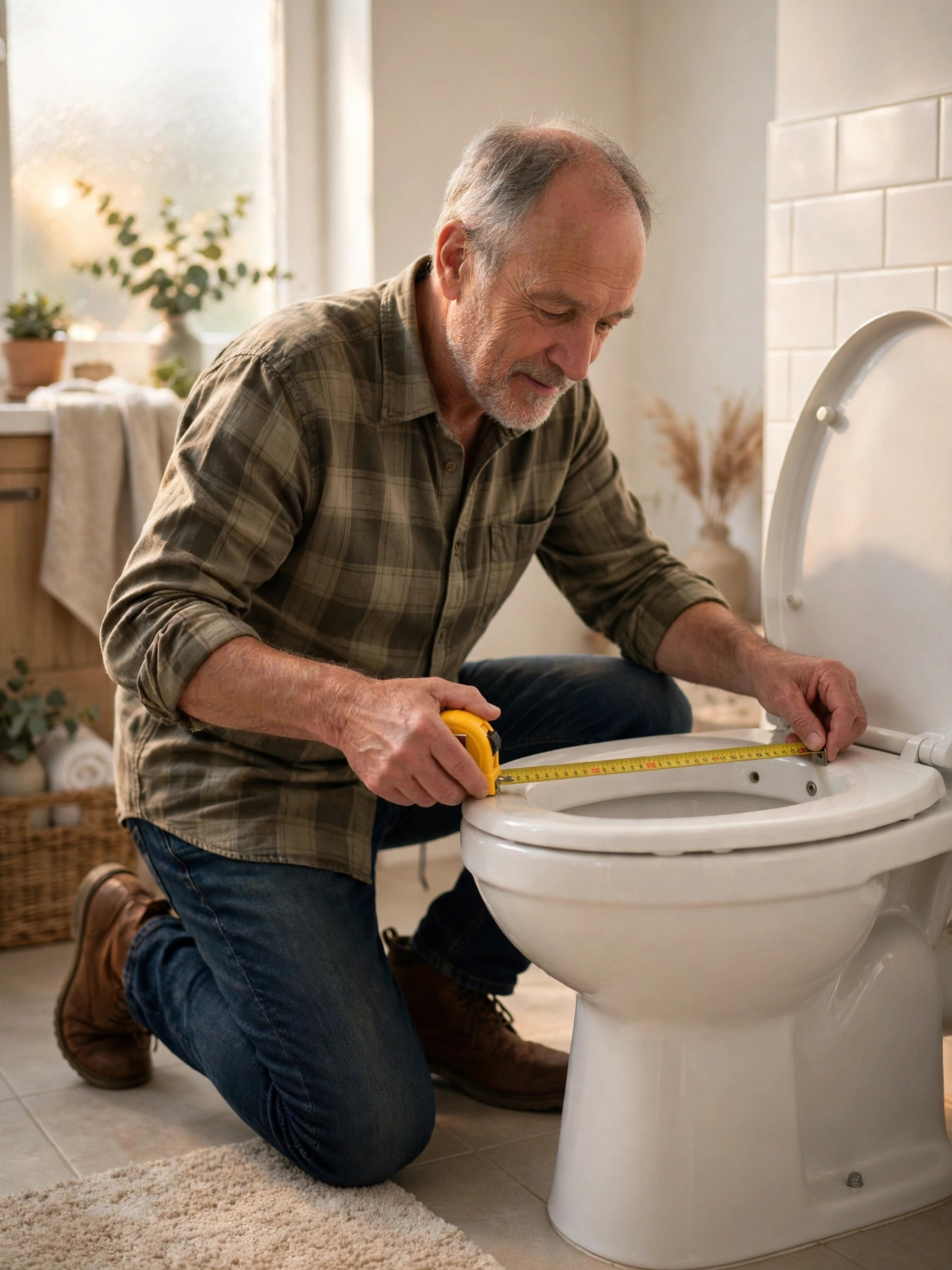
Also measure the space around the toilet and note the weight limit on the product.
Installation and cleaning
Most raised seats install without tools in a few minutes: lift the existing seat, set the raised seat on the bowl, tighten the lock or clamps, and test it.
- Clean the bowl rim first — grime under the clamps can let the seat slip.
- Follow the maker’s instructions — some models sit under your existing seat, others replace it.
- Retighten after the first week — new clamps can settle slightly.
- Keep the original seat if the raised seat is only temporary, for example after surgery.
Cleaning matters more than most people expect: a raised seat has more nooks than a standard seat — the underside of the ring, the clamp mechanism, the joints where arms attach. Wipe it down regularly with a bathroom disinfectant, paying attention to the underside and clamp areas where moisture collects. Smooth, non-porous plastic with few crevices is easiest to keep hygienic, and a hinged or lift-off design lets you remove the seat to clean the bowl. If the seat has a padded top, check that the padding is sealed and waterproof.
Make the whole bathroom safer, not just the toilet
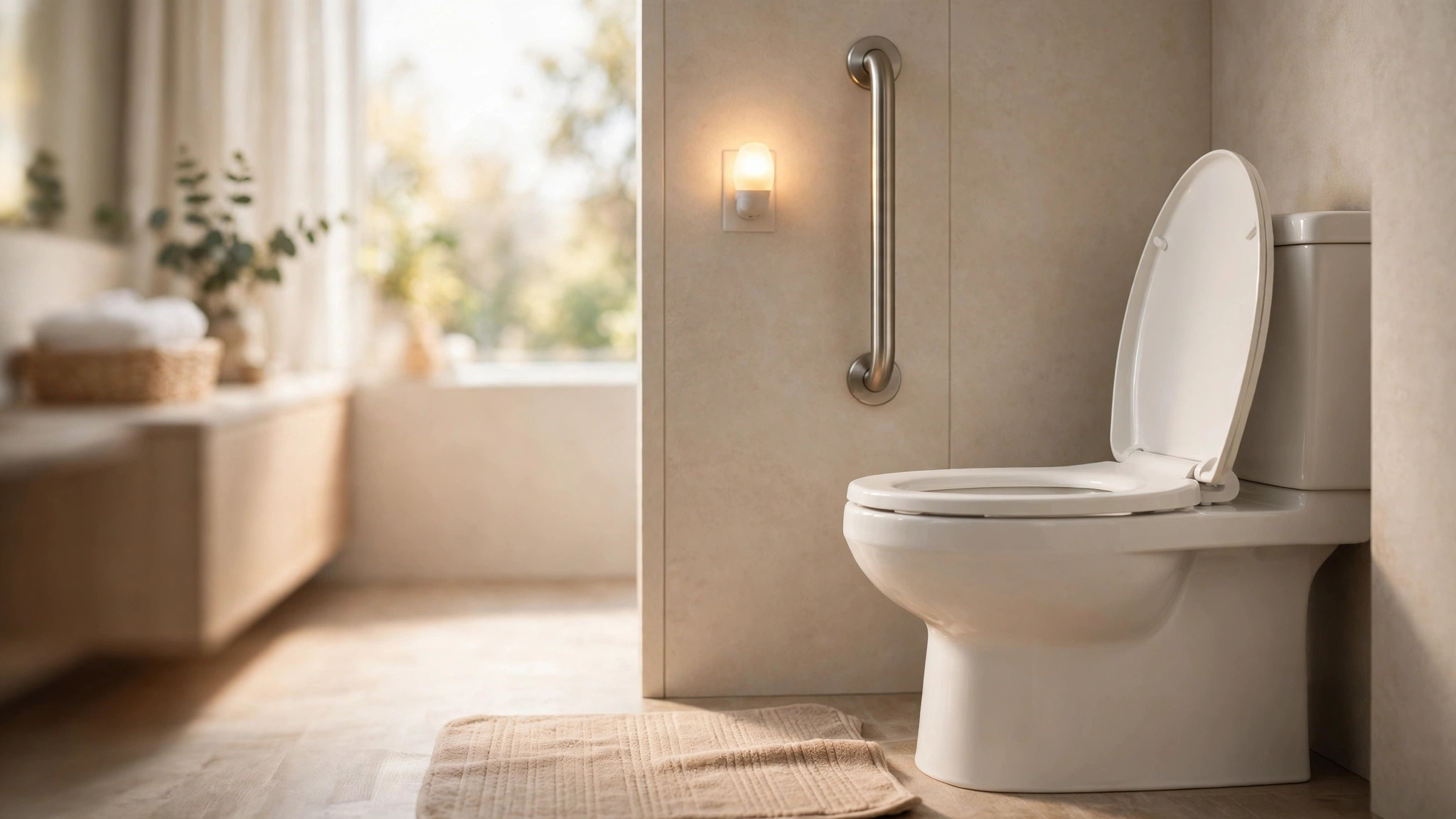
A raised seat works best as part of a small set of changes. The CDC’s home fall-prevention checklist recommends grab bars next to and inside the tub and next to the toilet, non-slip mats on the tub or shower floor, and better lighting. A grab bar beside the toilet gives you something to pull on while the armrests let you push up; a non-slip mat helps on wet floors; and a night light matters, because many falls happen on the way to the toilet after dark. If standing in the shower is also difficult, see our shower chair buying guide. Keep the floor clear, too — towels, laundry baskets, and loose rugs near the toilet are trip hazards.
When to see a doctor
A raised toilet seat is a home aid, not a treatment. Talk to your clinician, or ask for a referral to an occupational therapist, if any of these apply:
- You have fallen in the bathroom, or nearly fallen, more than once — a clinician can check your balance, review your medications, and assess whether you need more than a raised seat.
- Hip or knee pain is getting worse, or new pain does not settle within a few weeks — new or worsening joint pain deserves an assessment, not just a higher seat.
- You are recovering from hip or knee surgery without clear guidance on seat height or hip precautions — an occupational therapist can measure your toilet, recommend the right height, and show you the safest way to sit and stand.
- You often feel dizzy or unsteady when standing up. This can have many causes — blood pressure changes, medication side effects, inner-ear problems — and it is worth checking.
- You need help with everyday tasks that used to be easy, such as dressing or bathing — a sign to ask for a broader assessment of strength, mobility, and home safety.
An occupational therapist is often the best person to ask about bathroom equipment: they can match it to your height and toilet and teach you the safest way to sit and stand.
The bottom line
A raised toilet seat is a small change with an outsized effect: a few extra inches, a stable lock, and armrests to push on can turn the hardest movement in the bathroom into an ordinary one. Measure your bowl first — round or elongated — then choose a height that leaves your hips slightly above your knees, a lock that does not budge, and armrests unless your bathroom is too narrow. Add a grab bar, a non-slip mat, and a night light, and keep the seat clean and tight. If standing up is getting harder despite the equipment, or you have had a fall, bring it up with your clinician — the seat helps the symptom, but the cause still deserves attention.
Sources
- Centers for Disease Control and Prevention, “Check for Safety: A Home Fall Prevention Checklist for Older Adults” (STEADI) — https://www.cdc.gov/steadi/pdf/STEADI-Brochure-CheckForSafety-508.pdf
- Centers for Disease Control and Prevention, “Older Adult Falls Data” — https://www.cdc.gov/falls/data-research/facts-stats/index.html
- Frimley Health NHS Foundation Trust, “Hip Precautions” (patient information, reviewed 2025) — https://www.fhft.nhs.uk/patients-and-visitors/patient-information-library/hip-precautions
- NHS Lanarkshire, “Total Hip Joint Replacement — Information for Patients from Occupational Therapy” (January 2025) — https://www.nhslanarkshire.scot.nhs.uk/download/xs-pil-hipre2-total-hip-joint-replacement-patient-information-download/?wpdmdl=107167&ind=1776090719510&refresh=427ab2ae&filename=XS-PIL.HIPRE2_.25_00151.L-Total-hip-joint-replacement.pdf
- National Institute on Aging, “Falls and Older Adults: Causes and Prevention” — https://www.nia.nih.gov/health/falls-and-falls-prevention/falls-and-older-adults-causes-and-prevention
- Mayo Clinic, “Fall Prevention: Simple Tips to Prevent Falls” — https://www.mayoclinic.org/healthy-lifestyle/healthy-aging/in-depth/fall-prevention/art-20047358
This article is for general information only and is not a substitute for professional medical advice. Talk to your clinician before making changes to your bathroom setup after surgery or injury.