
Are Eggs Bad for Cholesterol After 60? What the Evidence Says
Few foods have been through as many reputation swings as the egg. First it was a breakfast staple. Then it became the villain of the cholesterol scare. Then the guidelines softened, and eggs were welcomed back — only for a big 2019 study to put them back in the hot seat. If you’re over 60 and wondering whether your morning eggs are quietly raising your heart risk, you are not alone, and the confusion is understandable.
Here is the honest situation: the research on eggs and heart disease genuinely disagrees with itself. Rather than picking one side, this article walks you through the strictest study against eggs, the strongest evidence in their defense, and where a reasonable person over 60 lands — with moderation, not a verdict.

The strictest study against eggs: Zhong et al., JAMA 2019
In 2019, researchers led by Victor Zhong published a large analysis in JAMA that got a lot of attention. They pooled individual-level data from six US cohorts — 29,615 adults — and followed them for a median of 17.5 years. This wasn’t a headline-friendly survey; it was a serious piece of epidemiology.
The numbers they reported were striking:
- Each additional 300 mg of dietary cholesterol per day was linked to a 17% higher risk of incident cardiovascular disease (hazard ratio 1.17) and an 18% higher risk of death from any cause (hazard ratio 1.18).
- Each additional half-egg per day was linked to a 6% higher risk of cardiovascular disease (hazard ratio 1.06) and an 8% higher risk of all-cause mortality (hazard ratio 1.08).
These are the kind of numbers that made headlines like “eggs are bad for your heart again.” And on the surface, they look damning.
The fine print most headlines skipped
Two details from the same study matter enormously — and they usually got buried below the headline.
First: it wasn’t really about eggs. When the researchers adjusted their analysis for total dietary cholesterol, the association between eggs specifically and cardiovascular disease became non-significant — meaning it could no longer be distinguished from chance. In plain language: the cholesterol signal came through, but eggs themselves stopped looking like the culprit once total cholesterol from all foods was accounted for. As the authors essentially found, it was cholesterol, not eggs per se, driving the result.
Second: diet was measured once. Participants’ eating habits were captured at a single baseline point — one snapshot meant to stand in for nearly two decades of eating. People change their diets over 17.5 years, sometimes a lot, and a single measurement can’t capture that. The authors acknowledged this limitation, but it is worth keeping in mind when weighing the findings: the exposure was measured once, the outcomes unfolded over many years.
None of this means the study is worthless. It means it is one piece of evidence about dietary cholesterol in general, not a proof that eating eggs causes heart disease.
The counter-evidence: studies that found no harm
On the other side of the debate sits a substantial body of research that found eggs are not the heart risk they were once feared to be.
The BMJ 2020 analysis by Drouin-Chartier and colleagues examined three large US cohorts totaling about 215,000 people, and then added an updated meta-analysis covering roughly 1.72 million participants. Their conclusion: eating one egg per day was not associated with a higher risk of cardiovascular disease in these populations. That is a finding with a lot of statistical weight behind it.
The China Kadoorie Biobank, a prospective study of 512,891 Chinese adults, found that daily egg consumption was actually associated with a lower risk of cardiovascular disease — not higher. Now, eating patterns, genetics, and overall diets differ between populations, so a result in China doesn’t automatically transfer to an American breakfast plate. But it is further evidence that the “eggs = heart danger” story is far from settled.
So we have one rigorous study linking higher dietary cholesterol (from eggs among other sources) to higher risk, and much larger bodies of evidence finding no association — or even a modestly favorable one. This is not a contradiction someone is hiding from you; it is simply what observational nutrition science looks like when honest researchers use different populations, different methods, and different adjustments.
Why the research keeps disagreeing with itself
If the studies feel like they can’t all be true, it helps to understand why nutrition science is so messy — especially around cholesterol and eggs.
- Eggs don’t travel alone. People who eat lots of eggs often eat them with bacon, butter-fried hash browns, and white toast — foods heavy in saturated fat, which is the dietary factor most strongly linked to higher LDL (“bad”) cholesterol. When a study links eggs to heart disease, is it the eggs, or the company they keep? Statistical adjustment tries to separate this out, but it is never perfect.
- Populations differ. The average Chinese adult in the Kadoorie Biobank eats a very different overall diet than the average American. A food’s effect depends on the dietary pattern it sits inside.
- “Adjusted for” changes the answer. As the JAMA 2019 study itself showed, whether eggs look harmful depends on what else the model controls for. Different researchers make different defensible choices, and the conclusions shift.
- One snapshot vs. a lifetime. A single dietary questionnaire cannot capture decades of changing habits.
The takeaway is not that scientists are incompetent — it is that observational studies can show associations, not prove causes, and this particular question sits in the gray zone.
What eggs actually give you

Whatever side of the debate you lean toward, eggs bring genuine nutritional value that matters after 60:
- Protein — about 6 grams per egg, in a form that’s easy to chew and digest. As we wrote in our guide to eating well after 45, getting enough protein is one of the biggest nutrition gaps for older adults.
- Choline — eggs are one of the richest food sources of this nutrient, which supports normal liver function and brain health.
- Lutein and zeaxanthin — antioxidants concentrated in the yolk that support eye health.
How you prepare them matters too. A vegetable omelet cooked in olive oil is a very different proposition, saturated-fat-wise, from eggs fried in butter alongside bacon and sausage. The sides and the cooking fat are part of the decision, not just the egg.
A practical way to think about it after 60
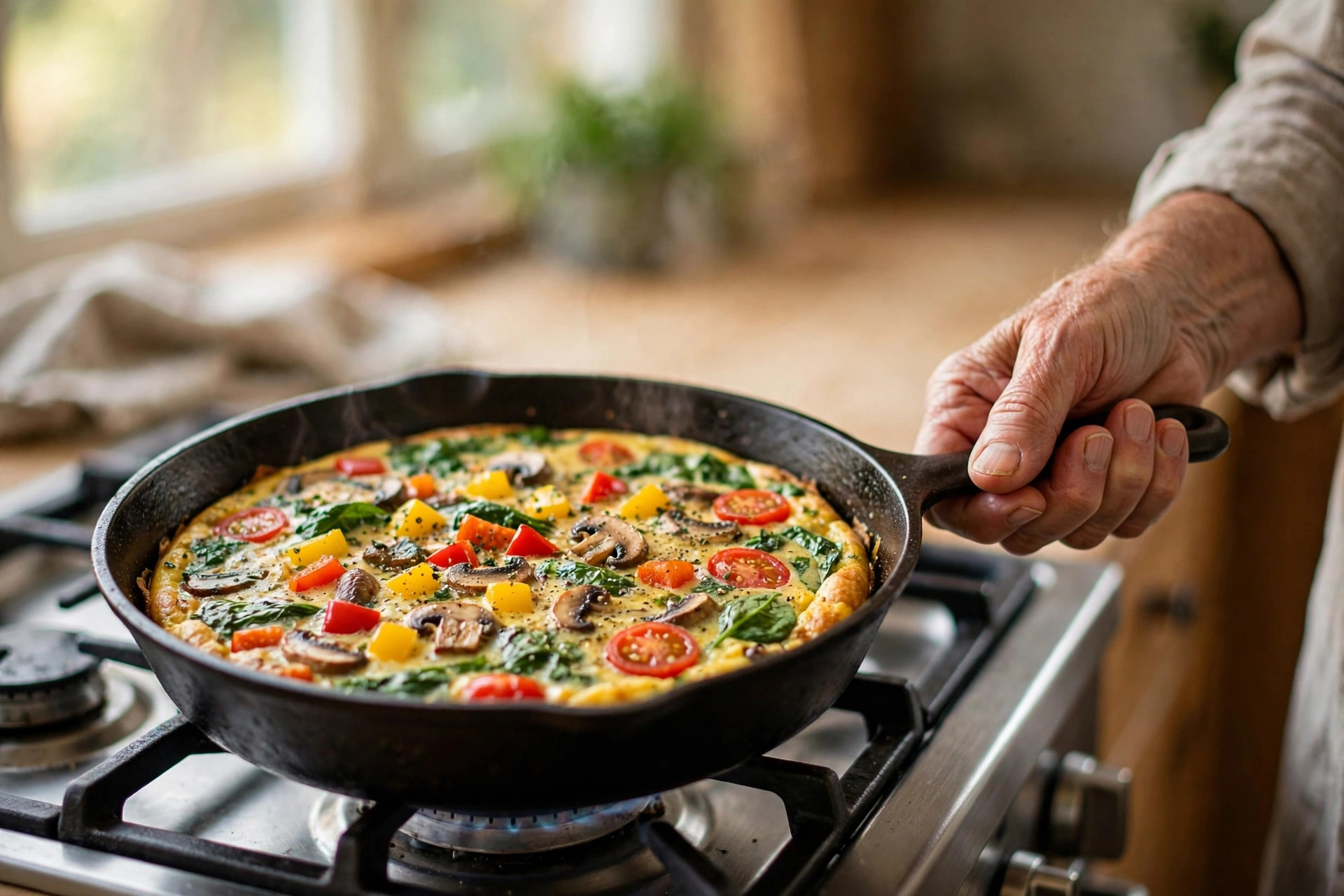
So where does this leave your breakfast? Across the evidence, a reasonable middle ground emerges:
- For most people, a few eggs per week is reasonable. Nothing in the research supports eliminating eggs entirely out of fear, and nothing supports eating them unlimited either.
- Look at the whole pattern. What matters more than any single food is your overall dietary pattern: plenty of vegetables and fiber, moderate saturated fat, whole grains. If your diet is otherwise rich in fiber and low in saturated fat, a few eggs are a small detail — not the headline. Our guide to high-fiber foods that lower cholesterol is a good companion read here.
- Keep the sides in mind. If eggs come with vegetables instead of processed meats and butter, you’ve already improved the equation.
- If you have high cholesterol or diabetes, don’t DIY this. Talk to your clinician about a personal limit. People with these conditions were often analyzed separately or underrepresented in the general-population studies, so their situation deserves individual medical guidance rather than a magazine-style rule.

And if you want to understand what your numbers mean in the first place, start with our explainer on the cholesterol numbers that actually matter after 50.
When to see a doctor
Eggs are a diet question, but cholesterol is a medical one. Talk to your doctor if:
- You’ve been told you have high LDL cholesterol and you’re unsure how diet changes fit with your treatment
- You have diabetes — some studies suggest the egg–heart risk relationship may look different in people with diabetes
- You have a family history of early heart disease (a close relative with heart disease before 55 for men, 65 for women)
- You’re experiencing chest pain, shortness of breath, or unusual fatigue — these need medical evaluation, not a diet tweak
- You’re considering a major change to your diet and you take cholesterol or blood-pressure medication
Your clinician can look at your full lipid panel and your overall risk — not just your breakfast — and give you guidance that actually fits your situation.
The bottom line
The evidence on eggs and cholesterol after 60 is genuinely mixed: one rigorous study linked higher dietary cholesterol to higher risk, while much larger bodies of evidence found no association for a daily egg. The honest conclusion isn’t “eggs are safe” or “eggs are dangerous” — it’s that eggs are one small piece of your dietary pattern, and the pattern matters far more.
For most people over 60, a few eggs a week, prepared simply and eaten alongside vegetables and fiber-rich foods, fits comfortably within a heart-healthy way of eating. If you have high cholesterol or diabetes, that’s a conversation for your doctor — not a headline.
Sources
- Zhong V.W. et al., “Associations of Dietary Cholesterol or Egg Consumption With Incident Cardiovascular Disease and Mortality,” JAMA, 2019 — full text: https://pmc.ncbi.nlm.nih.gov/articles/PMC6439941/ ; abstract: https://jamanetwork.com/journals/jama/article-abstract/2728487
- Plain-language summary of the Zhong et al. findings — https://medicalxpress.com/news/2019-06-cholesterol-eggs-tied-cardiac-disease.html
- Drouin-Chartier J.P. et al., “Egg consumption and risk of cardiovascular disease: three large prospective US cohort studies, systematic review, and updated meta-analysis,” BMJ, 2020
- Qin C. et al., “Associations of egg consumption with cardiovascular disease in a cohort study of 0.5 million Chinese adults,” Heart, 2018 (China Kadoorie Biobank)
- Carson J.A.S. et al., “Dietary Cholesterol and Cardiovascular Risk: A Science Advisory From the American Heart Association,” Circulation, 2019 — https://www.ahajournals.org/doi/10.1161/CIR.0000000000000743
- American Heart Association — dietary cholesterol guidance: https://www.heart.org/en/healthy-living/healthy-eating/eat-smart/nutrition-basics/dietary-cholesterol-and-risk-of-coronary-heart-disease
This article is for informational purposes only and is not a substitute for professional medical advice. Always talk to your doctor before changing your diet.