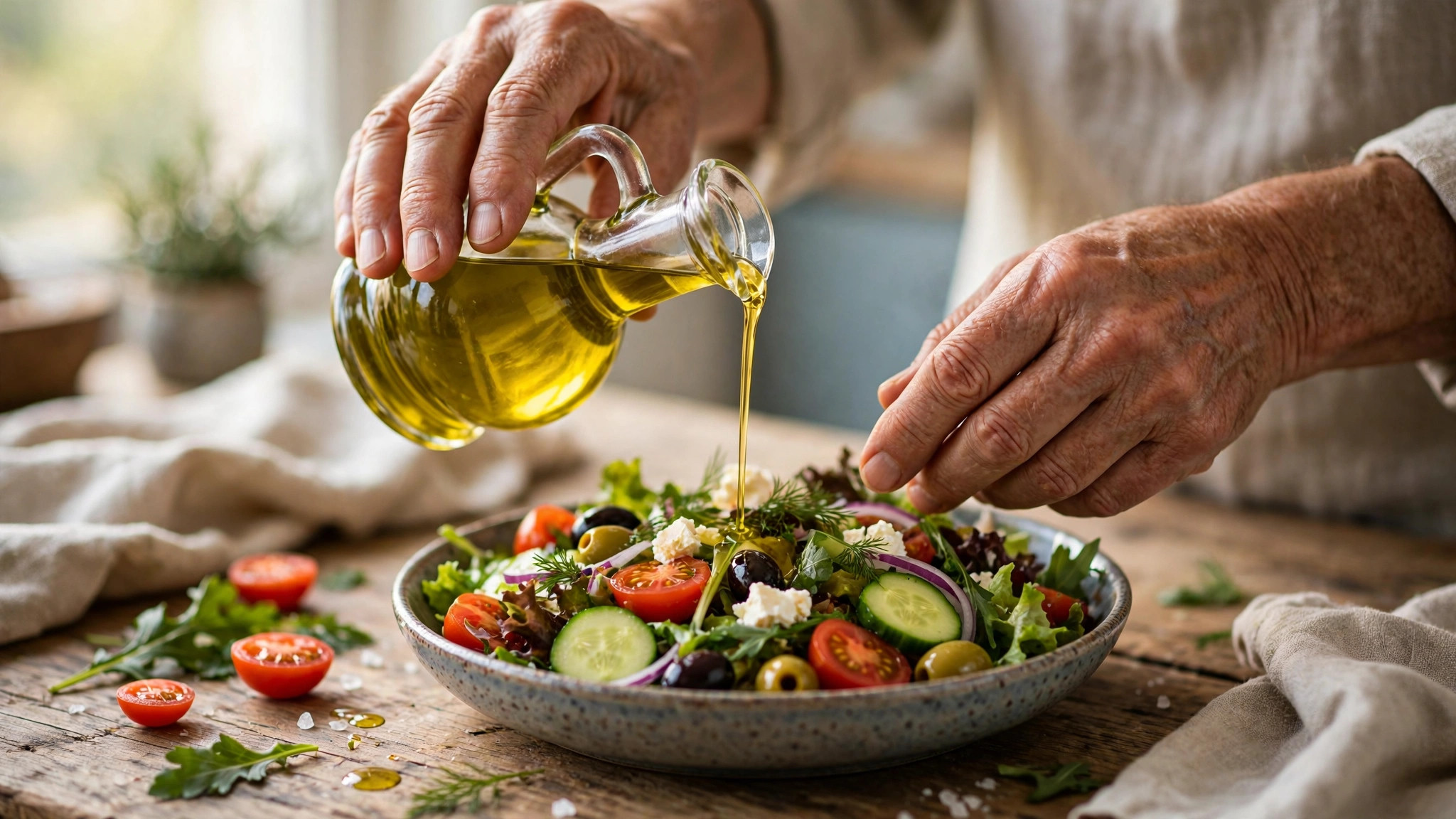
Olive Oil Health Benefits After 50: How Much and Which Type
Olive oil has been called a "healthy fat" for so long that it is easy to stop asking why. For adults over 50, though, the question is worth revisiting — because the evidence has moved beyond tradition and into actual trials. The fat you cook with every day quietly shapes your heart risk, and olive oil, especially the extra-virgin kind, is one of the best-studied options we have.
This guide walks through what makes olive oil different from other cooking fats, what the research actually shows, how much to use each day, which bottle to pick, and how to keep it fresh.
Why olive oil is different from most cooking fats
The biggest difference is the type of fat. About three-quarters of olive oil’s fat is monounsaturated fat — mainly a fatty acid called oleic acid. Most cooking fats are instead rich in saturated fat (butter, lard, coconut oil) or highly processed blends of polyunsaturated fats. The American Heart Association advises replacing saturated fats with unsaturated fats, including monounsaturated fats like those in olive oil, to help manage cholesterol levels.
Olive oil is also mostly unrefined. The good bottles are simply pressed from olives, which means they keep plant compounds — polyphenols like oleocanthal and hydroxytyrosol — that refined oils largely lose during processing. These compounds are the reason extra-virgin olive oil has that peppery bite at the back of your throat.
Extra-virgin vs. refined: which type should you buy?
Walk down any cooking-oil aisle and you will find several grades. Here is what the labels mean:
- Extra-virgin olive oil (EVOO): the least processed grade, mechanically pressed from olives with no heat or chemicals. The most flavor, the most polyphenols, and the most researched for health. Use a dark bottle and expect some price range — suspiciously cheap EVOO is often mislabeled.
- Virgin olive oil: a step down, with minor imperfections; fine but harder to find in US stores.
- "Light" or "pure" olive oil: refined with heat and/or chemicals to remove flavor and impurities. Higher smoke point, but fewer of the polyphenols linked to the health effects. "Light" refers to color and flavor, not calories.
For daily use after 50, extra-virgin is the best-supported choice — nearly all the notable trials used EVOO. Keep a refined olive oil or another high-smoke-point oil around only for the rare very-hot cooking job.
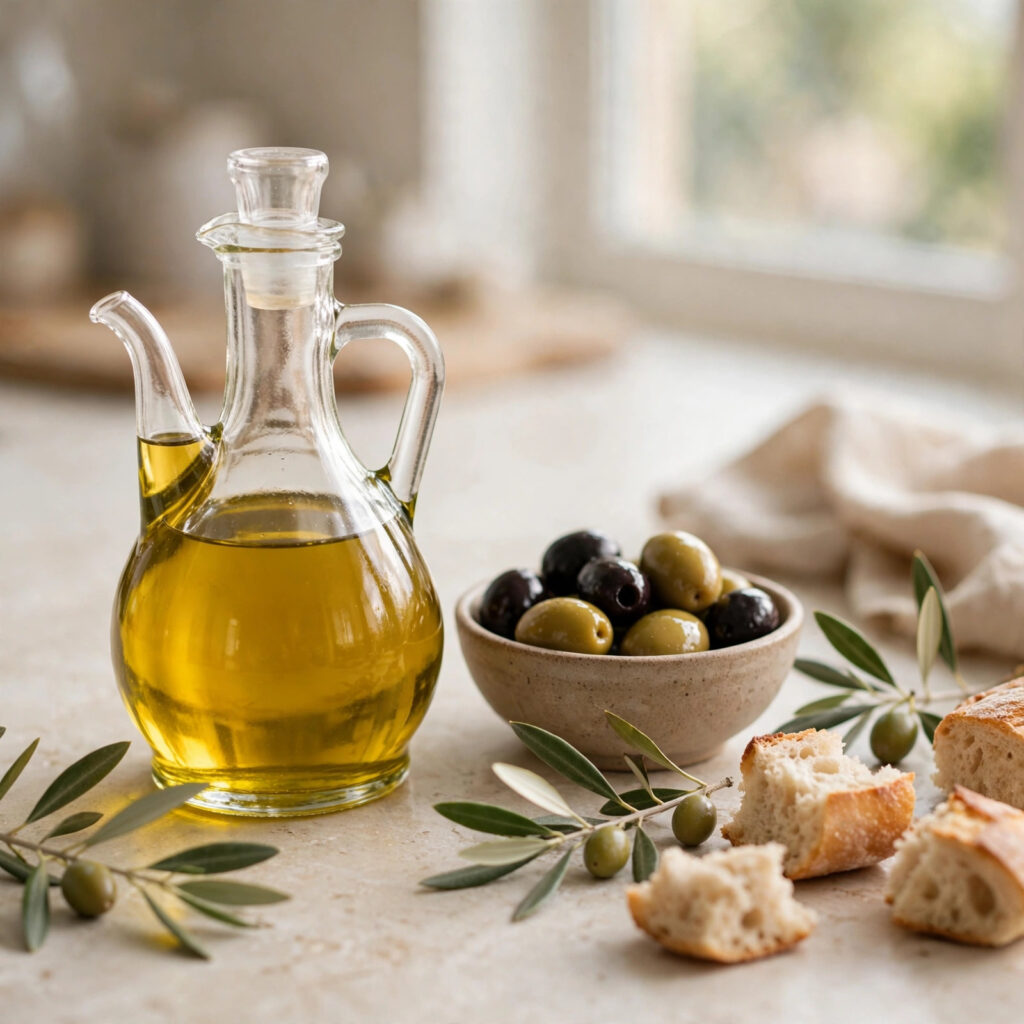
What the research says about the heart
The strongest evidence comes from the PREDIMED trial in Spain. It enrolled about 7,447 men and women aged 55 to 80 who were at high cardiovascular risk but had not yet had a major event. Participants were assigned to one of three groups: a Mediterranean diet supplemented with extra-virgin olive oil (the study supplied roughly a liter of EVOO per week), a Mediterranean diet supplemented with mixed nuts, or a control group given advice to cut dietary fat. After a median follow-up of 4.8 years, the Mediterranean-diet groups had about a 30% lower rate of major cardiovascular events (heart attack, stroke, or cardiovascular death) than the control group. The EVOO-supplemented group reached roughly 50 grams of olive oil a day — around 4 tablespoons.
A few honest caveats. This was a test of a whole dietary pattern, not olive oil alone — you cannot isolate the oil’s effect from the vegetables, fish, and legumes that came with it. And the trial’s history deserves a footnote: randomization was later found to have gone wrong for about a fifth of participants, so the paper was republished in 2018 after reanalysis with the headline result holding.
Still, the PREDIMED result does not stand alone. The FDA, after reviewing the evidence in 2018, allowed a qualified health claim that about 1½ tablespoons (20 grams) a day of high-oleic-acid oils such as olive oil, used in place of fats and oils higher in saturated fat, may reduce the risk of coronary heart disease — with the explicit warning that the evidence is "supportive but not conclusive."
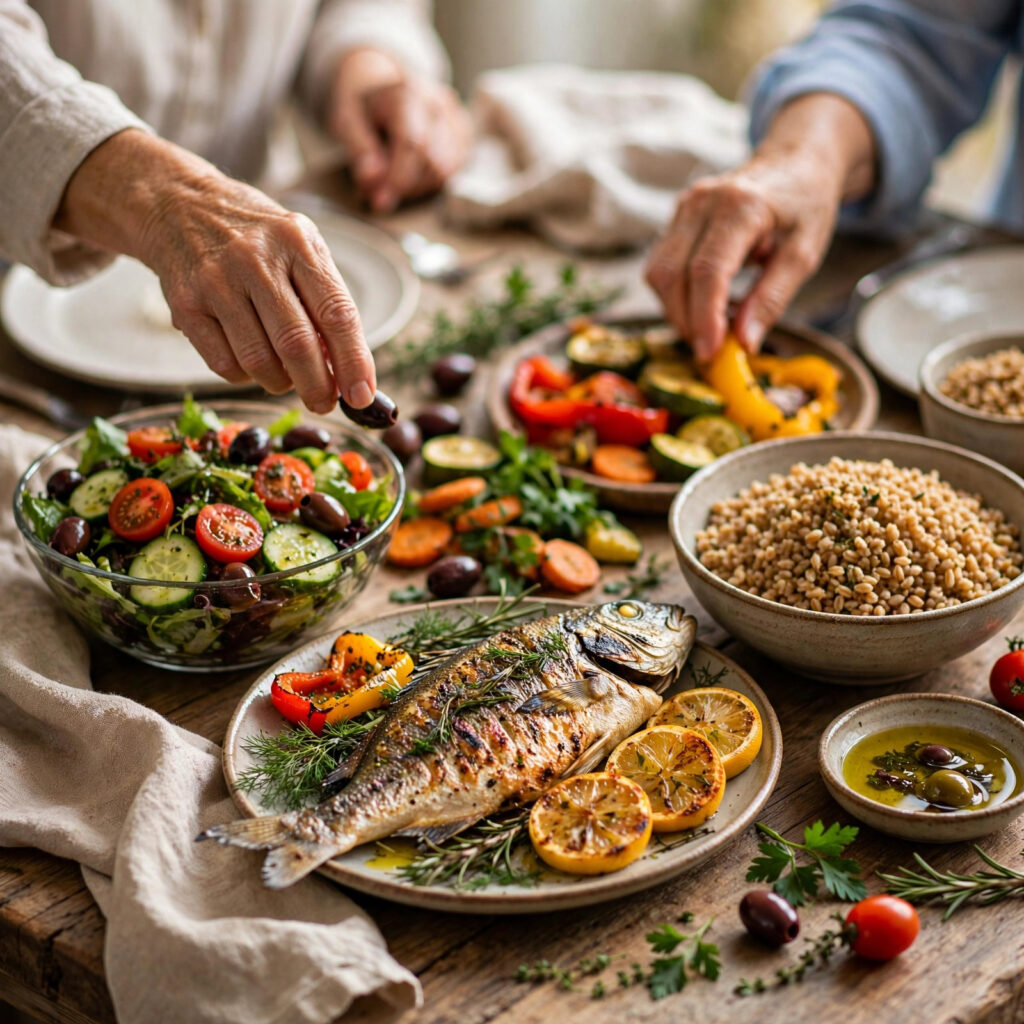
The brain evidence is newer — and encouraging
A 2024 study in JAMA Network Open pooled two large US cohorts totaling more than 92,000 adults and followed them for up to 33 years. People who consumed more than 7 grams of olive oil a day — roughly half a tablespoon — had a 28% lower risk of dying from dementia than those who rarely or never consumed it. The association held even after accounting for overall diet quality, and it remained after adjusting for APOE ε4, the main genetic risk factor for Alzheimer’s. Interestingly, swapping margarine or mayonnaise for olive oil was also linked to lower dementia-related mortality.
Keep perspective: this is observational research. It shows a link, not proof that olive oil itself prevents dementia. But the amount involved — half a tablespoon a day — is easy to reach, and the direction of the evidence lines up with the cardiovascular data.
How much olive oil should you use per day?
There is no official daily requirement for olive oil, but the research gives us practical benchmarks:
- About 1 to 2 tablespoons a day is a sensible floor: it covers the amount linked to lower dementia-related mortality in the observational data and roughly matches the FDA’s qualified health claim.
- Up to 3–4 tablespoons a day is reasonable within a Mediterranean-style eating pattern — that is what the higher-intake groups in PREDIMED reached.
The hard part is the calorie math. A tablespoon of olive oil carries about 120 calories, so four tablespoons adds nearly 500 — half a meal. The rule every serious source agrees on: olive oil should replace other fats, not be added on top of them. Pour it on vegetables instead of melting butter over them; dress salads with it instead of creamy dressing.
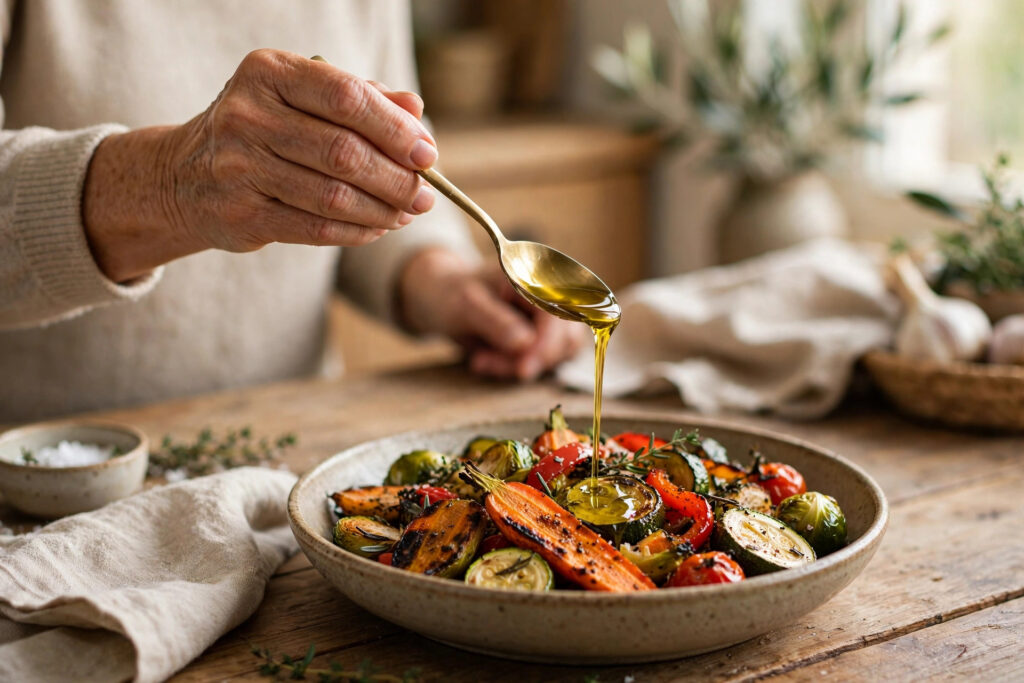
The most valuable swap: butter and margarine
If you change only one thing, make it this. Replace the butter or margarine you cook with and spread on bread with olive oil. Observational research from the large Harvard cohorts found that replacing even about 2 teaspoons of butter or margarine a day with olive oil was linked to lower total and cause-specific mortality. The FDA’s health claim is built on the same logic: the benefit comes from the substitution, because saturated fat from butter raises LDL cholesterol while oleic acid does not.
Practical swaps:
- Fry eggs and sauté vegetables in olive oil instead of butter
- Dip bread in olive oil with a pinch of herbs instead of spreading margarine
- Use olive oil in place of butter in salad dressings and marinades
- In baking, olive oil can replace butter at a ratio of about 3 parts oil to 4 parts butter
Can you cook with extra-virgin olive oil?
Yes — but match the oil to the heat. EVOO’s smoke point sits around 190–210°C (375–410°F), lower than refined oils. It is perfectly fine for sautéing, roasting, and pan-cooking at moderate heat, but if you heat it until it smokes, you lose the flavor and the polyphenols you paid for.
A sensible division of labor:
- Extra-virgin: dressings, drizzling over finished dishes, bread dipping, gentle sautéing
- Refined ("light") olive oil or another high-smoke-point oil: searing, stir-frying at very high heat, deep-frying
Never reuse cooking oil many times over, whatever type it is — repeated heating degrades any fat.
How to store it so it stays fresh
Olive oil is a fresh food, not a pantry heirloom. Light, heat, and air are its enemies:
- Keep it in a dark bottle or a dark cupboard. Clear bottles on a sunny countertop degrade the oil fastest.
- Keep it away from the stove. The cupboard next to the oven feels convenient but bathes the bottle in heat every time you cook.
- Cap it tightly after each use to limit air exposure.
- Use it within a few months of opening — ideally within 3 to 6 months. Buy smaller bottles if you cook for one or two; the large "economy" jug is a false economy if half of it oxidizes before you finish it.
- Don’t refrigerate it routinely — condensation can introduce moisture. A cool, dark cupboard is the standard advice.
If your oil smells waxy, like crayons, or tastes flat and greasy with no pepperiness, it has likely gone stale.

What olive oil is not
A little honesty keeps expectations realistic:
- It does not "clean your arteries" or dissolve plaque.
- It is still 100% fat — pouring it freely over everything will stall weight management.
- No single food, olive oil included, replaces the basics: not smoking, staying active, keeping blood pressure and cholesterol in range, and taking prescribed medications.
When to see a doctor
Olive oil is a food, not a treatment — but talk to your doctor if any of these apply:
- You take blood thinners or blood-pressure medication: large increases in olive oil intake can modestly affect blood pressure, and dietary changes interact with some drugs
- You have diabetes: adding oil without removing other calories can raise blood sugar control difficulty through weight gain
- You are planning a major diet overhaul and have heart disease, kidney disease, or take multiple medications
- You notice chest pain, shortness of breath, or sudden neurological symptoms (face drooping, arm weakness, speech difficulty) — these are emergencies, not dietary questions
Quick answers to common questions
Is olive oil better than coconut oil? For heart health, yes. Coconut oil is over 90% saturated fat and raises LDL cholesterol; olive oil’s monounsaturated fat does not.
What about avocado oil? Avocado oil has a similar monounsaturated profile and a higher smoke point, so it is a reasonable alternative for high-heat cooking. But it lacks olive oil’s large body of trial evidence.
Can I drink a spoonful of olive oil straight? You can, but there is no evidence it is better than using it on food. On food it replaces other fats and helps you absorb fat-soluble vitamins from vegetables — that is the useful part.
Is "cold-pressed" the same as extra-virgin? Not exactly. Extra-virgin has strict chemical and taste standards; "cold-pressed" is a processing claim any grade can carry. Look for "extra-virgin" first.
The bottom line
After 50, extra-virgin olive oil is one of the easiest evidence-backed upgrades in your kitchen: about 1–2 tablespoons a day (up to 4 within a Mediterranean-style pattern), used instead of butter or margarine. The heart evidence is anchored in a real randomized trial, the brain signal is promising but still observational — buy extra-virgin in a dark bottle, keep it cool and dark, and use it within months of opening.
Sources
- American Heart Association, "Monounsaturated Fats" — https://www.heart.org/en/healthy-living/healthy-eating/eat-smart/fats/monounsaturated-fats
- Estruch R. et al., PREDIMED Investigators, "Primary Prevention of Cardiovascular Disease with a Mediterranean Diet Supplemented with Extra-Virgin Olive Oil or Nuts," New England Journal of Medicine 378(25):e34, 2018 (republished) — https://www.nejm.org/doi/full/10.1056/NEJMoa1800389
- U.S. Food and Drug Administration, "FDA Completes Review of Qualified Health Claim Petition for Oleic Acid and the Risk of Coronary Heart Disease" (Nov 19, 2018) — https://WWW.fda.gov/food/hfp-constituent-updates/fda-completes-review-qualified-health-claim-petition-oleic-acid-and-risk-coronary-heart-disease
- Tessier A.-J. et al., "Consumption of Olive Oil and Diet Quality and Risk of Dementia-Related Death," JAMA Network Open 7(5):e2410021, 2024 (summarized by NIA) — https://www.nia.nih.gov/news/olive-oil-consumption-linked-lower-risk-dementia-related-death
- Harvard T.H. Chan School of Public Health / Harvard Health, "Expand your healthy cooking oil choices" — https://www.health.harvard.edu/staying-healthy/expand-your-healthy-cooking-oil-choices
- Guasch-Ferré M. et al., "Consumption of Olive Oil and Risk of Total and Cause-Specific Mortality Among U.S. Adults," Journal of the American College of Cardiology 79(2):101–112, 2022
This article is for informational purposes only and is not a substitute for professional medical advice. Always talk to your doctor before changing your diet.