
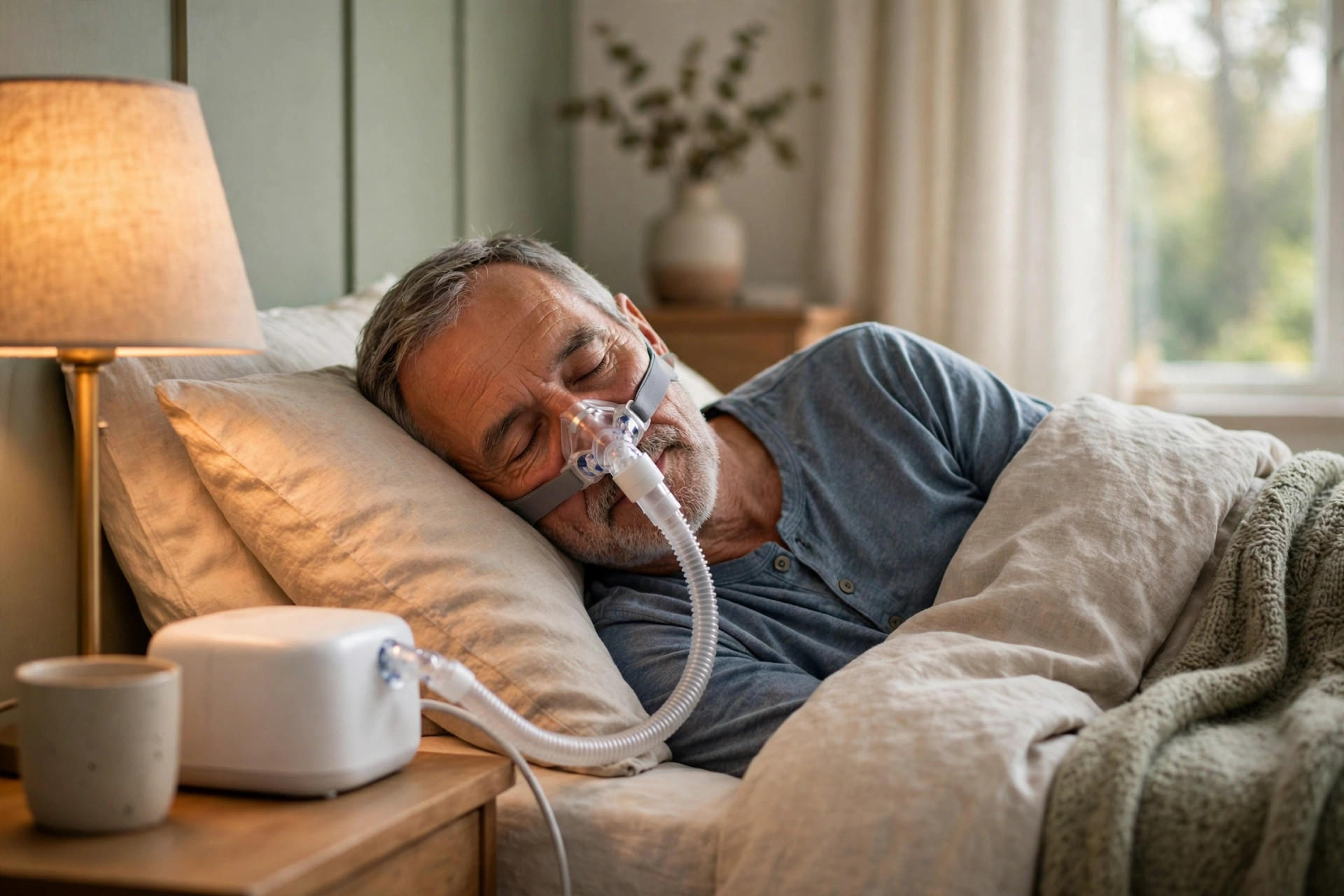
CPAP After 60: Getting Used to Sleep Apnea Treatment
You have the diagnosis and the machine — now there is a mask to wear every night. If your first reaction is “how am I supposed to sleep with this thing on my face?” — you are in very good company. Most people find the first nights strange, and quite a few quietly give up in the first two weeks. That early window matters: how you do in the first month strongly predicts whether you will still use the machine a year or two from now. This guide is for readers already diagnosed and prescribed CPAP. If you are still wondering whether you have it, start with our article on sleep apnea warning signs in older adults.
What the machine is actually doing
CPAP stands for continuous positive airway pressure. While you sleep, the machine sends a gentle stream of pressurised air through a mask, holding your airway open so it does not collapse and pause your breathing. Those pauses are called apneas — the reason you may wake unrefreshed, snore loudly, or nod off during the day. Your pressure was set by your sleep clinician after your sleep study — a prescription, not a preference, so never adjust it yourself or copy someone else’s setting. CPAP only helps while you use it.
What “good” first weeks actually look like
Many people expect to feel transformed after one night. Some do; others feel no different for a week or two, and a few feel more tired at first because the mask keeps waking them. All three are normal. The first nights feel foreign and you may pull the mask off without remembering; by the end of week one you should be finding a comfortable position with the hose. Some need two to four weeks of regular use — at least four hours a night — before noticing a clear benefit, so do not judge it on night three. By the end of the first month, the mask should feel like part of the bedtime routine; if not, tell your clinician at follow-up.
A common benchmark is four hours a night on 70% of nights — the Medicare standard for continued coverage in the US. But that is a floor: benefits keep increasing with each extra hour, so aim for the whole night, every night, including naps.
Getting the mask right
The mask usually decides whether someone sticks with CPAP. There are three main styles. Nasal pillows seal gently at the nostrils — the most minimal option, good if you feel claustrophobic in larger masks, but less suitable if you breathe through your mouth. Nasal masks cover the whole nose and are the usual starting point for most people without nasal obstruction. Full-face masks cover nose and mouth, suit mouth breathers and people with frequent congestion, but are bulkier and more likely to leak.
Fit the mask lying down with the machine running — your face changes shape when you lie flat. Aim for snug, not tight: cranking the straps to stop a leak usually means the mask does not fit, and over-tightening can distort the cushion so it leaks more. Wash your face before bed, as skin oils loosen the seal. Speak up early: Mayo Clinic advises contacting your care team within the first few days if the fit is bad.
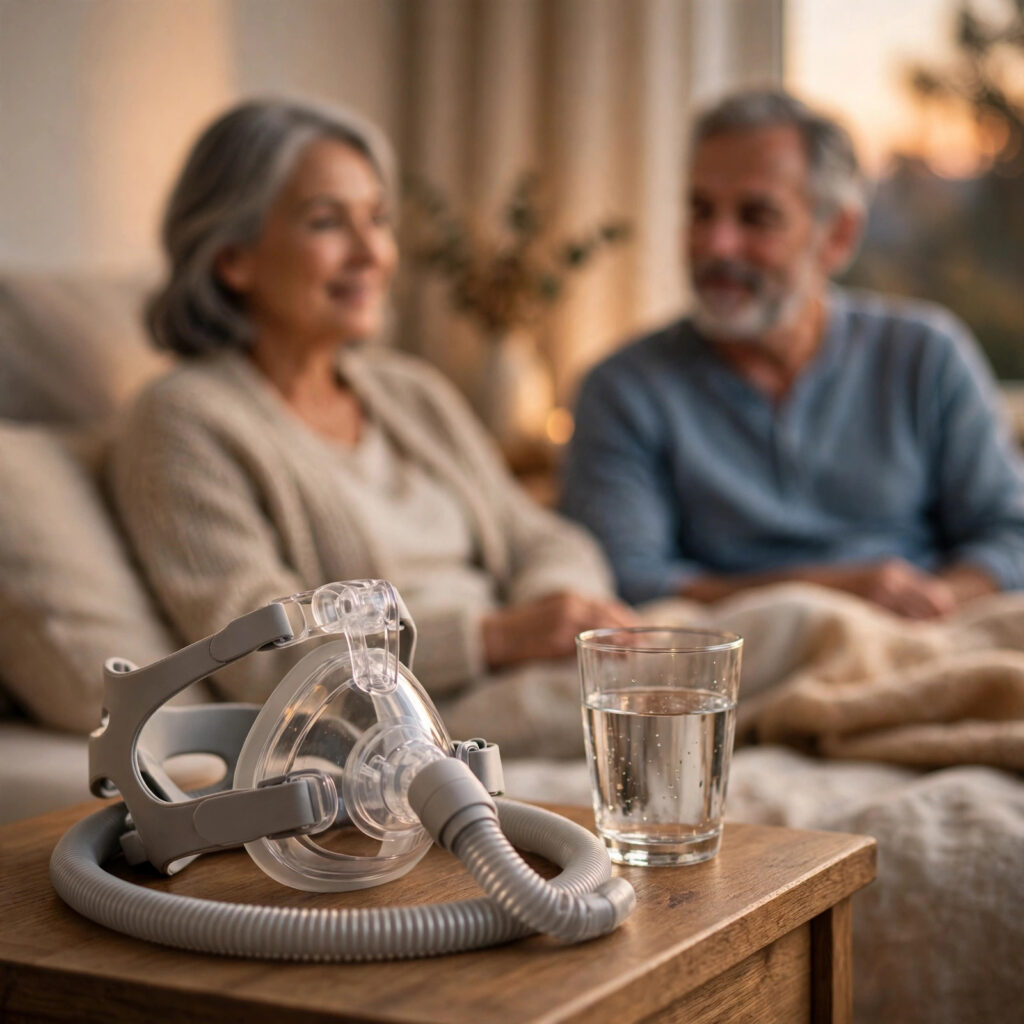
Practise while you are awake
The most useful tip from sleep medicine: wear the mask during the day first. Mayo Clinic recommends starting with just the mask for short periods while awake — watching television, for example — then mask and hose with the machine on, still awake. Once that feels ordinary, use the machine every time you sleep, including naps. Short, relaxed sessions teach your brain the mask is safe and boring — ten or fifteen minutes a day for a few days can ease the first real nights. Use the machine every night, even if only for part of the night at first — skipping nights may delay getting used to it.
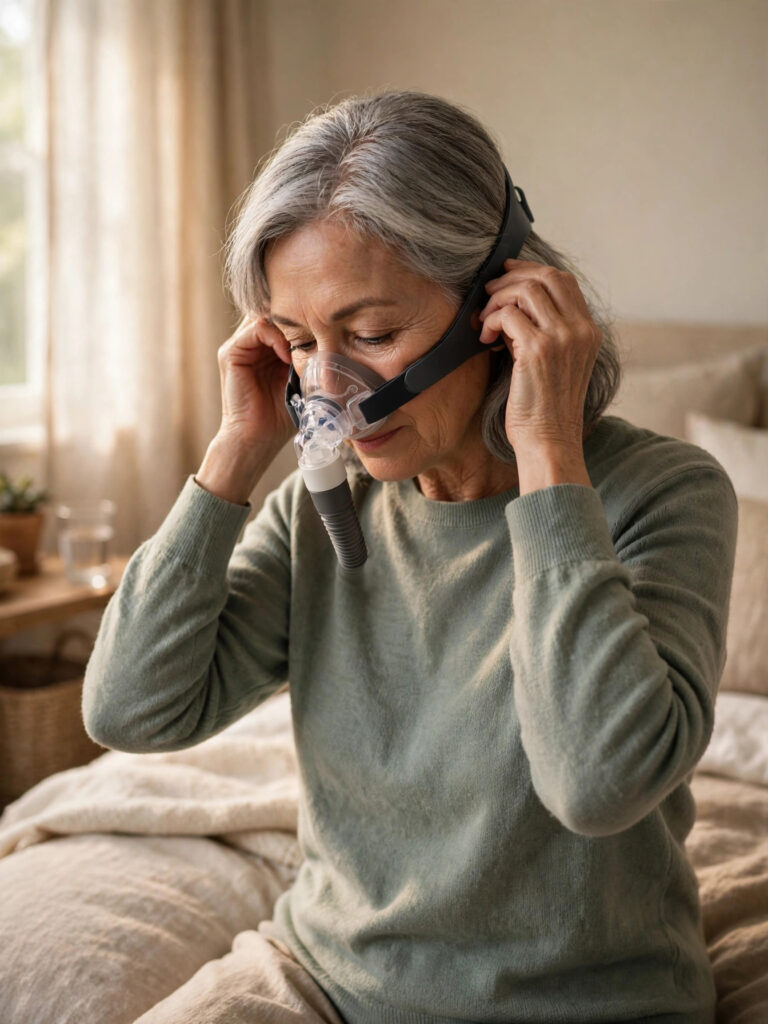
The ramp feature
Many people find full prescribed pressure hard to tolerate at switch-on. Ramp starts the air low and gentle, then gradually increases it to your prescribed level, giving you time to fall asleep. On most machines ramp can be set to off, a fixed period (commonly 5 to 45 minutes), or Auto, where the device detects sleep and then rises to full pressure. Air too strong at the start? Your ramp may be off or too short. Too weak? It may still be running. These are comfort settings you can usually adjust in the menu — your provider can show you how. Pressure relief, a related feature, briefly lowers pressure as you breathe out — ask your clinician whether it is on. Never change the prescribed pressure itself.
Dry mouth, stuffy nose, and other common complaints
Most early CPAP problems have a fix. Dry mouth often means air is escaping through your mouth. A heated humidifier may help — an American Academy of Sleep Medicine review found it reduced dry mouth and throat, nasal congestion, dry nose, and sore throat. If it persists with a nasal mask, ask your provider about a chin strap or a full-face mask. Dry or stuffy nose? Check the fit first — a leak can dry out your nose — then try turning the humidity up. If moisture collects in the mask or tubing (“rainout”), turn it down or ask about heated tubing. Air blowing into your eyes usually means the mask sits too high on the nose bridge; lower it slightly. Leaks often respond to re-seating the cushion: pull the mask gently away, let it re-inflate, and settle it back — a soft or torn cushion will leak however you adjust it. Bloating may ease with the ramp feature; if it persists, tell your clinician.
A cleaning routine you will actually keep
A dirty mask is one of the quiet reasons people quit: it smells, it leaks, and it irritates the skin — yet two minutes each morning and ten once a week covers it. Every morning, wipe the cushion with warm water and a drop of mild, unscented soap (or a CPAP wipe), rinse, and air dry it on a clean towel. Empty the humidifier chamber — never leave water sitting in it all day — and refill at night with distilled water: the CDC recommends distilled or sterile water for devices that turn water into breathable mist, and tap water leaves mineral deposits.
Once a week, wash mask parts, tubing, and chamber in warm water with mild soap, rinse well, and air dry completely. Check the filter too — disposable filters are usually replaced every two to four weeks, or sooner if they look grey. Skip ozone or UV “CPAP cleaner” devices: the FDA says they are not approved or cleared for general CPAP cleaning, and has received reports of asthma attacks, headaches, and breathlessness after ozone-based cleaners were used. Mild soap and warm water is the standard — and it is enough. Wash in the morning, not at bedtime, so parts are dry by evening.

Reading your numbers without obsessing over them
Most machines report hours used, mask leak, and AHI (apnea-hypopnea index) — breathing pauses per hour. Under 5 per hour is widely regarded as well treated. But these numbers are a guide, not a verdict. Two things matter more: the trend over a few weeks, and how you feel — are mornings easier, is daytime drowsiness easing? Do not chase a perfect score by changing your pressure. If the numbers look wrong or you feel worse, ask your sleep clinician to review the machine’s data and adjust the prescription if needed.
Building the routine around the machine
CPAP works best inside a steady routine: the same bedtime and wake time, including weekends, and a cool, dark, quiet bedroom — our guide to the best bedroom temperature for sleep in older adults explains what “cool” means. Avoid alcohol late in the evening: it relaxes the throat muscles and can make apneas worse. Keep the machine at or below mattress level so condensation drains away from you, and give the hose slack to turn over without tugging the mask. Sleep itself changes with age — lighter sleep, earlier waking, more bathroom trips — and CPAP does not change that; see sleep changes after 50 for the wider picture.

When to see a doctor
CPAP is managed at home, but some situations need a clinician promptly. Seek emergency care for chest pain or severe shortness of breath. Contact your sleep clinician or doctor if the mask causes sores, swelling, or a rash that does not clear up; if you develop a persistent cough, wheeze, or fever; if you feel much sleepier than before, or fall asleep while driving; if morning headaches are new or worsening; or if bloating or ear and sinus pain persist despite adjusting the comfort settings. Also seek advice if a month of regular use brings no improvement, and before stopping treatment — a different mask or setting may solve the problem. Tell your doctor about new medicines, and let any surgical team know you use CPAP.
The bottom line
Getting used to CPAP after 60 is rarely a single breakthrough night — it is a few weeks of small adjustments: a mask that fits without being tight, daytime practice, the ramp set so you can fall asleep, a comfortable humidifier level, and a cleaning routine that takes minutes. Most who persist through the first month find the machine fades into the background, and mornings feel like their own again. If the first week feels hard, it usually means something small needs adjusting — call your care team early and give yourself patience.
Sources
- Mayo Clinic, “CPAP machines: Tips for avoiding 10 common problems” — https://www.mayoclinic.org/diseases-conditions/obstructive-sleep-apnea/in-depth/cpap/art-20044164
- Patil SP et al., “Treatment of adult obstructive sleep apnea with positive airway pressure: an American Academy of Sleep Medicine systematic review,” Journal of Clinical Sleep Medicine, 2019 — https://jcsm.aasm.org/doi/10.5664/jcsm.7638
- ResMed, AirSense 11 product page (ramp and humidity guidance) — https://www.resmed.com/en-us/products/cpap/machines/airsense-11/
- NHS Sheffield Children’s Hospital, “Cleaning your CPAP equipment” — https://library.sheffieldchildrens.nhs.uk/cleaning-your-continuous-positive-airway-pressure-cpap-equipment/
- U.S. Food and Drug Administration, “CPAP Machine Cleaning: Ozone, UV Light Products Are Not FDA Approved” — https://www.fda.gov/consumers/consumer-updates/cpap-machine-cleaning-ozone-uv-light-products-are-not-fda-approved
- Centers for Medicare & Medicaid Services, Local Coverage Determination L33718 (adherence: 4+ hours per night on 70% of nights) — https://www.cms.gov/medicare-coverage-database/view/lcd.aspx?lcdid=33718
This article is for general information only and is not medical advice. Talk to your doctor or sleep clinician about your personal treatment needs.