
The Best Bedroom Temperature for Sleep After 60
If you have ever woken at 3 a.m. feeling too warm under the blanket — or, just as often, too chilly to drift back off — you are not imagining it. For adults over 60, bedroom temperature can quietly make or break a night’s rest. And the number on your thermostat may need to be a few degrees warmer than what the standard sleep advice tells you.
For years, the widely quoted guidance for the best bedroom temperature for sleep has been 60–67°F: cool, crisp, and easy on the body’s natural nighttime cooldown. That advice still holds for many younger adults. But a 2023 study that followed 50 older adults in their own homes suggests that after 65, the sweet spot shifts warmer — with the most restful sleep happening right around 70–74°F.
This article walks through what that study actually found, why aging bodies handle nighttime temperature differently, and how to tune your own bedroom for better rest. A note up front: comfort is personal, and no thermostat setting replaces a conversation with a clinician if sleep problems persist.
Why older adults feel nighttime temperature differently
Sleep depends on a small but deliberate drop in core body temperature. About two hours before bedtime, your circadian rhythm starts easing your internal temperature down by a degree or two, and that cooling signal helps tell the brain it is time to wind down. A cool bedroom supports that process — which is why the classic advice leans toward the cool side.
After 60, though, the machinery behind that process runs a little differently. Sweat glands tend to become less active with age, skin thins, and blood vessels may not narrow or widen as efficiently as they once did. The result is a narrower comfort window: an older adult can feel too cold when a younger person feels perfectly comfortable, and overheating can arrive faster once the blanket comes off and back on again.
This is also why temperature troubles feed so easily into the broader pattern of sleep changes with age. When the room is too warm, heart rate can tick up and sleep becomes lighter and more fragmented. When it is too cool, muscles stay tense, joint stiffness can flare, and it takes longer to fall asleep in the first place. For many people over 60, finding the middle ground matters more than it ever did.
What the Boston study actually found
The study behind the 70–74°F headline was led by Amir Baniassadi, PhD, of the Hinda and Arthur Marcus Institute for Aging Research (part of Hebrew SeniorLife) together with Harvard Medical School, and published in 2023 in the journal Science of the Total Environment.
Instead of a sleep lab, the researchers followed 50 community-dwelling adults aged 65 and older in the Boston area in their own homes, from 2021 through 2023. Each participant wore a sleep-tracking ring linked to a smartphone and had environmental sensors installed in the bedroom. In total, the team collected nearly 11,000 person-nights of sleep and temperature data — and controlled for other factors that could skew the results.
Three findings stood out:
-
The sweet spot was 68–77°F (20–25°C). Within that range, sleep was “most efficient and restful.” Zooming in further, the lead author said “the real peak of the sleep — where it is most restful — is within the 70 to 74 range.”
-
Warmer than that, sleep efficiency slipped measurably. As nighttime temperature rose from 77°F toward 86°F (25°C to 30°C), sleep efficiency dropped by 5–10%. Sleep efficiency is the share of time in bed actually spent asleep rather than awake or restless — so for someone already dealing with fragmented sleep, those lost minutes add up.
-
Colder than that, sleep suffered too. Sleep efficiency also fell when bedroom temperature dropped below 68°F. The relationship was nonlinear: too warm and too cool both cost rest, with a comfortable middle in between.
The researchers also found wide variation between individuals, so their takeaway emphasized personalization: use the 70–74°F range as a starting point, not a prescription.
A word of caution: this was one observational study of 50 people in a single city, showing associations rather than proof of cause and effect. Treat it as a useful clue, not a diagnosis.
The 60–67°F advice vs. the 70–74°F finding
So why does the classic guidance say 60–67°F while the older-adult study points to 70–74°F? The short answer is that most sleep-temperature guidance — including from the Cleveland Clinic and the Sleep Foundation, which commonly cite 60–67°F for adults — was developed around younger and middle-aged sleepers, whose thermoregulation is more robust.
For older adults, weaker thermoregulation appears to shift the comfortable zone upward. Independent sleep specialists commenting on the study noted that aging bodies struggle more to conserve warmth, so a room that feels comfortably cool to a 40-year-old can feel genuinely chilly to a 70-year-old — and chill is itself a sleep disruptor.
None of this invalidates the general-adult advice; it simply means the “right” temperature has an age dimension, and your personal comfort should drive the thermostat. Think of 70–74°F as the evidence-backed starting range for adults 65 and older, and then adjust a degree or two toward what your body tells you.
Practical tips: tuning your bedroom for better sleep
Here is how to put the science to work without overthinking it.
Start at 70–74°F and adjust toward your own comfort
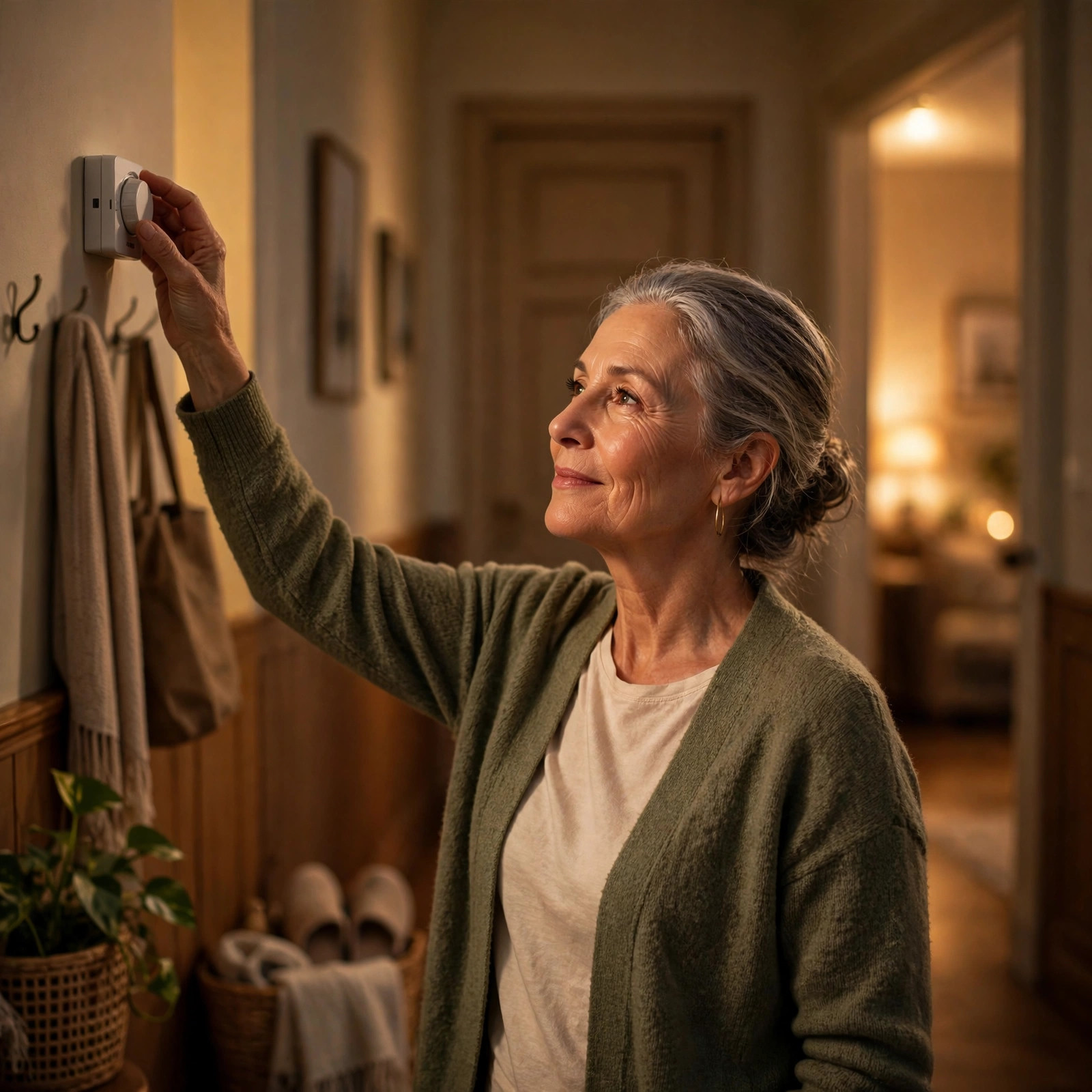
Set your thermostat somewhere in the 70–74°F range for a few nights and pay attention to how you feel — not just at bedtime, when you are still warm from the day, but in the small hours, when the body’s core temperature is at its lowest. If you wake chilly, nudge it up a degree; if you wake sweating, nudge it down. Keep changes small: a degree or two is usually enough to notice a difference.
On hot nights, cool the sleeper, not just the room
When summer nights push the bedroom above the comfort zone, a few low-effort moves may help:
- Run a fan to keep air moving — moving air helps sweat evaporate and can make a warm room feel several degrees cooler.
- Switch to light, breathable bedding: a cotton sheet plus a light blanket you can push aside beats one heavy comforter.
- Take a lukewarm shower before bed. The gentle drop in body temperature afterward supports the natural nighttime cooling signal.
- Watch out for heat-trapping mattresses. Memory foam in particular can reflect body heat back at you all night.
These are the same kinds of evening habits that protect sleep in general — a cooler bedroom works best alongside a consistent wind-down routine.

On cold nights, layer bedding instead of overheating the room
If the bedroom dips below 68°F, adding layers around the sleeper is usually more comfortable than cranking the whole house’s heat. A throw at the foot of the bed gives you a quick adjustment lever at 3 a.m. — pull it up, push it down. (If you use a weighted blanket, check the safety basics for older adults first, since extra weight is not right for everyone.)
Warm socks can also make a surprising difference: warming the hands and feet helps blood vessels dilate, which actually supports the core-temperature drop that initiates sleep.
Keep the thermostat consistent overnight
One of the quieter lessons from the research is consistency. A steady temperature supports the circadian rhythm’s cooling arc; a “thermal seesaw” — the heat blasting on, then off, then on again — can nudge a light sleeper awake just as effectively as a too-warm room. If your thermostat has a sleep schedule, use it: set the night range once and let it hold, rather than swinging wide.
A small room thermometer at pillow height is a cheap reality check. The thermostat in the hallway may read 72°F while the corner of the bedroom where you actually sleep runs a degree or two off — and it is the air around your bed that matters.
Personalize, don’t chase perfection
Here is the reassurance worth repeating: there is no magic number. The Boston study itself found wide individual variation, and the researchers’ clearest message was to personalize. Some 68-year-olds sleep beautifully at 68°F under a down comforter; others need 74°F and a fan. Health conditions, medications (some affect heat tolerance or sweating), bedding, humidity, and even how warm your partner runs all shift the target.
Treat 70–74°F as a well-researched starting line, run a short experiment, and land where your own sleep feels deepest. Comfort is the outcome you are optimizing — not the thermostat display.
If you share a bed with someone whose temperature needs run opposite to yours, separate bedding layers — or even separate blankets — resolve more thermostat arguments than any study ever will.

When to see a doctor
Temperature tuning helps with comfort, but it cannot fix medical sleep disorders — and it should not be asked to. Talk with a clinician if you experience any of the following:
- Trouble falling or staying asleep three or more nights a week for a month or longer
- Loud snoring, gasping, or pauses in breathing during sleep (possible sleep apnea)
- Daytime sleepiness that interferes with daily activities or driving
- Restless legs, frequent nighttime urination, or chronic pain that keeps waking you
- Any new or worsening sleep problem that started after a medication change
Persistent insomnia and sleep apnea are common after 60 and highly treatable — but they need proper evaluation, not a thermostat tweak.
Sources
- Baniassadi, A. et al. (2023). “Nighttime ambient temperature and sleep in community-dwelling older adults.” Science of the Total Environment. https://pmc.ncbi.nlm.nih.gov/articles/PMC10529213/
- WebMD. “For Older Adults, Best Sleep Temp is 70-74 Degrees: Study.” September 15, 2023. https://webmd.com/sleep-disorders/news/20230915/cm/older-adults-best-sleep-temp-study
- Medical Xpress. “Restful sleep for older adults depends on nighttime temperature.” August 2023. https://medicalxpress.com/news/2023-08-restful-older-adults-nighttime-temperature.html
- Cleveland Clinic. “What Is the Ideal Sleeping Temperature for My Bedroom?” https://health.clevelandclinic.org/what-is-the-ideal-sleeping-temperature-for-my-bedroom
- Sleep Foundation. “Tips for Coping With Shift Work Disorder.” (Notes 60–67°F as the generally recommended bedroom range for most sleepers.) https://www.sleepfoundation.org/shift-work-disorder/tips/healthy-habits
This article is for general information only and is not medical advice. If you have persistent sleep problems or a health condition, talk with your own clinician.