When to Get a Bone Density Test (DEXA Scan): The 2025 Guide
Few health screenings cause as much quiet confusion as the bone density test. You hear about it at a checkup, a friend mentions her “T-score,” and suddenly you’re wondering: Do I need one? Am I too young? Too late? What happens during the scan — and what will the results actually tell me?
You’re not alone in asking. Bone thinning is almost entirely silent until a fracture happens, which is exactly why screening exists: to catch bone loss early enough that you can do something about it. This guide walks through the current (January 2025) U.S. screening recommendations, who should get tested and when, what a DEXA scan feels like, and how to read your T-score — plainly, and without alarm.
One important note before we start: this is general guidance about screening, not a diagnosis and not a prescription. Screening schedules differ by country and by personal risk, so treat this as background for a conversation with your own clinician.
Who Should Get Screened — and When
The most influential set of recommendations in the United States comes from the U.S. Preventive Services Task Force (USPSTF), which updated its osteoporosis screening guidance in January 2025 (published in JAMA, PMID 39808425). Here’s the short version:
Women 65 and older: The USPSTF recommends routine screening for osteoporosis (a Grade B recommendation — meaning there’s moderate to high certainty the benefit is worth it). Age 65 is the universal starting line for women at average risk.
Postmenopausal women under 65: Screening is also recommended if you carry at least one risk factor (more on those below). The Task Force suggests clinicians use a clinical risk assessment tool first — such as the FRAX fracture-risk calculator — to decide who among younger postmenopausal women should get a DXA scan.
Men: Here the science is honest about its limits. The USPSTF found the evidence insufficient to recommend for or against screening in men (an “I statement”). That doesn’t mean men don’t get osteoporosis — they do. It means the research isn’t yet solid enough for a blanket recommendation. Other organizations fill the gap: the Bone Health and Osteoporosis Foundation recommends screening all men starting at age 70, and many clinicians discuss testing with men ages 50–69 who have risk factors. If you’re a man in that group, this is a conversation to have with your doctor, not a reason to skip it.
Anyone with a warning sign: Regardless of age, a fracture from minor impact — a fall from standing height, a bump that shouldn’t have broken anything — is a red flag that deserves evaluation. So is long-term steroid (corticosteroid) use, which accelerates bone loss. These situations warrant a scan discussion at any age.
It’s also worth knowing that other expert bodies set slightly different lines. The American Academy of Family Physicians recommends against routine DXA in women under 65 and men under 70 who have no risk factors. These differences are normal in medicine — they reflect different readings of the same evidence. Your clinician knows which guidance fits your situation and your country’s practice.
Know Your Risk Factors
Risk factors are the second half of the screening equation. The USPSTF specifically lists these:
- Low body weight. Smaller frames mean less bone to begin with.
- A parent who broke a hip. Family history, especially a parental hip fracture, is one of the strongest predictors.
- Smoking. Tobacco is linked to lower bone density and higher fracture risk.
- Heavy alcohol use. Excessive drinking is linked to weaker bones and more falls.
Other commonly cited risk factors include prior fractures, rheumatoid arthritis, certain medications (long-term corticosteroids, some cancer therapies, seizure medications), early menopause, low calcium or vitamin D intake, and prolonged inactivity. You don’t need to memorize this list — when your clinician runs a risk assessment tool like FRAX, these are the questions it asks.
What a DEXA Scan Is Actually Like
“Bone density test” sounds intimidating. In practice, it’s one of the most uneventful medical tests you’ll ever have.
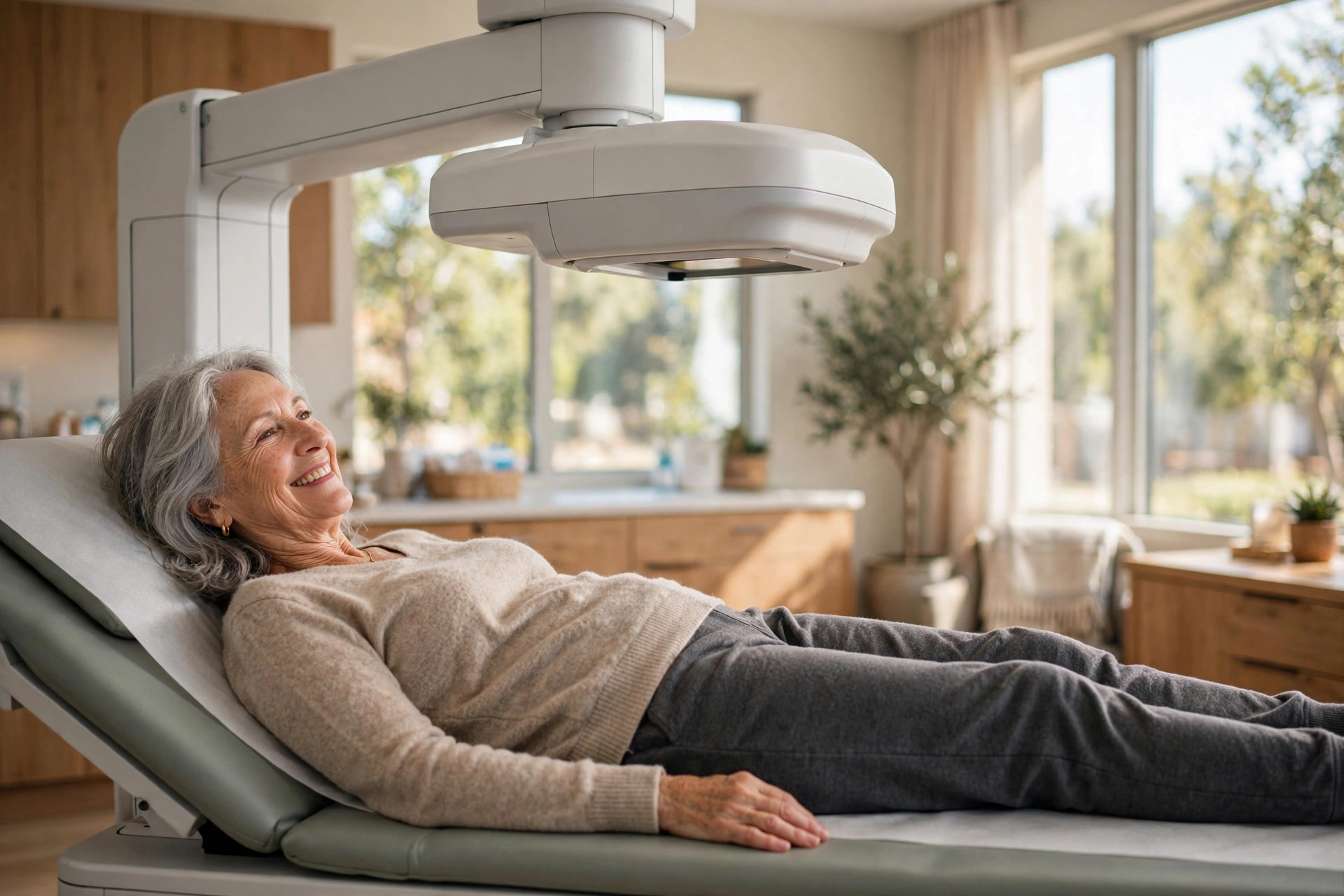
The standard test is called central DXA (dual-energy X-ray absorptiometry). It’s like an X-ray: a large, flat scanning arm passes over your body while you lie still on a padded table, fully clothed. It measures your hip and your lower spine — the sites most vulnerable to fractures. It uses a very small amount of ionizing radiation, far less than a standard chest X-ray. There are no needles, no enclosures, no contrast dye, and nothing hurts. Most scans take about 10 to 20 minutes, and you can go straight back to your day afterward.
You may be asked to skip calcium supplements for about 24 hours before the scan (calcium pills can show up on the image), and to wear clothing without metal zippers or buttons. That’s usually the full extent of preparation.
T-Scores Explained: What Your Results Mean
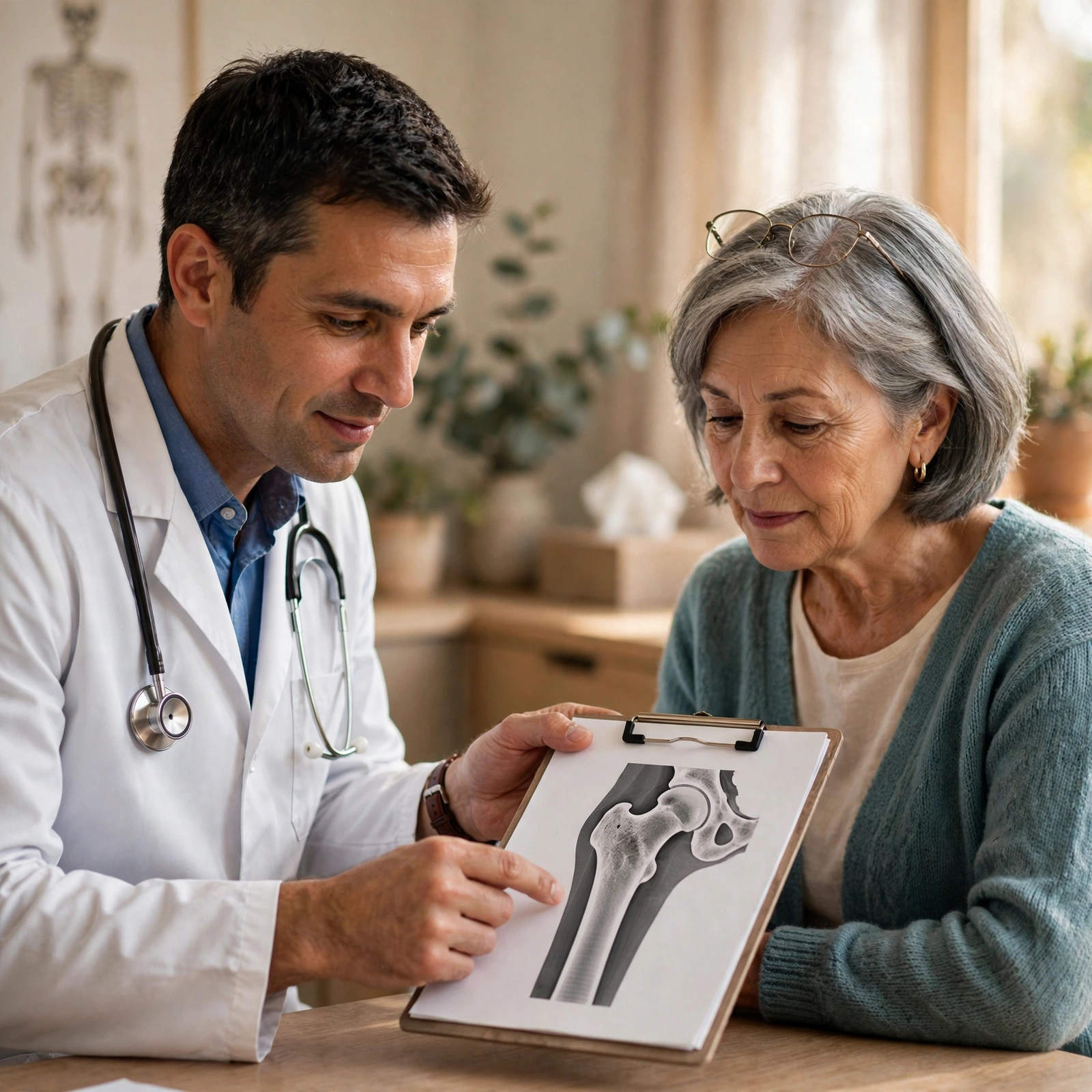
Your scan report will include a T-score. For postmenopausal women and men age 50 and older, the T-score compares your bone density to that of a healthy young adult of the same sex. Think of it as a report card measured against bones at their strongest.
The National Institute of Arthritis and Musculoskeletal and Skin Diseases (NIAMS) gives these ranges:
- −1.0 or higher: healthy. Your bone density is in the normal range.
- −1.0 to −2.5: low bone mass (osteopenia). Your bones are thinner than ideal, though not yet in the osteoporosis range. This is a signal to pay attention — not a verdict.
- −2.5 or lower: osteoporosis. Your bones are significantly less dense, and your fracture risk is higher. This is when clinicians most often discuss treatment options.
If you’re premenopausal or under 50, you’ll get a Z-score instead, which compares your bone density to people your own age, sex, and size. A low Z-score often prompts a search for an underlying cause rather than an osteoporosis label.
As a rough sense of scale: fracture risk rises roughly 1.5 to 2 times with each one-point drop in T-score. So a T-score of −2.5 carries meaningfully more risk than a score of −1.0. Your clinician will put that number in context rather than treating it in isolation — which brings us to an important point.
Why Your T-Score Isn’t the Whole Story
Here’s a fact that surprises most people: the majority of fragility fractures happen in people whose T-score is above the osteoporosis cutoff — in the osteopenia or even normal range. Bones break for many reasons, and density is only one of them.
That’s exactly why clinicians don’t treat the number alone. They combine the scan with a fracture-risk assessment — most commonly FRAX, a tool from the World Health Organization that estimates your 10-year probability of a major fracture using your T-score plus your age, weight, smoking status, family history, and other risk factors. FRAX is the tool the USPSTF points to for deciding which postmenopausal women under 65 need a scan in the first place.
This combined approach also answers the “when should I repeat it?” question. Cohort studies have found that repeating bone density scans every 4 to 8 years did not meaningfully improve fracture prediction over the first scan plus risk factors. So there’s no universal re-scan schedule — your clinician sets the interval based on your results and your risk profile. A repeat scan is most useful when it would change a treatment decision, such as monitoring whether therapy is working.
The takeaway: your T-score is a valuable data point, not a diagnosis of your future. Never let a single number become a verdict — and never let a “normal” result lull you into ignoring the habits that keep bones strong.
Small Habits That Support Your Bones
A screening guide wouldn’t be complete without the short version of what protects bones. These are the lifestyle factors with the strongest evidence behind them:

- Get enough calcium and vitamin D from food. Dairy, leafy greens, fortified foods, and fatty fish are the usual sources. (For a fuller rundown, see our guide to calcium-rich foods after 50.)
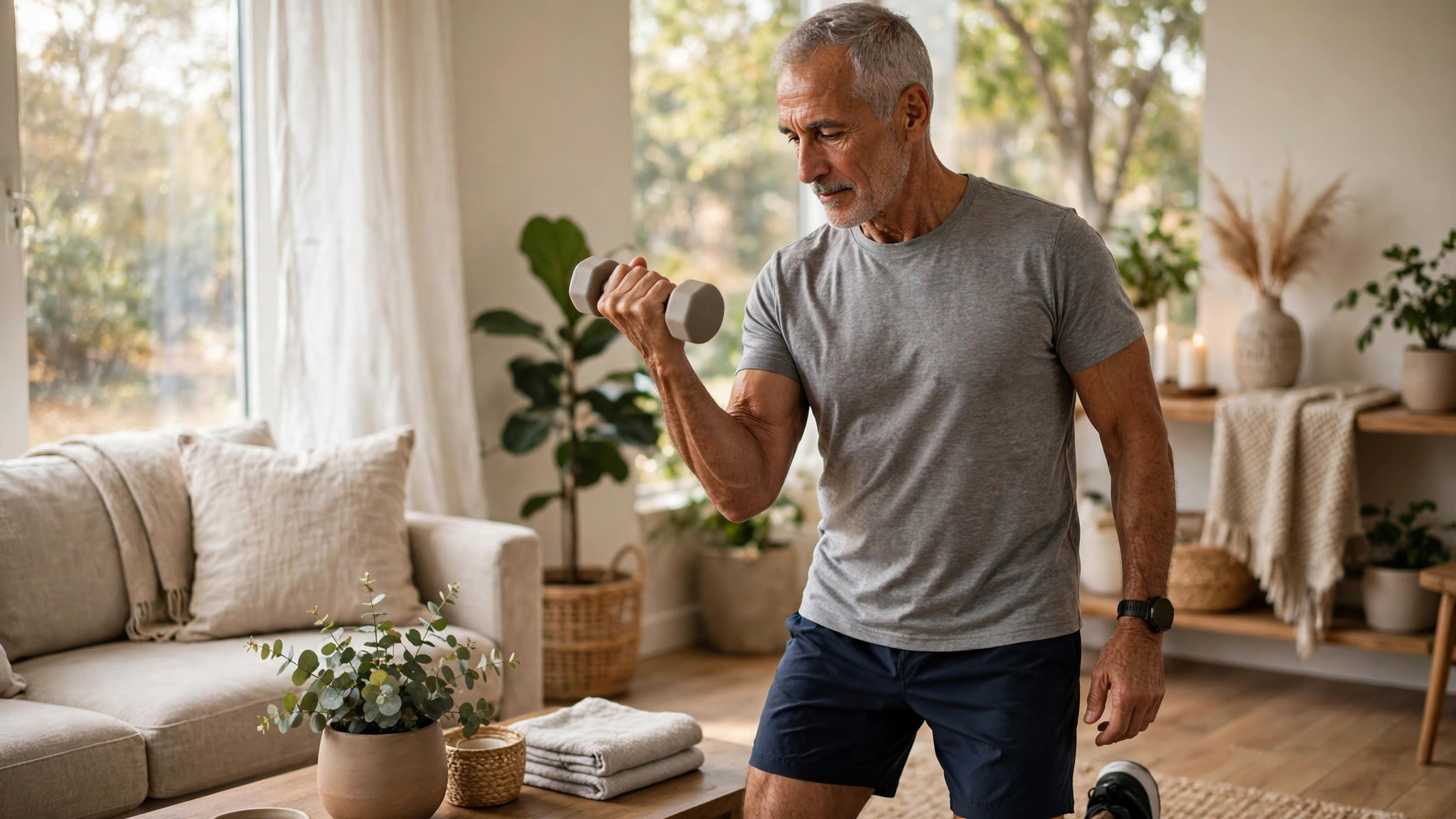
- Do progressive resistance exercise. Lifting, pressing, and pulling against resistance is linked to better bone density than walking alone. Start light and build up — here’s how to begin with strength training at home.
- Quit smoking and limit alcohol. Both are directly linked to weaker bones and higher fracture risk.
- Work on balance. Many fractures start as falls, so balance exercises and fall-proofing your home matter as much as bone density itself.
The details of each of these live in the linked articles above — this guide stays focused on screening timing. For the bigger picture of aging well, see our roundup of science-backed healthy aging habits.

When to See a Doctor
Book a conversation with your clinician if any of these apply:
- You’re a woman approaching or past 65 and have never had a bone density scan.
- You’re a postmenopausal woman under 65 with one or more risk factors (low body weight, a parent who broke a hip, smoking, heavy alcohol use, prior fractures, long-term steroid use).
- You’re a man 70 or older — or 50 to 69 with risk factors — and want to discuss whether screening makes sense for you.
- You’ve broken a bone from a minor fall or impact.
- You’ve noticed height loss (more than about an inch and a half), a stooped posture, or new back pain, which can signal a spinal fracture.
You don’t need to wait for a milestone birthday if something feels off. A scan is quick and painless — the hard part is only deciding to ask.
Sources
- U.S. Preventive Services Task Force — Screening for Osteoporosis to Prevent Fractures: Recommendation Statement (published in JAMA, January 14, 2025; PMID 39808425). https://www.uspreventiveservicestaskforce.org/uspstf/document/draft-recommendation-statement/osteoporosis-screening
- Rheumatology Advisor — Screening for Osteoporosis: Factsheet summarizing the updated USPSTF recommendation. https://www.rheumatologyadvisor.com/factsheets/screening-for-osteoporosis/
- National Institute of Arthritis and Musculoskeletal and Skin Diseases (NIAMS) — Bone Mineral Density Tests: What the Numbers Mean. https://www.niams.nih.gov/health-topics/bone-mineral-density-tests-what-numbers-mean
- NIAMS — Frequently Asked Questions About Osteoporosis. https://www.niams.nih.gov/health-topics/osteoporosis/frequently-asked-questions
- Bone Health and Osteoporosis Foundation — Bone Density Exam / Testing. https://www.bonehealthandosteoporosis.org/patients/diagnosis-information/bone-density-examtesting/
This article is for general information only and is not medical advice. Screening guidance can differ by country and personal risk — talk to your clinician about when a bone-density test fits your history.