Best Foam Rollers for Seniors: The Gentler Recovery Option
If you have ever watched someone flop onto the floor, drape their body over a foam cylinder, and wince their way through a “recovery routine,” you may have concluded that foam rolling is a young person’s game. It is not — provided you choose the right roller and use it the right way.
Foam rolling, sometimes called self-myofascial release, is simply pressing a firm foam cylinder against a muscle and rolling slowly over it. Research suggests it can improve flexibility in the short term, which is why athletes and physical therapists have used it for years.
For adults over 45, though, the standard approach has problems. Getting down on the floor and back up again is a project in itself. Very firm or knobbly rollers can feel punishing on older joints and thinner skin. And aggressive rolling carries real risks if you have fragile bones or take blood thinners. The gentle end of the spectrum — soft density, smooth surfaces, and wall-assisted or seated techniques — may offer comfort and flexibility benefits without the floor gymnastics. If you have been curious about percussive devices too, our safety-first guide to massage guns for older adults explains why a foam roller is often the gentler first step.
Foam Roller Types Explained: What Actually Differs
Walk into any sporting-goods aisle and you will see a wall of foam cylinders that all look vaguely alike. They differ in five ways that matter for older users.
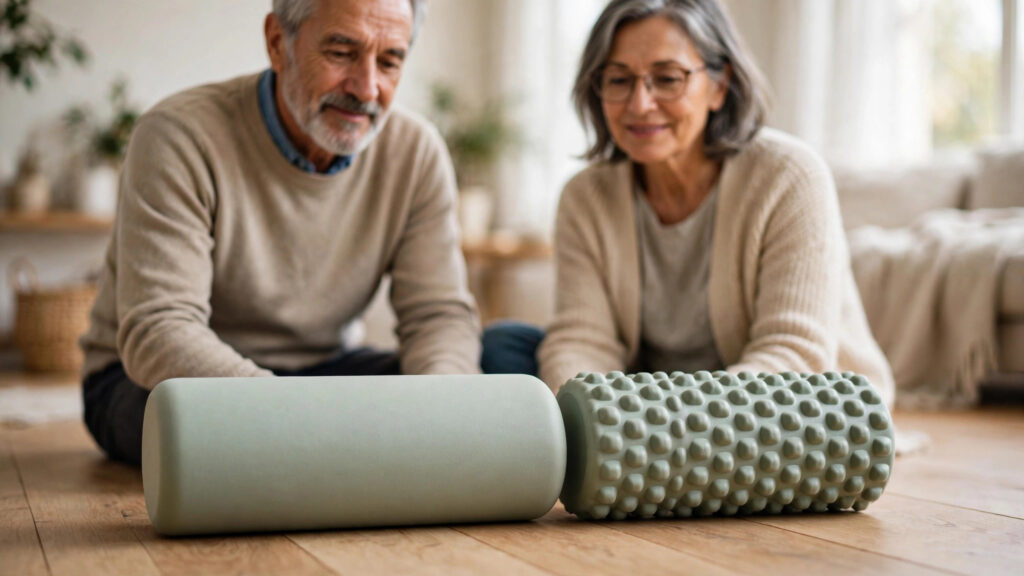
Smooth vs. textured. Smooth rollers spread pressure over a broad area and feel the mildest. Textured rollers — with ridges, bumps, or grid patterns — concentrate pressure and feel much more intense. For seniors, smooth is the sensible starting point; textured designs suit people who already roll regularly and want deeper pressure.
Density (firmness). This is the single most important choice. Low-density rollers are softer and compress under your weight, which keeps pressure gentle. High-density rollers barely compress and deliver firm, deep pressure. Many beginners of any age pick a roller that is far too firm, feel bruised, and quit. Older adults with thinner skin and more sensitive joints should start at the soft end. You can always move up later if the soft roller stops feeling effective.
Length. The classic full-length roller is about 36 inches (91 cm). Shorter rollers (12–18 inches) suit legs and arms, store easily, and are simpler to control for seated and wall-assisted work.
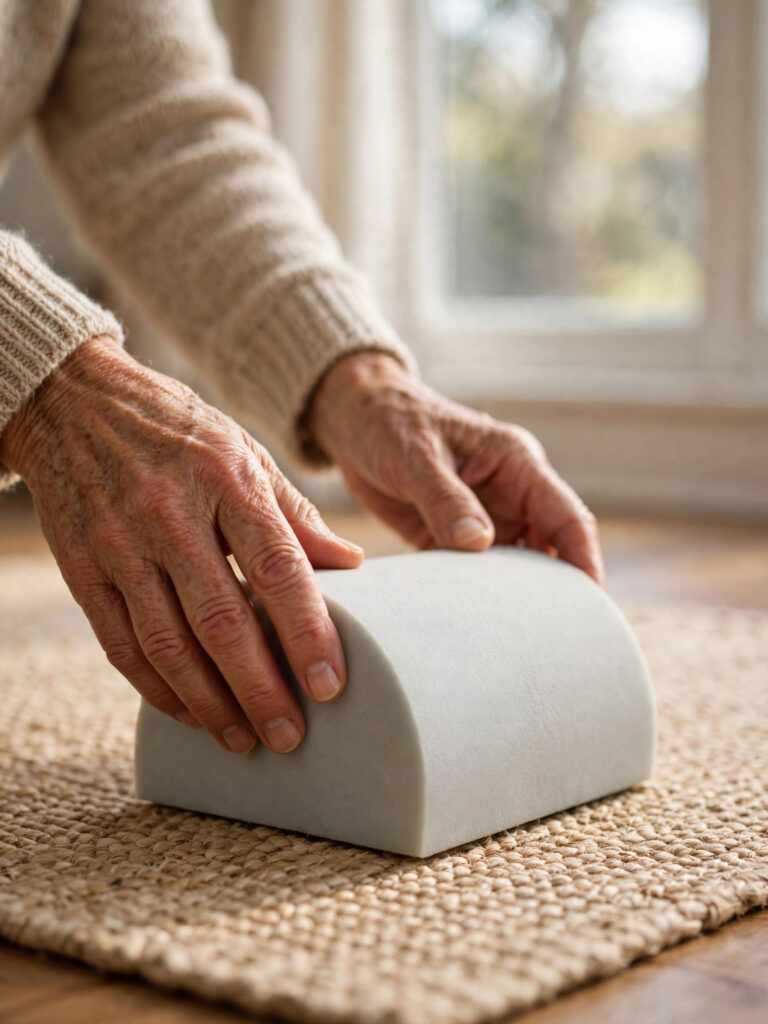
Full-round vs. half-round. A half-round roller is a cylinder cut in half lengthwise, with one flat side. Placed flat-side-down, it barely rolls at all — which makes it excellent for gentle, stable work. It is also a good prop for balance support. Beginners who feel unsteady on a full roller often do better starting with a half-round.
Vibrating vs. standard. Some rollers have a built-in vibration motor with a rechargeable battery. A small study in older women found that staff-administered vibration foam rolling produced acute improvements in flexibility, strength, and balance after a single session — but in older women with prehypertension, vibration rolling temporarily reduced single-leg balance and raised blood pressure (details below). Vibration adds cost and charging hassle — approach it as an extra, not a must-have.
How to Choose a Foam Roller After 50
Forget the marketing. Here is a practical checklist for picking the best foam roller for seniors:
- Choose low to medium density. Look for rollers described as “soft,” “standard density,” or “for beginners.” Avoid anything marketed as “extra firm” or “deep tissue” until you know how your body responds to gentle rolling.
- Choose smooth over textured. A plain, smooth surface is far more comfortable and still lets you work calves, thighs, and the upper back effectively.
- Pick a manageable size. An 18-inch roller covers most leg and back work and is easier to store and carry than a 36-inch one. Larger is not better here.
- Consider a half-round for stability. If balance or floor work concerns you, a half-round roller used against a wall or on the floor is reassuringly stable.
- Check the weight rating and surface. The roller should support your body weight without collapsing. Wipeable, closed-cell foam is easier to keep clean than open, porous foam.
- Skip the fancy features at first. Vibration, app connectivity, and heating are extras. A simple soft roller used regularly will do more for you than an expensive one gathering dust.
Before a walk or after a light workout with dumbbell exercises for seniors, a few gentle minutes on a soft roller may help you feel looser.
Safe Foam Rolling Techniques for Seniors: No Floor Required
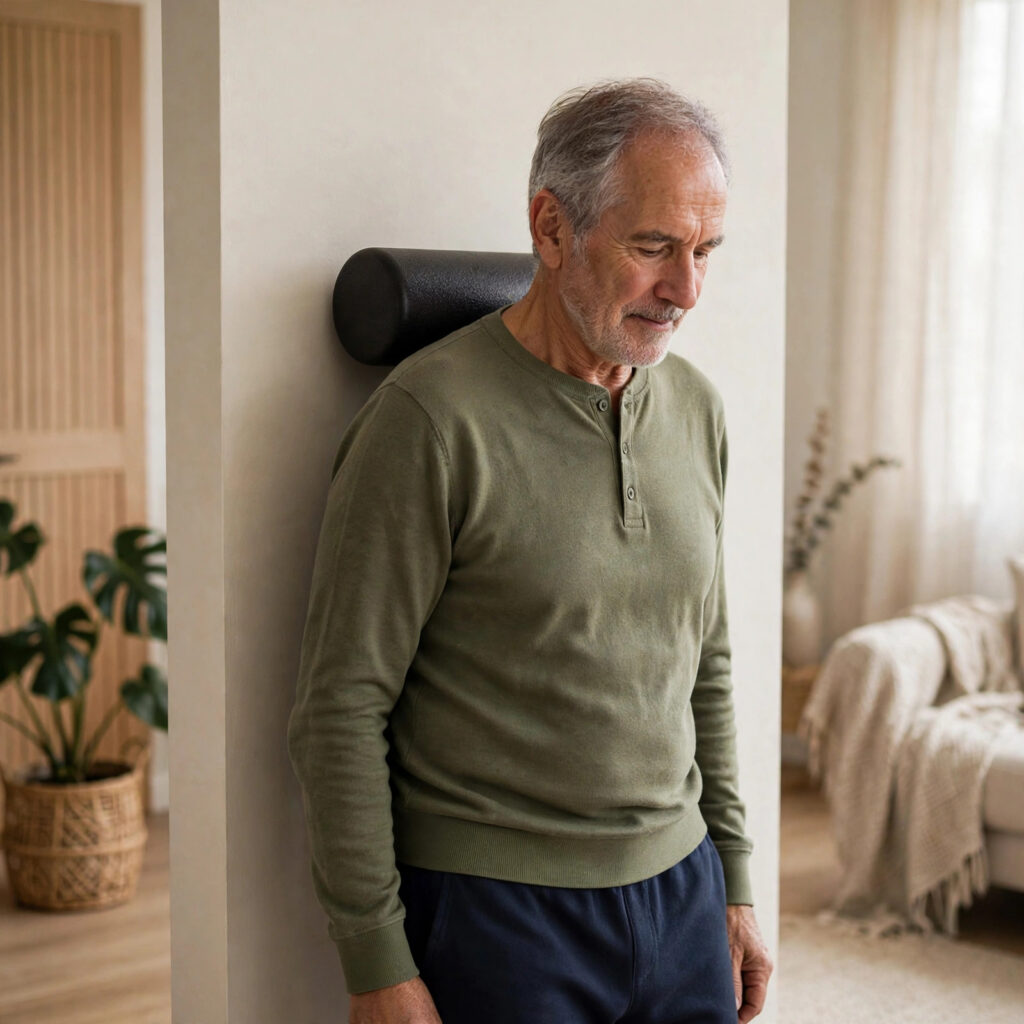
The biggest barrier for older adults is not the roller — it is the getting down and getting up. So here are three approaches that skip floor gymnastics entirely.
Wall-assisted calf and back rolling. Stand with your back to a wall and place the roller vertically between your shoulder blades and the wall. Bend your knees slightly and let the roller glide up and down your upper back as you straighten and bend your legs. Never roll directly over the spine itself — keep the roller on the muscles on either side. For calves, stand facing the wall with the roller between your calf and the wall, shifting your weight gently.
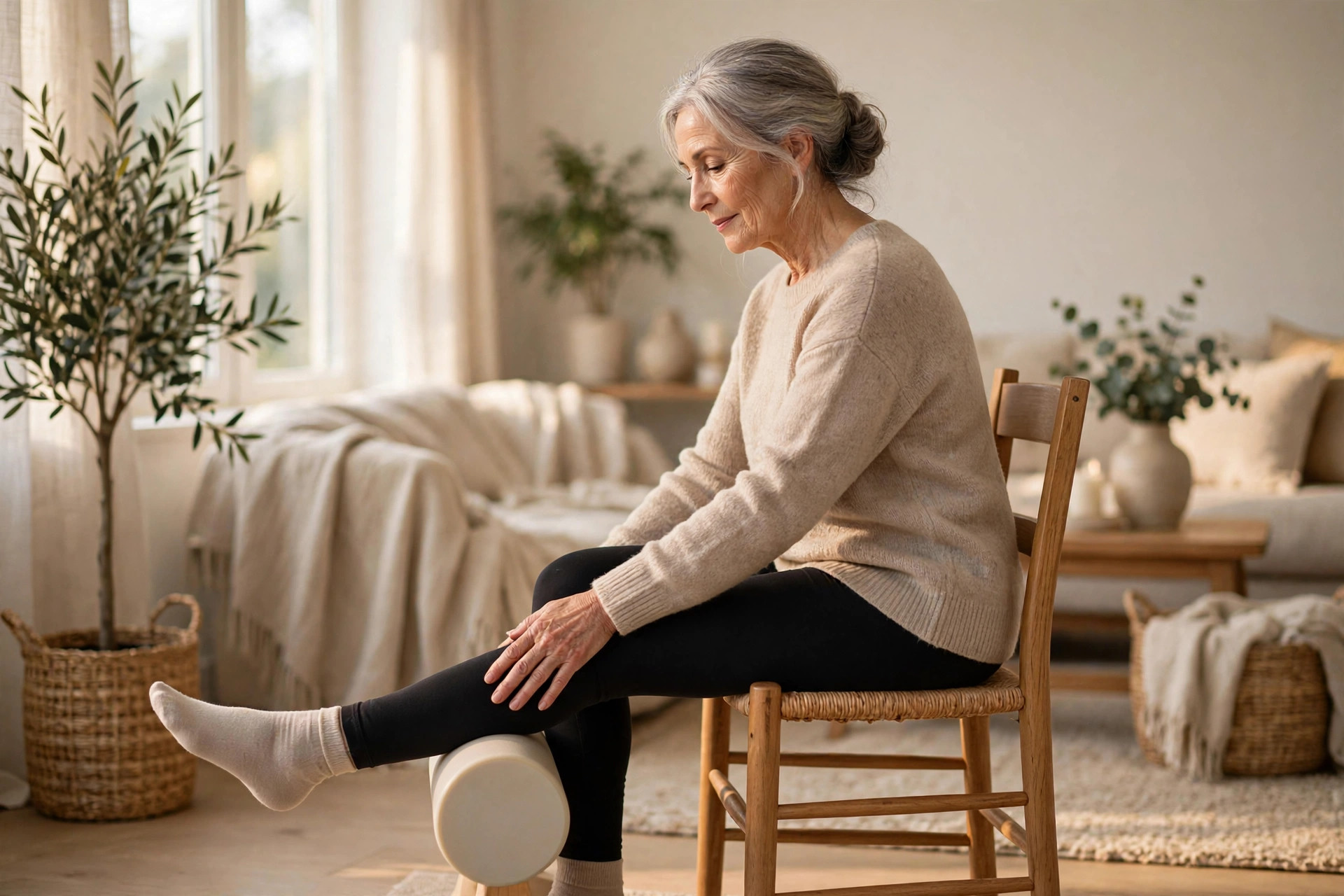
Seated thigh and calf rolling. Sit in a chair with the roller on the floor. Rest your calf or the back of your thigh on the roller and use your other foot on the ground to control pressure. Roll back and forth slowly — full control, safely seated.
Seated foot rolling. Place the roller under your desk or beside your chair and roll the sole of your foot over it while seated. Many people find this pleasantly relaxing after a long day on their feet.
How long and how hard? A 2026 randomized trial comparing low-volume and high-volume hamstring foam rolling found no dose-response effect — the researchers suggest acute flexibility gains come from changed stretch tolerance, not lasting tissue change. (That trial studied young men; the senior studies used about 60 seconds per muscle group.) The takeaway: brief, gentle sessions are enough. About 30–60 seconds per muscle group with mild pressure is sensible. More pressure and more time are not better; sharp pain means you are pressing too hard.
What the Research Says (and What It Doesn’t)
Foam rolling research is growing, and several studies have specifically included older adults:
- Vibration foam rolling in older women (Int. J. Environ. Res. Public Health, 2021): in 15 women around age 73, one session of researcher-administered (not self-administered) vibration rolling improved shoulder flexibility, leg and arm strength, and dynamic balance right after the session, while moderate-pressure rolling also improved a stepping endurance test. The authors concluded vibration rolling can be a suitable home exercise for older women under proper supervision and guidance. Caveats: effects were measured only right after one session and the sample was small — promising, not proven long-term.
- Passive foam rolling for older women with prehypertension (Biology, 2022): in 13 women around age 72, stretching plus vibration rolling improved shoulder flexibility, arm strength, and stepping endurance versus stretching alone; stretching plus plain (non-vibration) rolling also improved stepping endurance. Researchers used passive rolling — staff assisted participants rather than having them do floor work — to keep older participants safe. Two cautions: the vibration protocol temporarily reduced single-leg standing balance and raised systolic blood pressure, so readers with balance concerns or elevated blood pressure should favor plain foam rolling plus stretching.
- Low-volume vs. high-volume rolling (Sports, 2026): in healthy men aged 20–35 (not seniors), rolling each hamstring 2 minutes versus 10 minutes produced no extra benefit — no dose-response. The researchers suggest acute flexibility gains come from the nervous system becoming more tolerant of the stretch, not from lasting tissue change. It may not generalize to older adults.
What is missing: long-term studies in older adults, and head-to-head comparisons of roller types. The evidence supports foam rolling as a short-term flexibility and comfort aid — not as a treatment for any condition.
Mistakes and Safety Warnings
Foam rolling is low-risk for healthy adults, but certain situations call for extra care:
- Never roll directly over the spine, ribs, or neck. These bony areas are not meant to bear concentrated pressure. Work the muscles alongside the spine instead.
- Osteoporosis. Fragile bones and firm pressure are a bad combination. If you have low bone density, talk to your clinician before rolling, and stick to the softest density with light pressure.
- Blood thinners (anticoagulants). Rolling can cause bruising, and blood thinners make bruising and bleeding more likely. Use minimal pressure or skip rolling over areas that bruise easily.
- Varicose veins and blood-clot history. Never roll over varicose veins or over an area where you suspect a blood clot. Rolling over a clot could dislodge it, which is dangerous.
- Stop signals. Stop immediately if you feel sharp pain, numbness, tingling, or dizziness. Mild “good pressure” discomfort is one thing; anything sharp or radiating is not.
- Skin. Older skin tears easily; smooth rollers and light pressure are safest.
Care and Storage
Foam rollers are simple to maintain. Wipe it down with a damp cloth and mild soap after use and let it air-dry completely before storing — trapped moisture degrades the foam. Keep it out of direct sunlight and avoid stacking heavy objects on it. A well-kept roller can last several years.
When to See a Doctor
Foam rolling is a self-care comfort tool, not a medical treatment. See your clinician if you have persistent muscle or joint pain that does not improve, swelling or warmth in a limb (possible clot signs — seek urgent care), numbness or weakness, unexplained bruising, or any new pain after rolling. And talk to your clinician first if you have osteoporosis, take blood thinners, or have vascular disease — they can advise whether foam rolling is appropriate for you and which precautions to take.
Sources
- National Institute on Aging — Exercise and Physical Activity: https://www.nia.nih.gov/health/exercise-and-physical-activity
- CDC — Physical Activity for Older Adults: https://www.cdc.gov/physicalactivity/basics/older_adults/index.htm
- Mayo Clinic — Slide show: Balance exercises: https://www.mayoclinic.org/healthy-lifestyle/fitness/multimedia/balance-exercises/sls-20076853
- NHS — Exercise as you get older: https://www.nhs.uk/live-well/exercise/exercise-as-you-get-older/
- Harvard Health Publishing — The importance of stretching: https://www.health.harvard.edu/staying-healthy/the-importance-of-stretching
- Cleveland Clinic — Foam Rolling: https://health.clevelandclinic.org/foam-rolling-how-to
- Vibration foam rolling in older women (Int. J. Environ. Res. Public Health, 2021): https://www.mdpi.com/1660-4601/18/21/11186/htm
- Passive foam rolling and stretching in older women with prehypertension (Biology, 2022): https://www.mdpi.com/2079-7737/11/7/1025
- Low-volume vs. high-volume hamstring foam rolling RCT (Sports, 2026): https://www.mdpi.com/2075-4663/14/8/354
This article is for general information only and is not medical advice. Foam rolling is a comfort and flexibility aid, not a treatment for any condition. Talk to your clinician before starting if you have osteoporosis, take blood thinners, have vascular disease, or are unsure whether foam rolling is safe for you.